






Why Summer Puts a Strain on Your Circulation — and What TCM Recommends to Counteract It
Ask the Yellow Emperor
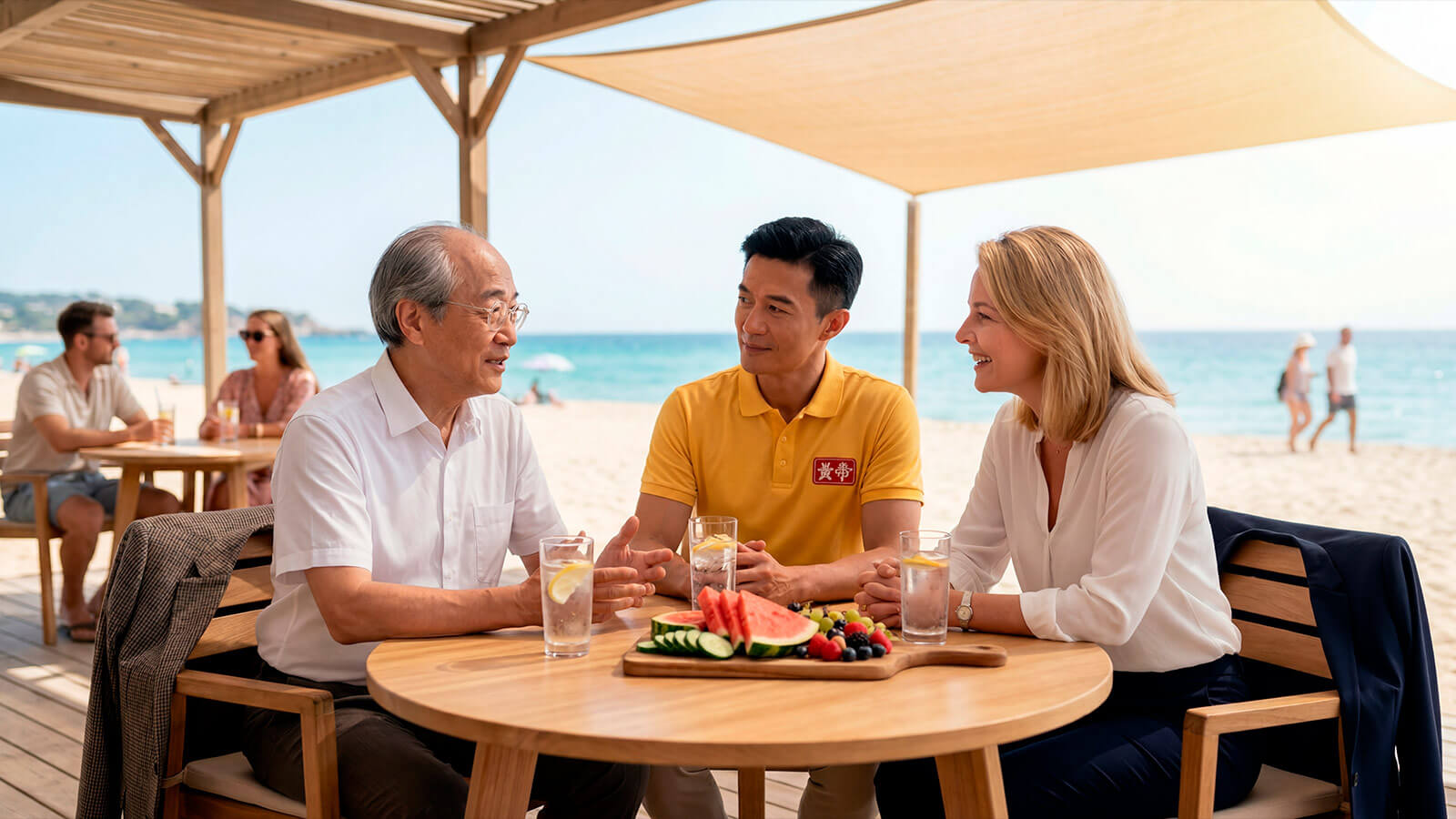
Qí Bó | The Yellow Emperor Huangdi | Dr. Weber
Note: When this post refers to the „heart,“ „liver,“ „spleen,“ „lungs,“ or „kidneys,“ it always means the Functional Circuits in Traditional Chinese Medicine—energetic systems, not anatomical organs.
The Yellow Emperor: „Qí Bó, what you’re saying surprises me. You say that summer is the most difficult season for the heart. But people love summer. They seek out the sun. They wait all winter for this time of year. How can a season that everyone looks forward to also be the most demanding for the body’s most important organ?“
Qí Bó: „Your Majesty, I understand that. You’re right—summer is a time of joy. But that’s exactly why it’s so taxing on the heart.”.
In our teachings, the heart governs the fire element, and summer is the season of fire. Just as the kidney is central in winter and the liver in spring, so is the heart in summer. It is now working at its most intense.
At the same time, every drop of sweat depletes the Yin—the body’s cooling reserve. Those who sweat recklessly in the summer allow their hearts to slowly dry up. You don’t feel it right away: when your circulation fails in the afternoon, when your sleep is disrupted, when restlessness refuses to subside at night.“
Dr. Weber: „What Qí Bó describes has a very specific physiological basis. In the heat, three things happen simultaneously: The blood vessels in the skin dilate to release heat. Blood pressure drops, and the heart has to beat faster to maintain the brain’s oxygen supply.”.
There is also a fourth factor that is often overlooked: Through sweat, the body loses not only fluid but also sodium, potassium, and magnesium—the electrolytes the heart needs for electrical conduction.
“Anyone who replenishes these losses with water alone further dilutes their electrolyte balance instead of restoring it. The heart gets more of what harms it—and less of what it needs."
The Yellow Emperor: „So, four forms of strain. The dilation of the blood vessels. The drop in blood pressure. The exhaustion of the heart itself. And the silent loss of bodily fluids through sweat. When do people feel this most acutely?“
The Causes of Summer Fatigue
Qí Bó: „Your Majesty, between 11:00 a.m. and 1:00 p.m. is the time of the heart in our organ clock. Between 1:00 p.m. and 3:00 p.m., the small intestine—its Yang counterpart—takes over. During this phase, the heart is working at full capacity—and after every peak comes a slump.”.
Anyone who ate during this time will have their digestion drawing additional blood away from other parts of the body. Anyone who worked has used up their reserves.
The result: At two o'clock, your circulation slows down, your eyes grow heavy, and your head feels foggy. Your heart is asking for a break—and you ignore it.“
Dr. Weber: „It is precisely this drop that can be measured. After a meal, postprandial hypotension occurs—blood pressure drops because blood flow to the digestive tract increases. This effect is amplified in hot weather.".
“Reaction times and concentration levels drop noticeably in the early afternoon, and even more so in the heat. Mediterranean cultures have always responded to this with the siesta—and for good reason."
The Yellow Emperor: „What makes this burden even worse?“
Qí Bó: „Three things, Your Majesty. First: pure water without minerals. In our teachings, sweat is the sap of the heart; it contains substance, not just fluid. Whoever replaces it with clear water replenishes the volume—but not the Yin.”.
Second: ice-cold drinks. They shock the body’s core, block digestive heat, and force the body to generate heat in response. What people think of as a way to cool off actually costs them extra energy.
Third: Midday activities in the heat. The “heart hour” is not a work hour. Those who ignore it will pay the price in the afternoon and evening.”
Dr. Weber: „I would add two scientific factors. First: thermoregulatory exhaustion. Anyone who is active in the heat for several days in a row experiences a measurable decline in sweat production—the body cools less effectively and overheats more quickly.
Second: sleep disturbances caused by an elevated core body temperature. Deep sleep requires the body temperature to drop by about one degree. On hot nights, this doesn’t happen, and sleep becomes shallower and more fragmented. Anyone who is also dehydrated will wake up between three and five in the morning—precisely when the cortisol level is already rising.“
The Yellow Emperor: „That sounds like a complex situation. How can we help people protect their circulatory system?“
The Path Back to Summer Energy
Qí Bó: „Your Majesty, the solution lies in harmonizing with the Fire element rather than fighting it: nourishing the Yin, calming the heart, and accepting that summer calls for rest.”.
The ancient masters taught: “In summer, one rises early, when the air is still cool. At noon, one rests; in the evening, one avoids overexertion. One eats bitter foods that temper the heart’s fire and drinks juices that nourish the yin.”
Dr. Weber: „Three pillars are crucial here—and all three can be directly explained by physiology. First: minerals instead of just water. Second: physical activity at the start or end of the day, early in the morning or late at night. Third: actively preparing for sleep through targeted cooling and calming the nervous system.
“People who adjust their rhythm in this way suffer measurably less from summer fatigue."
The Yellow Emperor: „Then let’s come up with a concrete plan—one that people can put into action starting on the first day of summer.“
Qí Bó: „I suggest we divide the day into three phases. In the morning, replenish the Yin before the heat sets in. At noon, protect the circulatory system. In the evening, calm the heart and prepare for sleep.“
Dr. Weber: „And every recommendation should combine both TCM wisdom and scientific evidence.“
☀️ The "3 Wise Men" Method for Combating Summer Fatigue
🌅 MORNING ROUTINE (Replenish Yin before the heat sets in)
TCM: Start the day with a lukewarm drink rich in minerals. A pinch of salt, a little lemon, and a teaspoon of honey in lukewarm water—that’s the old farmers’ broth, with a modern twist. Eat a light, cooked breakfast with fresh summer fruits. Watermelon, berries, and cucumber directly nourish the yin and restore to the heart the vitality that yesterday’s activities drained from it.
Science: Lukewarm water is absorbed more quickly than ice-cold water and does not shock the vagus nerve. The pinch of salt replenishes the sodium lost overnight through breathing and light sweating. Watermelon contains 92 percent water, 112 mg of potassium per 100 g, and citrulline—an amino acid that is being studied in nutritional research in relation to circulation.
Practical:
- 6:30 a.m. — 1 large glass of lukewarm water with a pinch of good-quality sea salt, the juice of half a lemon, and, if desired, 1 teaspoon of honey
- 7:00 a.m. — a light breakfast (e.g., oatmeal with berries, yogurt with watermelon, whole-grain bread with tomato and olive oil)
- 7:30 a.m. — 10 minutes of exercise in the cool of the morning
- 8:00 a.m. — a second cup of lukewarm water; drink it regularly from now on, not just when you're thirsty
🌞 LUNCHTIME STRATEGY (Protect Your Circulation)
TCM: Eat a warm, moderate meal at lunchtime. The center of the body needs warmth to transform—even in summer. Take a break of at least fifteen minutes between 1:00 and 2:00 p.m. Drink mineral-rich water or a light broth every two hours. Avoid ice-cold drinks. They don’t cool you down; they force your body to generate counter-heat. What you think is refreshing actually costs your heart extra energy.
Science: Warm meals are digested more easily than cold ones because the stomach empties more efficiently and the circulatory system has to work less to compensate. A short lunch break can lower cortisol levels and help you stay focused in the afternoon. Ice-cold drinks trigger reactive thermogenesis via the vagus nerve—the subjective cooling effect lasts only a few seconds, but the physiological strain lasts much longer.
Practical:
- 12:00 p.m. — a warm, light lunch (e.g., rice with steamed vegetables and some fish or tofu)
- 1:00 p.m. — 15-minute break: Close your eyes, put your feet up, and stay away from screens
- 2:00 p.m. (Low Point Time) — 1 glass of lukewarm water or peppermint tea with a pinch of salt
- In between — Drink 1 glass every 2 hours; be proactive—don't wait until you're thirsty
🌙 EVENING RITUAL (Calm the Heart and Prepare for Sleep)
TCM: The hottest part of the day is over. Now is the time to calm the heart. A lukewarm foot bath with sea salt and peppermint oil soothes swollen summer legs. It draws the rising Yang downward—directly to Kidney 1, the most important grounding point on the sole of the foot. Eat a light dinner: a cool salad with bitter ingredients, cucumber soup, or thick slices of watermelon. Avoid alcohol. It stokes the heart fire and disrupts the very sleep you need.
Science: A lukewarm foot bath lowers core body temperature indirectly: Vasodilation in the feet allows the body to release heat more efficiently, and the cooling effect lasts for several hours. A foot bath one to two hours before bedtime can make it easier to fall asleep and promote restful sleep. A light, cool evening meal also reduces the thermal burden of digestion during the night.
Practical:
- 7:00 p.m. — a light, refreshing evening meal (no alcohol, no heavy food)
- 8:30 p.m. — Prepare a foot bath (lukewarm, about 35 °C, 1 handful of sea salt, 3 drops of peppermint oil, 15 minutes)
- 8:45 p.m. — Dry your feet, massage the "Kidney 1" point (center of the sole of the foot, 1 minute per side, firm pressure)
- 9:30 p.m. — Cool the bedroom (open the windows, place a wet cloth in front of a fan; goal: below 22 °C)
- 10:00 p.m. — Turn off the screens
- 10:30 p.m. — Lights out
The insider tip of the 3 wise men
Qí Bó: „Your Majesty, there is a place that the old masters called the ‚Gushing Spring‘— Ni01, Yongquan. It is located in the depression in the center of the sole of the foot, roughly in the front third. “When we stimulate this point daily—especially in the evening, when the Yang is supposed to withdraw inward—we draw the rising summer fire downward. Yongquan is like an anchor point. It tells the body: ‘Come home. It’s time to rest.’”
The Yellow Emperor: „And the second point?“
Qí Bó: „In combination with Pc 06, the ‚Inner Pass‘ on the inner side of the forearm, we simultaneously calm the heart and directly stabilize blood circulation.“
The Yellow Emperor: „I’m familiar with these points. Yongquan—the Gushing Spring—is the lowest point of the body. The first point of the Kidney Meridian. What moves me time and again: Especially in the heat, when everything strives upward—the fire, the restlessness, the thoughts—the ancient teaching shows us: The answer lies below. In the ground. In the root.“
Qí Bó: „Your Majesty, you’ve got it. Ni 01 grounds. HK 06 calms. Together, they give the body what it needs most in the summer: the message that it’s safe to let go. That the night may come. That the fire no longer needs to burn.“
📋 Quick Check for Today
How is your circulation between 1:00 and 3:00 p.m.?
- Very low—I feel like I'm about to collapse = likely severe yin deficiency
- So-so, but noticeably worse than this morning = the onset of summer fatigue
- I feel stable and am getting through the day just fine = your yin is well-nourished
How do you sleep on hot nights?
- I wake up between 3 and 5 a.m. and can't fall back asleep = a blazing fire in my heart
- I'm a light sleeper and sweat a lot = mild Yin deficiency
- I sleep well, even when it's hot = good Yin reserve
How do you deal with excessive sweating?
- Afterward, I feel exhausted, my head feels foggy, and I'm still thirsty = fluid loss without replenishment
- I'm tired, but I'm resting and recovering = normal need for rest
- It doesn't bother me much; I drink and I'm fine = good resilience
🛁 TONIGHT you can: Take a 15-minute lukewarm foot bath with salt and peppermint oil, and while doing so Ni01 Massage yourself. It won't take you more than 20 minutes and will immediately give you a sense of grounding and coolness. Your body will thank you for it.
Your 7-Day Summer Challenge
BEFORE the 3-way method (note today):
Energy level between 1:00 p.m. and 3:00 p.m. (1–10): ___
Sleep quality on hot nights (1–10): ___
Recovery after sweating (1–10): ___
Morning freshness (1-10): ___
AFTER 7 days (note on the 8th day):
Energy level between 1:00 p.m. and 3:00 p.m. (1–10): ___
Sleep quality on hot nights (1–10): ___
Recovery after sweating (1–10): ___
Morning freshness (1-10): ___
Result: If your scores have improved by at least 2 points, you're on the right track. Keep it up—the second week often brings even more noticeable results.
🍁 The Bill in the Fall
The Yellow Emperor: „Qí Bó, there’s a question that’s been on my mind since the beginning of our conversation. What happens to those who burn out this summer without taking precautions? Many will say, “It’s only one summer. It’ll get cooler in the fall, and then I’ll recover.’ Is that true?”
Qí Bó: „Your Majesty, that is exactly what many believe. And that is precisely the mistake that the old masters repeatedly lamented. The bill is not paid in the summer. It is presented in the fall—by a body that remains silent until it can no longer do so.“
The Yellow Emperor: „Explain that to me.“
Qí Bó: „Look to our doctrine of the Five Phases, Your Majesty. Fire nourishes Earth. Earth supports Metal. Metal gives birth to Water. These phases are not a calendar—they are a promise the body makes to itself. Each season provides the substance on which the next depends. Summer gives. Autumn takes. Those who have nothing to give in summer leave autumn with an empty treasury.“
The Yellow Emperor: „And what does autumn find there?“
Qí Bó: „A weak Earth—both digestive power and foundation. Weak Earth gives rise to weak Metal: a lung that does not protect; skin that does not seal; a Wèi Qì—the defensive energy on the surface—that does not live up to its name. The first autumn wind then encounters a body that has no response.“
Dr. Weber: „Stress biology paints the same picture—just in different terms. The human body does not recharge on its own in the fall. It must actively prepare for seasonal transitions. Anyone who falls short on sleep, electrolytes, and rest for three months measurably alters their cortisol levels, their mucosal barriers, and their immune regulation—silently, below the threshold of perception, until the days grow shorter and the body draws on reserves that aren’t there.“
The Yellow Emperor: „That means: Fall only reveals what summer has done.“
Qí Bó: „Exactly, Your Majesty. The ancient masters said: The wise physician treats before the illness arises. The mediocre one treats when it begins. The poor one treats when it has fully broken out. Whoever protects his Yin in the summer need not fear the fall. Those who do not will have to treat in the fall what they neglected in the summer.“
Dr. Weber: „And the key point from a biological perspective: The window of opportunity is now. Not in September, when symptoms become apparent—but in the summer, while the body is still functioning at full capacity and can build up its reserves. In chronobiology, prevention isn’t just a recommendation. It’s the only strategy that works.“
The Yellow Emperor: „So that’s the real message for everyone reading these words: Don’t wait until fall comes to settle the bill. Take action while summer is still here.“
Qí Bó: „Summer and fall are not two separate seasons. They form a single arc. Whoever understands one understands the other.“
Wisdom to take away
The Yellow Emperor: „So the message is: Summer isn’t our enemy. It’s a teacher that shows us we need to take it easy?“
Qí Bó: „Exactly, Your Majesty. Summer tells us: Protect your yin. Nourish your heart. Treat yourself to an afternoon nap. If we follow this advice, we won’t just get through the heat. We’ll enter fall feeling refreshed. Exhaustion is a signal—not a fate.“
Dr. Weber: „If we respect the daily rhythm of light and shadow, replenish our electrolytes, and provide our bodies with minerals, shade, and sleep, then we can use summer as a source of strength. It’s about working with our bodies—not against them.“
The Yellow Emperor: „Then may everyone who reads these words understand: Your exhaustion in the summer is not a failure. It is an invitation to live more wisely. Protect your yin. Rest in the midday heat. Nourish your heart. In the fall, you will reap the rewards.“
Qí Bó: „Just as the farmers rest under the trees in the midday heat—so should we.“
Preview: August
The Yellow Emperor: „Next month, in August, we'll be focusing on a topic that particularly affects many women—and many men as well—especially during the summer: menopause. When internal and external heat combine, summer becomes twice as challenging.“
Qí Bó: „We’ll talk about kidney yin—the cooling reserve that needs to be especially protected during this stage of life. And we’ll discuss what the ancient masters knew about this time, long before modern medicine had a name for it.“
Dr. Weber: „And I'll show you why TCM and modern hormone research reach surprisingly similar conclusions here—and where the greatest leverage lies when hot flashes coincide with the summer heat.“
The Yellow Emperor: „Until then—may your Yin remain protected and your heart beat in peace. Stay cool, stay calm, stay strong!“
About our „3 Wise Men“ story
Who are the Yellow Emperor and Qi Bo?
The Yellow Emperor (Huangdi, 黄帝) is said to have lived around 2600 BC and is regarded as the mythical founder of Chinese culture and medicine. Qi Bo was his most important advisor and personal physician. Their discussions about health, illness and human nature were recorded in the most important fundamental work of TCM.
The book: Huangdi Neijing
The „Huangdi Neijing“ (黄帝内经), also known as „The Yellow Emperor - The Fundamental Work of Traditional Chinese Medicine“, was probably written between 200 BC and 200 AD. It is the oldest surviving work of Chinese medicine and consists of dialogues between the Yellow Emperor and his advisors - mainly Qi Bo.
This work is to TCM what the Bible is to Christianity: the absolute foundation. All the important concepts - yin and yang, the 5 elements, qi, meridians and acupuncture points - are systematically described here for the first time.
Our modern approach: The 3 wise men
In our series „The 3 Sages“, we bring the Yellow Emperor and Qi Bo together with the fictional modern doctor and microbiologist Dr. Weber.
Important note: All three characters and their conversations are purely fictitious and invented by us.
We use this narrative form, similar to the dialog form in the book Huangdi Neijing, to convey the often complex relationships of TCM in an understandable and entertaining way. When the 4000-year-old emperor is confronted with modern science, enlightening „aha moments“ arise which show that ancient wisdom and new research often speak the same language: Ancient wisdom and new research often speak the same language - just in different words.
This makes TCM lively, understandable and practically applicable for your everyday life.
The dialogs are creative interpretations - not historical documents. For medical questions, please consult a qualified TCM therapist or doctor.
Yin is not destroyed by heat.
It dies from neglect.
TCM Principle
More interesting tips & articles

TCM tip of the week
Your nose remembers things faster than you do
You're walking home in the late afternoon; the light is already slanting across the street, and it smells like wet leaves…
Oct
TCM tip of the week
No sooner is it done than you're flat on your back
You hang in there for weeks, and as soon as the move or project is over, your throat starts to feel scratchy. Why do your defenses fail at this very moment…
Oct


Sep


Our most popular products

Back pain
Hi Wolfgang, thank you very much for the detailed suggestions regarding the individual transformation phases. I always enjoy reading them. What made me a little skeptical this time, however, is the recommendation to eat a salad in the evening. Generally speaking, the advice is not to eat raw foods in the evening, since the liver then produces „fusel alcohol.“ I’d appreciate a reply. Oh, and one more thing: is there anywhere I can read the previous posts—is there an archive?
Best regards, Katrin
Dear Katrin, thank you so much—I'm glad you're reading the conversations so carefully!
That’s a really good question, and you’re absolutely right about the basics: As a rule of thumb in TCM, warm, cooked meals in the evening are gentle on the „center“ (spleen and stomach), because raw and cold foods require digestive heat.
This intuition is absolutely correct and, for most people, is the best general recommendation—all year round.
But I want to be honest about the „fusel alcohol“ issue: The idea that the liver produces fusel alcohol from raw food eaten in the evening is a notion that’s circulating online, but it can’t really be scientifically proven. The real reason behind this is simply that raw foods are harder to digest in the evening, and some people sleep more restlessly as a result.
Why do we still recommend this refreshing salad with bitter ingredients even in this intense heat? Because extreme summer heat is an exceptional situation.
Throughout the day, heat builds up in the body and drives the “heart fire” upward—you may feel this as restlessness, poor sleep, or night sweats. In the evening, the goal is precisely to release this accumulated daytime heat and nourish the depleted Yin. A cool salad with bitter ingredients (such as radicchio, endive, chicory, arugula, or dandelion) is ideal for this: The bitter taste directs the heat downward and away, while the cooling effect replenishes the reserves depleted by the hot day.
One very important point here—and this is often misunderstood—is that by „cooling,“ we mean the thermal effect of the food in TCM, not the temperature straight from the refrigerator. Bitter substances have a naturally cooling effect, even if you eat them at room temperature. You should definitely not eat the salad ice-cold straight from the refrigerator—that would shock the “center.” So: thermally cooling ingredients, but at a comfortable room temperature.
And here’s another interesting point about the liver: Bitter substances are actually the liver’s true friends. Through their bitter taste, they stimulate bile flow, and a healthy flow of bile aids in the digestion of fats, thereby relieving the liver of some of its workload. From a TCM perspective, this fits together perfectly—the bitter taste directs excess heat downward and away, and at the same time, the free-flowing bile benefits the liver. So rather than putting a strain on the liver, the opposite actually happens here.
Here’s my practical tip that combines both: Season the salad with mild, cooling flavors—such as fresh mint, basil, parsley, cilantro, or dill—along with a good oil and a few fennel seeds to aid digestion. It’s best to save warming, stimulating spices like ginger, garlic, chili, or pepper for lunch—in the evening, they’re more likely to stoke the “heart fire” and disturb your peace. And have your salad earlier in the evening.
So this isn’t a contradiction to the concept of “warm cuisine,” but rather a deliberate adaptation to these particularly hot days—and it depends on your constitution: If you have a cool, weak center, it’s better to stick to lightly cooked foods even now. If you’re suffering from the heat and inner restlessness, a light dinner is a good choice.
Sincerely,
Wolfgang & Team