






Why You Sigh More Often in the Fall
It has little to do with fatigue

Your LUNG wears,
what your heart doesn't PRONUNCIATION.
A word to swallow, It only takes a moment. You hold your breath briefly, your jaw tenses, and your chest feels tight for a moment. Then the conversation continues, and the moment is over.
The body remembers it anyway. People who often hold something back tend to breathe shallowly out of habit over time. Their breath then stays high in the chest, their shoulders are tense and hunched, and their abdomen barely moves at all when they breathe.
In everyday life, hardly anyone notices this, and you're the least likely to notice it yourself.
In the fall You start to feel it. The days are getting shorter, the hustle and bustle of summer is over, and you have more time to enjoy the quiet around you.
In this silence, things that have long had no place to be felt come to the surface: a tightness in the chest for no apparent reason, a sigh in the middle of the afternoon, and a heaviness that defies explanation.
🚨 However, shallow breathing caused by tension is different from actual shortness of breath. If you feel short of breath while at rest or even just walking up the stairs, you should see a doctor to have it checked out.
For most people, however, the reason lies elsewhere—namely, in what they haven't said for a long time.
🍂 The Lungs and Fall in Chinese Medicine
In the classroom the five Phases of Change Each season is associated with an element and a pair of organs.
Fall belongs to the Metal element and thus to the Lung and her partner, the Large Intestine. Both represent the same motion: taking in and giving out.
In ancient texts, the lungs are considered the most delicate of the internal organs. They form the boundary between the inside and the outside; they thrive on moisture and suffer from the dryness that autumn brings. Through the Wei-Qi, the defensive energy in Chinese medicine, protects the body from wind and cold.
ℹ️ Note: When Chinese medicine refers to the “lung” or “large intestine,” it is referring to energetic systems, not the anatomical organs.
Two classifications of the lungs are important for the topic of this article. The first is grief.
In Chinese medicine, each organ is associated with an emotion, and grief is associated with the lungs. This refers not only to major losses but also to the small goodbyes of everyday life: the disappointment you smiled away, the worry you didn’t share with anyone, and the moment when tears welled up, but you took a deep breath and carried on.
💡 We explain why fall is the season of grief and how you can cope with it in this post Learning to Let Go: Grief, Breathing, and the Metal Element described.
The Second Assignment is less well known. The *Nánjīng*, the classic text on difficult questions, states that the lungs govern the voice.
The voice depends on the breath, and every word you speak is formed as you exhale. A word you don't speak doesn't follow this path.
The Huángdì Nèijīng also describes how grief constricts the upper chest and, over time, leads to Qi consumes.
From the perspective of Chinese medicine, what remains unsaid therefore stays where the lungs are located. In the fall, when the Metal element reigns, it rises to the surface again.
🔍 How to Recognize Yourself
Not everyone This manifests itself in the same way. Traditional Chinese medicine distinguishes several patterns related to the lungs, and in the fall, two of them are particularly prominent.
Lung Qi Deficiency — when the lungs lack strength
- Your voice is soft, and speaking for long periods of time tires you out.
- You get out of breath quickly.
- You sweat easily, even without exertion.
- You catch almost every infection that's going around.
Lung Yin Deficiency — when the lungs lack moisture
- Your throat is dry, and you're coughing without any phlegm.
- Your skin and lips are chapped.
- You're thirsty, but you prefer to drink in small sips.
When the Unspoken Resonates
- You feel a tightness in your chest for no apparent reason.
- You sigh frequently, and your breathing is shallow.
- Your sleep is restless and doesn't help you feel refreshed.
- You feel like you're holding on to something that should have been gone long ago.
Grief is not a pattern in and of itself. In Chinese medicine, however, it is considered one of the most common underlying causes, because over time it weakens lung qi and leads to Yin consumes.
That's why the symbols often overlap. On our page about the TCM Patterns You'll find over sixty patterns of Chinese medicine explained in an easy-to-understand way, and the free TCM analysis at the end of this post will show you which one is most prominent in your case.
ℹ️ If you’ve been feeling down for weeks, nothing brings you joy anymore, or everyday life is getting the better of you, then this is more than just a seasonal mood.
In this case, talk to your family doctor, a psychotherapist, or a psychological counseling center.
🧠 What physiology has to say about this
From a Western perspective as well It's easy to describe what happens in the body when we hold back.
It begins in the act of suppression itself. In a well-known study by psychologists James Gross and Robert Levenson Participants should not let their feelings show while watching a movie.
Outwardly, they succeeded in doing so; internally, however, activation of the sympathetic nervous system in the cardiovascular system increased. The results suggest that a hidden emotion does not calm the body but instead puts it under additional stress.
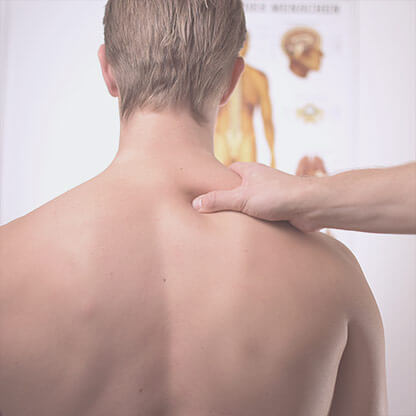
Next comes breathing. When under stress, breathing shifts from the diaphragm to the upper chest. This is where the accessory breathing muscles come into play, including the scalene muscles in the neck and the upper portion of the trapezius muscle.
These muscles aren't designed for such a sustained effort, which is why people with shallow breathing My neck and shoulders are so often stiff.
At the same time, the diaphragm moves less, and the lower sections of the lungs—those located toward the sides and the back—are less actively involved in breathing.
Finally, there's the exhalation. When you inhale, your heart beats a little faster; when you exhale, the parasympathetic nervous system takes over, and your heart rate slows down.
We explain how this relationship works in the article Why You Can't Relax When You Try to explained in detail. For the exercise below, one thing in particular is important: If you exhale longer than you inhale, you give the parasympathetic nervous system more time.
Both perspectives describe the same process from two different angles. What is being held back is evident in the breath and in the muscles of the chest.
🌬️ Every evening, breathe from your chest down
Shallow breathing It's impossible to imagine life without it, and it can't be deepened on command. But you can show him where he can go.
That is exactly what diaphragmatic breathing does: Breathe into your abdomen, then into both sides, and then into your lower back, one after the other, until your breath fills the entire space again.
Diaphragmatic Breathing in Four Directions
- Sit upright on the front half of a chair and place your feet flat on the floor.
- Place one hand on your abdomen and breathe calmly through your nose, filling the front of your abdomen. Exhale slowly through slightly parted lips, taking about twice as long as the inhalation.
- Place your hands on either side of your lower ribs and breathe first into your right side and then into your left.
- Place the backs of your hands on your lower back and breathe into that area until you feel it expand beneath your hands.
- Finally, breathe out in all directions at the same time. Your shoulders should not rise as you do this.
Hold each position for four to five breaths, That adds up to about five minutes.
The Hands show you where your breath is going, and exhaling slowly through your lips gives your parasympathetic nervous system time. Practice every evening at the same time and in the same place for a week.

📱 Let Atemraum guide you through the exercise
Diaphragmatic Breathing is available in our Atemraum App as a guided exercise. You don't have to count or watch the clock, because the app guides you step by step through the five minutes. With the maximum exhalation duration test, you can see for yourself after a week what has changed.
You can use the app for free for seven days with access to all content. After that, you make a one-time purchase for €29.99, and there are no subscriptions or ads.
Three additions for this week
- Acupuncture Point CV 17 (Shān Zhōng) — „Center of the chest.“. The point is located in the center of the sternum; in men, it is roughly level with the nipples. In Chinese medicine, it is considered the master point for qi in the chest area and is recommended for chest tightness. After the breathing exercise, place three fingertips on it and gently circle for sixty seconds or tap lightly. During pregnancy, please consult a healthcare professional before using acupressure.
- Say a sentence. This week, pick a sentence you’ve kept to yourself and say it out loud. It doesn’t have to be directed at the person it’s about. All it takes is someone to listen, or a walk during which you say it to yourself. The key is for it to leave your body through your voice, even just once.
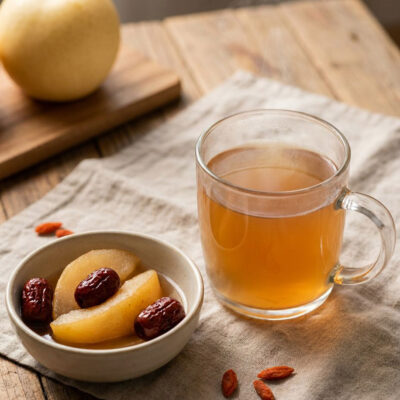
- Moisten from the inside. Drink warm beverages throughout the day and eat foods that moisturize your lungs in the fall, such as steamed pears, almonds, or white radishes. To find out which foods Chinese medicine recommends for this, read the article about Autumn's White Foods.
Get started tonight and stick with it for a week. The lungs take on a lot without complaining, but they need space to do so. Five minutes in the evening give them that space back.
📌 Recommended
🔍 Free TCM Analysis: Find out in about ten minutes which pattern of Chinese medicine applies to you. 👉 Get a Free TCM Analysis
📖 The TCM Patterns: Over sixty patterns in Chinese medicine, explained in an easy-to-understand way. 👉 About TCM Patterns
📩 „The Three Wise Men“ Newsletter: Once a month, the Yellow Emperor writes to you personally: practical tips on herbs and nutrition, simple recipes, and Eastern wisdom in language everyone can understand—delivered right to your inbox. Subscribe for free: 👉 Sign up for free
Keep your mind calm and focused,
to soften the harshness of autumn.
Don't point it outward,
Then the lung qi remains clear.
— *Huángdì Nèijīng*, *Sù Wèn*, Chapter 2
🎥 Live Qi Gong on Monday, October 5, at 6:00 p.m.
„What protects you isn’t deep inside you. It’s right on the outside, just beneath the skin.“ On Monday, Wolfgang will show you LIVE where this boundary lies and how you can strengthen it with qigong.