







The Old Alchemist's Brew
A broth made from spring onions, recorded 1,700 years ago

Green onions and ginger: a traditional Chinese broth for the first cool evening.
⚗️ The Alchemist of Luofu Mountain
The man's name was Gě Hóng He lived in the fourth century. He was a scholar and a Daoist, and he devoted his life to exploring how a person could become immortal. To that end, he studied alchemy and prepared elixirs from minerals such as cinnabar.
When, in his old age, he heard that cinnabar could be found in the distant south of the empire, he asked the emperor for a minor post in that remote region. The emperor considered the post too insignificant, but Gě Hóng replied, He said it wasn't about the honor, but about the cinnabar.
So he set out for the south, stopped in Guangzhou along the way, and finally settled on Mount Luofu to prepare his elixirs there.
In addition to his writings on alchemy, Gě Hóng also compiled a small book of recipes for emergencies. From his own extensive work, consisting of one hundred volumes, he selected only those recipes that could be applied quickly and for which the ingredients were readily available.
The Title Zhǒuhòu, Beijing, Fang refers to a book that you carry close at hand, by your elbow.
It wasn't until sixteen hundred years later that the true value of this little book became apparent. The Chinese researcher Tu Youyou He found the key clue there for a new treatment for malaria and was awarded the Nobel Prize in Medicine in 2015 for his work.
The same book also includes a decoction made from scallions and fermented black beans. It is intended for the first day or two, when the cold has settled in the body and a headache begins, and you are supposed to drink it all at once to induce sweating.
In Chinese families today, people usually cook an even simpler version that consists only of scallions and fresh ginger. It's meant for a very specific evening.
🌬️ Why the First Night Matters
Maybe you've had an evening like this. You come home from being out in the wind, and even though the apartment is warm, a shiver runs down your spine.
You're shivering without breaking a sweat, your neck is stiff, your nose is running, and all you want to do is curl up under a blanket with something hot.
According to Chinese medicine, the cold is still on the very surface at this point. Wind and cold do not immediately penetrate deep into the body, but first come into contact with the protective layer between the skin and the muscles, which Wei Qi means.
We explain how this protective layer is structured in the article Kick Off Fall the Right Way described.
The cold causes the surface to contract, and the pores remain closed. The Huángdì Nèijīng, the oldest textbook of Chinese medicine, offers a brief piece of advice regarding this condition: What's trapped in the skin should be released through sweat.
That is exactly what this broth is for. In Chinese nutritional theory, scallions and ginger are considered spicy and warming, and both are associated with the lungs, which govern the skin and pores.
The sharpness opens up the surface a little, a light sweat breaks out, and after this sensation, the cold leaves the body the same way it came.
We always say that ginger belongs in the morning because it drives warmth outward, whereas in the evening, warmth should be directed inward.
On this particular evening, things are different, because the cold is outside—and that's exactly where the warmth is supposed to go. That's why this brew isn't a drink for every day, but rather for those evenings when you're feeling a chill.
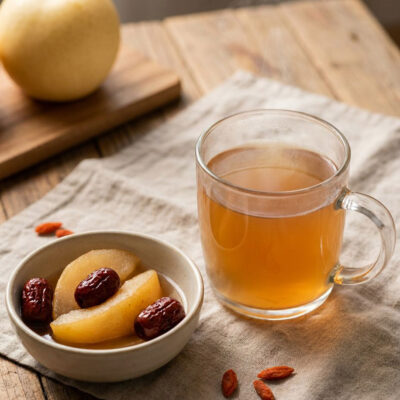
Anyone who finds the recipe for the Pear and Date Soup Anyone who has tried it already knows the other side of fall. Pears moisturize when your throat is dry and your skin feels tight, and—like almonds and radishes—they are part of the White Kitchen of Autumn.
The spring onion serves a different purpose: it warms and opens up the body when the cold rises to the surface.
ℹ️ Note: When Chinese medicine refers to the lungs or the "center," it is referring to energetic Functional Circuits and not the anatomical organs. Wèi Qì, too, is a concept within this tradition and not an anatomical structure.
📋 The Recipe
Ingredients for a large cup
- 🧅 the white parts of five to seven scallions, preferably with the root hairs still attached
- 🌿 a thumb-sized piece of fresh ginger—that makes about five thin slices
- 💧 500 ml water
- ✨ 1 teaspoon of brown sugar, if desired
Preparation
- 🚿 Wash the scallions thoroughly, especially around the roots, since there’s often still dirt there. Cut off the green tops and set them aside.
- 🔪 Cut the white part, including the root hairs, into finger-length pieces and press down lightly with the flat side of the knife to release the flavor. Slice the ginger into thin slices.
- 🔥 Bring the water and ginger to a boil and let it simmer for five minutes.
- ⏳ Add the white parts of the scallions, put the lid on, and let everything Let it simmer for just two or three more minutes. Don't let it cook any longer than that, or the strong flavors will evaporate with the steam.
- 🍵 Take the pot off the stove, stir in the sugar, pour the brew through a strainer into a cup, and drink it as hot as you like.
You don't need the green parts of the spring onions for this broth. Finely chopped, they can be added to broth or scrambled eggs the next day.
🛌 Here's how it's drunk in China
According to tradition, the brew needs a little more time to steep after that. Drink the cup while it's hot and take your time; put on some warm socks and lie down under a blanket for half an hour.
The goal is a light sweat. As early as the year 200, the famous physician Zhāng Zhòngjǐng wrote that the entire body should become only slightly moist during this process, and that sweat should not run down like water. Thus, more sweat does not yield greater benefits; rather, it saps the body of strength.
If your skin gets damp, dry off and put on a clean, dry top. Don't go out into the wind again that evening, and don't take a cold shower, because your pores are open now.
If you're still feeling chilly, you can boil the decoction a second time that same evening. If there's been no change after two days or if new symptoms appear, this decoction is no longer the right remedy.
🍚 If you want more: the porridge of the immortals
With very little effort, you can turn the broth into a small meal, and its name would have been Gě Hóng liked. In China, it's called Shénxiān Zhōu, the porridge of the immortals.
Ingredients
- 🍚 about 50 g of glutinous rice or short-grain rice
- 💧 half a liter of water
- 🌿 five slices of fresh ginger
- 🧅 the white parts of seven scallions
- 🥄 two tablespoons of mild rice vinegar
Preparation
Cook the rice in water until tender, which takes about 30 minutes. Then add the ginger and scallions and cook for five minutes. Finally, stir in the vinegar. Half a cup is too sour for most people, so Two tablespoons are enough to start with.
According to Chinese nutritional theory, rice strengthens the center, ensuring that the body has enough reserves to compensate for sweat loss. In China, vinegar is explained as having an acidic taste that balances out the spiciness, thereby preventing excessive sweating.
⚠️ When You Should Be Careful
This decoction is a traditional home remedy from Chinese cuisine and is not a treatment. It is not a substitute for a medical evaluation.
- If your throat feels sore, you have a fever, your mucus is yellow or thick, or you're sweating anyway, If the brew isn't right, then it's no longer about the cold on the surface.
- If you sweat easily or sweat at night, Leave it out—it's supposed to make you sweat, after all.
- For heartburn or a sensitive stomach Use less ginger, and don't add vinegar to the porridge.
- If you're taking blood-thinning medications, Consult your doctor before taking large amounts of ginger.
- For Diabetes Leave out the sugar and keep in mind that sticky rice causes blood sugar levels to rise quickly.
- In cases of illness and during pregnancy Talk to your doctor or midwife first.
- If you feel unwell while drinking or afterward, stop. If you have a high fever, shortness of breath, or symptoms that last longer than a week, please see a doctor.
💡 So you'll have the ingredients ready when the evening comes
A recipe for a spur-of-the-moment meal is only helpful if you already have the ingredients on hand.
🧅 Spring onions They'll stay fresh for a good week if you place them upright in a tall glass with two to three centimeters of water, loosely cover them with a freezer bag, and put the glass in the refrigerator. Change the water every three days.
🌿 Fresh ginger You can wash it, dry it thoroughly, and freeze it in a freezer bag; it will keep for several months. When frozen, it can be easily grated using a fine grater. For this broth, it’s even more convenient to slice the ginger into thin slices before freezing it, because then you can add the frozen slices directly to the water.
In conclusion
According to the *Chronicle of the Jin Dynasty*, Gě Hóng died on Mount Luofu at the age of 81. His face is said to have looked like that of a living person, and when he was placed in the coffin, his body was as light as empty clothes.
People of his time therefore believed that he had shed his body and joined the immortals. So the legend goes.
This weekend, put a bunch of scallions in a glass of water and pop a few slices of ginger in the freezer—then the old alchemist's potion will be ready when you need it on a windy evening.
📌 Recommended
🎥 Live Qi Gong with an In-Depth Look at TCM: Every Monday, Wolfgang practices with you LIVE on YouTube.
👉 Go to the "Simply Live Better" channel
🔍 Free TCM Analysis: Our analysis, which takes about ten minutes, will show you how your center and your immune system are faring from the perspective of Chinese medicine.
👉 Get a Free TCM Analysis
🌬️ Atemraum App: Guided breathing exercises for every day.
👉 Try it free for 7 days
📜 Once a month, the Yellow Emperor writes to you personally: practical tips on TCM, nutrition, simple recipes, and Eastern wisdom—all in language everyone can understand—delivered right to your inbox.
👉 Sign up for free
When the harmful wind comes, it is as swift as a storm and rain.
That's why those who take good care of themselves start with their skin and hair.
— *Huángdì Nèijīng*, *Sù Wèn*, Chapter 5