






The Autumn Constitution: The Lungs and Large Intestine in the Metal Element
How to Prepare for the Cold Season

What you NOW maintain,
carries you through the WINTER.
The reason behind this is one of the oldest principles of Chinese medicine, and it states specific disease, that is, to address what has not yet manifested. The best doctor, according to this view, is not the one who treats an illness well, but the one whose patients never develop it in the first place.
For you, this means that fall isn't a waiting room—it's your workshop.
🍂 The Art of Starting Early
Prevention has an image problem because it's so unspectacular. No one notices a quiet winter, and there's no applause for an autumn when you've taken good care of yourself.
That is why preventive care receives so little attention, even though traditional Chinese medicine has always placed it at the top of the list. The *Huángdì Nèijīng* states that the superior physician treats what has not yet manifested.
Fall is the season when this principle matters most, because several things happen at once during these weeks. Your body is adjusting to the cold, building up its reserves for the dark season, and your respiratory system is now most receptive to being strengthened.
Those who take these weeks to themselves are accompanying this transition rather than overlooking it.
🌬️ The Lungs and the Large Intestine — An Inseparable Pair
ℹ️ Note: When Chinese medicine refers to the “lung” or “large intestine,” it is referring to energetic systems rather than the anatomical organs.
In Chinese medicine The organs come in pairs, and each Yin Organ has its Yang partner. In the Metal element—the element of autumn—these are the Lung and the Large Intestine.
At first glance, this seems like a strange pairing—after all, what does the respiratory organ have to do with the end of digestion? But upon closer inspection, it becomes clear that both serve the same purpose.
Both are boundary organs. The lungs are the boundary to the top and outside because, with every breath, they exchange what is inside for what is outside, and the large intestine is the boundary to the bottom because it determines what ultimately leaves the body. Both manage the transition between what belongs to you and what does not.
Both thrive on rhythm. The lungs inhale and exhale, and the large intestine absorbs, passes on, and eliminates. When this rhythm falters, things come to a standstill both above and below.
And the two are never considered separately. When things are stagnant below, Chinese medicine also looks upward, and when breathing is laboured, it examines digestion. Whether one sees this as a metaphor or an observation, it leads to the same awareness.
For your fall health regimen, this means you can't strengthen your lungs while neglecting your large intestine. The two work as a team, and a team is only as strong as its weakest link.
When this system is weakened, traditional Chinese medicine has names for it. Three patterns are most common in the fall:
- Lung Qi Deficiency — when the lungs are too weak to supply the surface with oxygen
- Lung Yin Deficiency — when the dryness of autumn depletes the nourishing juices
- Wei-Qi Deficiency — when the protective layer has become thin overall
🔬 Side Note: What Research Has Found on This Topic
Modern Research comes from a completely different perspective. It recognizes neither Qi nor the Metal element, and yet in recent years it has nevertheless focused on the same two organs. Four observations:
- The Gut-Lung Axis — Research in recent years has shown that the gut and lungs communicate with each other through the immune system and that the composition of the gut microbiota affects how the respiratory tract responds.
- The Microbiome — A large proportion of immune cells are located in the gut, where they are shaped and kept on standby. A diverse gut microbiota is therefore considered an important foundation, and it can be influenced by diet.
- The Mucosal Immune System — The mucous membranes of the respiratory tract and intestines are permeated by their own immune tissue, which forms a continuous line along all of the body's surfaces.
- Vitamin D — As the sun sets earlier in the fall, the body’s natural production of this hormone decreases, and low levels are common in our part of the world during the winter. It’s best to consult your doctor and have a blood test to determine whether you should take supplements and, if so, how much.
Two languages, two ways of observing. Both focus on the same interfaces.
🌿 The Five Pillars of Fall Recovery
How So, how exactly do you strengthen this system? The fall training program is built on five pillars, and none of them is complicated.
Pillar 1: Addressing Drought
Fall It's dry, and the heated air doesn't help matters. Dry heated air irritates the mucous membranes—as everyone knows from winter—and in Chinese medicine, the lungs prefer a moist environment anyway.
- Drink warm beverages throughout the day rather than in large amounts all at once
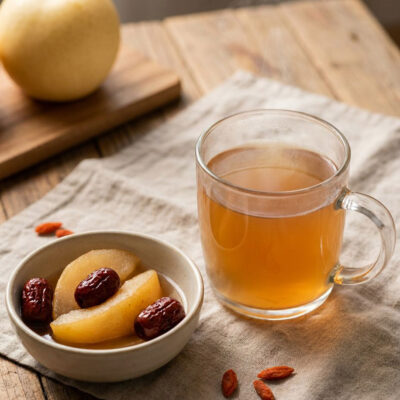
- Add hydrating foods, such as pears, almonds, or white radishes
- Keep the air in the room humid; often, a bowl of water on the radiator is enough to do the trick
Pillar 2: Keeping Your Digestive System Moving
A Well-Nourished Colon He's the other half of the team, and he doesn't need much to do his job.
- Fiber from vegetables, oats, and flaxseed—that's what your gut flora thrives on
- Fermented foods such as sauerkraut or kefir, in small, regular amounts
- Enough fluid to keep everything moving
Pillar 3: Practicing Breathing
Breathed It's not the lungs themselves that do this, but the diaphragm and the muscles between the ribs—and they become more flexible when you challenge them.
- Take a few minutes every day to breathe calmly and deeply
- Focus on exhaling, because that's the part we tend to neglect in our daily lives
- Get some fresh air, even if it's cool—especially then
Pillar 4: Taking Care of Your Skin
In Chinese medicine It is said that the lungs govern the skin. Both belong to the Metal element, and both serve as a boundary to the outside world—so whatever is good for the skin is also good for the lungs.
- Dry brushing in the morning stimulates blood circulation
- Contrast showers help the body get used to responding to temperature changes
- Dress warmly, especially around your neck and lower back, because according to TCM, that's where wind-cold enters the body
Pillar 5: Taking the Light With You
Every day The sun is lower in the sky, which means the window of time during which your body can produce vitamin D on its own is also shorter.
- Make the most of every hour of fall sunshine you can — a lunch break outdoors counts double
- Let your mirror decide if you want to know for sure
- Talk to your doctor about whether taking a supplement during the darker months makes sense for you.
📍 Three acupressure points for building up your strength in the fall
These three points They target the lung-large intestine system and are well-suited as a short daily morning routine.
Lu 07 (Liè Quē) — „Interrupted Sequence“
The point where the lung passes through, connecting it directly to the large intestine—and thus the point where the subject of this article comes together.
- Location: On the forearm on the thumb side, about two finger-widths above the wrist crease
- Traditionally classified as: the Lung Qi, which Wei-Qi, a free breath
- Application: Gently massage in a circular motion for 30 to 60 seconds on both sides
- When: Every day, preferably in the morning
LI 11 (Qū Chí) — „Curved Pond“
One of the most important points on the Large Intestine Meridian.
- Location: At the outer end of the elbow crease, with the arm bent
- Traditionally classified as: the external defenses as understood in TCM, heat, the flow of the meridian
- Application: 60 seconds of firm pressure on both sides
- When: Every day, having a good time with Lu 07
LI 20 (Yíng Xiāng) — „Pleasant Fragrance“
The point for the nose and upper respiratory tract, whose name comes from the fact that a clear nose can smell again.
- Location: Right next to the nostrils, in the small indentation
- Traditionally classified as: a clear nose, the mucous membranes of the upper respiratory tract
- Application: Gently massage in a circular motion for 30 to 60 seconds on both sides
- When: Every day, and whenever your nose is stuffy
The daily routine: All three exercises in the morning, each lasting about a minute. It takes less than four minutes and can therefore be easily incorporated into your daily routine.
- Note: During pregnancy, use acupressure only after consulting a healthcare professional.
🧭 You can find all the points with video tutorials in our free acupuncture atlas: 👉 www.meine-tcm.com/akupunkturatlas
🍂 Live Qigong with Wolfgang: The Autumn Journey
After the summer break, classes will resume every Monday starting September 14 and continue for seven weeks through the fall, featuring qigong and an in-depth course on Traditional Chinese Medicine (TCM).
Those who take part will experience this time of year differently.
💫 The deeper message
Once the pain is there, it's easier to take action.
Fall calls for something a little more unusual.
It demands that you make preparations while you’re still well. And that you take care of something you don’t even feel yet. That is the quiet dignity of this time of year.
What you do during these weeks, you’re not doing just for today. You’re doing it for the version of yourself who’ll be standing in the cold wind in February—and who will then draw on what you’re building now.
ℹ️ This post is intended for general informational purposes only and is not a substitute for a medical diagnosis or treatment. The patterns, recommendations, and acupressure points described here are based on traditional Chinese medicine. If you have persistent or unclear symptoms, please consult your doctor or a qualified TCM practitioner.
Anyone who waits until then to dig a well,
if he's already thirsty,
He waited too long.
— *Huángdì Nèijīng*, *Sù Wèn*
📌 Recommended
🍂 The Fall Journey, LIVE every Monday on YouTube: Seven weeks through the fall, featuring qigong and an in-depth exploration of Traditional Chinese Medicine (TCM). Starts September 14.
👉 Check out the Fall Trip on YouTube
🧭 Acupuncture Atlas: Over 80 points, including a map and video tutorial. Free and no registration required. 👉 To the acupuncture atlas
📩 Once a month, the Yellow Emperor writes to you: Practical tips on TCM, nutrition, simple recipes, and Eastern wisdom—all in language everyone can understand—delivered right to your inbox. Subscribe for free: 👉 Sign up for free