





No sooner is it done than you're flat on your back
Why the Body Waits Until the Very End

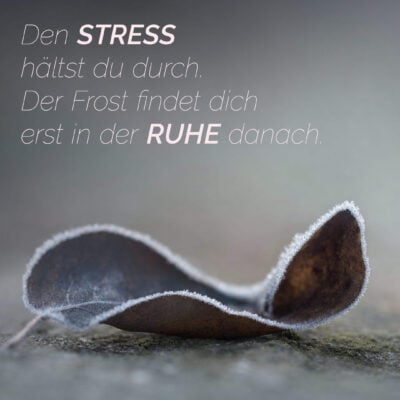
The STRESS You'll stick with it.
The frost won't reach you until PEACE after that.
🍂 As long as it matters, the body holds up
Moving on my own That has little to do with it. Many people experience the same pattern after a major project, after weeks of caring for a loved one, on the first day of vacation, or during the days between Christmas and New Year’s.
As long as something is demanded of you, your body can keep going—often for weeks. It only gives out when no one wants anything from it anymore.
A coincidence That's not the case. In the weeks leading up to it, you slept less, ate faster, and spent many evenings finishing up work. Your body still managed to keep everything going. It just didn't draw on its full reserves—it ran on its reserves instead.
🛡️ The Border Guard Post
Chinese Medicine has a special name for the force that protects you from the outside world. It's called Wei Qi, and the character wèi (衛) means "guard.".
What is meant is one shift, which is not located deep within the body, but rather on the very surface, between the skin and the muscles. It warms the surface, regulates the opening and closing of the pores, and keeps the wind and cold from penetrating any deeper.
How this layer is structured, we discussed in the article Kick Off Fall the Right Way described. One thing suffices here: The guard depends on resupply.
According to ancient texts, the center—that is, the spleen and stomach—derives qi from foodi, which makes up the guard, and the lungs distribute it to the surface. At night, the guard retreats inward and gathers itself again.
During a difficult time Both are missing. You're eating on the side and not getting enough sleep, and the guard is receiving fewer supplies than it uses. Still, it can't pull out, because it's needed.
So she stops and draws on what’s left. Only when the tension eases does it become clear just how thin the line has become.
In the fall This happens very easily. The lungs are part of the Metal element, which is associated with fall, and the body is now adjusting from the open environment of summer to the more enclosed one of winter. So at this transition, it already has plenty to deal with.
ℹ️ Note: When Chinese medicine refers to the lungs, spleen, or stomach, it is referring to energetic systems rather than the anatomical organs.
Wèi Qì, too, is a concept within this tradition and not an anatomical structure.
🔍 How to Tell If the Guard Is Living Off Its Reserves
Some characters appear right in the middle of this stressful time, long before you feel a scratchy throat.
- You feel cold more quickly than usual, even though it's not any colder outside than it was in the weeks before.
- In the evening, you're tired, but you still have trouble falling asleep.
- I have a slight scratchy feeling in my throat that comes and goes.
- You'll only make it through the afternoon with coffee.
None of these characters is a finding. But if two or three of these occur together, it's time to relieve the guard—and to do so during this period, not after it's over.
🔬 What stress research has to say about this
Research, too describes a close connection between stress and the immune system, and this connection works both ways.
Short-Term Stress This initially makes the immune system more alert. When the sympathetic nervous system kicks in, the body releases adrenaline and cortisol, and certain immune cells migrate in greater numbers to the areas where injury is most likely to occur—that is, the skin and outer tissues.
The Stress Researcher Firdaus Dhabhar describes this as a kind of "standby mode" for the immune system.
If this condition persists for weeks, the situation is reversed, and the body becomes more vulnerable. In a well-known study from 1991 Sheldon Cohen and his colleagues administered cold viruses into the noses of nearly four hundred healthy people.
The higher the stress levels the participants had reported beforehand, the more often they actually caught a cold. Among those with the lowest stress levels, it was about one in four; among those with the highest stress levels, it was nearly one in two.
Getting sick afterward, too has already been studied. Dutch researchers have described it as a "leisure-time illness." In their Pilot Study Of the nearly 1,900 respondents, about 3 percent reported regularly falling ill on weekends or while on vacation, and they identified a heavy workload and the difficulty of switching from work to leisure time as the main risk factors.
A common explanation is that stress hormones drop when we are at rest, and that is when symptoms first become noticeable. This has not yet been conclusively proven.
🌿 Slow down a little every day—don't wait until it's all over
The Guardhouse You don't need a long break at the end, but rather short breaks while the strenuous part is still going on. That way, the rest doesn't have to come all at once.
📍 Tap your arms
The Tap Test It is one of the simplest exercises in qigong. It takes one minute and targets the exact layer where Chinese medicine believes the “guard” is located.
The meridian of the Lung, on the outside, that of the Colon, and both are associated with fall.
- Stand with your body relaxed and cup your right hand as if you were holding a little water in it.
- Extend your left arm, with your palm facing up. Tap down along the inside of your arm, starting at your shoulder and continuing all the way to your hand.
- Turn your arm over and tap your way back up the outside of your arm to your shoulder.
- Repeat this three times, then switch sides.
Tap gently, not hard. After half a minute, your skin will feel noticeably warm. It’s best to do this every evening once you’ve finished your work for the day, because then the exercise becomes a sign that the day is over.
ℹ️ Please note: Do not tap over injured or inflamed skin, or over varicose veins.
Three Habits for the Busy Weeks Ahead
1. Create transitions instead of stopping abruptly
The Dutch researchers cited the difficulty of switching gears as one of the greatest risks.
So, at the end of every exhausting day, plan a little break: a twenty-minute walk, a detour through the park, or two minutes during which you exhale longer than you inhale before sitting down on the sofa.
And when the whole Once this phase is complete, Don't leave the first few days after that empty—just take it easy, with a walk, a get-together, or a small task.
This way, your body doesn't have to release the tension all at once. If you'd like to practice with guidance, our Atemraum App through the breathing exercises.
2. Eat one warm meal a day while sitting down
The Center supplies the Guard with sustenance, and according to Chinese medicine, it does so most easily with warm, cooked foods.
During stressful weeks That's often the first thing to go. That's why one meal a day should be a hot meal and eaten in a relaxed setting.
A vegetable soup with leeks and carrots, a stew, or chicken broth can be made ahead of time on the weekend and frozen in individual portions.
3. Go to bed early on the evening when everything is done
After a stretch like that, it's very tempting to stay up late on the first night and toast what they've accomplished. But the guard gathers its strength during the night, and that's exactly the time it's been missing for weeks.
So go to bed earlier rather than later tonight. You can make up for the toast on the second night.
The Guardhouse has carried you through this whole difficult time without you even noticing. It doesn't ask you for a vacation, just a minute in the evening, a warm meal, and an early night before peace sets in.
If a cold lasts longer than a week, is accompanied by a high fever, or if you keep feeling sick, you should see a doctor.
🔖 Recommended
🔍 Free TCM Analysis: Our analysis, which takes about ten minutes, will show you how your center and your immune system are faring from the perspective of Chinese medicine.
👉 Get a Free TCM Analysis
🧘♂️ Live Qi Gong with Wolfgang: Next Monday (October 12, 2026), we'll be discussing the body clock—why you wake up between 3 and 5 a.m. and what you can do about it.
👉 About the Live Session
📜 Once a month, the Yellow Emperor writes to you personally: Practical tips on TCM, nutrition, simple recipes, and Eastern wisdom—all in language everyone can understand—delivered right to your inbox.
👉 Sign up for free
Where harmful substances accumulate,
The Qi there is certainly depleted.
— *Huángdì Nèijīng*, *Sù Wèn*, Chapter 33