




Learning to Let Go: Grief, Breathing, and the Metal Element
Why Fall Is the Season of Goodbyes and How to Embrace It

LET GO is not a weakness.
It is the highest ART of autumn.
In Chinese medicine, we are now in the fall, and with that, the Metal element takes center stage. With it comes an ancient lesson that can be summed up in a single word: letting go.
In the fall, everything slows down a bit and takes on a deeper quality, because something is ready to move on and make room for what comes next. During these weeks, something inside you asks a quiet question, and it goes like this: Do you really still need that?
The ancient texts have been addressing this question for over two thousand years, and they always pose it to us at the same time of year.
🍂 Fall and the Metal Element
Every season In Chinese medicine, each season corresponds to an element. Spring corresponds to Wood, summer to Fire, fall to Metal, and winter to Water, and the transitional periods between them—the Dojo periods—correspond to Earth.
So now metal reigns supreme, and at first that sounds harsh and relentless to our ears. But the meaning is quite different, for metal stands for that which purifies and separates, leaving only the essential in the end.
Imagine a rock crystal—clear, pure, and precious. That’s roughly how Chinese medicine conceives of the metal element: not as something raw, but as something distilled—what remains once everything superfluous has been stripped away.
In spring, everything awakens; in summer, it blossoms; and in fall, we harvest and let go. What is ripe is brought in, and what no longer bears fruit is allowed to go.
The metal is connected to the Lung and the Large Intestine, that is, the two systems in the body responsible for taking in and releasing. We'll take a closer look at how they do that and how you can help them get through the fall in a separate post.
Today we're talking about the other side of fall—the one you won't find in any calendar: the emotional lesson that the element of metal teaches us.
ℹ️ Note: When Chinese medicine refers to the kidneys, large intestine, or lungs, it is referring to energetic systems rather than the anatomical organs.
💧 Grief — the emotion of fall
Each element In Chinese medicine, each element is associated with a specific emotion. Anger is associated with Wood, joy with Fire, brooding with Earth, fear with Water—and grief with Metal.
This is perplexing in a Western context, because here grief is supposed to be something that is part of life, something that is allowed to exist, and even has its own season. That is exactly what the ancient texts say.
There, grief is not an illness, but the natural response to what autumn makes clear to everyone: that everything passes. The leaves, the light, and the warmth pass, and sooner or later, so do the people we love, the bodies that carry us, and the ideas we had of ourselves.
Healthy grief is the ability to say goodbye without being broken by it. It allows us to stand with both feet firmly planted in a world where nothing lasts, and without it, we would not be stronger, but merely more superficial.
If grief isn't given space, it eventually takes a toll:
- Into a melancholy that refuses to lift
- Into a bitterness that turns everything gray
- A retreat that eventually turns into a prison
- Shallow breaths and a sigh that no longer brings relief
- Into a vague heaviness that cannot be pinned down anywhere
When grief is allowed to be felt, it transforms:
- With the realization that something was important and is now over
- In gratitude that it ever happened at all
- The freedom to keep moving forward
- Making Room for What's Next
Traditional Chinese medicine puts it bluntly: A tear that is shed strengthens the lungs, and a tear that is held back weakens them.
So if you find yourself caught up in a wave this fall that you can't quite put your finger on, just let it come. It doesn't mean something is wrong—it means something is right.
A few words on that
Grief comes in waves. It builds up, and then it eases off for a while.
But if that heaviness lingers week after week, if nothing brings you joy anymore, if you can't find a reason to get out of bed in the morning—then that's no longer just the autumn blues.
Then seek support—from your family doctor, a psychotherapist, or a counseling center. Chinese medicine can provide support and strength, but it is no substitute for professional help.
Seeking help is not a failure. It is self-care.
🕯️ The Body-Soul — When Grief Has a Place
In the „Fifth Season“ we have the Five Shen We’ve already learned about the five mental and spiritual aspects that reside in the Yin organs. Today we’ll take a closer look at one of them—namely, the spirit of the lungs. The ancient texts refer to it as Pò (魄), known in German as the "body soul.".
Unlike the Hún—the spirit soul of the liver, which wanders at night and is connected to dreams—the body soul remains firmly anchored in the body. It is the part of you that reacts before you’ve even had a chance to think about it, and that knows transience without needing it explained to it.
The body-soul reveals itself in your instincts, in the way you are present in your own body, and in your ability to be in the moment rather than somewhere else.
If she is strong:
- You feel at home in your body
- You can be there without constantly overthinking things
- You trust your instincts
- You notice your breath, your heartbeat, and the subtle signals
If she is weak:
- You feel out of place and not fully present
- You're in your head and rarely in your body
- You lose touch with your feelings
- You're breathing shallowly without even realizing it
Because the body-soul is so closely connected to transience, it is particularly drawn to fall, of all seasons. When you become calmer during this time of year, become more grounded in your body, and pay closer attention to the subtle signals, that’s when it makes itself known.
It is precisely this quality that makes fall a time when many things can heal.
🔬 Side Note: What Research Has Found on This Topic
Modern Research comes from a completely different perspective. It makes no mention of qi or the metal element, yet in several places it nevertheless describes something that comes very close to them.
- The Polyvagal Theory According to Stephen Porges describes how the nervous system shifts between attachment, fight, and flight, and how this shift can become fixed under chronic stress. Shallow breathing, a tense diaphragm, and a high-pitched voice are considered signs of this in this model. While the theory is controversial among experts, it remains helpful as a description of what many people observe in themselves.
- Research on the Vagus Nerve shows that calm breathing with a prolonged exhalation measurably slows the heart rate.
- Attachment Research explains that people who experienced a sense of security early on find it easier to let go of things later in life, while those for whom closeness was a source of insecurity often cling more tightly.
- Research on Gratitude Exercises suggest that they can lift one's spirits and lower stress markers. Traditional Chinese medicine would say that gratitude nourishes the body-soul and opens the lungs.
Two languages, two ways of observing. Both come to the conclusion that the ability to let go is not a luxury.
The question remains: How can you practice this if no one has ever taught you? Traditional Chinese medicine has an answer, and it's simpler than most people expect.
🌾 The Five Ways to Let Go
Let go It can be practiced—not as a technique, but as an attitude. The following five approaches are therefore not rules, but invitations. Choose one or two that speak to you, and start there.
1. Decluttering Your Physical Space — The Outside Reflects the Inside
Your Space is like an extension of your body, and what you hold onto in your surroundings, you usually hold onto inside yourself as well. Unorganized drawers, overcrowded closets, and things you haven’t used in years weigh on you even when you’ve long since stopped consciously noticing them, because every unused object is a quiet I really should in your head.
Here's what you can do right now:
- Open a drawer, a cabinet, or a nook—but only one per day
- Pick out three items to donate, sell, or throw away
- Get rid of any clothes you haven't worn in a whole year
- Tidy up piles of paper and files
- With everything, ask yourself if it still nourishes you
What doesn't really help:
- Don't try to clean everything up at once—it's overwhelming and just creates more chaos.
- Sorting things out just for the sake of minimalism, because it's about resonance, not purism
- Planning for weeks on end without ever getting started
📣 Insider tip: If you want to get to know someone, take a look in their fridge and their closet. The same goes for you.
2. Allowing Yourself to Grieve — Tears as Medicine
Our Culture has a problem with grief, because we're supposed to be strong, stay positive, and look ahead. Chinese medicine turns that on its head and says that no one can heal if they aren't allowed to grieve.
What really helps:
- Consciously give grief time and space, rather than letting it run its course on the side
- Write a letter to whatever you want to let go of—a person, a situation, a phase of your life, or an old image of yourself
- Cry when you feel like it, whether you're alone or with someone you trust
- Find a ritual that honors the farewell—such as lighting a candle, taking a walk, or reciting a poem
- Talking to someone who listens without immediately trying to comfort you
What doesn't really help:
- Trying to numb grief through distractions, alcohol, shopping, or scrolling
- Feeling ashamed of being sad
- Comforting others before you've felt it yourself
📣 Insider tip: Find a set spot for those difficult evenings—an armchair, a bench, a specific path. When grief knows where it’s allowed to go, it’s less likely to overwhelm you when it’s not convenient.
3. Breathing as Letting Go — Autumn Breathing
The lungs It involves two movements every second: inhalation and exhalation. For most people, inhalation is overemphasized because they are constantly taking in, holding, and storing. Autumn breathing reverses this balance by emphasizing exhalation.
The 4–7–8 Breathing Technique by Dr. Andrew Weil:
- Breathe in through your nose for four seconds, deep into your belly
- Hold your breath for seven seconds
- Exhale through your slightly open mouth for eight seconds, slowly and without straining
- Three to five minutes, in the morning and in the evening
Why this is good for you:
- Extended exhalation calms the heartbeat via the vagus nerve
- The diaphragm and rib cage become more flexible again
- The body receives the signal that it can let go
What doesn't really help:
- Compulsively counting along or wanting to do it perfectly
- Trying the exercise for the first time in a stressful situation of all places—practice it when you're calm
- To view it as an achievement, because it is an invitation
ℹ️ Please note: The 4–7–8 breathing technique is a relaxation exercise, not a treatment. If you have a heart, lung, or nervous system condition, are pregnant, or are currently undergoing medical treatment, talk to your doctor first. If you feel dizzy or unwell while practicing, stop and return to breathing normally.
📣 Insider tip: We have a video with complete instructions on the 4–7–8 breathing technique, so you can start practicing right away. You'll find the link at the end of the article.
4. Embracing Silence — Retreat as Medicine
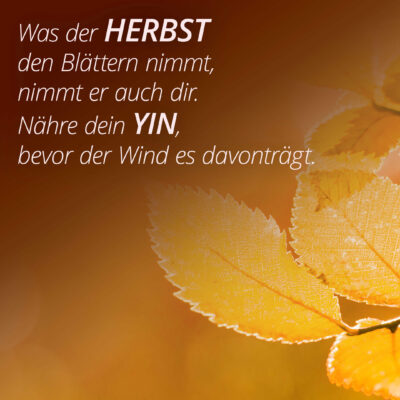
Fall It is the season of retreat, when Yang—the active, outward-directed energy—withdraws and Yin—the quiet, inward-directed energy—grows. You can see this everywhere in nature: the leaves fall, the sap flows back into the roots, and the days grow shorter.
Those who follow this rhythm draw strength from it, while those who work against it wear themselves out.
What fall needs right now:
- Going to bed earlier, with the sun instead of against it
- Fewer appointments and more breaks, so we can slow down a bit
- Quiet moments without distractions, even if they're only five minutes long
- Time spent in nature, preferably alone and in silence
- Deliberate breaks from media—in other words, less consumption and more reflection
What doesn't really help:
- Maintaining a summery pace even though the body has long since slowed down
- Filling every gap with noise, stimuli, and scrolling
- The desire to be productive all the time
- Never Really Being Alone
📣 Insider tip: An old saying goes that in winter, you’ll lack what you didn’t stock up on in the fall. So taking a step back isn’t laziness—it’s being proactive.
5. Gratitude as a Counterbalance — What Remains of What Is Lost
Grief and Gratitude are not opposites, but siblings, and anyone who truly wants to let go needs both.
However, in recent years, gratitude within the self-help community has become a means of suppressing emotions. Be grateful for what you have, and you'll feel better, or so they say, or Attract high vibrations and avoid the low ones. That's no longer gratitude; it's denial with a pretty name.
Traditional Chinese medicine does not recognize this misconception at all, because it does not judge emotions morally. In this tradition, grief is not negative and joy is not positive; rather, both have their place, and both nourish their corresponding organ when they are expressed, and harm it when they are suppressed.
True Gratitude:
- Embrace your grief instead of trying to talk it away
- It lets you feel the pain and, at the same time, realize that it was beautiful, that it happened
- It doesn't demand anything from you, because it is a perception, not an obligation
Toxic positivity:
- They tell you to think positively, and then things will get better
- Requires you to manifest away unpleasant feelings
- Makes you feel guilty if you're still feeling down
Anyone who is allowed to feel only gratitude and not sadness will eventually become ill, and the ancient texts are very clear on this point: An emotion that is not allowed to be expressed becomes lodged in the body.
Here's what you can do specifically:
- Every evening, write down three things you were grateful for that day.
- Every time you say goodbye, ask yourself what you're grateful for—that this person was in your life.
- Write to the people you're grateful to, even if you've lost touch with them
- Celebrate what's possible with a small ritual, whether inwardly or outwardly
- Take five minutes a day just for this one thought
📣 Insider tip: The most effective way to express gratitude is in a sentence that allows for both: It hurts, and I'm grateful that I had it. Grief and gratitude in the same breath—that is precisely the healing power of autumn.
📍 Three acupressure points for the lungs and letting go
Acupressure It is something you can do right away, and at the same time, something that grows over time. Together, these three points form the “Letting Go” program of Chinese medicine.
Lu 01 (Zhōng Fǔ) — „Middle Palace“
The alarm point of the lungs—that is, the spot on the chest where their energy gathers.
- Location: In the first intercostal space below the collarbone, on the outer side of the chest, where the rib cage and shoulder meet
- Traditionally classified as: Lung Qi, an open chest, free breathing
- Application: Gently massage in a circular motion with your fingertips for 30 to 60 seconds on both sides
- When: For chest tightness and after difficult days
Lu 09 (Tài Yuān) — „Great Abyss“
The source point of the lung and, at the same time, its tonification point—that is, the point through which it is strengthened.
- Location: On the crease of the wrist on the thumb side, in the indentation next to the tendon, right where you feel your pulse
- Traditionally classified as: Lung Qi and Yin, a Calm Breath
- Application: Gently press with your thumb for 60 seconds on both sides
- When: After long and difficult periods, and to help with daily recovery
LI 04 (Hé Gǔ) — „United Valleys“
The source point of the large intestine and the "great release" in Chinese medicine.
- Location: On the hand, in the muscle belly between the thumb and index finger, pressed toward the index finger
- Traditionally classified as: Stagnation, a clear mind, a porous surface
- Application: Using the thumb and index finger of your other hand, press firmly for 60 seconds on both sides
- When: For resentment and tension, and whenever something just won't go away
- Note: Do NOT use during pregnancy (may induce labor)
The Daily Letting-Go Exercise: Massage these three points once in the morning, each for just under a minute. It takes less than four minutes in total and follows a simple sequence: first open, then build up, then release.
🧭 You can find all the points with video instructions in our free acupuncture atlas. 👉 To the acupuncture atlas
🔴 Next Monday, 6 p.m.: Learning to Let Go — Qi Gong for Fall
This is exactly the topic Wolfgang will be covering in next Monday’s live session. We’ll practice Qi Gong together, followed by an in-depth TCM session for channel members on grief, breathing, and letting go.
„You're carrying more than you need to. On Monday, we'll lighten the load a bit.“
💫 The deeper message
There's a reason, why autumn has been the season of poets for millennia. The trees know something we’ve forgotten over the years: namely, that no one can make it through winter who cannot let go. Your body knows this, too, because it grows weary of everything it holds on to, and your heart knows it as well, because you cannot love when your hands are full.
You don't have to reinvent yourself this fall. All you need to do is be willing to let go of a little something—maybe a grudge, maybe a worry, maybe an old image of yourself.
One of our upcoming posts will focus on the other, more external aspect of fall: how to protect yourself when the wind picks up, and how the lungs and large intestine work together to get you through the cold season.
But for these weeks, something else applies: Let go of whatever wants to go.
🍂 In the September 25 newsletter
Chinese medicine recognizes a force that protects you on the surface. It is called Wei Qi, and ancient texts describe it as a protective layer that lies between the skin and the muscles and keeps out the wind and cold.
In the newsletter dated September 25 The Yellow Emperor will explain what this protective cloak is all about and how you can use it to get through the fall.
Added to this is a recipe that is about 1,700 years old: the ancient alchemist’s brew. It was written down by a man who was actually searching for the elixir of immortality, and 1,600 years later, a researcher found a clue in his little book that led to a Nobel Prize.
Not a member yet? Sign up here for free, then both will be delivered directly to your mailbox on September 25.
ℹ️ This post is intended for general informational purposes only and is not a substitute for a medical diagnosis or treatment. The relationships, exercises, and acupressure points described here are based on traditional Chinese medicine. If you have persistent or unclear symptoms, please consult your doctor or a qualified therapist.
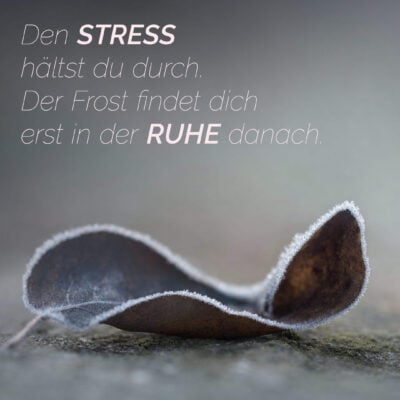
The falling leaves don't make a fuss about it.
They simply let go, and that is where their dignity lies.
📌 Recommended
🍂 The Fall Journey, LIVE every Monday on YouTube: Seven weeks through the fall, with qigong sessions to practice along with and an in-depth TCM session afterward. Those who participate will experience this season in a different way.
👉 Check out the Fall Trip on YouTube
📺 Video: The 4–7–8 Breathing Technique with Instructions
👉 Watch the video tutorial
🧭 Acupuncture Atlas: Over 80 points, including a map and video tutorial. Free and no registration required. 👉 To the acupuncture atlas
📜 Once a month, the Yellow Emperor writes to you personally: Practical tips on TCM, nutrition, simple recipes, and Eastern wisdom—all in language everyone can understand—delivered right to your inbox. Subscribe for free: 👉 Sign up for free