








Your throat feels scratchy, your skin feels tight, and your digestion is sluggish—in the fall, these symptoms all have a common cause
ASK THE YELLOW EMPEROR
The lungs distribute water throughout the body—first through their own pathways, then outward to the skin and downward to the intestines. If they become dry, you'll notice it in all three.
— Qí Bó
Most We treat these as three separate issues: cream for the skin, lozenges for the throat, and more fiber for the intestines. For two thousand years, Chinese medicine has viewed these as a single condition. And it addresses them all at a single point.
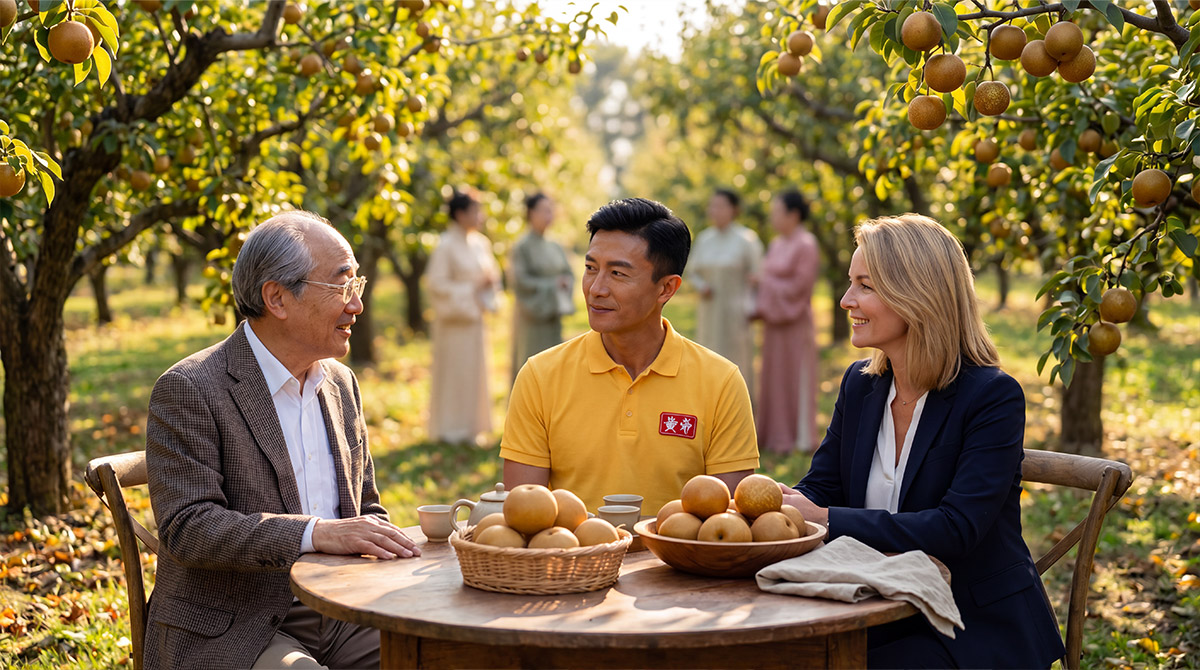
Qí Bó | The Yellow Emperor Huángdì | Dr. Weber
Note: Whenever this article refers to the „lung,“ „colon,“ or „kidney,“ it always means the Functional Circuits in Chinese medicine—energetic systems, not anatomical organs.
The Emperor's Question
The Yellow Emperor: „Qí Bó, every fall I hear the same three complaints. Some complain of a dry throat and a cough that brings up nothing. Others say their skin becomes rough and tight. And still others complain of sluggish digestion, even though they haven’t changed their diet. I’ve always considered three different causes for this. Was that a mistake?“
Qí Bó: „That’s easy to understand, Your Majesty. Think of a tree that lacks water. The leaves wither, the bark cracks, and the fruit remains small. Anyone who merely looks at it sees three problems. In truth, there is only one: nothing reaches the roots anymore.”.
It's the same with humans. The lungs do more than you think. They don't just breathe—they distributes water throughout the body. What the center extracts from food rises to the lungs. First, it uses this to keep its own passages moist: the throat and airways through which air flows with every breath. From there, it sends the water outward, beneath the skin, like a fine mist. And it allows part of it to sink downward, all the way to the intestines, so that they remain moist and everything can pass smoothly.
Now here's the key point: the lungs and the large intestine are a pair. They belong together like the inside and the outside. Both are part of the Metal element, and Metal governs autumn.
“When the lungs become dry in the fall, the drizzle stops. You first feel it where the water has to pass through: in your throat. Then you feel it on the outside of your skin and down in your intestines. Your three complaints are a single process. You simply see it from three different angles."
The Yellow Emperor: „So dry skin in the fall isn't actually caused by the skin itself.“
Qí Bó: „It’s not just her. She’s merely a sign of what’s missing deeper inside.“
Dr. Weber: „If I may make a comment, Your Majesty—it’s important to me. We’re talking here about the usual dryness of the season: rough, tight skin when the air gets cooler. Skin that is severely itchy, weeping, or inflamed is a different matter and should be treated by a doctor.“
What modern medicine has to say about this
The Yellow Emperor: „And how do you view Qí Bó’s model, Dr. Weber? The neck, skin, and intestines as a single process?“
Dr. Weber: „To be honest, that surprised me when I first heard it—until I realized that we were actually describing the same thing, just from the other side.
We now know that the body’s mucous membranes are not a patchwork of separate parts. The nose, airways, and intestines form a cohesive system with a shared defense mechanism. What is missing at one end is often missing at the other as well. Researchers call this the gut-lung axis: A healthy gut microbiota produces substances that, according to current understanding, strengthen the respiratory tract’s defenses.
“And the skin is part of that. It is not a dead shell, but the outermost boundary of the same system."
The Yellow Emperor: „So it's the same order, just put in different words.“
Dr. Weber: „That’s right. And all three work with the same material: moisture. A thin film of fluid lines the airways, on which millions of tiny hairs beat in unison, carrying dust and pathogens out of the body. This only works as long as everything remains moist. Water is reabsorbed in the intestines; if there isn’t enough of it, the contents become hard and sluggish. And the skin retains its moisture with fats and water-binding substances, which the body produces less of as we age.”.
“Three places, one substance. When it runs low, all three react—usually in this order: first the throat and nose, then the skin, and finally the intestines."
Try it out on your own tonight
The Yellow Emperor: „That makes sense to me. But is there anything a person can check for themselves?“
Qí Bó: „There is something, Your Majesty. It's in the organ clock.".
The time of the lungs is from 3:00 to 5:00 a.m.. Right after that, from five to seven, followed by the large intestine. At night, the two lie side by side, just as they belong together inside the body.
Ask people when their dry cough is at its worst. They’ll say: in the early morning hours. Ask when they wake up in the fall with a dry mouth. They’ll mention the same time. And digestion, which should be active in the morning, is now more sluggish than in the summer—that’s the hour after.
“That's no coincidence. A pair of organs is making itself known in its own time."
Dr. Weber: „And that aligns with what we measure. In the early morning hours, the body is at its driest: it has gone many hours without a single sip of water, saliva production drops significantly during sleep, and anyone who breathes with their mouth open loses additional moisture. Toward morning, cortisol levels also rise, sleep becomes lighter, and the airways become more sensitive. That’s why a dry cough is at its worst for many people at exactly that time.”.
“And the intestines do indeed experience their strongest urge to move shortly after waking up. Everyone can test for themselves tonight what Qí Bó’s clock describes."
The Causes of the Fall Drought
The Yellow Emperor: „Then tell me why this drizzle is letting up.“
Qí Bó: „Three things, Your Majesty.
The first thing is air. Each season brings its own influence: summer brings heat, winter brings cold, and fall brings dryness. Of all the organs, the lungs are affected first, because they are the most sensitive. They are the only ones in constant contact with the outside world: through the nose, through the skin, with every breath. Whatever is in the air soon finds its way into them.
The second thing is the table. The water that the lungs distribute doesn't come out of nowhere. It is derived from what you eat. Those who eat mainly cold, raw, and dry foods—bread, roasted foods, fried foods—give the center nothing from which to draw. Then the mist has no source.
The third is the night. “You recharge in the dark, in the stillness. Those who keep their nights short gather during the day and lose in their sleep what they set out to gather."
The Yellow Emperor: „So, three causes: the air, food, and sleep. Do you have anything to add, Dr. Weber?“
Dr. Weber: „Two things, Your Majesty.
One of these is the rooms. As soon as the heaters come on, the humidity in apartments drops to twenty to thirty percent. Forty to sixty percent would be ideal for the mucous membranes. Cold outdoor air contains hardly any moisture; when it’s heated, it draws moisture from everything it comes into contact with—including every breath you take. And this goes on all night long, during precisely the hours that Qí Bó mentions.
The other is a common misconception. Many people think that simply drinking more helps combat dryness. That’s only partly true. Water you drink is absorbed quickly and excreted just as quickly. The moisture film on the mucous membranes is produced by glandular cells, and they need more than just water: they need a body that is well-nourished and well-rested overall. That’s why a warm, water-rich meal is more beneficial than a tenth glass of water.“
The Way Back — With Both Hands
The Yellow Emperor: „Then show me the way back. And make it simple enough that I can get started on it first thing tomorrow morning.“
Qí Bó: „The path has two hands, Your Majesty, and both are gentle. One hand fills, the other holds fast.”.
The first hand fills up — through what ends up on the table. The old masters had a rule for this that every kitchen understands: When the air turns dry in the fall, eat something white. The color white is associated with the lungs. First and foremost is the pear, gently steamed with a little honey; no other fruit soothes dryness quite as well. Along with whatever is coming out of the ground now: white radish, carrot, parsnip, and pumpkin. Warm oatmeal or rice porridge in the morning, a handful of soaked almonds.
And how you prepare it makes all the difference: warm, boiled, steamed, as a soup or porridge. Moist heat brings out the juices. Raw, cold, and seared foods dry it out.
One more thing for this time of year: Less spicy and more sour. Pungent flavors drive outward and disperse—in the fall, they disperse exactly what you want to gather. Sour flavors contract and retain moisture in the body.
The second hand holds on tight, which is what the first one gathers. Because if you gather with one hand and waste with the other, you’ll never get ahead. So: don’t work up a sweat until you’re exhausted, drink little alcohol, and eat few spicy foods. And above all, go to bed a little earlier than you do in the summer.“
Dr. Weber: „There’s a reason for all of this, Your Majesty. Steamed fruit and cooked root vegetables contain water bound to soft fibers—the body absorbs it slowly rather than releasing it quickly. Those same fibers nourish the gut flora, which in turn benefits the respiratory tract. The fats from almonds and sesame seeds serve as building blocks for the layer that retains moisture in the skin.”.
And sleep is no afterthought: During deep sleep, the body regenerates the skin and mucous membranes and restores its water balance. Short nights rob the body of the very hours it needs to replenish itself.“
The account you don't want to touch
The Yellow Emperor: „I have one more question, Qí Bó. Why do you emphasize autumn so much? Can’t you do that just as well in winter?“
Qí Bó: „It is possible, Your Majesty. But what is easy today will be a struggle in the winter. For you have not one supply, but two.”.
The first is the daily supply. Your body draws the moisture it needs for the day from it. You replenish it every day: with what you eat and drink, and with the sleep you get.
The second one is lower. It is your lifelong reserve. In Chinese medicine, it is called the "essence," which in Chinese is Jing. You are born with it; it resides in your kidneys, and it is meant to sustain you through difficult times: through the cold, through illness, through old age.
As long as the first supply lasts, no one touches the second. But if you take out more every day than you put back, your body will start to dip into the second supply—and it will dip a little deeper each year.“
Dr. Weber: „If I may put it this way, Your Majesty: Imagine two accounts.
The first one holds the money for everyday expenses. It empties quickly, but it fills up just as quickly.
The second one is a savings account for life. “It fills up only slowly, and it's meant for tough times. If the everyday account is covered, the savings account remains untouched. If it's empty, the body takes what's missing from there. It spends what it had intended to save."
The Yellow Emperor: „He reaches for his savings book.“
Qí Bó: „To what you had set aside for hard times. And what’s missing there comes back only slowly, Your Majesty. Much more slowly than it’s being spent.”.
That’s why there’s that fatigue in winter that just won’t go away, even after a long sleep. It runs so deep because it comes from way down there.
Now you know why I emphasize fall. It’s the time of year when you can effortlessly build up your everyday savings. Nature shows us how it’s done: Trees draw their strength into their roots, animals stock up on food, and cellars fill up. If you get started now, you won’t have to touch your savings account.
And what’s more: According to our teachings, the lungs nourish the kidneys—metal gives rise to water. A checking account with plenty of funds in it will even end up putting a little money into your savings account.“
Dr. Weber: „From my perspective, it’s the same thing, just put more plainly: The body is best able to build up reserves as long as it isn’t under stress at the same time. The mild weeks leading up to the cold season are the best time to do this. Not because it would be impossible later on—but because it costs the least now.“
The Yellow Emperor: „Then let’s turn that into a plan. One that people can start following first thing tomorrow morning.“
🍂 The 3-Step Method for Building Up This Fall
🌅 TOMORROW — Laying the Foundation
TCM: Start with something warm and moist. A slow-cooked oatmeal or rice porridge gives the center exactly what it needs to produce fluids. Before that, have a glass of lukewarm water—not cold. If you like, add some steamed pear, a little honey, and almonds that have been soaked overnight.
Science: Warm, soft foods are easy to digest and contain water that is slowly absorbed as it binds to fiber. Almonds provide vitamin E and fats that help build the skin’s moisture-retaining layer. Wait about ninety minutes after getting up before having coffee—it flushes out water before your body has a chance to store it.
Practical:
- 7:00 a.m. — a glass of lukewarm water
- 7:15 a.m. — warm porridge with a steamed pear, 1 teaspoon of honey, 5 to 6 soaked almonds
- starting at 8:30 a.m. — the first cup of coffee
🌞 DAY — Refill and Don't Waste Anything
TCM: For lunch, eat a warm, cooked meal—not something cold straight from the fridge. Choose what’s in season and full of juice: white radish, squash, carrots, parsnips, and a little tofu—as a soup or stew. Go easy on the spicy stuff, but add a little something tangy: a splash of lemon, a spoonful of sauerkraut. Get some exercise, but don’t overexert yourself.
Science: Cooked vegetables release water and soft fibers that nourish the gut microbiota—which, via the gut-lung axis, benefits the respiratory tract. Fermented foods, such as sauerkraut, provide live cultures. Heavy sweating depletes the body of water and electrolytes, which are difficult to replenish during the dry fall months.
Practical:
- 12:30 p.m. — a hot lunch, such as pumpkin soup or rice with steamed vegetables and white radish
- 3:00 p.m. — instead of something salty: a few almonds, a steamed pear, warm tea
- In between — Moderate exercise: a walk, gentle qigong
🌙 EVENING — restock
TCM: The evening replenishes what the day has depleted. A steamed pear with a little honey nourishes the lungs and soothes. Eat a light meal early, and avoid alcohol—it dehydrates you and disrupts the very sleep you need to recharge. And go to bed a little earlier than you do in the summer.
Science: During deep sleep, the body regenerates the skin and mucous membranes and restores fluid balance. Alcohol and late, heavy meals shorten this very phase. Going to sleep an hour earlier extends the most restorative part of the night.
Practical:
- 7:00 p.m. — a light, warm dinner, no alcohol
- 8:30 p.m. — a steamed pear with honey
- 10:00 p.m. — Turn off the screens, go to bed half an hour earlier than usual
🍐 Recipe of the Month
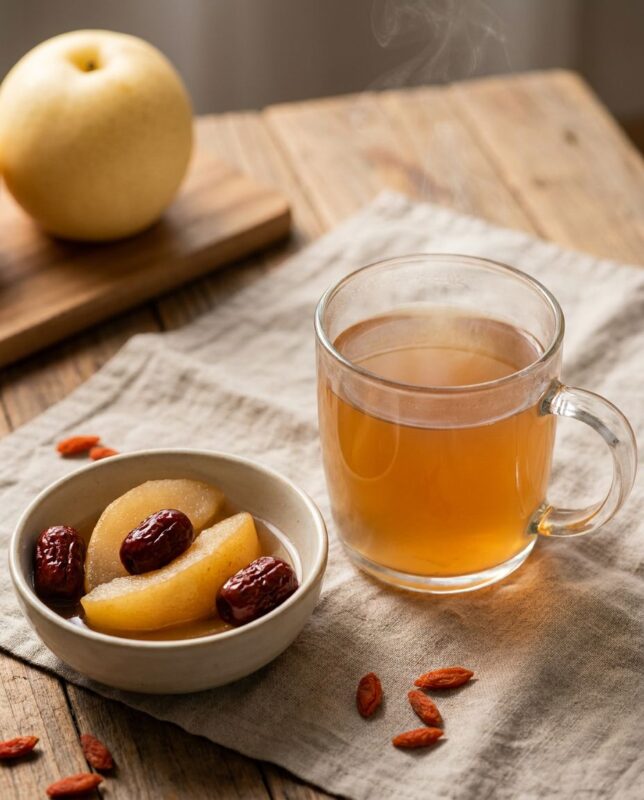
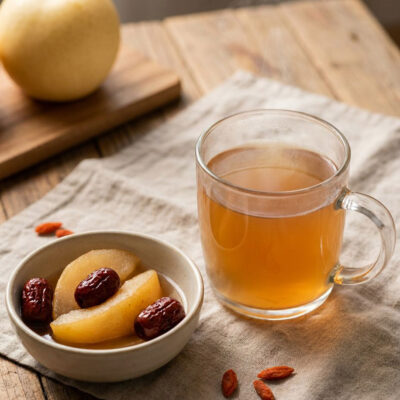
Pear-Date Soup
The classic From the White Kitchen: Pear, red dates, and goji berries, simmered gently for an hour. Here, we eat pears raw, but in China they cook them—almost every day in the fall. You can read why that makes a difference in the recipe.
The insider tip of the 3 wise men
Qí Bó: „There are two acupressure points, Your Majesty, that support from the outside what the kitchen does from the inside. One is associated with the lungs, the other with the kidneys. One keeps the passages moist, the other ensures that there is something to keep them moist.“
Luke 9 — Tai Yuan, the „Great Abyss“
On the crease of the wrist, on the thumb side, where you feel your pulse. The Acupuncture Point Lu 09 strengthens Qi and Yin of the lung. It is located on the Lung meridian.
Gently press for 30 seconds on both wrists—preferably in the morning.
Ni 6 — Zhào Hǎi, the „Shining Sea“
In the in-depth section directly below the tip of the inner ankle. The Acupuncture Point Ki 06 is the classic point for treating dryness: It nourishes the Yin. It is located on the Kidney meridian.
Massage in a circular motion for 45 seconds with moderate pressure on both sides—preferably in the evening.
🧭 You can find both of these points, along with detailed instructions, in our free Acupuncture Atlas.
📋 Quick Check: How are your juices?
How does your throat feel in the morning?
- My throat feels dry and scratchy—I have to clear my throat = lung yin is running low
- Dry at times = the onset of fall dryness
- Moist and free = well-nourished
How has your skin been since it's gotten cooler?
- Tightness and flaking, especially on the lower legs and hands = the drizzle stops
- Dry in places = previous shortage
- Soft and supple = good reserve
How does digestion compare to the summer?
- I'm more out of breath and it's harder, even though I'm eating as usual = my lungs aren't sending enough air down
- Slightly more irregular = early signs of drought
- Still going strong = you have enough energy
And do you wake up between 3 and 5 a.m. with a dry mouth? Then the pair of organs will perform at their designated time.
🍐 You can get started tonight: Simmer a pear in a little water until tender, add a teaspoon of honey, and eat it while it’s still warm. It takes ten minutes—and it’s the first step in getting ready for fall.
The Yin Weeks — Your 14-Day Program
Best The fall fitness routine will start to show results if you give it two weeks. Write down where you stand today, follow the "3-Wise" method, and check in again on the 15th day. The scale ranges from 1 to 10: 1 means dry and tired, and 10 means fresh and supple.
Today
- Throat in the morning: ____
- Skin: ____
- Digestion: ____
- Sleep: ____
- Afternoon energy: ____
After 14 days
- Throat in the morning: ____
- Skin: ____
- Digestion: ____
- Sleep: ____
- Afternoon energy: ____
Most They notice the first changes in their throat and while sleeping, often after just a few days. The skin and digestive system follow a little later—they’re at the end of the line.
Wisdom to take away
The Yellow Emperor: „So the message is: three symptoms, one cause. And if you address the cause, all three will respond.“
Qí Bó: „That’s right. Your throat, your skin, and your digestion all depend on the same gentle drizzle. Nourish them—with warmth, with nourishment, with peaceful nights. Then your savings account will remain untouched. Autumn asks for little in return. It only asks that you start now, while it’s still easy.“
Dr. Weber: „And the best part, Your Majesty: It’s not a cure, and it doesn’t require any sacrifice. It’s a warm meal, a steamed pear, and an extra hour of sleep. Rarely do such pleasant things have such a powerful effect.“
The Yellow Emperor: „Then let everyone who reads this steam their first pear tonight. Not out of worry—but because it’s good for you.“
Preview: October
The Yellow Emperor: „Next month, when the first cold winds blow, we'll talk about defense—that Wei Qi, “the invisible protective layer on your surface."
Qí Bó: „If you’ve replenished your reserves in the fall, you’ve laid the foundation. Then we’ll show you how to seal that foundation.“
Dr. Weber: „And I'll explain why a well-moisturized mucous membrane and a strong immune system are two sides of the same coin.“
About our „3 Wise Men“ story
Who are the Yellow Emperor and Qi Bo?
The Yellow Emperor (Huangdi, 黄帝) is said to have lived around 2600 BC and is regarded as the mythical founder of Chinese culture and medicine. Qi Bo was his most important advisor and personal physician. Their discussions about health, illness and human nature were recorded in the most important fundamental work of TCM.
The book: Huangdi Neijing
The „Huangdi Neijing“ (黄帝内经), also known as „The Yellow Emperor—The Foundational Text of Traditional Chinese Medicine,“ was likely written between 200 B.C. and 200 A.D. It is the oldest surviving work on Chinese medicine and consists of dialogues between the Yellow Emperor and his advisors, primarily Qi Bo.
This work is to Traditional Chinese Medicine (TCM) what the Bible is to Christianity: the absolute foundation. All the key concepts—Yin and Yang, the Five Elements, Qi, meridians, and acupuncture points—are described systematically here for the first time.
Our modern approach: The 3 wise men
In our series „The 3 Sages“, we bring the Yellow Emperor and Qi Bo together with the fictional modern doctor and microbiologist Dr. Weber.
Important note: All three characters and their conversations are purely fictitious and invented by us.
We use this narrative style—similar to the dialogue format in the book *Huangdi Neijing*—to convey the often complex concepts of TCM in a way that is both understandable and entertaining. When the 4,000-year-old emperor is confronted with modern science, enlightening „aha moments“ arise that show: ancient wisdom and modern research often speak the same language, just in different words.
This makes TCM lively, understandable and practically applicable for your everyday life.
The dialogs are creative interpretations, not historical documents. For medical questions, please consult a qualified TCM therapist or doctor.
Fall provides what winter thrives on.
— TCM Principle













A great and really helpful article! Why don't you turn your trialogues into a book? I'd buy it right away!
Dear Elena,
That goes down a treat—thanks!
And you're bringing up something that we've actually been thinking about for quite some time. The idea for a book featuring the Three Wise Men is there, and it's not going away. We just don't know when yet.
These conversations have something that a typical self-help book doesn't. Between the Yellow Emperor, Qi Bo, and Dr. Weber, it's okay to argue, ask questions, and even feel at a loss sometimes—and that's exactly what brings these ancient ideas to life. It would make a great book; we agree.
We can't give you a specific date, because something like this needs to be done right—not rushed. But we'll take your word for it that you'd buy it right away. Statements like that are often what turn an idea into a project.
Kind regards