







Spring allergies - when pollen becomes a nuisance
Ask the Yellow Emperor

Qí Bó | The Yellow Emperor Huangdi | Dr. Weber
The invisible enemy
The Yellow Emperor: „Qi Bo, a mystery gives me no peace: outside, nature is blooming in all its glory. But instead of rejoicing, my subjects are suffering. Their eyes are watering, their noses are running, they can barely breathe. What kind of curse is this?“
Qi Bo: „Majesty, what you describe is not a curse - it is a misunderstanding. The body confuses friend with foe. The pollen from the flowers is harmless. But the Wei-Qi - the protective shield - recognizes them as intruders and sounds the alarm.“
Dr. Weber: „In der modernen Medizin spricht man von einer allergischen Reaktion. Das Immunsystem hält harmlose Substanzen — Pollen, Gräser, Blütenstaub — fälschlicherweise für eine Bedrohung. Dann wird Histamin ausgeschüttet, und das löst all diese Beschwerden aus: Juckreiz, Schwellung, laufende Nase, tränende Augen.“
The Yellow Emperor: „So the body is fighting an enemy that isn't an enemy at all?“
Qi Bo: „That's exactly how it is. An overzealous guard that sounds the alarm at every breath of wind.“
The wind and the open gates
The Yellow Emperor: „How does TCM explain this phenomenon?“
Qi Bo: „Majestät, in unserer Tradition sprechen wir vom Wind — einem der sechs äußeren Faktoren. Wind ist flüchtig, er kommt plötzlich, er wandert. Genau wie die Beschwerden: Mal juckt es hier, mal dort. Mal die Augen, mal die Nase.“
The Yellow Emperor: „But there is always wind. Why don't all people suffer?“
Qi Bo: „Because wind can only enter when the gates are open. These gates are the Wei-Qi - the protective energy that circulates under your skin. In some people, this Wei-Qi is as strong as a fortress wall. The wind bounces off it. For others, it's full of holes like an old fishing net.“
Dr. Weber: „Das passt zu dem, was wir über das Immunsystem wissen. Menschen mit Allergien haben oft eine durchlässigere Schleimhautbarriere — die ‚Mauer‘ ist weniger dicht. Und das Immunsystem reagiert leichter über.“
Why now?
The Yellow Emperor: „Why do these complaints occur in spring of all times?“
Qi Bo: „Der Frühling gehört zum Holz–Element und zur Leber. Das Leber–Qi steigt auf — nach oben und außen. Bei Menschen mit Leber–Qi–Stagnation oder Leber–Hitze verstärkt sich diese Aufwärtsbewegung. Die Hitze steigt zum Kopf — zu den Augen, zur Nase, zum Hals.“
Dr. Weber: „Auch die westliche Sicht kennt das: Nach dem Winter mit wenig Licht ist das Immunsystem oft empfindlicher. Gleichzeitig steigt die Pollenkonzentration in der Luft — beides trifft zusammen.“
Das Histamin
The Yellow Emperor: „Dr. Weber, explain to me this ‚histamine‘ you were talking about.“
Dr. Weber: „Histamin ist ein Botenstoff, den unser Körper selbst bildet. Normalerweise ist es nützlich — es reguliert die Magensäure, hält uns wach, weitet Blutgefäße. Bei einer allergischen Reaktion wird davon zu viel freigesetzt.“
The Yellow Emperor: „And what happens then?“
Dr. Weber: „Es wirkt an vielen Stellen im Körper gleichzeitig:“
- In der Nase: Schwellung, Schleim, Niesen
- In den Augen: Juckreiz, Rötung, Tränen
- In der Haut: Juckreiz
- Im Kopf: Müdigkeit, Benommenheit — der typische ‚Allergie–Nebel‘
Why some react and others don't
The Yellow Emperor: „That confuses me: two people breathe the same air. One suffers, the other doesn't notice anything. Why?“
Qi Bo: „Majestät, es liegt an der Konstitution. Menschen mit schwachem Lungen–Qi und Wei–Qi sind anfälliger. Ebenso jene mit Milz–Schwäche — denn die Milz bildet das Qi und wandelt Feuchtigkeit um.“
Dr. Weber: „Auch die Veranlagung spielt eine Rolle — Allergien liegen oft in der Familie. Und die Umwelt: Kinder, die auf Bauernhöfen aufwachsen, haben seltener Allergien — ihr Immunsystem lernt früh, was harmlos ist. Man nennt das die ‚Hygiene–Hypothese‘.“
🌱 Die 3–Weisen–Methode für die Pollenzeit
🌅 MORGEN–RITUAL
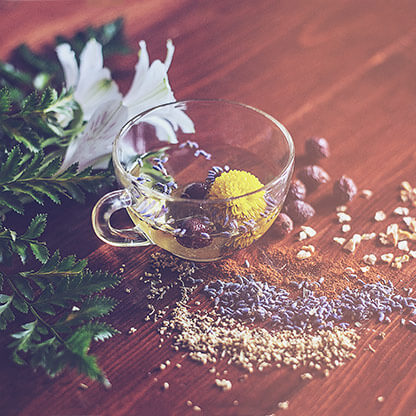
- TCM: Start the day with a tea made from chrysanthemum blossoms and goji berries.
- Good to know: Chrysanthemenblüten werden in der TCM traditionell für klare, kühle Augen geschätzt.
- Practical: Pour hot water over 5-6 chrysanthemum blossoms + 1 tbsp goji. Leave to infuse for 5 minutes.
🆘 BEI AKUTEN BESCHWERDEN
- TCM: Acupressure point Tue 20 (neben den Nasenflügeln) gilt als klassischer Punkt, um die Nase zu öffnen.
- Good to know: Auch LI 04 an der Hand wird in der TCM zusammen mit LI 20 traditionell für die Nase genutzt.
- Practical: Beide Punkte 60–90 Sekunden massieren.
🌙 ABEND–RITUAL
- TCM: Kühle Chrysanthemen–Kompresse auf die Augen.
- Good to know: Die Kühle tut gereizten, müden Augen einfach gut.
- Practical: Allow the chrysanthemum infusion to cool, soak cotton pads and place on the eyes for 10-15 minutes.
Die drei Schlüssel: Leber, Lunge und Milz
The Yellow Emperor: „Ihr habt mir gezeigt, wie ich den Wächter im Moment beruhigen kann. Aber was ist mit der Wurzel? Warum ist der Wächter bei manchen Menschen so überempfindlich?“
Qi Bo: „Majesty, the answer lies in three organ systems. The liver, the lungs and the spleen - when these three harmonize, the wind bounces off like rain on an oiled umbrella.“
Dr. Weber: „Das ist bemerkenswert stimmig! Die Leber ist am Histamin–Abbau beteiligt. Die Lunge steht für die Schleimhäute — unsere erste Verteidigungslinie. Und der Darm, den die TCM der Milz zuordnet, beherbergt einen großen Teil unseres Immunsystems.“
Qi Bo: „And every person has a different imbalance. One person's eyes burn and they are irritable - that's liver heat. Another person has a runny nose and is cold - that's lung weakness. In the third, the head is heavy and the nose is blocked - that's spleen dampness.“
The Yellow Emperor: „Also gibt es nicht DEN einen Weg für alle?“
Dr. Weber: „Genau. Die Beschwerden sind ähnlich, aber der Hintergrund ist bei jedem individuell.“
Qi Bo: „Wer seine Wurzel kennt, findet seinen Weg. Die Zusammenhänge sind zu vielschichtig für ein einziges Gespräch, Majestät. Wir haben sie deshalb ausführlich niedergeschrieben — mit einem Selbsttest für das persönliche Muster, den fünf Säulen und den wichtigsten Akupressur–Punkten.“
Wisdom to take away
The Yellow Emperor: „So an allergy is not fate, but an imbalance?“
Qi Bo: „So ist es, Majestät. Der Körper hat verlernt, Freund von Feind zu unterscheiden. Unsere Aufgabe ist nicht, den ‚Feind‘ zu bekämpfen — Pollen werden immer fliegen. Unsere Aufgabe ist, den Wächter zu schulen.“
Dr. Weber: „Und das Schöne ist: Das Immunsystem ist formbar. Mit Geduld und den richtigen Gewohnheiten lässt sich viel bewegen. Nicht über Nacht, aber Schritt für Schritt.“
The Yellow Emperor: „Then may the wind blow gently and the Wei-Qi be strong. Spring is too beautiful to miss!“
Preview April
The Yellow Emperor: „Im April widmen wir uns der Frühlingszeit — wie der Körper nach dem Winter wieder in Schwung kommt.“
Qi Bo: „We will talk about the liver - the great cleansing organ of TCM.“
Dr. Weber: „Ich erkläre, was im Körper passiert, wenn wir ihm nach dem Winter etwas Gutes tun.“
About our „3 Wise Men“ story
Who are the Yellow Emperor and Qi Bo?
The Yellow Emperor (Huangdi, 黄帝) is said to have lived around 2600 BC and is regarded as the mythical founder of Chinese culture and medicine. Qi Bo was his most important advisor and personal physician. Their discussions about health, illness and human nature were recorded in the most important fundamental work of TCM.
The book: Huangdi Neijing
The „Huangdi Neijing“ (黄帝内经), also known as „The Yellow Emperor - The Fundamental Work of Traditional Chinese Medicine“, was probably written between 200 BC and 200 AD. It is the oldest surviving work of Chinese medicine and consists of dialogues between the Yellow Emperor and his advisors - mainly Qi Bo.
This work is to TCM what the Bible is to Christianity: the absolute foundation. All the important concepts - yin and yang, the 5 elements, qi, meridians and acupuncture points - are systematically described here for the first time.
Our modern approach: The 3 wise men
In our series „The 3 Sages“, we bring the Yellow Emperor and Qi Bo together with the fictional modern doctor and microbiologist Dr. Weber.
Important note: All three characters and their conversations are purely fictitious and invented by us.
We use this narrative form, similar to the dialog form in the book Huangdi Neijing, to convey the often complex relationships of TCM in an understandable and entertaining way. When the 4000-year-old emperor is confronted with modern science, enlightening „aha moments“ arise which show that ancient wisdom and new research often speak the same language: Ancient wisdom and new research often speak the same language - just in different words.
This makes TCM lively, understandable and practically applicable for your everyday life.
The dialogs are creative interpretations - not historical documents. For medical questions, please consult a qualified TCM therapist or doctor.
„The wise doctor treats before the disease breaks out.“
- Huang Di Nei Jing
More interesting tips & articles

TCM tip of the week
Der Herbst entscheidet, wie du durch den Winter kommst
Wird die Luft im Herbst trocken, koch dir etwas Weißes. Birne, Mandel und Rettich tun deiner Lunge gerade jetzt etwas Gutes…
Aug

TCM tip of the week
Warum Loslassen im Kopf nicht funktioniert
Irgendwann an diesem Tag hat dein Körper beschlossen, dass es gefährlich wird. Die Schultern gingen nach oben, der Nacken wurde hart…
Aug






Our most popular products





Back pain