




How TCM herbal blends are formulated
What an orchestra has in common with a herbal remedy
Emperor, Minister, Assistant, Messenger—every TCM herbal formula follows a clear compositional logic.
This is exactly how the herbal blends used in Traditional Chinese Medicine work.
A TCM formula is not a haphazard collection of medicinal plants that were thrown together at some point simply because they seemed useful when considered individually. It is a carefully thought-out composition in which each herb plays a specific role. These roles were systematized over two thousand years ago and still form the foundation of every classical formula today.
Traditional Chinese medicine calls this principle Jun–Chen–Zuo–Shi (君臣佐使) — translated as: Emperor, Minister, Assistant, Messenger. Four hierarchical levels that, when combined, produce an effect that none of the individual herbs could achieve on its own.
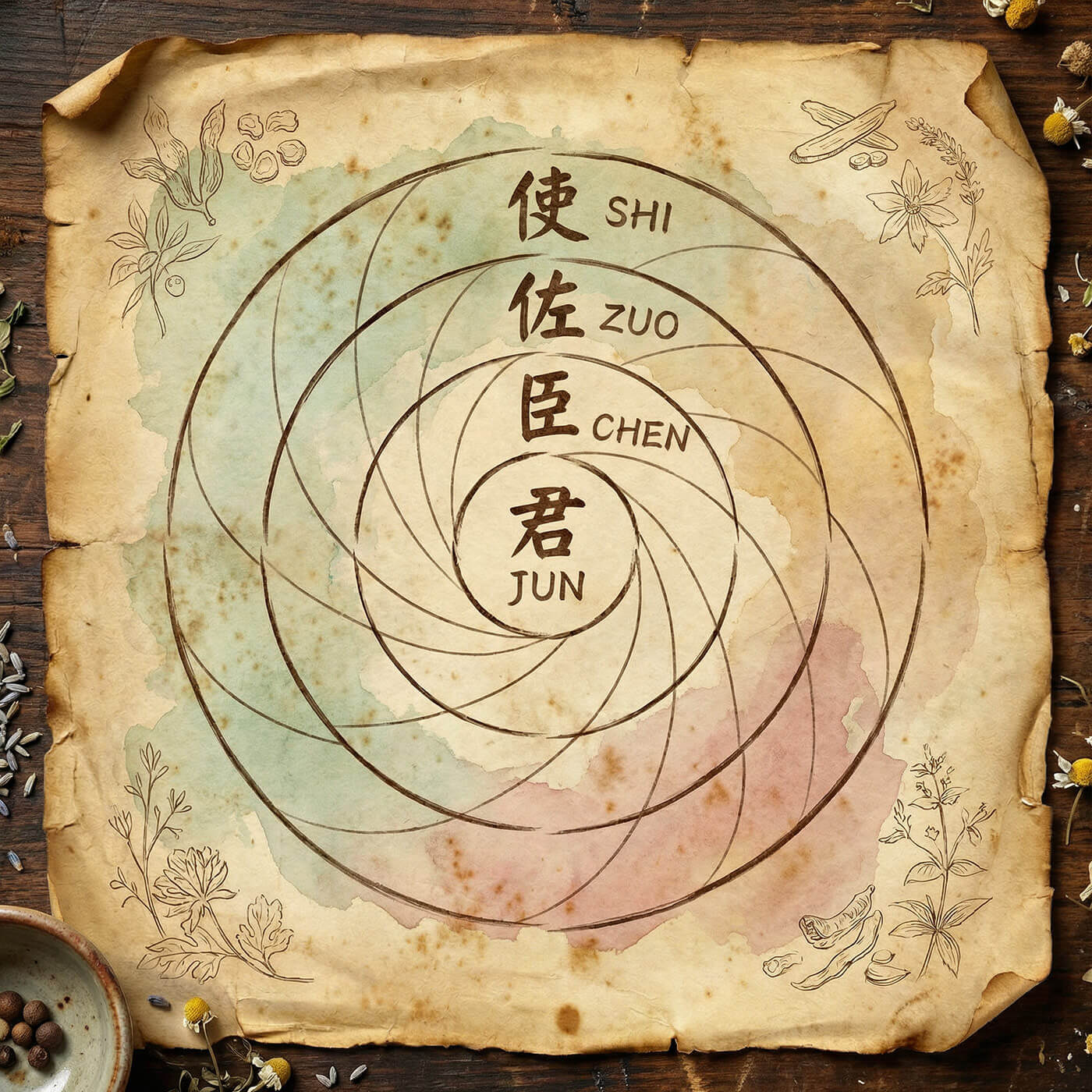
Emperor, minister, assistant, messenger.
Four hierarchical levels that work together to produce an effect
Four roles, one goal
Jun (君) — The Emperor
Every formula has a central theme: the primary set of symptoms it is designed to address. The herb responsible for this primary effect is the “Kaiser”—in orchestral terms, the first violin that sets the melody.
The "Kaiser" makes up the largest proportion of the mixture. It determines the therapeutic direction. Without it, the formula loses its purpose, just as a concert without a melody would be nothing more than a wall of sound. In some simple formulas, there is only a single Emperor herb. In more complex mixtures, there may be two—but never more, because a composition needs clear leadership.
Chen (臣) — The Minister
The minister supports the emperor directly. He reinforces the emperor’s influence or complements it from a second angle—like the second violin, which picks up the melody played by the first, harmoniously underscores it, and lends it depth.
The minister often addresses a closely related accompanying symptom. For example, if the emperor is supposed to calm the mind, the minister ensures that the underlying restlessness finds a physical outlet as well. The minister and the emperor work as a unit, but the minister never takes the lead.
Zuo (佐) — The Assistant
The assistant is the most versatile role in a composition—comparable to the viola section, the woodwinds, or the entire middle section of an orchestra. Classical TCM literature distinguishes three functions that an assistant can perform:
Supporting Assistant (佐助, Zuo Zhu): Further enhances the effects of the Emperor and Minister, often in relation to a secondary symptom or a specific area of the body.
Correcting Assistant (佐制, Zuo Zhi): Alleviates potential side effects of the imperial herb. While the imperial herb has a strong warming effect, this corrective assistant provides a mildly cooling counterbalance. It prevents the primary effect from becoming excessive.
Opposing Assistant (Fan Zuo): This is the most subtle concept in the entire field of herbal formula design. Sometimes an herb is included that appears to have the opposite effect—a small dose of warmth in a cooling formula, for example. Not to sabotage the effect, but to prevent the body from resisting the treatment. In music, this is known as dissonance that resolves into harmony: a brief contradiction that makes the whole stronger.
Shi (使) — The Messenger
The messenger has two tasks: It directs the effects of the entire mixture to the right place in the body—much like a conductor who ensures that all the voices come together and sound at the right moment. And it harmonizes the herbs with one another so that they do not interfere with each other.
Two herbs appear particularly frequently in this role: Gan Cao (Licorice), licorice root) and Sheng Jiang (Ginger, fresh ginger). Gan Cao is arguably the most commonly used herb in all of TCM pharmacology. It is found in the vast majority of classical formulas—not because it has a strong effect on its own, but because it acts as a binding agent, holding the other herbs together and improving their tolerability.
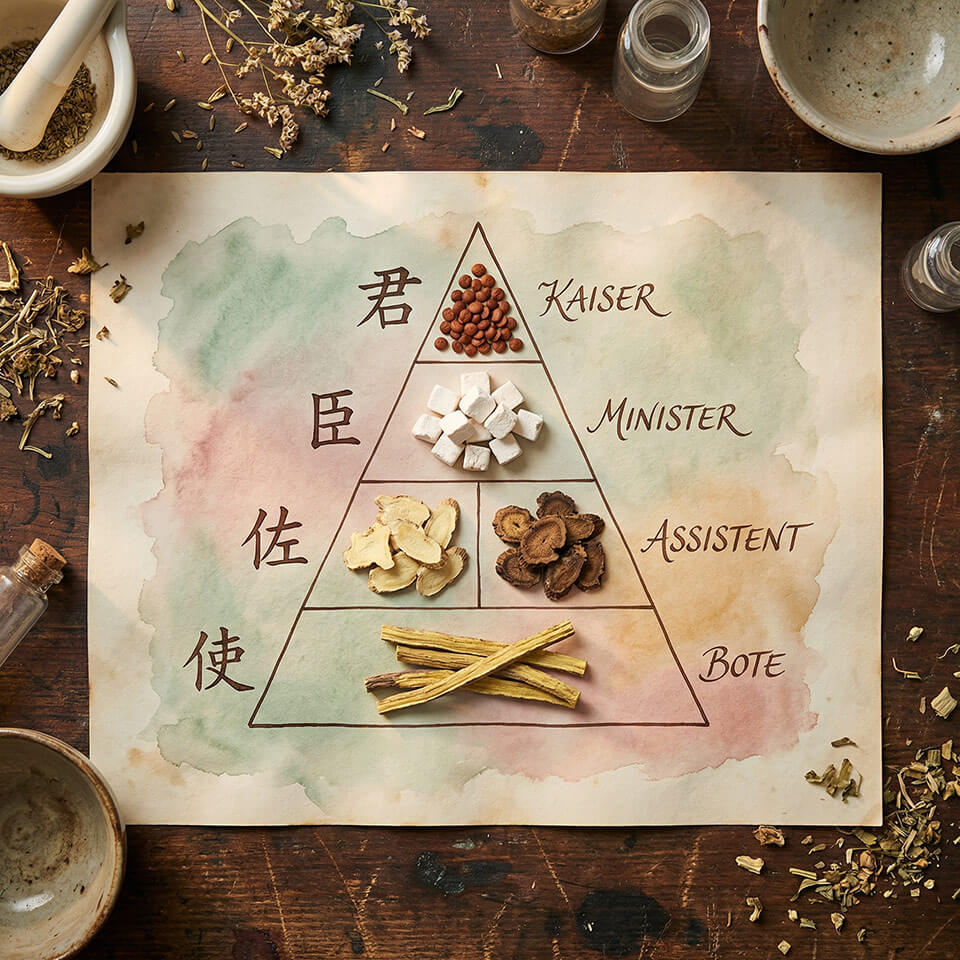
The Role of Herbs in the Suan Zao Ren Tang Formula
It's all in the dose
An important detail that is often overlooked: the same herb can play completely different roles in different formulations. What serves as the primary active ingredient in one mixture may act as a modest supporting ingredient in another. The role is not determined by the herb itself, but by its proportion by volume and his Function in context of the respective recipe.
It’s as if the same violinist were playing first violin in a string quartet and sitting in the second row in a large orchestral work. Her skill remains the same—but her role changes with the score.
This principle makes TCM’s theory of formula composition remarkably flexible. With a relatively manageable repertoire of a few hundred herbs, it is possible to create thousands of different formulas, each tailored to a specific pattern.
A Look at the Score — Suan Zao Ren Tang
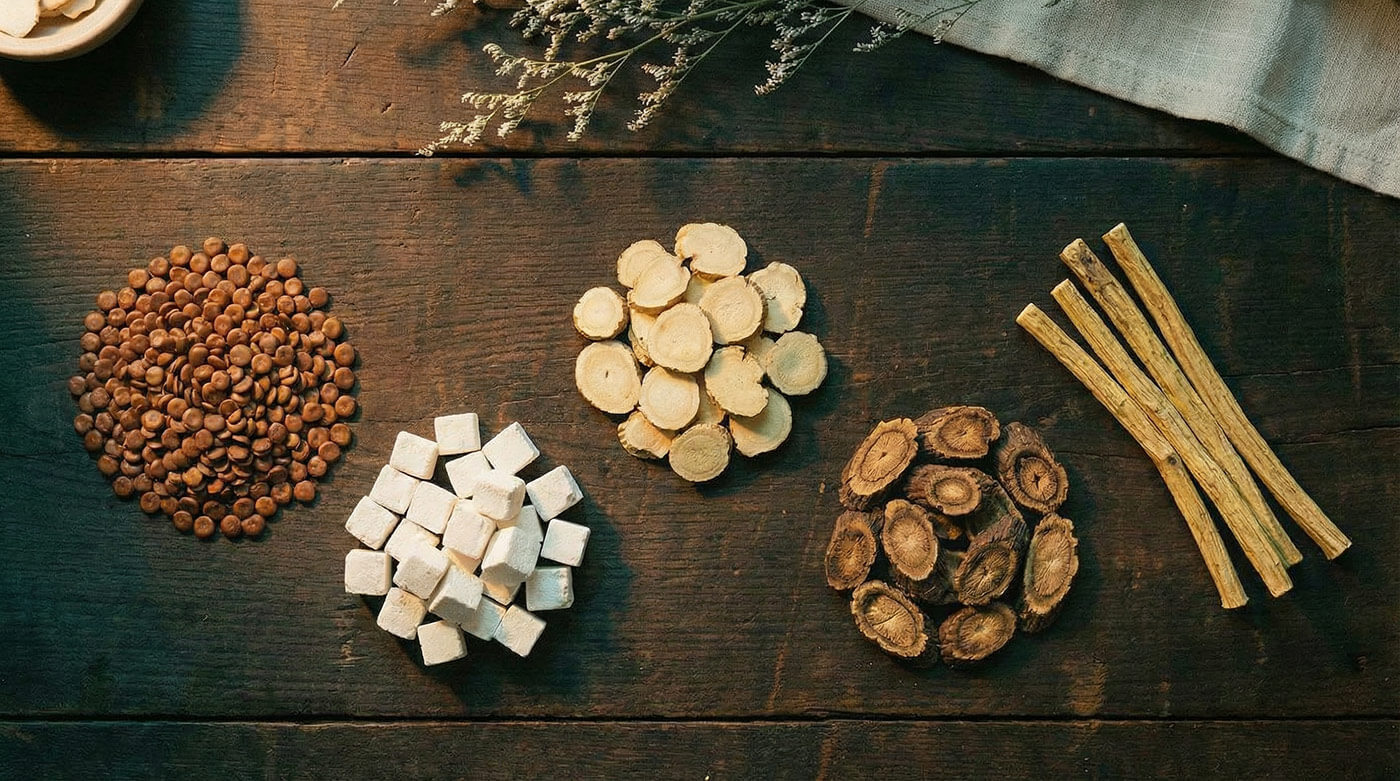
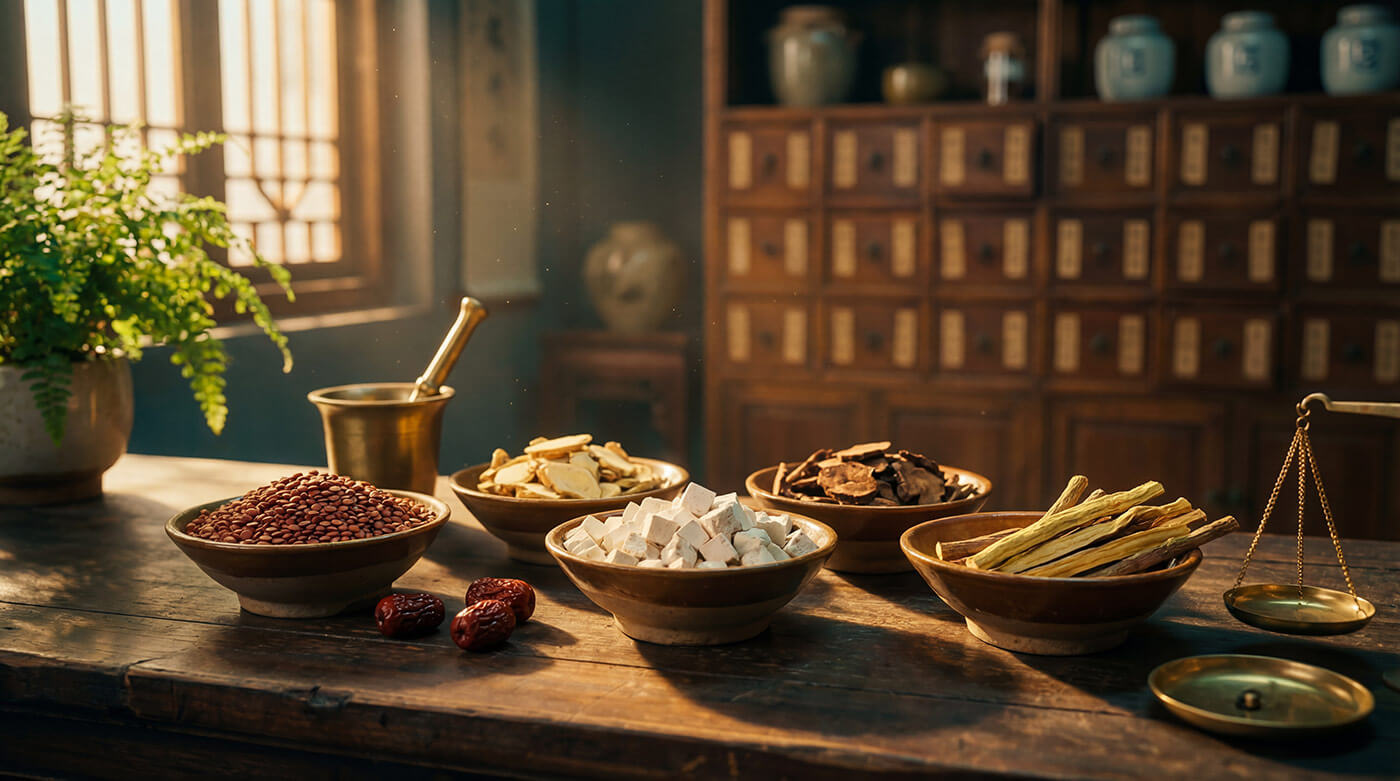
Left → Right:
Jujube seeds (reddish-brown) ◆ Poria cubes (white) ◆ Rhizome slices (light yellow) ◆ Root slices (dark brown) ◆ Licorice sticks (yellowish)
Theory only becomes tangible when it can be understood through a concrete example. Let’s consider one of the most elegant and oldest formulas in Chinese medicine: Suan Zao Ren Tang (Suanzaoren Tang) — the „Prickly Jujube Decoction“.
🍵 What is a decoction—and why is it called „Tang“?
Anyone who has ever wondered why so many traditional recipes are based on Tang (湯) ends: The word simply means "soup" or "broth"—thus revealing how it was originally prepared.
Dried herbs are boiled in water, strained, and drunk warm. That is exactly what a decoction is. Suan Zao Ren Tang has thus been taken as a decoction for nearly two millennia—ideally in the evening, just before bedtime.
Not all formulas are decoctions. TCM also recognizes Wan (丸) — Pills made by shaping herbal powder into small balls using honey or wax.
San (散) refers to a fine powder that is taken directly or brewed in hot water.
And Dan (丹) refers to highly concentrated pills, often containing mineral ingredients.
Modern TCM granules combine the following benefits: Die Kräuter werden wie im klassischen Dekokt ausgezogen, der Auszug dann zu einem feinen Granulat getrocknet. Die Zusammensetzung des Originals bleibt dabei erhalten — ohne täglich Kräuter kochen zu müssen.
The Story
The recipe comes from the Jin Gui Yao Lue (金匮要略), the „Essential Prescriptions from the Golden Chamber.“ This text was written by the physician Zhang Zhongjing (Zhang Zhongjing), who lived from around 150 to 219 CE during the late Han Dynasty and is still regarded today as one of the most influential physicians in Chinese history.
Zhang Zhongjing practiced medicine during a time of great upheaval. Epidemics decimated large segments of the population—according to reports, he himself lost numerous family members within a few years. This experience drove him to systematically compile and review the medical traditions of his time and to compile them into two works: the Shang Han Lun (on febrile diseases caused by cold) and the *Jin Gui Yao Lue* (on internal diseases). Together, they form the foundation of clinical TCM practice.
The Role of Herbs in the Suan Zao Ren Tang Formula
What makes Zhang Zhongjing's work so special is that he not only documented formulas, but also, for the first time, systematically described, for which specific symptoms he intended them to be used for. He designed Suan Zao Ren Tang for people suffering from insomnia, inner restlessness, and night sweats—a condition that TCM refers to as Exhaustion of vital energy accompanied by internal heat describes.
Nearly 1,800 years later, the recipe is still used in virtually the same form. Not out of a sense of tradition for tradition’s sake, but because the logic behind its composition is so precise that it has stood the test of time over the centuries.
The Five Herbs and Their Roles
Suan Zao Ren Tang consists of just five ingredients. This makes it a particularly clear example—each ingredient has a clearly defined role, and there is nothing superfluous in this formula.
The Emperor: Suan Zao Ren (酸枣仁) — Prickly jujube seeds
Comprising 40 percent of the total blend, Suan Zao Ren is the undisputed king. According to TCM principles, the herb nourishes the heart blood and calms the Shen—the spirit that, according to classical teachings, resides in the heart and finds peace only when sufficiently nourished there. Suan Zao Ren sets the overall therapeutic direction: to calm, nourish, and promote sleep.
The Minister: Fu Ling (茯苓) — Poria mushroom
Fu Ling supports the Emperor on two levels. On the one hand, it also calms the mind—thus reinforcing the main effect. On the other hand, it drains dampness and strengthens the Middle (the digestive system). This is important because, according to TCM, a weakened center can produce less blood—precisely the blood that the Emperor so urgently wants to build up. The Minister thus ensures that the basic prerequisite for the Emperor’s effect is met in the first place.
The Auxiliary Herbs: Zhi Mu (知母) and Chuan Xiong (川芎)
This is where the composition becomes particularly elegant.
Zhi Mu (Anemarrhena rhizome) is a cooling, yin-nourishing herb. It addresses the internal heat that often arises with heart blood deficiency: When there is too little „cooling“ blood, signs of deficiency heat become apparent—night sweats, irritability, and a feeling of inner restlessness. Zhi Mu intercepts this heat and prevents it from disrupting sleep. As a corrective assistant, it ensures that the nourishing effect of the Emperor is not negated by uncontrolled heat.
Chuan Xiong (Szechuan lovage) is surprising at first glance. It is an herb that moves blood and qi—that is, it stimulates rather than calms. In a formula for insomnia? This is precisely where the depth of the formula’s logic becomes apparent: when blood stagnates, it cannot flow where it is needed—namely, to the heart, to nourish the spirit. Chuan Xiong ensures free flow. It is the supportive assistant that removes an obstacle that would otherwise block the entire effect. In the orchestral metaphor: the brief wind motif that creates a transition and makes the melody possible in the first place.
The Messenger: Gan Cao (甘草) — Licorice Root
Gan Cao harmonizes the formula and ensures that its various actions—nourishing, cooling, moving, and calming—do not work against one another, but instead come together to form a coherent whole. At the same time, it strengthens the middle jiao and thereby indirectly supports blood production.
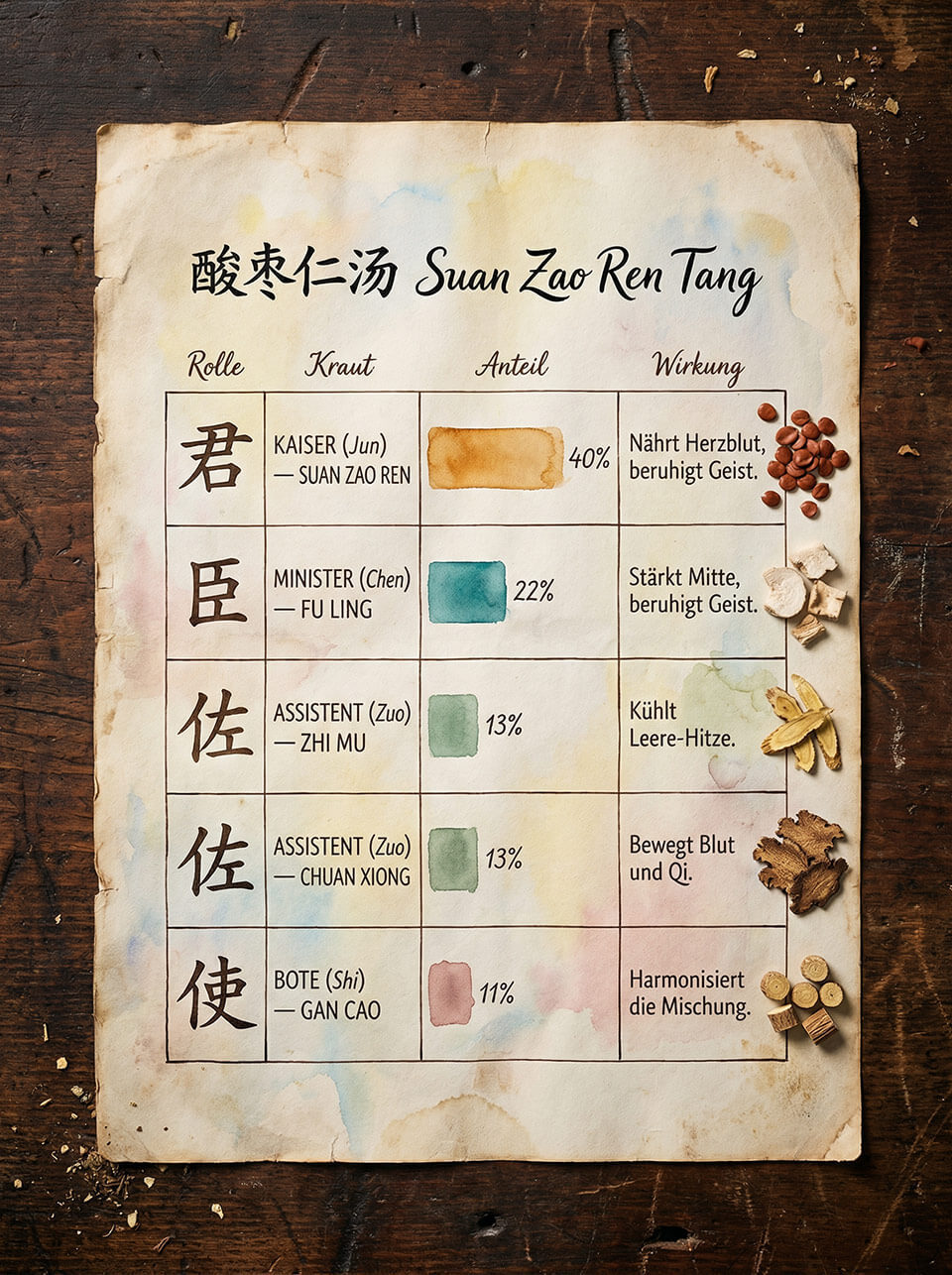
The Role of Herbs in the Suan Zao Ren Tang Formula
The composition as a whole
What happens when you listen to these five voices together?
One herb nourishes the vital blood (Emperor). One herb strengthens the foundation upon which blood is formed and also calms the mind (Minister). One herb cools the empty heat that robs one of sleep (Assistant). One herb ensures that the blood can actually flow (Assistant). And one herb holds everything together (Messenger).
No ingredient is superfluous. No ingredient acts in isolation. Each of the five herbs addresses a different aspect of the same problem—and only when combined do they produce the effect for which Suan Zao Ren Tang has been known for nearly two millennia.
Why single herbs are rarely the answer
This principle of formulation also explains why TCM generally does not use single herbs. A single imperial herb—such as Suan Zao Ren without the other four—would indeed have the desired effect, but it would lack context: the correction provided by the assistant, the reinforcement provided by the minister, and the harmonization provided by the messenger.
It would be like asking a violinist to perform a string quartet all by herself. She plays her part perfectly—but the harmony, the tension, and the resolution that arise only through ensemble playing are missing.
This does not mean that individual herbs are ineffective. Some TCM herbs are certainly used on their own, usually in the form of simple teas or soups in dietary therapy. However, for more complex conditions, TCM relies on time-tested formulas based on the Jun-Chen-Zuo-Shi principle—compositions that have been documented, refined, and used clinically for centuries or even millennia.
More than just a historical curiosity
At first glance, the formulation logic of TCM may seem like a relic of the past. But the opposite is true. Modern research increasingly shows that the multi-component logic of herbal mixtures makes perfect pharmacological sense: individual ingredients can influence each other’s bioavailability, mitigate side effects, or enhance them synergistically.
The ancient masters, such as Zhang Zhongjing, had no laboratories and no molecular analysis. What they did have was systematic clinical observation spanning generations—and a principle of formulation that takes into account precisely those interactions that we are only now beginning to understand scientifically.
All mixtures follow this principle
Jede TCM–Kräutermischung, die dir begegnet — ob klassische Rezepturen nach den Texten von Zhang Zhongjing, bewährte Formeln aus der Song– oder Ming–Dynastie oder moderne Adaptionen erfahrener TCM–Ärzte — ist nach dem Jun–Chen–Zuo–Shi–Prinzip aufgebaut. Wenn du das nächste Mal die Zutatenliste einer Kräutermischung liest, weißt du: Der Inhaltsstoff mit dem höchsten Anteil ist der Kaiser. Und jedes weitere Kraut steht nicht zufällig dort, sondern spielt seine genau zugewiesene Rolle in der Komposition.
Dieser Artikel dient der Information über die Grundlagen der TCM–Kompositionslehre. Er ersetzt keine individuelle Beratung durch einen qualifizierten TCM–Therapeuten oder Arzt.
What treats the main illness is called the emperor; what assists the emperor is called the minister; what responds to the minister is called the messenger.
— From the Huang Di Nei Jing (Su Wen, Chapter 74)
„The primary disease is called the sovereign; the disease that assists the sovereign is called the minister; the disease that responds to the minister is called
More interesting tips & articles

TCM tip of the week
The Autumn Regimen: The Lungs and Large Intestine in the Metal Element
Anyone who waits until they're already thirsty to dig a well has waited too long—that's what the oldest textbook says…
Sep

TCM tip of the week
Kick Off Fall the Right Way
Between the first cool evening and the first frost, your body adjusts from summer to winter and is more vulnerable during that time…
Sep