








Grief in Chinese medicine
When the metal won't let go

Trauer ist kein Ende. Sie ist der stille Raum, in dem Neues atmen lernt.
Grief from the TCM perspective
In Chinese medicine, grief is not a psychological disorder,
but a emotional movementwhich is dedicated to the Metal element is assigned. This element stands for Structure, clarity, demarcation - and letting go.
The associated organ energy is the Lung (Fei). It receives what is fresh - and gives back what has been used up. It is the organ of exchange, of farewell and of dignity.
Grief belongs to the lungs,
because it is one of the few emotions that is not discharged outwardly,
but sinks inwards.
Grief contracts the Qi.
It slows, constricts, holds.
And that is precisely its essence.
⚖️ What happens when grief blocks?
When grief cannot be felt or expressed
for example because it is suppressed, rationalized or functionalized - in TCM this leads to a Stagnation of the lung qi.
Typical signs are
- Tightness in the chest
- shallow breathing, frequent sighing
- Emotional emptiness, withdrawal, inner pressure
- innere Trockenheit, Reizbarkeit, Spannungsgefühl
- das Gefühl, weniger widerstandsfähig zu sein
- Crying without access to emotion
The lungs can then no longer fulfill their regulatory function:
The Qi rises instead of sinking.
Das Abwehr–Qi (Wei Qi) wird schwächer.
The rhythm of life - inhale and exhale -
gets out of sync.
TCM then says:
„Das Lungen–Qi ist blockiert — und kann nicht absteigen.“
🫁 The metal functional circuit: lungs, large intestine, skin
Not only the lungs and breath work in the metal element. It also includes the large intestine (fu organ) and skin.
When grief blocks the metal, this can also manifest itself as:
— das Gefühl, nicht loslassen zu können
— trockene, empfindliche Haut
— ein gedämpfter Geruchssinn
— flacher Atem, Engegefühl im Brustraum
— der Wunsch nach Kontrolle oder rigide Denkweisen
— unruhiger Schlaf in den frühen Morgenstunden (3–5 Uhr)
The lungs are the organ that regulates the transition -
between inside and outside, between holding and giving.
🧘♀️ What brings grief back into motion
Chinese medicine does not offer short-term emotional therapy -
but it understands the body as a resonance chamber for everything that we (do not) process.
💠 Qi gong exercise - opening the cloud gates
→ Expands the chest, opens the upper Jiao, activates the lung Qi
„Ich öffne Raum für meine Trauer.“
„Ich lasse los, was gehen will.“
👉 To the exercise instructions:
www.meine-tcm.com/qi-gong-uebung-wolkentore-oeffnen
✨ Acupressure point - LUNG 1 (Zhōng Fǔ)
- Opens the chest, releases congested Qi, regulates the breath
— Besonders angenehm bei emotionaler Enge und Zurückhaltung
👇 Instructions here:
www.meine-tcm.com/akupunkturpunkte/akupunkturpunkt-lu-01
🌿 Further TCM tips for grief
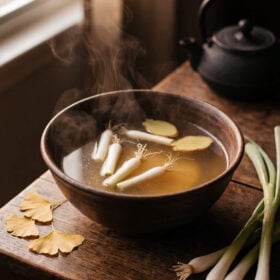
- Hot drinks & soups: relieve the lungs, strengthen the center.
- Prolong breathing: doppelt so lange ausatmen wie einatmen; der lösende Laut „Sssss…“ hilft, Spannung abzugeben.
- Nature contact: Walks in the fall, conscious breathing under trees clears the Qi.
- Letting go rituals: Kerze anzünden, Gedanken aufschreiben & verbrennen, Abendritual mit Atemzügen für „Loslassen“ und „Aufnehmen“.
- Fragrances & herbs: Myrtle, cypress or eucalyptus open the breath; mild herbal teas (e.g. thyme tea, lime blossom tea) nourish the lung yin.
🔎 What your tongue tells you
Die Zunge ist in der TCM ein Spiegel deiner inneren Energie —
The tip of the tongue and the front third in particular provide information about the lung Qi.
Typical signs of grief stagnation:
- Pale, dry tongue
- fine cracks in the front third
- White, thin or missing coating
- Trembling tongue or sunken shape (in case of exhaustion)
🎥 Watch our video on tongue diagnosis:
www.youtube.com/watch?v=L-cOXGvci1Y
🧭 Your free TCM analysis
Grief can be given space - even without an explanation, even without a goal.
TCM helps you to feel:
Where are you holding on?
What would like to be honored -
and what should be adopted?
👉 Do your TCM analysis now: www.meine-tcm.com/tcm-analyse
🌙 When grief comes in the night
Between 3-5 o'clock is the time of the lungs.
Wenn du dann aufwachst, unruhig bist oder nicht tief atmest,
often shows a disturbed Qi circulation in the metal.
www.youtube.com/watch?v=8AaPLMEs4Wk
✨ Conclusion
Grief is not a disorder. It is an expression of depth.
Chinese medicine does not ask,
how to get rid of your grief -
but: Was brauchst du, um wieder frei atmen zu können?
When the metal breathes again,
the heart can open up again.
Die TCM fragt nicht, wie du die Trauer loswirst.
Sie fragt: Was möchte gewürdigt werden?
Author: Unknown
More interesting tips & articles
TCM tip of the week
Kaum ist es geschafft, liegst du flach
Wochenlang hältst du durch, und kaum ist der Umzug oder das Projekt geschafft, kratzt der Hals. Warum die Abwehr ausgerechnet in…
Oct

TCM tip of the week
Warum du im Herbst öfter seufzt
Manchmal seufzt du, ohne zu wissen, warum. Es ist, als wollte etwas heraus, das du nie ausgesprochen hast. Das ganze Jahr…
Sep

Sep


Our most popular products





Back pain