






Stay cold-free through winter — How to activate your invisible protective shield
Ask the Yellow Emperor

Qí Bó | Dr. Weber | The Yellow Emperor Huangdi
The Yellow Emperor: „Qi Bo, I notice this every year: Some people get through the winter in great shape. Others feel constantly under the weather. Is there an explanation for this?“
Qi Bo: „Your Majesty, this concept is ancient—and it has a name: Wei–Qi. Imagine that your body is surrounded by an invisible protective shield. Like a warm cloud circulating just beneath your skin. If this shield is strong, the cold and wind bounce off it. If it is weak, they find their way in.“
Dr. Weber: „Qi Bo, that reminds me of our understanding of the body’s natural defenses. The first line of defense: the skin and mucous membranes. They react immediately when something comes from the outside.“
The Yellow Emperor: „So the same observation, just formulated 4,000 years apart?“
Qi Bo: „The truth about the body does not change, Your Majesty. Only the words we use to describe it.“
The armor with holes
The Yellow Emperor: „Okay, but why is this protective shield weak in so many people?“
Qi Bo: „Wei-Qi is governed by the lungs and nourished by the spleen. During the cold season, two forces clash: external cold presses in from the outside, and the internal Yang—our source of warmth—is often depleted. Weakened Wei–Qi is like armor full of holes. The wind whistles through the gaps.“
Dr. Weber: „From a Western perspective, this makes sense. In winter, we produce less vitamin D due to the lack of sunlight. Our mucous membranes dry out from the heated air. And when it’s cold, blood flow to the nose decreases—especially in the areas where we’re most sensitive.“
The Yellow Emperor: „And modern life makes it even worse, I suppose?“
Dr. Weber: „Yes. Lack of sleep noticeably weakens the immune system—even just one bad night's sleep makes a difference. Chronic stress and too much sugar aren't good for it either.“
Qi Bo: „In TCM, we say: Too much sweetness weakens the spleen. A weak spleen cannot produce strong Wei Qi. Modern people eat sweet foods, sleep little, and rush through the day. No wonder their protective shield has holes in it.“
The Yellow Emperor: „So the weakness isn't just coming from the outside?“
Qi Bo: „No, Your Majesty. The wind can only get in if the door is open from the inside.“
The three pillars of defense
The Yellow Emperor: „Enough analysis! People need solutions. How can we strengthen this protective shield?“
Qi Bo: „Three pillars, Your Majesty: build warmth from within, strengthen the center, and activate the Wei-Qi daily.“
Dr. Weber: „Perfect. I'll add what fits in from a Western perspective. Let's come up with a practical plan.“
The Yellow Emperor: „Then let's begin. What do people need in the morning, during the day, and in the evening?“
🛡️ The 3-way method for a strong defense
🌅 TOMORROW PROTOCOL (activate Wei-Qi)
TCM: A warm breakfast awakens the spleen and stimulates the Wei-Qi. Never eat cold food in the morning—it extinguishes the digestive fire!
Science: A hot breakfast with complex carbohydrates stabilizes blood sugar and provides a steady supply of energy for the morning. Cold foods require more energy to digest.
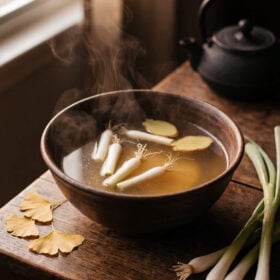
Practical: Warm oatmeal with cinnamon, walnuts, and stewed apple. Served with ginger tea: pour hot water over 3 slices of fresh ginger and let steep for 10 minutes.
🌞 TAGS STRATEGY (strengthen protective shield)
TCM: Acupressure point Stomach 36 (Zusanli) is a classic acupoint for strengthening Qi and Wei-Qi. The ancient masters said, „Massage Zusanli every day, and you will live to be a hundred years old.“
Science: Acupressure on this point has long been used to strengthen and ground the body, and it is pleasantly invigorating.
Practical: Four finger widths below the kneecap, on the outside next to the shinbone. Massage in a circular motion for 2 minutes twice a day — in the morning and in the afternoon.
🌙 EVENING RITUAL (ensure regeneration)
TCM: During sleep, the Wei Qi retreats into the body and regenerates. Eating too late disrupts this process. Going to bed too late depletes the Yin.
Science: The body regenerates most effectively during deep sleep. The release of growth hormones—which are important for cell renewal—peaks in the early hours of the night.
Practical: Last meal 3 hours before bedtime. A warm foot bath with fresh ginger (15 min.) directs energy downward and promotes deep, restful sleep.
The insider tip of the old masters
Qi Bo: „There is a point that the ancient masters called the ‚Sea of Qi‘—" Concept vessel 6, about three finger widths below the navel. It is called Qi Hai.“
The Yellow Emperor: „And what does it do?“
Qi Bo: „In TCM, it is considered a kind of heat center of the body. Heat is distributed from this point. Warming this point daily strengthens one’s Yang—and thus also the Wei-Qi. The imperial physicians recommended this to anyone prone to feeling cold and weak.“
Dr. Weber: „From a Western perspective, heat in this area is simply soothing: it promotes blood circulation and relaxes the abdomen.“
The Yellow Emperor: „So just warm your stomach?“
Qi Bo: „Sometimes it's that simple, Your Majesty. A hot water bottle on the lower abdomen for 20 minutes — every evening before bedtime. The effect unfolds over weeks.“
Dr. Weber: „A lovely ritual—people with cold feet, in particular, find it very pleasant.“
Instant check for tonight
- Have you been feeling run down or getting tired easily lately?
- Are your hands and feet often cold—especially in the evening?
- Do you sleep less than 7 hours per night?
TODAY you can: Place a hot water bottle on your lower abdomen (20 min.) and soak your feet in warm water with 3 slices of ginger. A soothing, warming ritual for the evening.
📊 Your 14-Day Well-Being Challenge
BEFORE the 3-wise method:
How often do you feel cold during the day? ___
Sleep quality (1-10): ___
Energy level in the afternoon (1–10): ___
Overall well-being (1–10): ___
AFTER 14 days:
How often do you feel cold during the day? ___
Sleep quality (1-10): ___
Energy level in the afternoon (1–10): ___
Overall well-being (1–10): ___
Wisdom to take away
The Yellow Emperor: „Let's summarize: Wei-Qi is our invisible protective shield. We can strengthen it every day — with warmth, good food, and rest.“
Qi Bo: „That is correct, Your Majesty. The wind can only find its way in when one’s inner balance is disrupted. Those who warm their core, nourish their qi, and rest at the right time build a protective shield that no wind can easily penetrate.“
Dr. Weber: „And from a Western perspective, it all fits together nicely: sleep, nutrition, and reduced stress are the three pillars of a strong immune system. Combined with TCM rituals—acupressure, heat, and mindful eating—this creates a wonderful holistic approach.“
The Yellow Emperor: „Then everyone can do something to build their own shield.“
Qi Bo: „One last word, Your Majesty: The best time to strengthen the Wei–Qi is not in the midst of it—but long before.“
The Yellow Emperor: „Take care of your defenses long before winter takes its toll. That’s what the old masters taught. Stay warm, stay alert, stay strong!“
Preview:
The Yellow Emperor: „Next month, we'll be focusing on spring fatigue — when your body is stuck between winter and spring.“
Qi Bo: „We will talk about the awakening of liver qi and why this transition period is so crucial.“
Dr. Weber: „I explain what melatonin and serotonin have to do with it — and why so many people are exhausted at precisely this time.“
The Yellow Emperor: „Until then—may your shield be strong and your defenses vigilant!“
About our „3 Wise Men“ story
Who are the Yellow Emperor and Qi Bo?
The Yellow Emperor (Huangdi, 黄帝) is said to have lived around 2600 BC and is regarded as the mythical founder of Chinese culture and medicine. Qi Bo was his most important advisor and personal physician. Their discussions about health, illness and human nature were recorded in the most important fundamental work of TCM.
The book: Huangdi Neijing
The „Huangdi Neijing“ (黄帝内经), also known as „The Yellow Emperor - The Fundamental Work of Traditional Chinese Medicine“, was probably written between 200 BC and 200 AD. It is the oldest surviving work of Chinese medicine and consists of dialogues between the Yellow Emperor and his advisors - mainly Qi Bo.
This work is to TCM what the Bible is to Christianity: the absolute foundation. All the important concepts - yin and yang, the 5 elements, qi, meridians and acupuncture points - are systematically described here for the first time.
Our modern approach: The 3 wise men
In our series „The 3 Sages“, we bring the Yellow Emperor and Qi Bo together with the fictional modern doctor and microbiologist Dr. Weber.
Important note: All three characters and their conversations are purely fictitious and invented by us.
We use this narrative form, similar to the dialog form in the book Huangdi Neijing, to convey the often complex relationships of TCM in an understandable and entertaining way. When the 4000-year-old emperor is confronted with modern science, enlightening „aha moments“ arise which show that ancient wisdom and new research often speak the same language: Ancient wisdom and new research often speak the same language - just in different words.
This makes TCM lively, understandable and practically applicable for your everyday life.
The dialogs are creative interpretations - not historical documents. For medical questions, please consult a qualified TCM therapist or doctor.
Staying warm from the inside is the best way to stay healthy.
Chinese proverb
More interesting tips & articles
TCM tip of the week
Kaum ist es geschafft, liegst du flach
Wochenlang hältst du durch, und kaum ist der Umzug oder das Projekt geschafft, kratzt der Hals. Warum die Abwehr ausgerechnet in…
Oct

TCM tip of the week
Warum du im Herbst öfter seufzt
Manchmal seufzt du, ohne zu wissen, warum. Es ist, als wollte etwas heraus, das du nie ausgesprochen hast. Das ganze Jahr…
Sep

Sep


Our most popular products

Back pain