




Stay cold-free through winter — How to activate your invisible protective shield
Ask the Yellow Emperor

Qí Bó | Dr. Weber | The Yellow Emperor Huangdi
The Yellow Emperor: „Qi Bo, I observe it every year: Some people get through every winter in good health. Others are laid low three times. Is there an explanation for this?“
Qi Bo: „Your Majesty, the explanation is ancient—and it has a name: Wei–Qi. Imagine that your body is surrounded by an invisible protective shield. Like a warm cloud circulating just beneath your skin. If this shield is strong, cold and pathogens bounce off it. If it is weak, they find their way in.“
Dr. Weber: „Qi Bo, that corresponds exactly to our innate immune system. The first line of defense: skin, mucous membranes, natural killer cells. They react immediately when intruders appear — even before specific antibodies are formed.“
The Yellow Emperor: „So the same observation, just formulated 4,000 years apart?“
Qi Bo: „The truth about the body does not change, Your Majesty. Only the words we use to describe it.“
The armor with holes
The Yellow Emperor: „Okay, but why does this protective shield fail in so many people? Why do some people get sick all the time?“
Qi Bo: „Wei-Qi is governed by the lungs and nourished by the spleen. In the cold season, two enemies attack at once: the external cold tries to penetrate, and the internal Yang—our heat energy—is depleted. A weakened Wei-Qi is like armor with holes in it. The wind whistles through the gaps.“
Dr. Weber: „Scientifically, we see exactly that. In winter, we produce less vitamin D due to a lack of sunlight—an important immune modulator. The mucous membranes dry out due to heated air. And studies show that when it's cold, the blood vessels in the nose constrict. Fewer immune cells reach the entry point for viruses.“
The Yellow Emperor: „And modern life makes it even worse, I suppose?“
Dr. Weber: „Absolutely. Lack of sleep reduces natural killer cells by up to 70 percent — after just one night! Constant stress increases cortisol, which actively suppresses the immune system. And too much sugar paralyzes white blood cells for hours after consumption.“
Qi Bo: „In TCM, we say: Too much sweetness weakens the spleen. A weak spleen cannot produce strong Wei Qi. Modern people eat sweet foods, sleep little, and rush through the day. No wonder their protective shield has holes in it.“
The Yellow Emperor: „So the illness doesn't just come from outside?“
Qi Bo: „No, Your Majesty. She can only enter if the door is open from the inside.“
The three pillars of defense
The Yellow Emperor: „Enough analysis! People need solutions. How can we strengthen this protective shield?“
Qi Bo: „Three pillars, Your Majesty: build warmth from within, strengthen the center, and activate the Wei-Qi daily.“
Dr. Weber: „Perfect. I'll add what the research confirms. Let's develop a practical plan.“
The Yellow Emperor: „Then let's begin. What do people need in the morning, during the day, and in the evening?“
🛡️ The 3-way method for a strong defense
🌅 TOMORROW PROTOCOL (activate Wei-Qi)
TCM: A warm breakfast awakens the spleen and stimulates the Wei-Qi. Never eat cold food in the morning—it extinguishes the digestive fire!
Science: A warm breakfast with complex carbohydrates stabilizes blood sugar and provides constant energy for the immune cells. Cold foods require more energy to digest.
Practical: Warm oatmeal with cinnamon, walnuts, and stewed apple. Served with ginger tea: pour hot water over 3 slices of fresh ginger and let steep for 10 minutes.
🌞 TAGS STRATEGY (strengthen protective shield)
TCM: Acupressure point Stomach 36 (Zusanli) is the „immune point“ par excellence. It strengthens both Qi and Wei-Qi equally. The ancient masters said: „Massage Zusanli daily and you will live to be a hundred years old.“
Science: Studies on acupuncture show that stimulating this point can increase the number and activity of certain immune cells.
Practical: Four finger widths below the kneecap, on the outside next to the shinbone. Massage in a circular motion for 2 minutes twice a day — in the morning and in the afternoon.
🌙 EVENING RITUAL (ensure regeneration)
TCM: During sleep, the Wei Qi retreats into the body and regenerates. Eating too late disrupts this process. Going to bed too late burns up the Yin.
Science: Most immune cells are produced during deep sleep. The release of growth hormones—crucial for cell repair—peaks between 10 p.m. and 2 a.m.
Practical: Last meal 3 hours before bedtime. A warm foot bath with fresh ginger (15 min.) directs energy downward and promotes deep, restful sleep.
The insider tip of the old masters
Qi Bo: „There is a point that the ancient masters called the ‚sea of qi‘ — Concept vessel 6, about three finger widths below the navel. It is called Qi Hai.“
The Yellow Emperor: „And what does it do?“
Qi Bo: „It is the boiler of your body. From here, heat is distributed throughout the entire organism. Warming this point every day strengthens your entire yang—and thus also your Wei Qi. The imperial physicians recommended this to anyone who was prone to cold and weakness.“
Dr. Weber: „That's brilliant! This area contains important lymphatic tissue and is located close to the solar plexus. Moderate heat improves local blood circulation and thus the transport of immune cells. Some modern clinics already use local heat therapy for immune stimulation.“
The Yellow Emperor: „So just warm your stomach?“
Qi Bo: „Sometimes it's that simple, Your Majesty. A hot water bottle on the lower abdomen for 20 minutes — every evening before bedtime. The effect unfolds over weeks.“
Dr. Weber: „I recommend this to my patients as well. Women with cold feet and poor circulation in particular benefit enormously.“
Instant check for tonight
- Have you had a cold in the last few weeks or are you feeling under the weather?
- Are your hands and feet often cold—especially in the evening?
- Do you sleep less than 7 hours per night?
TODAY you can: Place a hot water bottle on your lower abdomen (20 min.) and soak your feet in warm water with 3 slices of ginger. Your Wei-Qi will start to react immediately!
📊 Your 14-day immune test
BEFORE the 3-wise method:
How often do you feel cold during the day? ___
Sleep quality (1-10): ___
Energy level in the afternoon (1–10): ___
Signs of a cold (1–10): ___
AFTER 14 days:
How often do you feel cold during the day? ___
Sleep quality (1-10): ___
Energy level in the afternoon (1–10): ___
Signs of a cold (1–10): ___
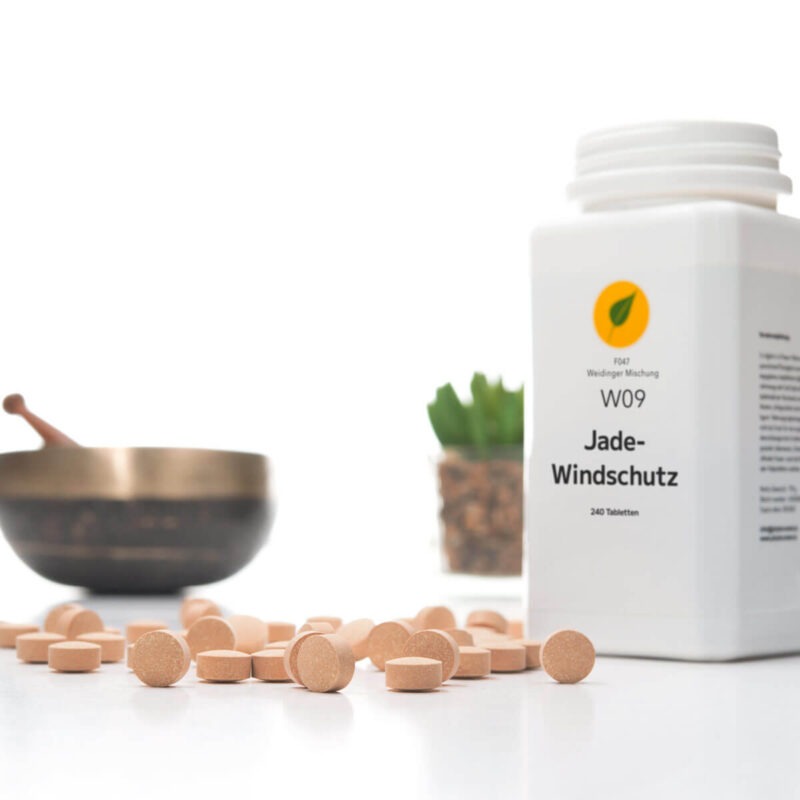
Qí Bó & Wolfgang recommend:
Product of the month: W09 — Jade windbreak
Qi Bo: „This formula is over 700 years old and bears its name for good reason. It creates a protective shield of jade around your body.“
The ingenious synergy of three herbs:
- Huang Qi (Astragalus) 40% — The „General of Defense,“ massively strengthens Wei-Qi
- Bai Zhu (Atractylodes) 30% — Strengthens the spleen as the center of qi production
- Fang Feng (Saposhnikovia) 30% — „The doorman“ protects against wind and cold
Who is it ideal for?
✓ People who frequently catch colds
✓ For those who want to get through winter preventively
✓ Those who suffer from fatigue due to qi deficiency
✓ Those who are sensitive to cold and wind
Wisdom to take away
The Yellow Emperor: „Let's summarize: Wei-Qi is our invisible protective shield. We can strengthen it every day — with warmth, good food, and rest.“
Qi Bo: „That's right, Your Majesty. Colds don't come from outside alone. They only find their way in when your inner balance is disturbed. Those who warm their core, nourish their qi, and rest in good time build a protective shield that no wind can penetrate.“
Dr. Weber: „Modern science confirms every single point. Sleep, nutrition, and stress reduction are the three pillars of a functioning immune system. Together with TCM methods—acupressure, heat, mindful eating—we have a holistic approach that works.“
The Yellow Emperor: „Then no one should say that colds are inevitable. With this knowledge, everyone can forge their own protective shield.“
Qi Bo: „One last word, Your Majesty: the best time to strengthen your Wei Qi is not when you become ill — but long before that.“
The Yellow Emperor: „Treat the illness before it strikes. That's what the old masters taught. Stay warm, stay alert, stay healthy!“
Preview:
The Yellow Emperor: „Next month, we'll be focusing on spring fatigue — when your body is stuck between winter and spring.“
Qi Bo: „We will talk about the awakening of liver qi and why this transition period is so crucial.“
Dr. Weber: „I explain what melatonin and serotonin have to do with it — and why so many people are exhausted at precisely this time.“
The Yellow Emperor: „Until then—may your shield be strong and your defenses vigilant!“
About our „3 Wise Men“ story
Who are the Yellow Emperor and Qi Bo?
The Yellow Emperor (Huangdi, 黄帝) is said to have lived around 2600 BC and is regarded as the mythical founder of Chinese culture and medicine. Qi Bo was his most important advisor and personal physician. Their discussions about health, illness and human nature were recorded in the most important fundamental work of TCM.
The book: Huangdi Neijing
The „Huangdi Neijing“ (黄帝内经), also known as „The Yellow Emperor - The Fundamental Work of Traditional Chinese Medicine“, was probably written between 200 BC and 200 AD. It is the oldest surviving work of Chinese medicine and consists of dialogues between the Yellow Emperor and his advisors - mainly Qi Bo.
This work is to TCM what the Bible is to Christianity: the absolute foundation. All the important concepts - yin and yang, the 5 elements, qi, meridians and acupuncture points - are systematically described here for the first time.
Our modern approach: The 3 wise men
In our series „The 3 Sages“, we bring the Yellow Emperor and Qi Bo together with the fictional modern doctor and microbiologist Dr. Weber.
Important note: All three characters and their conversations are purely fictitious and invented by us.
We use this narrative form, similar to the dialog form in the book Huangdi Neijing, to convey the often complex relationships of TCM in an understandable and entertaining way. When the 4000-year-old emperor is confronted with modern science, enlightening „aha moments“ arise which show that ancient wisdom and new research often speak the same language: Ancient wisdom and new research often speak the same language - just in different words.
This makes TCM lively, understandable and practically applicable for your everyday life.
The dialogs are creative interpretations - not historical documents. For medical questions, please consult a qualified TCM therapist or doctor.
The kitchen is the best pharmacy.
Chinese proverb
More interesting tips & articles

TCM tip of the week
Wieder geschmeidig werden — in jedem Alter
Erinnerst du dich? Wie du als Kind gerannt bist — ohne nachzudenken. Wie du gesprungen bist — ohne Angst. Wie du…
Apr
TCM tip of the week
Wetterfühlig? Das Problem ist nicht das Wetter
Gerade war noch Sonne. Jetzt Regen. Morgen wieder 20 Grad. Übermorgen Frost. April macht, was er will. Und dein Kopf macht…
Mar




Our most popular products