




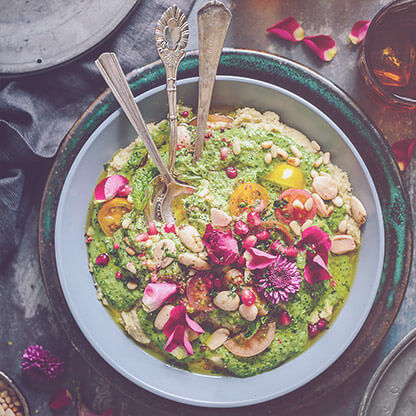
Becoming supple again - at any age
5 pillars for more mobility
You were once a child who DANCING. Your body has not forgotten.
Maybe he doesn't need miracles. No expensive therapies.
But only what it lacks.
TCM says: The liver nourishes the tendons.
If the liver is weak, the tendons become stiff.
When the liver is strong, the body remains supple. Even into old age.
Natürlich — bei schweren Verletzungen, chronischen Gelenkerkrankungen oder nach Operationen hat Steifheit handfeste Ursachen, die ärztlich abgeklärt gehören. Doch bei vielen Menschen ist der Grund ein anderer: Der Körper wurde schlicht vergessen.
And this is exactly where TCM comes in.
🌳 The liver and your mobility
In TCM, every tissue belongs to an organ. And the tendons? They belong to the Liver.
The wood element (liver/gall bladder) rules over:
- Tendons and ligaments
- Mobility and flexibility
- The eyes (the „opening“ of the liver)
- The nails (the „mirror“ of the tendons)
When the liver is strong: → Tendons elastic, movements flow, body supple.
If the liver is weakened: → Tendons stiff, movements falter, body feels old.
🌱 Why in spring?
Spring is the season of the wood element. The liver energy wants to awaken now - to strive upwards, to get moving.
But after a long winter it is often stagnant: too little exercise, too much heavy food, too little fresh greenery.
The good news: The liver reacts most strongly to support right NOW. What you do now has a double effect.
🩸 Liver blood - the key to suppleness
The tendons need more than Qi. They need Liver blood.
In TCM, blood is a nourishing, moisturizing substance that keeps the body supple. The liver stores and distributes this blood.
Signs of liver-blood deficiency:
- Stiff tendons, especially in the morning
- Cramps, especially at night
- Numbness and tingling sensations
- Brittle nails with grooves
- Blurred vision, dry eyes
- Pale lips, light sleep
Particularly affected:
- Women (menstruation consumes blood)
- Older people (blood production decreases)
- People with a lot of screen work (eyes consume liver blood)
- People with stress (liver qi stagnation blocks blood flow)
🧠 The western bridge
The Western perspective also recognizes these connections:
Fasciae können durch Bewegungsmangel und Stress „verkleben“ — das erinnert an das TCM–Konzept der „stagnierenden Leber“.
Kollagen–Bildung depends on good blood circulation - TCM says: The liver nourishes the tendons with good blood.
Chronic stress lässt die Faszien verkürzen — die TCM sagt: Leber–Qi–Stagnation führt zu Steifheit.
Two worlds. One realization: Stiffness is not destiny. It is a sign - and you can do something about it.
⚠️ The test: How stiff are you really?
📋 Before you start:
- Take the test in the morning, directly after getting up unheated
- How to see your real current status
- Don't cheat, don't cheat - be honest with yourself
- Tip: Repeat the test in 4 weeks and compare
Test 1: Pre-bending
- Standing position, legs stretched
- Bend forward slowly, let your arms hang down
- Don't rock, don't push
- just let it hang
- Where are you going?
→ Palms on the ground = 0 points
→ Fingertips on the ground = 1 point
→ Ankle = 2 points
→ Shin = 3 points
→ Knee or higher = 4 points
Test 2: Shoulders
- Right arm down over the shoulder
- Left arm from bottom to top behind the back
- Try to touch the fingers
- How far will they get?
→ Fingers interlock = 0 points
→ Fingers touch each other = 1 point
→ Less than 5 cm distance = 2 points
→ 5-10 cm distance = 3 points
→ More than 10 cm distance = 4 points
(Test both sides - the worse one counts!)
Test 3: Hip
- Sitting position on the floor
- Soles of feet together, knees outwards
- Let your knees fall relaxed
- How far are they from the ground?
→ Knees touch the floor = 0 points
→ Less than 10 cm = 1 point
→ 10-20 cm = 2 points
→ 20-30 cm = 3 points
→ More than 30 cm = 4 points
Test 4: Neck
- Sitting or standing position, back straight
- Turn your head slowly to the right
- Then to the left
- How far will you get?
→ Chin clearly above shoulder = 0 points
→ Chin over shoulder = 1 point
→ Chin almost over shoulder = 2 points
→ Significant restriction = 3 points
→ Starke Einschränkung + Beschwerden = 4 Punkte
Evaluation:
0-4 points: Good mobility Your tendons are well nourished. Keep them that way - with regular exercise and stretching.
5-8 points: Slight restrictions The first signs of stagnation. Now is the perfect time to take countermeasures. The 5 pillars will help you.
9-12 points: Significant stiffness Deine Leber braucht Unterstützung. Fokussiere dich auf Leber–Blut–Aufbau und tägliches Dehnen.
13-16 points: Severe stiffness Hier ist konsequentes Handeln gefragt. Alle 5 Säulen umsetzen, Akupressur täglich. Bei anhaltenden Beschwerden: an professionelle TCM–Beratung oder ärztliche Abklärung denken.
🌿 The 5 pillars for more mobility
1. stretching - but the right way
Not every stretch helps. The wrong technique can even do harm.
The golden rules:
→ Slowly and gently:
Tendons need time. No jerky movements.
→ Last a long time:
Mindestens 60–90 Sekunden pro Position. Erst nach etwa 30 Sekunden beginnen sich die Faszien zu lösen.
→ Daily:
Better 10 minutes every day than 1 hour once a week. Regularity beats intensity.
→ Morning:
The tendons are stiffest after sleep. This is where the effect is greatest.
→ With breathing:
Each time you exhale, go a millimeter deeper. Breathing releases the tension.
→ Without pain:
Pulling is okay. Pain is a warning signal. Never push through pain.
Avoid:
- Stretch cold muscles (warm up first!)
- Pushing through pain
📣 Insider tip: 4 simple exercises for more flexibility - with meridian tapping as a warm-up and targeted stretches for the liver and gallbladder meridians.
👉 Video: www.youtube.com/watch?v=ll6Nbh4h1ew
→ As of today: Stretch for 10 minutes every morning. Non-negotiable.
2. nourish the liver - build up blood
No supple tendons without liver blood.
Blood nourishing food:
Vegetables:
- Rote Beete (ein Klassiker fürs Blut)
- Carrots
- Dark leafy greens (spinach, chard, kale)
- Red peppers
Legumes:
- Lentils (especially black and red)
- Black beans
- Kidney beans
- Chickpeas
Dried fruit:
- Dates
- Goji berries
- Raisins
- Apricots
Animal (in moderation):
- Beef
- Liver
- Eggs (especially the yolk)
- Bone broth
Relax the liver:
Sour - moves the liver qi:
- Lemon, lime
- Apple cider vinegar (in warm water in the morning)
- Fermented vegetables (sauerkraut, kimchi)
Greens - nourish the liver:
- Spinach, Swiss chard
- Broccoli, kale
- Rocket, lamb's lettuce
- Sprouts
Bitter - relieves the liver:
- Dandelion
- Chicory, radicchio
- Artichoke
- Grapefruit
Avoid:
- Alcohol — belastet die Leber. Selbst kleine Mengen.
- Too much coffee — trocknet aus und erhitzt aus TCM–Sicht die Leber. 1–2 Tassen sind okay.
- Greasy, fried food — belastet die Leber, erzeugt Feuchtigkeit.
- Sugar — schwächt die Milz, die das Blut bildet.
- Dairy products in excess — erzeugen aus TCM–Sicht Feuchtigkeit und Schleim.
→ This week: Eat something red or dark green every day.
3. hydrate fasciae - drink and move
Faszien bestehen zu einem großen Teil aus Wasser. Dehydrierte Faszien fühlen sich weniger gleitfähig an. Nur mit ausreichend Flüssigkeit bleiben sie geschmeidig.
Practical:
- Ausreichend Wasser täglich - Herbal teas are included, coffee is not
- Start in the morning - A large glass of warm water before coffee
- Spread throughout the day - Don't drink everything at once
- Movement - Promotes fluid transport into the fasciae
- Variety - Don't just sit, don't just stand. Change position.
In addition:
- Neck stretches (ear to shoulder, 30 sec per side)
- Shoulder circles (10x forwards, 10x backwards)
- Loosen your jaw (often unconsciously tense!)
📣 Insider tip: Faszien–Rollen — 5 Minuten täglich mit der Faszienrolle löst Verklebungen und fördert die Durchblutung. Besonders schön: Oberschenkel–Außenseite (Gallenblasen–Meridian!).
🎥 Die besten Übungen für die Faszien — komplettes Workout:
👉 www.youtube.com/watch?v=UbYz8Hscnl8&t=1048s
→ As of today: Water bottle always in sight.
4. warmth - the tendons love it warm
In the warmth:
- Blood flows better
- Make the fascia more elastic
- Relax the muscles
- Loosen adhesions more easily
In the cold:
- Everything pulls together
- If the blood flow stops
- Tense muscles
- Werden die Sehnen spröder
Practical:
- Warm clothing - Especially for knees, shoulders and neck. Even when it's „not so cold“.
- Before stretching - Warm bath, warm shower, or 5 minutes of exercise to warm up
- Hot water bottle - Place on stiff areas, 10-15 minutes
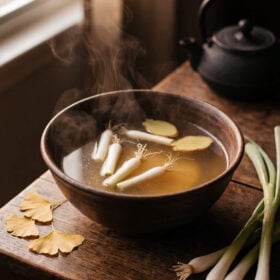
- ginger tea — Wärmt von innen
Avoid:
- Cold drinks (especially in the morning)
- Air conditioning directly on the neck or joints
- Too light clothing in spring (April is treacherous!)
- Wet hair in the wind
📣 The golden rule: First heat, then stretch. Never the other way around.
→ For stiffness: 10 minutes of warmth before the morning ritual.
5. movement - flowing instead of jerky
The liver loves flowing movement. The wood element wants to expand - but gently, like a tree that grows. Not explosively like fireworks.
Ideal for the tendons:
-
Qi Gong - Ideal for tendons and meridians. The gentle, flowing movements release stagnation and nourish the liver.
-
Yoga - Gentle and mindful, not acrobatic. Yin yoga is particularly good for fascia and tendons.
-
Tai Chi - The „meditation in motion“. Perfect for liver qi stagnation.
-
Swimming - Gentle on the joints, flowing, relaxing. The water carries you.
-
Walking in nature - Especially in the forest. The liver loves green.
Less ideal:
- High-intensity training without warming up
- Jerky sports without preparation
- Only strength training without stretching
- Competitive mentality in sport
This does not mean that intensive sport is bad. But stiff tendons need suppleness first - then strength can follow.
→ This week: 3x flowing movement (Qi Gong, yoga, swimming).
📣 Our recommendation: 30 minutes of Qi Gong for more flexibility - flowing movements that release blockages and get your Qi flowing again.
👉 Video: www.youtube.com/watch?v=mS00c78oHNo
📍 4 acupressure points for more mobility
Acupressure is both immediate help and long-term care. These 4 points nourish the tendons, move the liver qi and release blockages.
Le 03 (Tài Chōng) — „Big Meeting“
- Where: Back of the foot, between the big toe and the second toe, in the hollow where the bones meet
- What he does: Moves liver qi, nourishes liver blood, relaxes the tendons
- When: For any type of stiffness
Gb 34 (Yáng Líng Quán) - „Spring on Yang Hill“
- Where: Outer side of the lower leg, in the hollow in front of and under the head of the fibula
- What he does: THE master point of the tendons. Makes them supple, elastic and resilient. Relieves cramps
- When: For tendon stiffness, muscle cramps, restricted mobility
Gb 30 (Huán Tiào) - „Pivot point of the femur“
- Where: Buttocks, on the outside. After 2/3 of the distance between the sacrum and the greater trochanter. Best found in the lateral position with the leg bent.
- What he does: Öffnet die Hüfte, löst Steifheit im unteren Rücken und in den Beinen
- When: Bei Hüftsteifheit, schwerfälligem Gang, nach langem Sitzen
- How: Place the tennis ball under your buttocks, put your body weight on it, remain lying down for 60-90 seconds or gently circle it
Bl 40 (Wěi Zhōng) - „Supporting center“
- Where: Exactly in the middle of the hollow of the knee, between the two tendons
- What he does: Ein klassischer Punkt für den unteren Rücken
- When: For back stiffness, knee stiffness, after prolonged standing
Duration: 5-7 minutes
How often: Daily for the best results
🧭 You can find all points with detailed instructions in our free acupuncture atlas: 👉 www.meine-tcm.com/akupunkturatlas
💫 The deeper message
You were once a child who danced.
Your body has not forgotten.
Stiffness is not your age.
Stiffness is not your destiny.
Stiffness is a sign - an invitation.
Your liver is calling for support.
Your tendons are asking for nourishment.
Your body longs for movement.
Spring is the best time to answer him.
Give your body what it needs: Stretching, nourishment, warmth, flow.
And watch how the stiffness gives way - week after week.
Like a child learning to dance again.
📌 Recommended
🔍 How is your liver doing? Kostenlose TCM–Analyse — finde heraus, welche Muster gerade bei dir im Vordergrund stehen.
👉 www.meine-tcm.com/tcm-analyse
📜 Newsletter - Monthly TCM wisdom: The Yellow Emperor, Qi Bo and Dr. Weber in conversation. 👉 www.meine-tcm.com/newsletter-anmeldung
Hinweis: Dieser Beitrag ist allgemeine TCM– und Lebensstil–Information und ersetzt keine ärztliche Beratung. Bei starken, anhaltenden oder plötzlich auftretenden Beschwerden, nach Verletzungen oder bei bekannten Gelenkerkrankungen lass die Ursache bitte ärztlich abklären.
The soft conquers the hard.
Das Fließende überwindet das Starre.
Laozi
More interesting tips & articles
TCM tip of the week
Kaum ist es geschafft, liegst du flach
Wochenlang hältst du durch, und kaum ist der Umzug oder das Projekt geschafft, kratzt der Hals. Warum die Abwehr ausgerechnet in…
Oct

TCM tip of the week
Warum du im Herbst öfter seufzt
Manchmal seufzt du, ohne zu wissen, warum. Es ist, als wollte etwas heraus, das du nie ausgesprochen hast. Das ganze Jahr…
Sep

Sep


Our most popular products
Back pain