






Winter congee against exhaustion
The 2,000-year-old energy breakfast
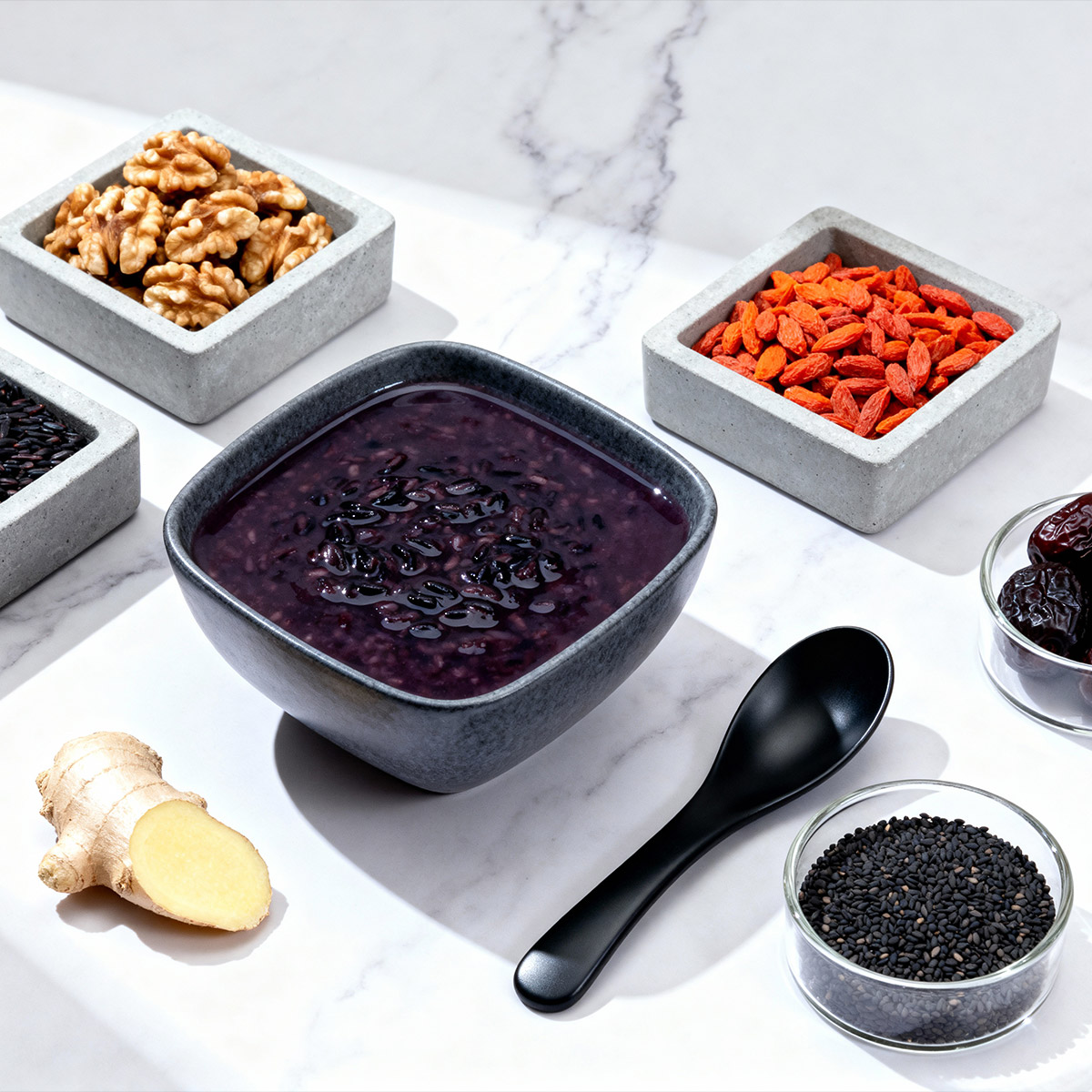
The winter congee against December exhaustion: black rice, walnuts, goji berries, ginger.
The forbidden rice that belonged only to the emperor
There is an old story from imperial China: A farmer discovered black rice in his fields - darker than the night, shiny like jade.
He tasted it and felt a warmth that came from deep within. But when the emperor heard about it, he issued a decree: from then on, this rice was forbidden to the people. Only the imperial court was allowed to eat it.
Why? Because it was ascribed a special power - the ability to nourish Jing, to preserve the essence of life.
The „forbidden rice“, as it is still called today, was considered so valuable that it was treated as medicine. Every morning, the emperor ate a congee made from this black rice. Not for pleasure - but to maintain his vitality, strengthen his kidneys and stay strong into old age.
2,000 years later, we know: The old masters were right.
Why you need this congee in winter
In TCM, December and winter are the time of the water element, the time of maximum yin energy. Nature retreats. The days are at their shortest. And your body is crying out for rest, for warmth, for food that nourishes from within.
This is exactly where the winter congee comes into play.
What is Congee?
Congee (粥, pronounced „Zhōu“) is much more than just rice porridge. In traditional Chinese medicine, it has been considered a healing food for over 2,000 years - as the breakfast that „nourishes the center and preserves the Jing“.
Unlike Western muesli or bread, congee is cooked for hours until the rice breaks down almost completely and becomes a creamy, easily digestible mass.
This long cooking time makes the nutrients maximally bioavailable - the body hardly has to expend any energy to digest the food. Perfect if you're already exhausted.
The magic of black rice
In the 5-element theory of TCM, the color black corresponds to the water element and the water element governs the kidneys. Black foods therefore directly nourish the kidneys and the Jing, your deepest energy reserve.
Black rice is not just „healthier“ than white rice. It is in a different category:
TCM perspective:
- Nourishes kidney yin AND kidney yang (rare!)
- Strengthens the Jing - your life essence
- Tonifies blood - important after menstruation, for anemia, exhaustion
- Thermally neutral to slightly warm - perfect for winter
Scientific perspective:
The black color comes from anthocyanins - the same antioxidants found in blueberries. Research shows:
- 3x more iron as white rice
- 6x more antioxidants → Anti-aging, anti-inflammatory
- Twice as much fiber → Stable blood sugar
- Protects the mitochondria (your cellular power plants) and increases energy production
White rice gives you Qi and strengthens the spleen - that's good. But black rice goes deeper. It nourishes the root.
The recipe: Winter congee against exhaustion
Ingredients (for 3-4 portions)
Basis:
- 70g black rice (Alternative: 35g black + 35g white as a compromise)
- 1 liter of water
Jing-nourishing ingredients:
- 50g walnuts, roughly chopped
- 5 dried dates (jujube), pitted
- 30g goji berries
- 3 slices of fresh ginger
To refine:
- 1 pinch of sea salt
- 1 tsp roasted sesame oil
- 1 tbsp black sesame seeds (roasted)
Preparation: choose your method
Method 1: The traditional cure (at the weekend)
The evening before:
- Wash the rice until the water is clear
- Soak in 1 liter of water overnight (at least 6-8 hours)
In the morning:
- Prepare the soaked rice
- Add walnuts, dates and ginger
- Bring to the boil, then reduce the heat
- With half-open lid 1.5-2 hours Simmer gently
- Stir occasionally (so that nothing sticks)
- Add the goji berries in the last 10 minutes
- Season to taste with sea salt and sesame oil
Result: Creamy, intense, all ingredients have completely released their Qi. Keeps in the fridge for 3-4 days.
Method 2: The everyday variant (for working people)
Sunday - Pre-cook pure basic congee (2 hours):
Ingredients:
- 200g black rice (or 100g black + 100g white)
- 2.5 liters of water
- 1 pinch of sea salt
Preparation:
- Wash the rice on Saturday evening and soak in water overnight
- Sunday: Boil the soaked rice
- Reduce the heat, simmer gently for 1.5-2 hours
- Add a pinch of sea salt
- Allow to cool completely
- Portion into 6-7 sealable containers
- Store in the refrigerator (keeps for 5-7 days)
That's it! Pure rice base - no topping, nothing else.
Daily - topping as desired (10 minutes):
- Warm up the base:
- 1-2 ladles of basic congee in a small pot
- Add 100-150ml water (congee thickens when stored)
- Add toppings of your choice:
- Standard: Handful of walnuts (roughly chopped) + 2 dried dates (sliced) + handful of goji berries + 1 slice of ginger (grated)
- Or: Vary daily (see variations below)
- Bring to the boil: Simmer for 5-10 minutes over a medium heat until everything is really hot
- Refine: 1 tsp roasted sesame oil, black sesame seeds for sprinkling, optional honey or sea salt
- Eat immediately - steaming hot!
Time balance:
- Sunday: 2 hours one-off (pure basis)
- Daily: only 10 minutes (warm-up + topping)
Advantage: Maximum flexibility! Different topping possible every day. Goji berries and walnuts stay fresh and retain more nutrients.
⚠️ The golden rule: always eat warm!
Congee MUST should be eaten warm. Cold congee weakens the spleen yang and drains your body of energy instead of giving it. Always heat it in a pot with a little water until it steams - not just lukewarm!
What the ingredients do
Black rice: Nourishes kidneys, strengthens Jing, tonifies blood
Walnuts: Warms kidney yang, strengthens back and brain
Goji berries: Nourish liver and kidney yin, improve eyesight, one of the most famous longevity herbs
Dates: Tonify Qi and blood, calm the mind, strengthen digestion
Ginger: Warms, dispels cold, makes all ingredients more available
Variations for different needs
If you are very cold
Add: 3 dried longan fruits, ½ teaspoon cinnamon, 1 slice dried ginger
For stress & sleep problems
Add: 10g lotus seeds, 5g longan fruit, reduce ginger
At the onset of a cold
Add: 2 spring onions (white parts), 3-4 slices of ginger, 1 clove of garlic
For women with cycle complaints
Add: 10g longan fruit, extra dates, 5g dong quai (if available)
For seniors (extra Jing nourishing)
Add: 10g black sesame seeds, 5g mulberries, 3g ginseng, extra walnuts
For athletes (regeneration)
Add: 1 tbsp hemp seeds, extra walnuts and dates, 10g mulberries
When and how often?
Ideal: For breakfast between 7-9 am (stomach time in the organ clock)
Alternative: As dinner between 18-19 o'clock
Frequency:
- For acute exhaustion: daily for 2-3 weeks
- For prevention: 3-4 times a week in winter
- As a cure: 21 days in a row (in TCM: „21 days change a pattern“)
Practical tips
Where to buy:
- Black rice: Asian store, organic food store, health food shop, online
- Goji berries: Drugstore (dm, Müller), organic food store, TCM stores
- Jujube dates: Asian store (as „红枣“ or „Red Dates“), alternatively Medjool dates
Sweet or salty?
- Salty (sea salt + sesame oil) = stronger for kidneys
- Sweet (honey or maple syrup) = stronger for spleen
- Try both and listen to your body!
Meal Prep:
- Cook a large portion on Sunday
- Divide into 6-7 portions
- Keeps for 5-7 days in the refrigerator
- Can be frozen (lasts 3 months)
Cookware:
- Ideal: Heavy pot with thick base
- Slow cooker: 6-8 hours on a low setting (overnight!)
- Rice stove: 2 passes on „Porridge“ mode
What you can expect after 7 days
The 7-day challenge: A bowl of congee every morning, note your energy every day.
Expected improvements:
- Warmer hands and feet
- More energy in the morning
- Better, deeper sleep
- Less 5 p.m. exhaustion
- More stable mood
- Stronger immune system
Why it works
The long cooking time is the key: All nutrients are maximally bioavailable. The body hardly has to expend any digestive energy. The warmth penetrates you from the inside. The black color directly nourishes your kidneys.
It's not just food. It is medicine.
Frequently asked questions
Does it have to be black rice? For maximum effect: Yes. The black color is decisive for the kidney effect. As a compromise: 50/50 mixture (black + white). As an emergency solution: White rice with extra walnuts and goji - but then the kidney effect is significantly weaker.
Can I cook it in advance? Yes! 5-7 days in the fridge, 3 months in the freezer. Always reheat warm.
Can I also eat it cold? No. This weakens the yang and costs energy. Always warm!
Does it taste boring? No! You can season it sweet (honey) or salty (sea salt + sesame oil). Vary daily with different ingredients.
Summary
This congee is:
✅ 2,000 years of proven TCM knowledge
Scientifically confirmed (anthocyanins, omega-3, antioxidants)
✅ Easy to pre-cook (Sunday 2h, daily 10 min)
✅ Warms from the inside (perfect for December and winter)
Nourish your root (Jing, kidneys, life essence)
✅ Returns real energy (not just fast Qi)
A spoonful of congee = a spoonful of vitality.
Note: Please consult your doctor or TCM therapist if you have any existing illnesses or are taking medication.
A spoon at the right time
is more effective than a hundred pills at the wrong time.
From the records of the palace kitchen
More interesting tips & articles

TCM tip of the week
Exhaustion from the depths
January whispers an ancient truth: nature is resting—and it invites you to do the same. Outside, it's...
Jan

General TCM explained
Stay cold-free through winter — How to activate your invisible protective shield
There are people who simply never get sick. It's not coincidence or luck. It's a protective shield that most people don't know about. The...
Dec






General TCM explained
Why you're more exhausted in December - and how to recharge your batteries
Nov
Our most popular products







I learned that cooking food for a long time destroys important ingredients. Is that true?
Dear Kerstin,
great question - and you're basically right! Most cooking methods do indeed lose nutrients. But congee is a special case:
The decisive difference:
The cooking water is not poured away, but eaten with the dish.
Everything that passes from the rice and the ingredients into the water ends up in your bowl - nothing is lost.
Which gets even BETTER with prolonged cooking:
-Minerals (iron, zinc) are completely preserved
The anthocyanins in black rice (the valuable antioxidants) are amazingly heat-stable
-proteins and starch are broken down = your body can absorb them much more easily
The TCM idea behind it:
When you're exhausted, it's not just WHAT you eat that counts, but how much energy your body has to expend on digestion.
Congee is so easy to digest that almost no digestive energy is required. Better to absorb 80% of nutrients effortlessly than 100% of nutrients that you don't have the energy to digest.
A little tip:
This is precisely why we recommend only adding the goji berries in the last 10 minutes of the recipe - this way, their heat-sensitive vitamins are better preserved. 😊
I hope this helps you!
Kind regards
TCM Team