





On this page, you will learn:
- What this diagnosis means from the point of view of TCM and Western medicine
- Where your symptoms come from and how they are connected
- Which specific treatment methods can help you now
- How you can rebuild your energy with TCM herbs, acupressure, qi gong, and nutrition
The good news: A qi deficiency can be treated very effectively with the right measures. With patience and the right methods, you can regain your energy.
Take your time, Get to know the different treatment approaches—you don't have to implement everything at once. Choose what feels right for you and what you can easily integrate into your everyday life.
Your treatment at a glance:
Which TCM pattern is really behind your complaints?
Degree of
imbalance

Light to moderate
Typical
treatment duration

3 months
self-treatment
Possible

Can be treated yourself with instructions
Treatment
scope

1–2 Methods
Proposed
methods

Extensive range
Our free TCM analysis shows you your personal TCM pattern in just 10 minutes - and which treatment will help you best.
What is a qi deficiency?

When life energy is depleted
The TCM perspective: Your life energy is depleted
In traditional Chinese medicine, qi is the fundamental life energy that flows through your entire body. Qi is not just „energy“ — it is the driving force behind all life processes: breathing, digestion, movement, thinking, and even emotions.
When there is a deficiency of qi, this life energy is depleted or is no longer being produced in sufficient quantities. Think of qi as the electricity in your house—when the voltage drops, everything runs on low power: the lights flicker, appliances run slower, and eventually nothing works at all.
The main sources of your qi are the spleen, stomach, and lungs. The spleen and stomach obtain qi from food (known as „food qi“), while the lungs absorb qi from the air you breathe (known as „breath qi“). Both forms combine to form vital qi, which flows through the meridians—the energy channels of your body.
The consequence of a qi deficiency: When these organs are weakened, not enough qi is produced. Your body then simply no longer has the strength to perform all its functions optimally.
The typical signs of a qi deficiency:
- Deep fatigue and exhaustion that is not relieved by sleep
- Weak voice and no desire to speak
- Shortness of breath even with minimal exertion
- Paleness of the face and lips
- Poor digestion with flatulence and loose stools
- Spontaneous sweating without physical exertion
- Frequent colds due to weakened immune system
The good news: A qi deficiency can be treated. With the right diet, fortifying herbs, qi gong exercises, and acupressure, you can rebuild your qi and regain your life energy.
The Western perspective: Chronic fatigue and lack of energy
From a Western perspective, qi deficiency corresponds to a state of chronic exhaustion and reduced physical performance. It is not a specific disease, but rather a syndrome—an interplay of various factors that impair the body's energy balance.
Imagine your body as a battery that no longer charges properly. You sleep, eat, and rest—but the energy doesn't come back. This is because various systems are not working optimally: digestion is not absorbing nutrients properly, the mitochondria (the powerhouses of your cells) are not producing enough ATP (the universal energy carrier), and the hormone axes are out of balance.
What does modern medicine show?
- Mitochondrial dysfunction: The cell powerhouses work inefficiently and produce less energy.
- Adrenal insufficiency: Cortisol and other stress hormones are out of balance
- Hypothyroidism: Metabolism runs at a low level
- Vitamin and mineral deficiencies: particularly iron, B12, vitamin D, and magnesium
- Chronic stress: Permanently elevated cortisol levels deplete reserves
- Impaired intestinal health: Nutrients are not absorbed optimally
Modern research confirms: Chronic fatigue is closely linked to lifestyle factors—lack of sleep, lack of exercise, poor nutrition, and constant stress are among the main causes.
TCM treatment for qi deficiency targets precisely these interrelationships: it strengthens digestion, supports energy production, and restores balance to the body—holistically and sustainably.

The Yellow Emperor team explains your diagnosis
The Yellow Emperor | Qi Bo | Dr. Lisa Weber
Founder of TCM | Master of Healing Arts | Modern Physician
What happens when the legendary Yellow Emperor from TCM sits down with his advisor Qi Bo and a modern doctor? They explain YOUR diagnosis—using 4,000 years of knowledge AND the latest science.
Qi deficiency — When you lack vital energy and everything makes you tired
The Yellow Emperor: „Qi Bo, in my kingdom, many subjects complain of constant exhaustion. They feel weak, tired, and unmotivated—even after getting enough sleep. What is the cause of this affliction?“
Qi Bo: „Your Majesty, these people suffer from a deficiency of qi—the fundamental life energy that flows through everything. Imagine qi as a great river that irrigates the land. When the river dries up, the fields wither. Qi is the root of human beings — when it is weak, the entire body lacks strength. The spleen, the central organ for Qi production, can no longer fulfill its task. It should transform food and extract new Qi from it — but this inner fire now burns only weakly.“
Dr. Weber: „That's a wonderful analogy! In modern medicine, we would refer to this as mitochondrial dysfunction — the powerhouses of our cells no longer produce enough energy in the form of ATP. This is often accompanied by adrenal fatigue due to chronic stress, which leads to low cortisol levels. The result: the body literally does not have enough energy for its functions. Interestingly, studies show that people with chronic fatigue actually have reduced enzyme activity in the digestive tract — exactly what Qi Bo describes as weak spleen function.“
The Yellow Emperor: „So both healing arts describe the same phenomenon—just from different perspectives? The qi isn't flowing, the cells aren't producing?“
Qi Bo: „That's exactly right, Your Majesty. Wisdom has many languages, but only one truth.“
The Yellow Emperor: „But what causes this qi deficiency? What weakens my subjects so much?“
Qi Bo: „There are many causes, Your Majesty. First: irregular eating and cold food—they weaken the digestive fire. Second: overwork without sufficient rest—the qi is depleted but not replenished. Third: worry and brooding—they bind the qi and prevent its free flow. And fourth: chronic illnesses—they deplete the reserves. In TCM, we say: The spleen is weakened when we think too much and rest too little.“
Dr. Weber: „This accurately reflects our current understanding! Chronic stress permanently activates the sympathetic nervous system—the body is in constant fight mode. This consumes enormous energy reserves. Added to this are sleep deprivation, a nutrient-poor diet, and too little exercise. The adrenal glands become exhausted, the mitochondria are damaged, and the body enters a vicious cycle of exhaustion. Studies show that just four weeks of chronic stress can measurably reduce cortisol production.“
The Yellow Emperor: „What signs tell me that someone is suffering from qi deficiency?“
Qi Bo: „The signs are clear, Your Majesty. The affected person shows: Constant fatigue that does not improve with sleep. A pale complexion and quiet voice. Shortness of breath with little exertion. Spontaneous sweating for no reason. The tongue is pale, possibly swollen with teeth marks. The pulse is weak—like a thin thread. And after eating, they feel even more tired than before.“
Dr. Weber: „We are very familiar with these symptoms! Orthostatic intolerance, i.e., dizziness when standing up. Low heart rate variability. Prolonged recovery time after exertion. In the laboratory, we often see low ferritin levels, vitamin D deficiency, and reduced DHEA levels. The adrenal glands no longer produce enough stress hormones — the body can no longer respond adequately to stress.“
The Yellow Emperor: „Now let's talk about treatment. How can my subjects rebuild their qi?“
Qi Bo: „Your Majesty, the treatment principle is: Bu Qi — tonify and strengthen the Qi. This is done in several ways: First, through warm, nutritious foods that strengthen the spleen — especially cooked grains, soups, and stews. Secondly, through acupressure on powerful points such as Stomach 36, Conception Vessel 6, and Lung 9. Thirdly, through gentle exercise such as qigong — exercises such as ‚regulating qi‘ and ‚connecting heaven and earth‘ nourish the qi wonderfully. And fourthly, through sufficient rest and sleep — the qi regenerates at night.“
Dr. Weber: „That's an excellent holistic approach! From a scientific point of view, I would add: a nutrient-rich diet with sufficient B vitamins, iron, and magnesium—these are the cofactors for mitochondrial energy production. Adaptogenic herbs such as ginseng and astragalus have been shown to have positive effects on adrenal function. Gentle exercise such as tai chi or yoga activates the parasympathetic nervous system and promotes regeneration. And very important: stress management and sufficient sleep — at least 7-8 hours!“
The Yellow Emperor: „Qi Bo, are there any particular foods that are especially recommended?“
Qi Bo: „Very well, Your Majesty! A warm breakfast is essential—preferably oatmeal with cinnamon and steamed fruit. Soups and stews with chicken, beef, or fish nourish the qi. Root vegetables such as sweet potatoes and carrots strengthen the earth. And rice — the grain of the middle — harmonizes digestion. You should avoid: raw food on an empty stomach, cold drinks, too many dairy products, refined sugar, and white flour. These weaken the digestive fire.“
Dr. Weber: „From a nutritional point of view, this makes perfect sense! Warm, cooked foods are easier to digest—the enzymes don't have to work as hard. Complex carbohydrates from whole grains provide steady energy. Proteins from meat or legumes are important for amino acid supply. And avoiding sugar stabilizes blood sugar—no more energy roller coasters!“
The Yellow Emperor: „Wonderful! Let's turn this wisdom into a practical plan.“
THE 3-WISE METHOD AGAINST QI DEFICIENCY
MORNING PROTOCOL (building Qi):
- TCM: Warm water with ginger and a slice of lemon to start with
- Science: Activates digestion, stimulates metabolism
- Practical: Add 2-3 slices of fresh ginger to 250 ml of hot water, steep for 10 minutes, drink BEFORE breakfast.
- TCM: Hot breakfast — oatmeal with cinnamon and steamed apple
- Science: Complex carbohydrates for stable energy, cinnamon regulates blood sugar
- Practical: Cook 50g oatmeal with water or almond milk, add 1/2 teaspoon cinnamon and steamed apple pieces.
TAGS STRATEGY (preserving Qi):
- TCM: Acupressure on Stomach 36 (Zusanli) — the most powerful Qi point
- Science: Stimulates the vagus nerve, improves immune function and digestion
- Practical: 4 finger widths below the kneecap, on the outside of the shin. Massage in circular motions for 2 minutes, 2-3 times a day.
- TCM: Qi Gong exercise „Regulating Qi“ or „Connecting Heaven and Earth“
- Science: Deep breathing activates the parasympathetic nervous system, exercise promotes blood circulation
- Practical: 10-15 minutes daily, preferably in the morning or early afternoon
- TCM: No cold drinks — always room temperature or warmer
- Science: Cold liquids slow down gastric emptying by 30-45 minutes.
- Practical: Thermos flask with hot water or herbal tea for on the go
EVENING RITUAL (regenerate Qi):
- TCM: Acupressure on Conception Vessel 6 (Qihai) — the „Sea of Qi“
- Science: Activates the relaxation response, promotes regeneration
- Practical: Massage gently in circular motions for 3-5 minutes, 2 finger widths below the navel.
- TCM: Light, early dinner — no later than 7 p.m.
- Science: Gives the body time to digest before sleep
- Practical: Warm soup or steamed vegetables with some protein, at least 3 hours before bedtime
- TCM: Go to bed early — before 11 p.m.
- Science: Deep sleep phases before midnight are particularly restorative.
- Practical: Turn off screens 1 hour beforehand, darken the bedroom
The Yellow Emperor: „Qi Bo, how long will it take for the qi to be restored?“
Qi Bo: „Your Majesty, patience is key. Qi cannot be forced—it must be gently nurtured like a delicate plant. After 2-3 weeks of consistent practice, most people notice initial improvements: less fatigue after eating, slightly more energy. After 6-8 weeks, energy levels stabilize throughout the day. After 3 months, the qi is significantly strengthened and new habits are established. Consistency is more important than intensity.“
Dr. Weber: „This is exactly what we see in practice! Regeneration of the adrenal glands takes time—about 3-6 months for a full recovery. The good news is that initial improvements are often seen after just a few weeks. Continuity plays a key role. It is better to do 10 minutes of qigong every day than one hour once a week. The body needs regular signals to boost its energy production.“
The Yellow Emperor: „What should people do if they feel overwhelmed from time to time?“
Qi Bo: „Listen to your body! When you have low qi, rest is not a weakness, but medicine. Short breaks throughout the day are more valuable than a long sleep on the weekend. And don't forget: qi also needs joy to thrive. Laughter, the company of loved ones, time in nature — all of these things nourish qi in a way that no medicine can replace.“
Dr. Weber: „Beautifully said! Social contact and positive emotions have been proven to lower cortisol and strengthen the immune system. Laughter releases endorphins. Exposure to nature reduces stress hormones. This isn't esoteric — it's solid neurobiology!“
The Yellow Emperor: „Then the message is clear: Qi deficiency is curable—with patience, the right methods, and a loving approach to oneself. The tools are ready. People just have to use them.“
Qi Bo: [smiles] „That is correct, Your Majesty. Qi is the root of human beings. When the root is strong, the tree thrives. When qi flows abundantly, the body is healthy.“
About our „3 Wise Men“ story
Who are the Yellow Emperor and Qi Bo?
The Yellow Emperor (Huangdi) is said to have lived around 2600 BC and is considered the mythical founder of Chinese culture and medicine. Qi Bo was his most important advisor and personal physician. Their discussions about health, illness, and human nature were recorded in the most important fundamental work of TCM.
The book: Huangdi Neijing
The Huangdi Neijing, also known as The Yellow Emperor's Classic of Internal Medicine, was probably written between 200 BC and 200 AD. It is the oldest surviving work on Chinese medicine and consists of dialogues between the Yellow Emperor and his advisors, mainly Qi Bo.
This work is to TCM what the Bible is to Christianity: the absolute foundation. All the important concepts - yin and yang, the 5 elements, qi, meridians and acupuncture points - are systematically described here for the first time.
Our modern approach: The 3 wise men
In our series „The 3 Sages“, we bring the Yellow Emperor and Qi Bo together with the fictional modern doctor and microbiologist Dr. Weber.
Important note: All three characters and their conversations are purely fictitious and invented by us.
We use this narrative form, similar to the dialogue form in the book Huangdi Neijing, to convey the often complex interrelationships of TCM in an understandable and entertaining way. When the 4,000-year-old emperor is confronted with modern science, enlightening „aha moments“ arise that show that ancient wisdom and new research often speak the same language—just in different words.
This makes TCM lively, understandable and practically applicable for your everyday life.
The dialogs are creative interpretations - not historical documents. For medical questions, please consult a qualified TCM therapist or doctor.
Your treatment options
A qi deficiency is very easy to treat! TCM offers you a variety of effective methods to rebuild your energy and vitality. You don't have to do everything at once — choose the methods that suit you and your everyday life.
Here you will find specific treatment approaches that have been proven effective in TCM for thousands of years and that you can largely apply yourself.
TCM herbal therapy
TCM herbs are the basis every classic TCM treatment. The carefully compiled mixtures have a synergistic effect — this means that the individual herbs reinforce each other's effects and balance out any possible side effects.
What modern medicine is only just discovering—the power of plant substances—has been used successfully by TCM for over 2,500 years.
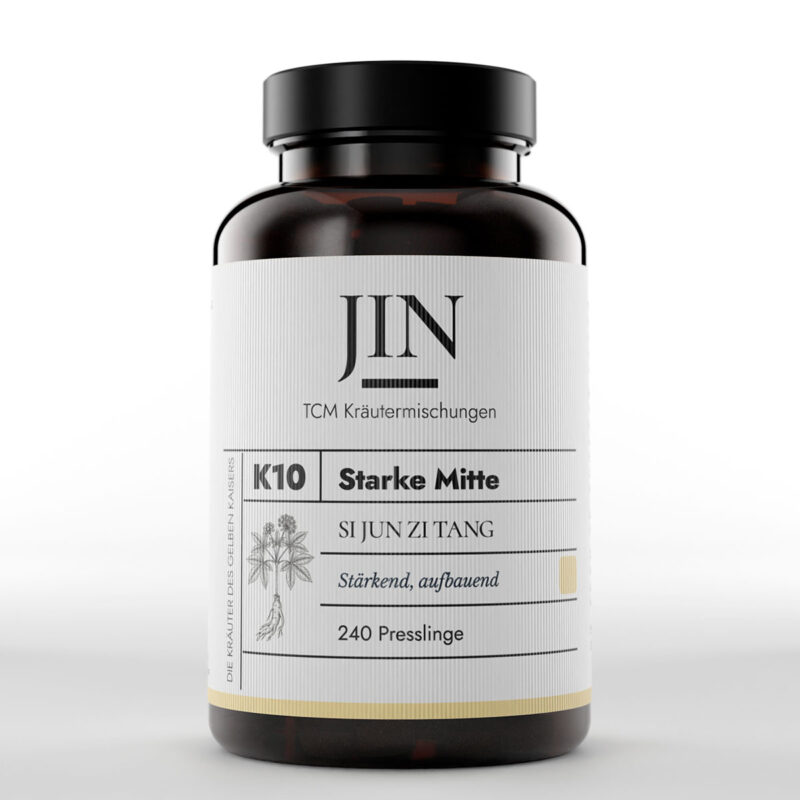
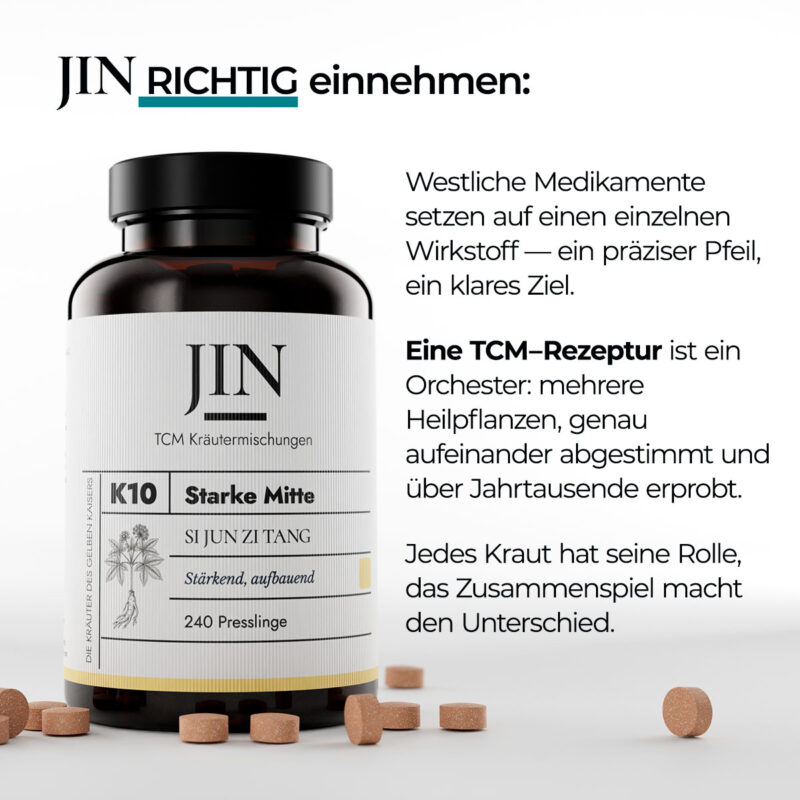
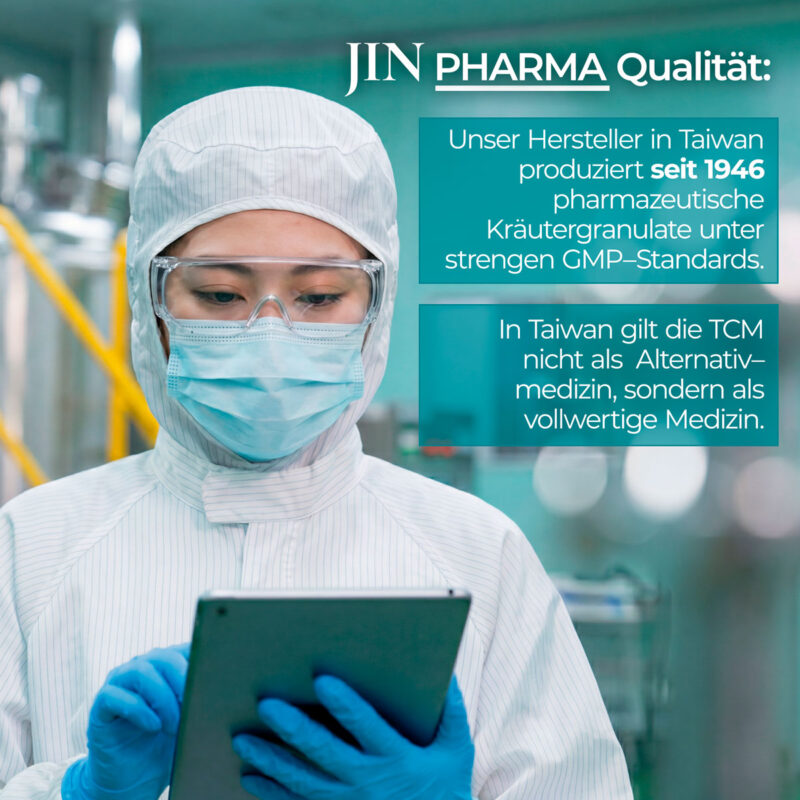
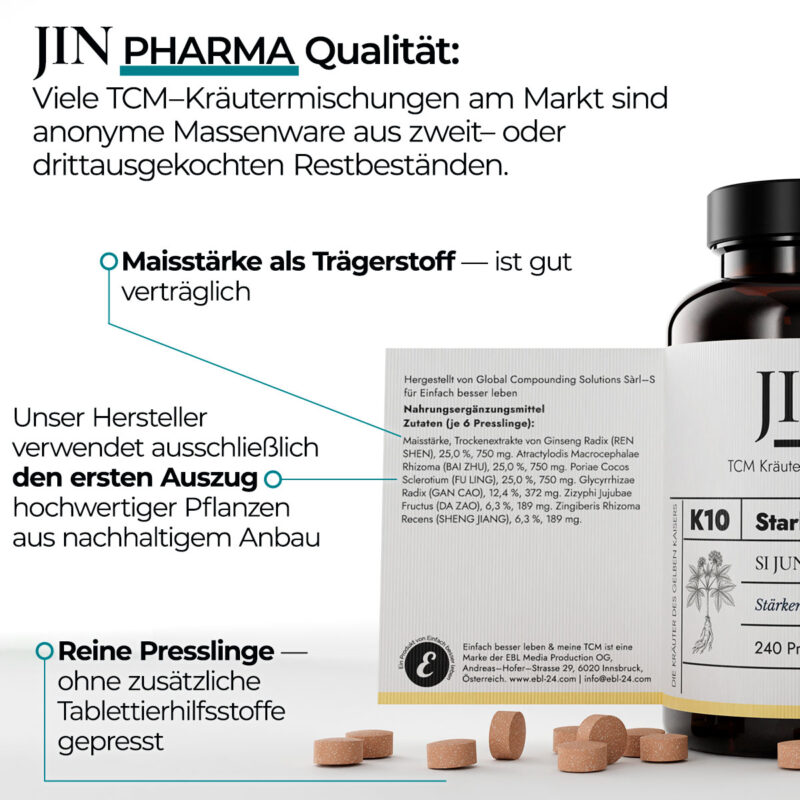
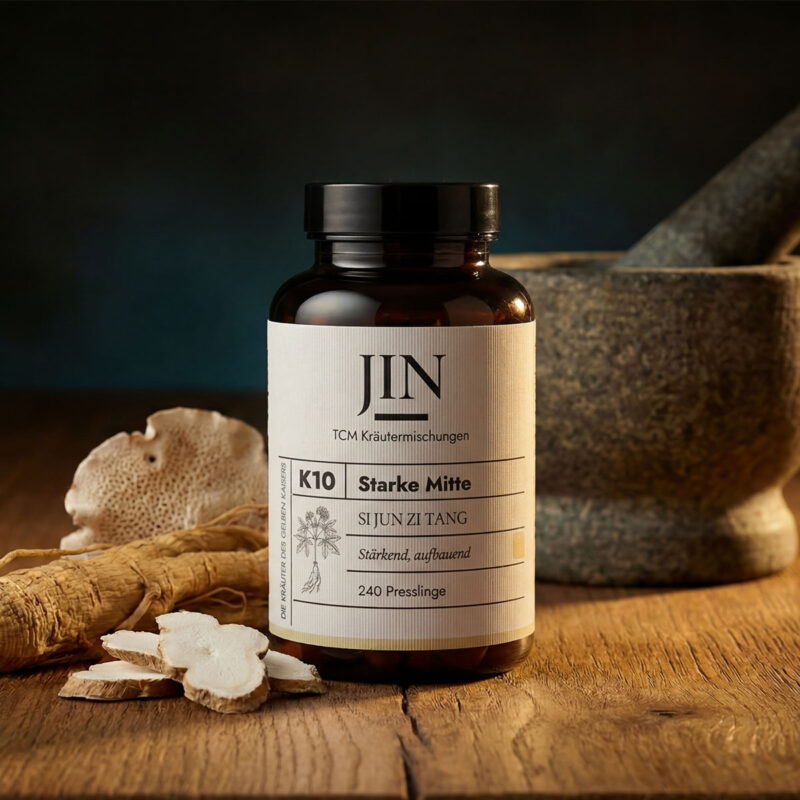
Empfohlene TCM–Kräutermischung bei Qi Mangel
JIN K10 — Strong Core
Die klassische Rezeptur Si Jun Zi Tang (四君子汤) — die „Vier Edlen Herren“. Sechs aufeinander abgestimmte Kräuter, die das Milz–Qi sanft tonisieren und das Fundament deiner Energie wieder aufbauen.
Mit Ren Shen (Ginseng) und Bai Zhu als Hauptkräutern stärkt diese Mischung die Mitte, kräftigt die Verdauung und leitet überschüssige Feuchtigkeit aus. Ideal bei Erschöpfung, schwacher Verdauung und einem Gefühl innerer Leere.
Quantity
329,70 €
i
To the product
The herbs in this recipeRecommended reading:How TCM herbal blends are formulatedLearn more now
| Herb (Pinyin) | German designation | Function in the recipe |
|---|---|---|
| Ren Shen (Ginseng Root) | Ginseng root | emperor Tonisiert das Qi kraftvoll, stärkt Milz und Lunge |
| Bai Zhu | White Atractylodes | minister Strengthens the spleen, dries moisture |
| Fu Ling | Poria mushroom | assistant Leitet Feuchtigkeit aus, beruhigt den Geist |
| Gan Cao | licorice root | harmonizer Harmonizes all herbs, protects the stomach |
| Da Zao | Jujuben (rote Dattel) | harmonizer Nährt das Blut, wärmt und nährt die Mitte |
| Sheng Jiang | Fresh ginger | harmonizer Wärmt den mittleren Erwärmer, unterstützt die Verdauung |
Explanation of the most important herbs
emperor Ren Shen (ginseng) — The energy booster
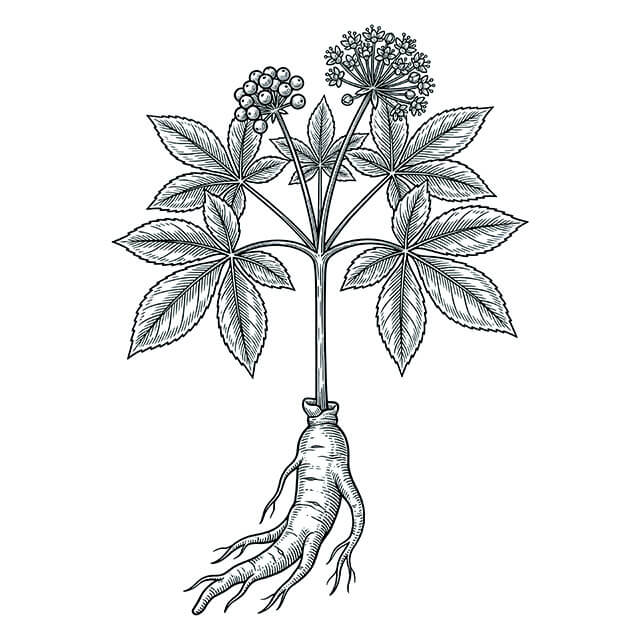
Ren Shen ist das kraftvollste Qi–Tonikum der TCM und bildet mit 25% das Herz dieser Rezeptur. Es ergänzt das Yuan–Qi (Ursprungs–Qi), stärkt Milz und Lunge und baut die Mitte von Grund auf wieder auf. Moderne Forschung zeigt: Die Ginsenoside wirken adaptogen, modulieren die Stressantwort und unterstützen die zelluläre Energieproduktion.
minister Bai Zhu (Atractylodes) — The spleen tonic
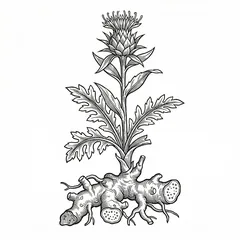
Bai Zhu ist das wichtigste Kraut zur Stärkung der Milz–Funktion. Es trocknet Feuchtigkeit, festigt die Mitte und hebt das klare Yang. Besonders wirksam bei Blähungen, weichem Stuhl und Schweregefühl nach dem Essen — der treueste Begleiter der Milz.
assistant Fu Ling (Poria) — Der Feuchtigkeits–Ausleiter
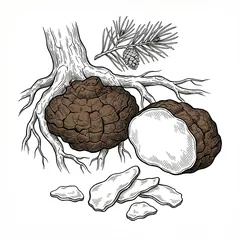
Fu Ling leitet überschüssige Feuchtigkeit nach unten aus und beruhigt zugleich den Geist. Es unterstützt Bai Zhu: Während Bai Zhu die Feuchtigkeit trocknet, leitet Fu Ling sie aus. Die enthaltenen Beta–Glucane wirken in Studien immunmodulierend, die entwässernde Wirkung ist klinisch belegt.
harmonizer Gan Cao (licorice) — Der Harmonisierer
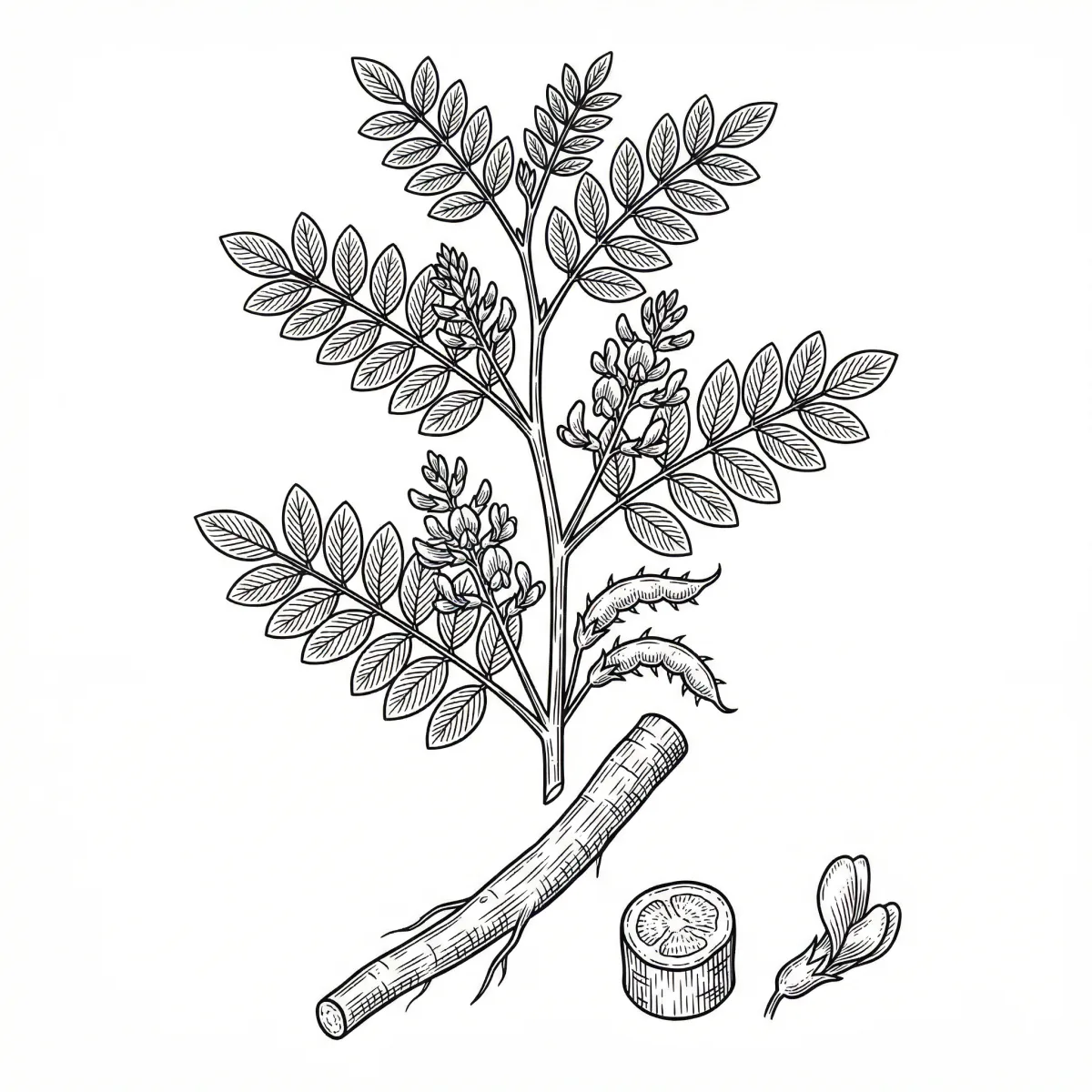
Gan Cao stärkt die Milz, harmonisiert alle Kräuter der Rezeptur und schützt den Magen. Sein süßer Geschmack nährt die Mitte direkt — denn Süße gehört in der TCM zur Erde und damit zur Milz. Ergänzt wird es vom klassischen Paar Da Zao und Sheng Jiang, das die Verdauungskraft unterstützt.
Recommended dosage
The dosage depends on the severity.
Based on your questionnaire results, we have highlighted the appropriate dosage for you below.
At light Severity:
- 2 tablets 3 times a day (morning, noon, and late afternoon) = 6 tablets per day
- Optional, if taking 3 doses a day is difficult for you: 3 tablets twice a day — same daily amount
- We recommend at least 2 cans, each containing 240 tablets (enough for about 12 weeks)
At middle Severity:
- 3 tablets 3 times a day (morning, noon, and late afternoon) = 9 tablets per day
- We recommend at least 3 cans, each containing 240 tablets (enough for about 12 weeks)
- If your condition improves, switch to the dosage recommendation for mild symptoms
At significantly Severity:
- 4 tablets 3 times a day (morning, noon, and late afternoon) = 12 tablets per day
- We recommend at least 4 cans, each containing 240 tablets (enough for about 12 weeks)
- If your condition improves, switch to the dosage recommendation for moderate severity
Why 3 times a day?
This ensures that the herbs' effects are evenly distributed throughout the day.
IMPORTANT:
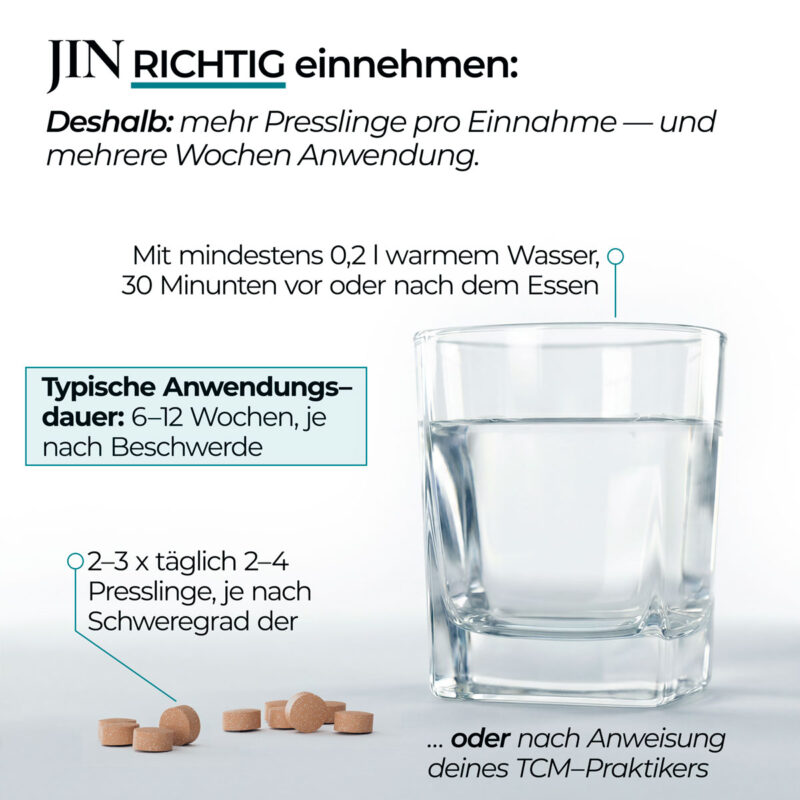
- Take the tablets with at least 0.2 liters of warm water
- Ideally, 30 minutes before or after a meal
- This suggestion is not a substitute for a medical diagnosis or treatment
- If you are pregnant or breastfeeding, have a chronic medical condition, or are taking medication, consult a doctor or a TCM practitioner beforehand.
- If you have a severe cold, fever, or diarrhea, stop taking this product
- Warme, gekochte Mahlzeiten bevorzugen — Rohkost und kalte Getränke schwächen das Milz–Qi
If little has changed after about 12 weeks:
Herbs are just one part of TCM. Combine taking them with other practices—acupressure, qigong, Pilates, or yoga, BS+, as well as meditation and breathing exercises. Afterward, take a two-week break from taking the herbs. Then, if needed, you can TCM analysis try again and/or compare your result with your TCM practitioner or discuss it with your doctor.
If you have any questions about how to take it, please feel free to contact us.
Want to know what dosage is right for you? Take our free TCM questionnaire—in just a few minutes, it will reveal your personal TCM pattern and the appropriate dosage of the recommended TCM herbal blend.
BS+ for your intestinal flora
A healthy gut is the basis for your well-being. Current studies show that around 80 % of people in Germany consume too little fiber - yet it is the most important food for your intestinal flora (also known as the intestinal microbiome).
BS+ was developed to support your daily fiber supply. With 11 high-quality, natural ingredients BS+ offers your intestinal flora a diverse nutrient base.
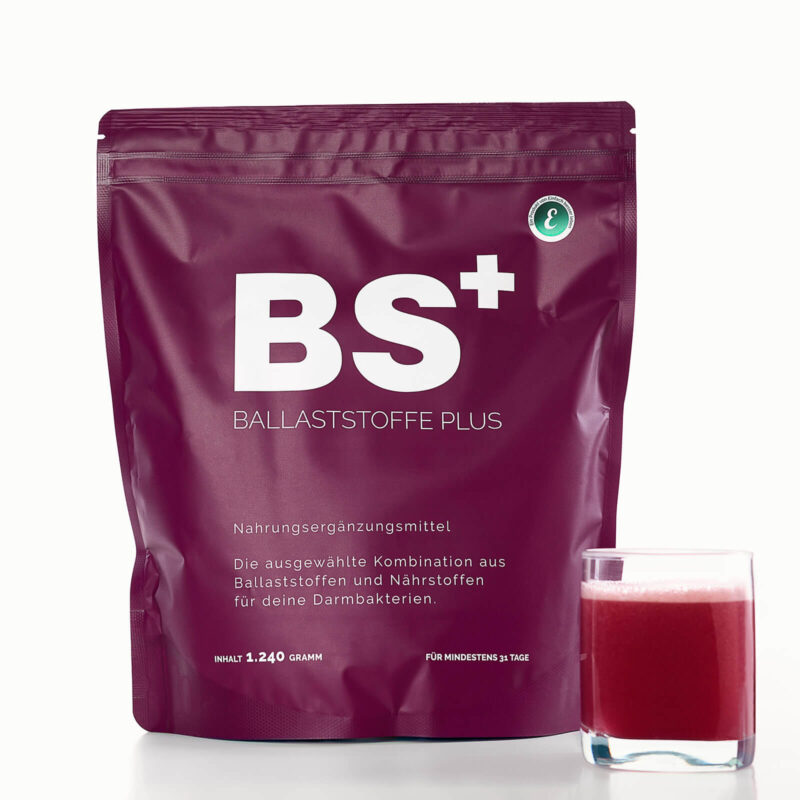
The revolutionary fiber formula
BS+ Dietary Fiber Plus
- Up to 20 g dietary fiber daily EXTRA
- Improved digestion and regular bowel movements
- Increased energy and vitality
- Better mood and mental clarity
- Support for your immune system
- Potential improvement in cholesterol and blood sugar levels
Simply stir into water twice a day - Your intestinal flora will thank you.
Warum BS+ bei Qi–Mangel?
Beim allgemeinen Qi–Mangel ist die Milz — das zentrale Verdauungsorgan der TCM — geschwächt und kann ihre Transformations– und Transportfunktion nicht mehr ausreichend erfüllen. Nahrung wird unvollständig umgewandelt, und aus dem Essen kann nicht genügend Qi gewonnen werden. Genau hier spielt der Darm eine entscheidende Rolle: Eine gestörte Darmflora schwächt die Milz–Funktion zusätzlich, weil Nährstoffe schlechter aufgenommen werden und trübe Feuchtigkeit im Verdauungstrakt entsteht — ein Teufelskreis, der den Qi–Mangel weiter verstärkt.
BS+ delivers 11 prebiotic fibers und unterstützt so gezielt den Aufbau einer vielfältigen Darmflora. Eine gut genährte Darmflora stärkt die Milz–Funktion, verbessert die Nährstoffaufnahme und hilft dem Körper, aus der Nahrung wieder mehr Qi zu gewinnen — die Grundlage für neue Energie und Vitalität.
Besonders wichtig bei Qi–Mangel:
- Stärkt die Darmflora als Basis für eine kräftige Milz–Funktion — damit aus der Nahrung wieder ausreichend Qi gewonnen werden kann
- Unterstützt die Transformation von Feuchtigkeit im Verdauungstrakt und beugt der Ansammlung trüber Feuchtigkeit vor, die das Qi zusätzlich blockiert
- Verbessert die Nährstoffaufnahme — damit Qi–stärkende Lebensmittel wie Reis, Hafer und gekochtes Gemüse ihre volle Wirkung entfalten können
Acupressure
Acupressure is acupuncture without needles. — you can apply them yourself at any time. By gently pressing on specific points, you activate the flow of energy in the meridians and strengthen the corresponding organs.
The following three points form the classic combination for strengthening qi and have been proven effective in TCM for centuries.
ACUPUNCTURE POINT: Ma 36
Stomach 36
Three Miles of the Foot — Zú Sān Lĭ
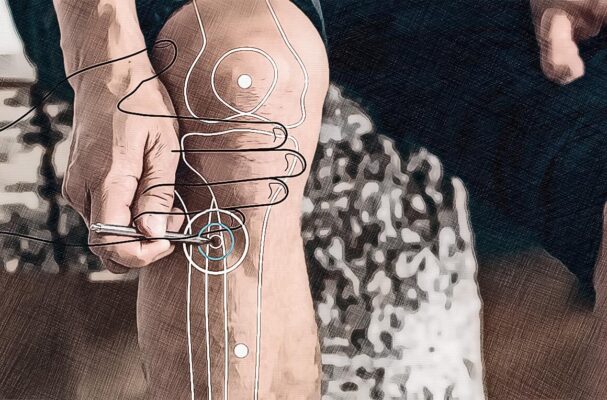
- The most important point for building up qi
- Strengthens the spleen and stomach
- Improves digestion
- Strengthens the immune system
- Helps with fatigue and weakness
Application:
Press firmly twice a day for 30–45 seconds. Ideal in the morning after getting up and at lunchtime to combat the midday energy slump.
ACUPUNCTURE POINT: KG 06
Concept vessel 06
Sea of Qi — Qì Hăi
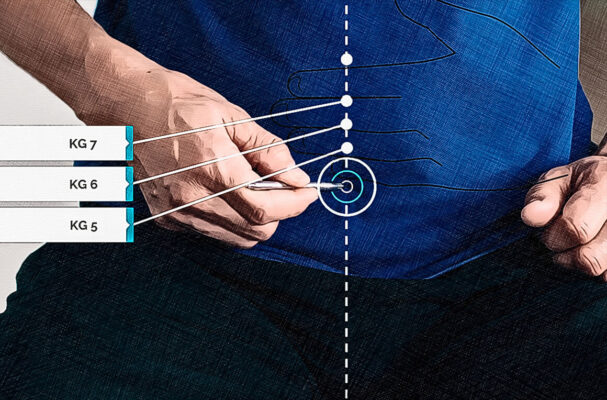
- The Sea of Energy — strengthens the Original Qi
- Strengthens Qi and Yang
- Regulates and moves the qi
- Additionally strengthens the spleen
- Affects all abdominal organs
Application:
Press firmly once a day for 30–45 seconds. Ideally in the evening before going to bed.
ACUPUNCTURE POINT: Lu 09
Lung 09
Great Abyss — Tài Yuān
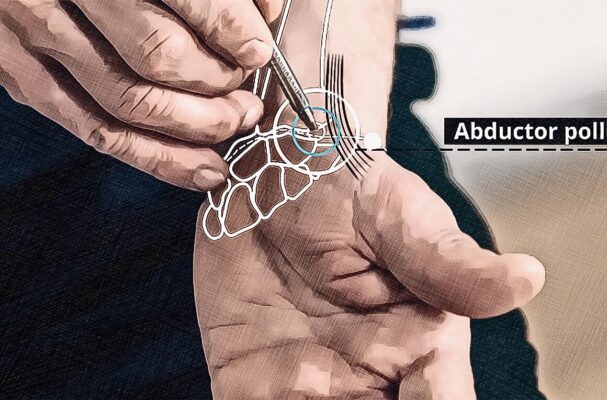
- Tonifies Qi and Yin of the lungs
- Strengthens the thoracic qi (heart and lungs)
- Promotes blood circulation
- Master point of the blood vessels
- Helps with cold hands and weak voice
Application:
Hold once a day for 30 seconds with medium pressure. Ideal as a short meditation break.
TIP
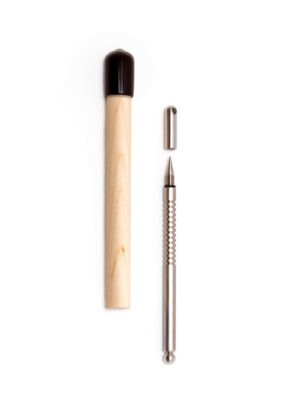
AkuPen
Acupuncture pen with video instructions
For even more intense stimulation You can use an AkuPen. The acupressure pen significantly enhances the effect of acupressure. With an extensive video library for over 80 acupuncture points.
Qi Gong
Qi Gong is moving meditation — gentle, flowing exercises that harmonize your energy flow and strengthen your qi. If you have a qi deficiency, these exercises help to build up new energy and store it in the body.
Regular practice of qigong (even just 10-15 minutes a day) has been shown to have positive effects on energy, digestion, and general well-being.
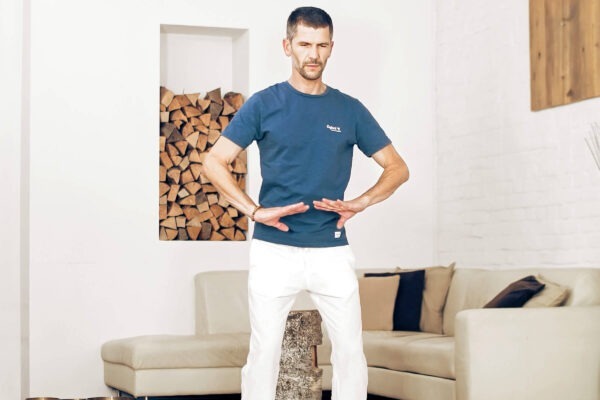
QI GONG: Exercise 1
Regulate Qi
Strengthens the spleen and stomach, reduces stress
Particularly helpful for:
- Fatigue and lack of energy
- Digestive weakness
- Stress and inner turmoil
- Flatulence and bloating
Effect:
This simple exercise strengthens the organ energies of the spleen and stomach, thereby improving your digestion. Perfect for short „energy breaks“ during the day — just 2 to 3 minutes can bring a lot of calm and give you strength.
QI GONG: Exercise 2
Connecting heaven and earth
Activates digestion and strengthens the core

Particularly helpful for:
- Tiredness after eating
- Digestive problems
- Heaviness in the legs
- Weak breathing
Effect:
This exercise stretches the spleen and stomach meridians, improves diaphragmatic breathing, and activates your digestive fire. It is best to do this between 7 and 11 a.m. — this is when the stomach and spleen are at their peak in the organ clock.
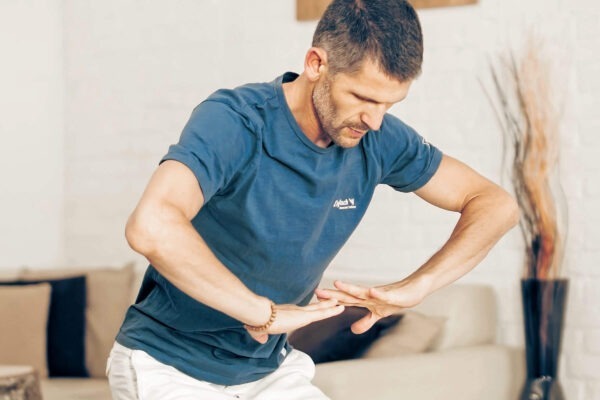
QI GONG: Exercise 3
Collect Qi
Builds up energy and stores it in the body
Particularly helpful for:
- General fatigue
- energy shortage
- Nervousness and restlessness
- Stress in everyday life
Effect:
In this exercise, you absorb vital energy from all directions and store it in your body. It is a perfect exercise for calming down, reducing stress, and building up new qi at the same time.
These Qi Gong exercises are specially selected for building up qi. They specifically strengthen the meridians of the spleen and stomach, promote qi production, and help you gather and store new energy in the body.
All exercises are particularly effective when practiced between 7 and 11 a.m. — this is the peak time for the stomach (7-9 a.m.) and spleen (9-11 a.m.) in the organ clock.
QI GONG:
When and how often?
In the morning (ideal):
- All 3 exercises as a sequence: approx. 15-20 minutes
- Or just 1-2 exercises: approx. 5-10 minutes
- Preferably between 7 and 11 a.m. (stomach/spleen time)
In between:
- Individual exercises as needed (e.g., after eating)
- „Regulate Qi“ for quick energy boosts
Regularity is more important than duration:
- Better to do 10 minutes every day than 60 minutes once a week.
- After 2-3 weeks, you will notice the first changes.
- After 3 months of regular practice: significant improvement
Pro tip: Combine qi gong with conscious abdominal breathing. This significantly enhances the effect on the digestive organs and energy build-up.
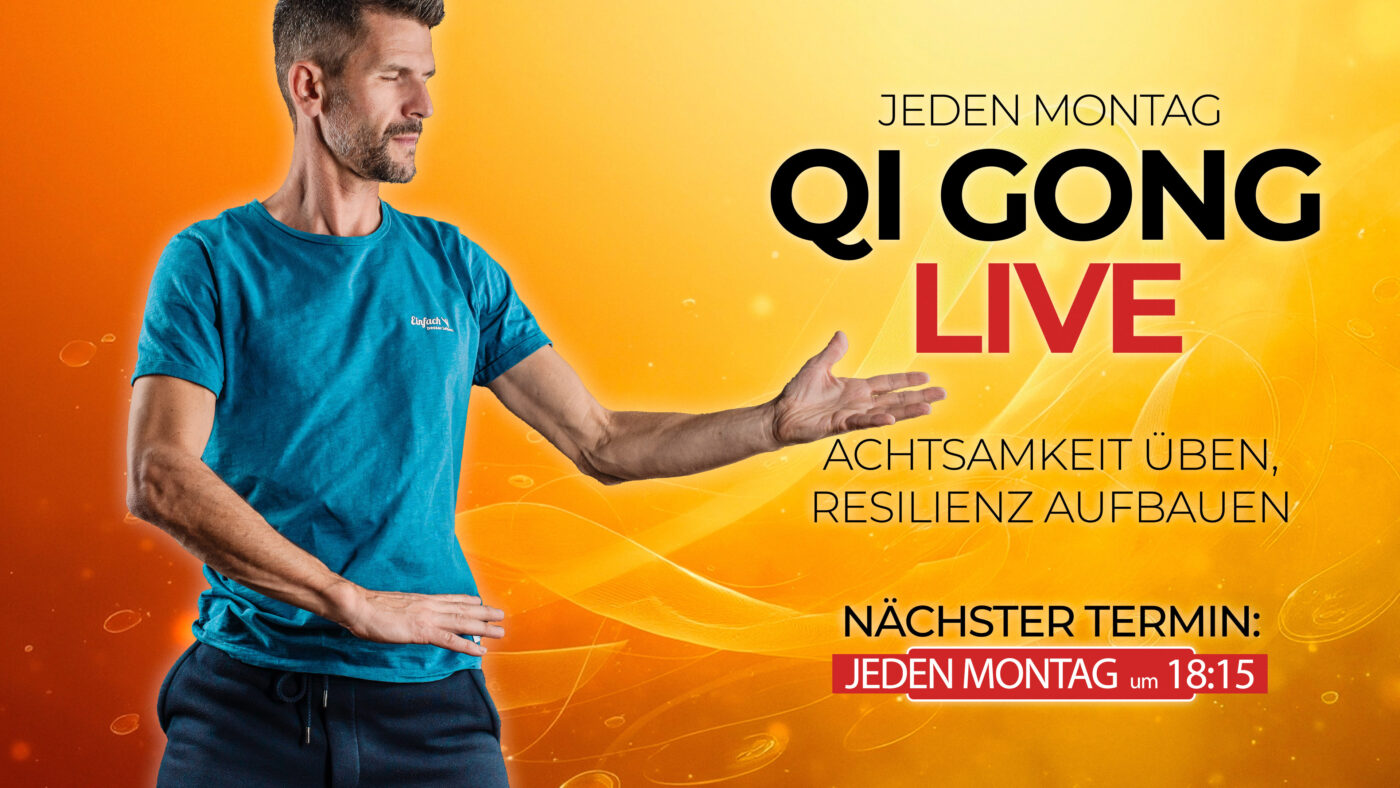
LIVE EVERY MONDAY: QI GONG WITH WOLFGANG
Every Monday at 6:00 p.m. Let's practice together live on YouTube. Among other things, Wolfgang will guide you through a complete qigong sequence — free of charge and suitable for all levels.
Why participate live? ✓ Practicing together is motivating ✓ Wolfgang explains the exercises in detail ✓ You can ask questions in the live chat ✓ Regular appointments help with your routine
More about Qi Gong LiveMeridian Yoga — The Yoga of TCM
Meridian Yoga combines classic yoga poses with the energy concept of traditional Chinese medicine. — more dynamic than traditional yoga and focused on improving health and energy levels.
Targeted stretches along the twelve main meridians open blocked energy pathways, strengthen organ functions, and increase permeability in fascia, joints, and muscles.
Accompanied by calm breathing and mindful body awareness, Meridian Yoga has a particularly balancing effect on stress, exhaustion, and inner restlessness. The gentle style is suitable for all ages—even without prior experience—and helps you strengthen your core, become more flexible, and let your life energy flow more freely again.
MERIDIAN YOGA: Exercise 1
The tree with acupressure
Strengthens balance and digestion at the same time
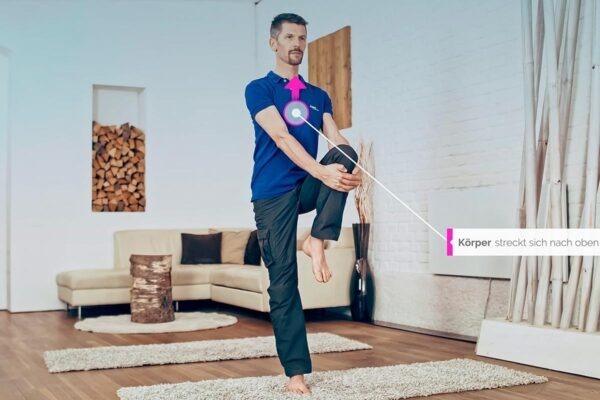
Particularly helpful for:
- Strengthens leg meridians (stomach, spleen)
- Activates Ma 36 (most important point for building up qi)
- Improves balance and grounding
- Promotes inner peace
Effect:
In this variation of the tree pose, you hold the Ma 36 acupuncture point on your lower leg while balancing. This combines balance training with targeted acupressure—a double effect for building up your qi!
MERIDIAN YOGA: Exercise 2
The bow
Intense stretching of the front

Particularly helpful for:
- Feeling of fullness and pressure in the stomach
- Reflux and heartburn
- Lack of energy and fatigue
- Tension in the abdominal area
Effect:
This backward bend stretches the entire stomach meridian, which runs along the front of the body. The stretch stimulates the flow of qi and strengthens the digestive organs.
Both exercises activate the stomach meridian, which runs along the front of the body and legs. Stretching stimulates the flow of qi and strengthens organ function.
Particularly effective: Hold each position for 3-5 breaths, breathing deeply into your abdomen.
MERIDIAN YOGA:
When and how often?
Best time:
- In the morning after getting up (7-11 a.m. is the time of the stomach meridian)
- Or in the evening before going to bed (relaxing)
Duration:
- Hold each position for 3-5 breaths.
- Complete sequence: 10-15 minutes
- 3-5 times per week for best results
Important:
- Never practice on a full stomach (wait at least 2 hours after eating).
- Breathe deeply and evenly during the positions.
- Stretching should be comfortable, never painful.
Pro tip: Combine Meridian Yoga in the morning with Qi Gong — first the flowing Qi Gong movements, then the slightly more dynamic Meridian Yoga exercises for maximum Qi build-up.
Nutrition according to TCM
„Let food be your medicine.“ — this principle has been applied in TCM for thousands of years. Proper nutrition is the basis of every TCM treatment and often the key to healing.
Nutrition is particularly important if you have a qi deficiency: your spleen needs warm, easily digestible food, to regain strength and produce sufficient qi.
What you eat, HOW you eat and WHEN What you eat—all of this affects your digestive power and energy.
The golden rules for a strong spleen
What is good for you:
Warm and cooked
- Eat all food warm or lukewarm
- Warm oatmeal in the morning instead of cold cereal
- Cooked vegetables instead of raw vegetables
- Soups and stews are ideal
Warm food eases digestion
The right grain
- Oats, millet, rice, quinoa (all cooked)
- Whole grain bread (toasted is better than fresh)
Grains are the basis for building qi
Sweet root vegetables
- Carrots, pumpkin, sweet potatoes
- Parsnips, beetroot
- Fennel (also has a flatulence-reducing effect)
Natural sweetness nourishes the spleen
Easily digestible proteins
- Chicken, turkey (both warming)
- Beef (tonic)
- Eggs (neutral)
- Fish (easily digestible)
In bulk for Qi building
Warming spices
- Ginger (ignites the digestive fire!)
- Cinnamon (warms the center)
- Cardamom (moves Qi)
- Caraway, fennel, anise (against flatulence)
Spices = natural digestive aids
What you should avoid:
Cold and raw
- Ice-cold drinks
- Raw food (especially in the morning)
- Salads for breakfast
- Smoothies from the refrigerator
- Ice cream, frozen food straight from the freezer
Extinguish the digestive fire!
Dairy products
- cow's milk
- Yogurt (especially cold)
- Cottage cheese, cream cheese
- Cream in large quantities
Produces moisture and mucus
White flour and sugar
- White bread, white flour pasta
- Industrial sugar, sweets
- Ready-made products with hidden sugar
Stresses the spleen, generates moisture
Hard to digest
- Fried, greasy food
- Pork (very moisturizing)
- Portions that are too large
Overwhelming the weakened spleen
Too much coffee
- More than 2 cups daily
- Coffee on an empty stomach
Weakens the spleen qi in the long term
HOW YOU SHOULD EAT:
Regular meals
- 3 fixed meals a day
- Breakfast is the most important meal of the day!
- Have breakfast between 7 and 9 a.m. (stomach time)
- Dinner before 7 p.m.
Mindful eating
- Chew slowly (at least 20 times per bite)
- Without distractions (no cell phone, TV)
- In a peaceful and relaxed atmosphere
- Don't eat when you're stressed
Digestion begins in the mind!
Drink properly
- Warm or lukewarm water
- Herbal tea (ginger, fennel)
- Do not drink while eating
- At least 30 minutes before or after eating
Drinks dilute digestive juices
IDEAL MENU FOR ONE DAY:
Breakfast (7-9 a.m.):
- Warm oatmeal with cinnamon, stewed apples, and walnuts
- In addition: hot water with fresh ginger
Lunch (12:00–1:00 p.m.):
- Steamed vegetables (carrots, fennel, pumpkin) with rice
- In addition: fried chicken with ginger and herbs
- Or: Vegetable soup with millet and fresh herbs
Dinner (6–7 p.m.):
- Steamed fish with potatoes and root vegetables
- Or: Vegetable stew with quinoa
- In addition: fennel tea
Snack if needed:
- Stewed pear compote with cinnamon
- Or: Handful of nuts (roasted)
The most important rule when changing your diet is:
Start with ONE step!
Don't change everything at once.
Our suggestion for getting started:
- Warm breakfast instead of cold cereal — 2 weeks
- Warm water instead of cold drinks — 2 weeks
- Reduce raw salads — 2 weeks
Step by step, you will notice how your digestion improves and your energy levels increase.
Your spleen will thank you!
RECIPE: THE PERFECT SPLEEN QI BUILDING PORRIDGE
Ingredients:
For 1 person
- 50g oatmeal
- 300ml water or almond milk
- 1 pinch of cinnamon
- 1 pinch of cardamom
- 1 small apple (peeled, stewed)
- 1 teaspoon honey
- Handful of walnuts (chopped)
- Optional: 3 thin slices of fresh ginger
Preparation:
- Cut the apple into small pieces and add a little water.
Sauté for 5 minutes - Bring oatmeal to a boil with water/almond milk.
- Add cinnamon and cardamom
- Simmer on low heat for 5-8 minutes.
- Stir in the stewed apple pieces.
- Sweeten with honey
- Top with walnuts
Effect:
Ignite the digestive fire
Builds up spleen qi
Nourishes the center sustainably
Best eaten every morning between 7 and 9 a.m.!
Breathing
Breathing is the bridge between body and mind. In TCM, we say: „The lungs govern qi“ — through conscious breathing, you can directly influence your energy flow, harmonize all organ systems, and activate your self-healing powers.
Studies show: Proper breathing activates the parasympathetic nervous system (rest & regeneration), massages the internal organs from within, improves oxygen supply, and reduces stress hormones. The good news: Just 5–10 minutes a day can have a measurable effect on your overall well-being.
Recommended breathing techniques
ABDOMINAL BREATHING — The basis for every breathing technique
Natural breathing
Abdominal breathing is the most natural and effective form of breathing. With every breath, you massage your internal organs, activate the flow of energy, and bring qi to the center of your body (dantian).
Wolfgang shows you step by step, How to learn abdominal breathing correctly—lying down to start with, then later also sitting and standing.
Duration: 9 minutes

4–7–8 BREATHING — Calms you down immediately
Breathing to fall asleep and combat inner restlessness
4–7–8 breathing (inhale for 4 seconds, hold for 7 seconds, exhale for 8 seconds) is known as a „natural sedative.“ This special rhythm calms your nervous system in just a few minutes—perfect for stress, racing thoughts, or trouble falling asleep.
Perfect for the evening or whenever you want to calm down quickly.
Duration: 9 minutes
To the interactive videoBOX BREATHING — For inner coherence
Professional breathing for focus and calmness
Box Breathing (4 seconds on, 4 seconds hold, 4 seconds off, 4 seconds hold) combines activation and relaxation in perfect balance. This method is used by elite soldiers, athletes, and executives to remain calm and focused even in extremely stressful situations.
Train your CO₂ tolerance and brings the heart, breathing, and nervous system
into a harmonious state.
Duration: 9 minutes
To the interactive videoCOHERENT BREATHING — Harmonizes body & mind
Breathing against burnout
With coherent breathing You breathe in for 5.5 seconds and out for 5.5 seconds. This rhythm brings your heart and breathing into perfect synchrony—a state that science refers to as „coherence.“ This method is also used in clinics for burnout treatment and stress reduction.
Proven to improve Heart rate variability (HRV) — the most important marker for stress resistance, health, and life expectancy.
Duration: 14 minutes
To the interactive video
COHERENT BREATHING Around the clock
Our 24/7 livestream on coherent breathing runs non-stop. You can tune in at any time and join in right away.
Perfect for:
✓ Spontaneous breaks to catch your breath in between
✓ If you need help breathing
✓ As background while working
✓ For falling asleep (calms the nervous system)
✓ For regular daily practice
relaxation
When your body is relaxed, all organ systems can function optimally. Chronic tension blocks your body's self-healing powers and keeps you in a state of constant stress. Through targeted relaxation techniques, you activate the parasympathetic nervous system and send your body the signal: „Now I can regenerate, heal, and build strength.“
Progressive muscle relaxation is one of the most researched relaxation methods and has been used successfully for over 100 years. It helps you to recognize tension, actively release it, and achieve a state of deep relaxation—whenever you want.
Recommended relaxation technique
PROGRESSIVE MUSCLE RELAXATION (PMR)
The scientifically proven relaxation method
Progressive muscle relaxation according to Jacobson is one of the most widely researched relaxation techniques worldwide. By deliberately tensing and relaxing individual muscle groups, you learn to consciously perceive tension and actively release it.
Proven effect:
Lowers blood pressure, improves sleep, reduces chronic pain, relieves tension, and activates self-healing powers. Successfully used by psychologists to treat anxiety disorders, depression, and chronic pain.
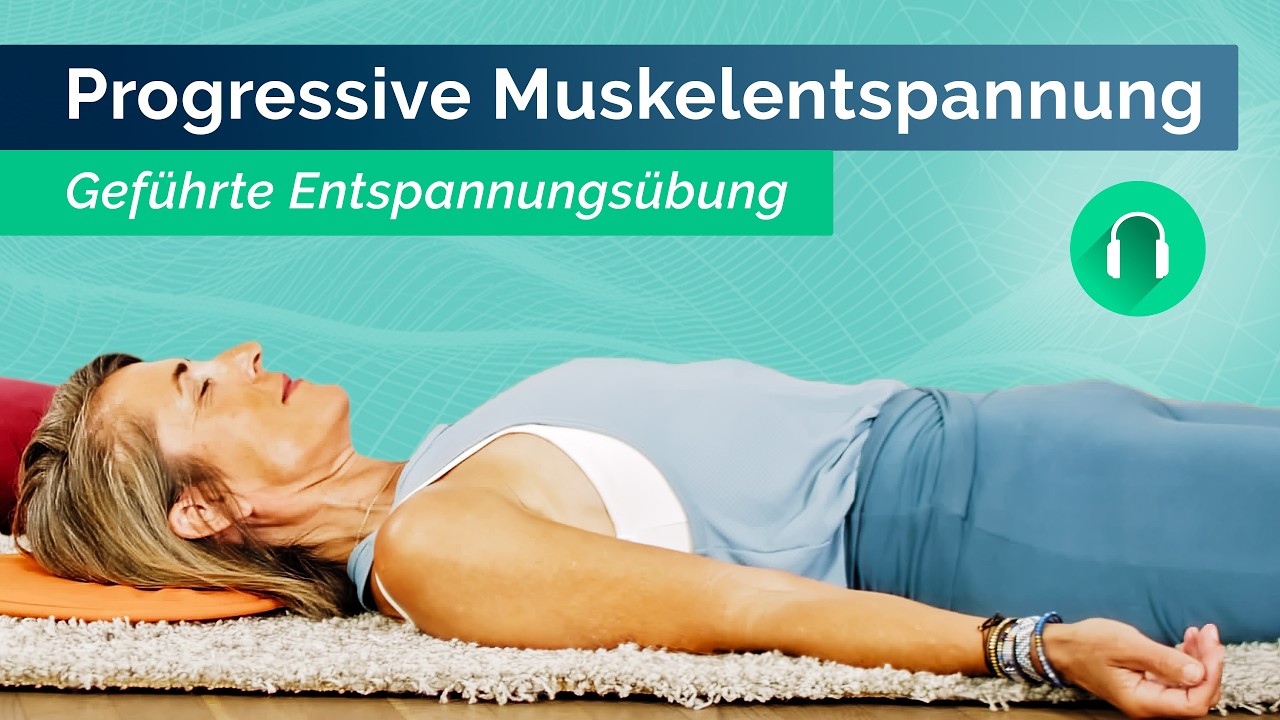
Maria guides you step by step through the entire exercise—perfect for beginners and advanced practitioners alike.
Duration: 23-minute complete guide
To the guided PMRMeditation
Meditation calms the mind — and a calm mind harmonizes the body. In TCM, we know that every emotion affects a specific organ. Through regular meditation, you learn to break out of destructive thought patterns, find emotional balance, and strengthen your inner core.
Modern studies confirm: Meditation has been proven to change brain structure, reduce stress hormones, strengthen the immune system, and improve self-healing powers. Just 10 minutes a day can change your life forever.
Recommended meditations
GUIDED MEDITATIONS FOR EVERY DAY
Your personal meditation library
We have a complete Playlist with over 60 guided meditations, breathing exercises, and relaxation techniques—from short 5-minute meditations for in between to deep 30-minute sessions for intensive practice.
In the playlist you will find:
- Morning meditations for a mindful start to the day
- Meditations for restful sleep
- Breathing meditations for inner peace
- Meditations against stress, brooding, and worries
- TCM standing meditations for all 5 elements
- Body scan and body journeys
- Healing meditations to activate self-healing powers
- Special breathing techniques (4–7–8, coherent breathing, bee breathing)
Perfect for beginners and advanced practitioners. Choose the right meditation for you depending on your time, the time of day, and your needs.
To the meditation playlistQi is the root of human beings.
If the root is strong, the tree will thrive. If qi flows abundantly, the body will be healthy.
– From the HUANG DI NEI JING
(The Yellow Emperor's Classic of Internal Medicine)
More tips for your everyday life
In addition to traditional TCM treatment methods There are many small everyday habits that can either support or block your qi development. Often, it is the small, consistent steps that make the difference.
Meditations and breathing exercises for building up qi
🧘 Bauchatmung (Die Basis)
Deep abdominal breathing is fundamental for building up qi:
- Sit or lie down comfortably
- Place one hand on your stomach, one on your chest
- Breathe in slowly through your nose — your belly will rise.
- Exhale slowly through your mouth—your belly will lower.
- Keep your chest as still as possible.
- 5–10 minutes daily, ideally in the morning
🌬️ 4–7–8 Atemtechnik
This technique calms and gathers qi:
- Inhale for 4 seconds (through the nose)
- Hold your breath for 7 seconds
- Exhale slowly for 8 seconds (through your mouth)
- 4–8 repetitions
- Ideal before bedtime or when stressed
✨ Gathering Qi in the Dantian
Simple meditation to strengthen qi:
- Sit upright, hands on lower abdomen (3 fingers below navel)
- As you inhale, imagine golden light flowing into your body.
- Collect this light in the lower dantian as you exhale.
- Feel the warmth and energy building up there
- 10–15 minutes daily
💤 Schlaf und Erholung
Your qi regenerates at night:
- Go to bed before 11 p.m. (important for qi regeneration)
- 7–8 hours of sleep per night
- Short nap (10–20 min) when feeling very tired
- Regular sleep pattern, even on weekends
- No heavy meals after 7 p.m.
⏰ Rhythm and timing
The body loves regularity:
- 7–9 a.m.: Hot breakfast (the most important meal of the day!)
- 12–1 p.m.: Hot lunch
- 6–7 p.m.: Light, warm dinner
- Stick to regular meal times
- Don't skip meals
🚶 Bewegung — sanft, aber regelmäßig
When you have a qi deficiency, the rule is: build up instead of exhausting yourself!
- Walking in the fresh air (20–30 minutes daily)
- Qi Gong — perfect for building up qi
- Gentle yoga or tai chi
- Light swimming (water not too cold)
- After eating: Short digestive walk (10 min)
❌ Avoid in case of qi deficiency:
- Intense cardio or marathon
- Extreme strength training
- Exercise until exhaustion
- Training on an empty stomach
🌡️ Wärme schützt dein Qi
Cold weakens the qi — protect yourself:
- Warm drinks instead of cold ones (even in summer)
- Keep your core warm (kidney warmer, undershirt)
- Hot water bottle on the stomach when feeling cold
- Warm foot baths in the evening
- Avoid drafts and air conditioning
📵 Energie–Management
Do not consume more Qi than you build up:
- Plan regular breaks into your daily routine
- Learning to say no — setting boundaries
- Avoid multitasking
- Reduce screen time
- Conscious cell phone-free times
Emotional aspects of qi deficiency
💭 Die emotionale Seite verstehen
Qi deficiency and emotions influence each other:
- Fatigue can lead to listlessness and despondency.
- Brooding and excessive thinking weaken the qi.
- Worries tie up energy and exhaust the spleen.
- Even positive emotions in excess can be exhausting.
🌱 Was dein Qi stärkt
Positive emotional habits:
- Gratitude exercises in the morning or evening
- Spending time in nature (forest bathing)
- Maintain social contacts (but don't exhaust them)
- Creative activities without pressure to perform
- Cultivating joy in small things
⚡ What weakens your qi
You should observe these emotional patterns:
- Constant brooding and rumination
- Perfectionism and excessive demands
- Feeling responsible for everything
- Unable to say no
- Suppressed feelings
🧘 Praktische Übungen
Small exercises for everyday life:
- Thought stopping: When you find yourself brooding, consciously think of something pleasant.
- Body scan: Briefly scan your body three times a day
- Grounding: Stand barefoot on the grass (if possible)
- Mindfulness while eating: Just eat, don't work at the same time
- Practicing self-compassion: Be gentle with yourself
💡 Important to know
Be patient with yourself. Building up your qi takes time—usually 3–6 months of consistent practice. Don't expect miracles overnight, but rejoice in small improvements. Every day with good habits is a step in the right direction.
For optimal treatment progress
TCM is not a quick fix for symptoms., but rather a holistic healing process. You will achieve the best results if you consistently integrate the treatment into your daily routine and give your body time to regenerate.
Integration into everyday life
Start with ONE step
Don't try to change everything at once! That's overwhelming and leads to
usually leads to you giving up. Instead:
- Weeks 1-2: Establish a warm breakfast
- Weeks 3-4: Warm water instead of cold drinks
- Weeks 5-6: Daily qigong practice (5-10 min)
- Weeks 7-8: Integrate acupressure Ma 36
- From week 9: Add further methods as needed
Realistic expectations
After 2-3 weeks: First improvements noticeable
- Less fatigue after eating
- Improved digestion
- A little more energy
After 6-8 weeks: Significant improvements
- More stable energy throughout the day
- Improved digestive capacity
- Less cravings for sweets
After 3-6 months: Sustainable healing
- Qi is significantly strengthened
- New habits are established
- Body has regenerated
TCM vs. Western medicine
TCM and Western medicine are not mutually exclusive—they complement each other!
When Western medicine is important:
- In acute emergencies
- In case of structural damage
- In case of infections
- For accurate diagnoses (laboratory, imaging)
Where TCM has its strengths:
- In case of functional disorders
- For chronic complaints
- For prevention
- For holistic healing
Ideal: Combine both systems! Use Western medicine for
Acute treatment and accurate diagnosis, TCM for lasting healing
and strengthening the body's self-healing powers.
Important: Never stop taking prescribed medication without consulting your doctor first!
Talk to your doctor when you start TCM treatment.
TCM diagnosis for professionals
Syndrome differentiation according to TCM:
Tongue: Pale, possibly swollen with teeth marks, thin white coating
Pulse: Weak (Ruo Mai 弱脉), especially in the right middle position (spleen)
Pathomechanism:
The spleen can no longer adequately fulfill its transformation and transport function (Pi Zhu Yun Hua 脾主运化). The ascending qi (Qing Qi 清气) is no longer powerfully transported upward, leading to fatigue and „sagging.“ At the same time, pathogenic dampness (Shi 湿) arises due to incomplete transformation.
Treatment principle:
Bu Pi Yi Qi (补脾益气) — Strengthen the spleen and tonify qi
Classic recipe:
Si Jun Zi Tang (四君子汤) as a base
Important modifications depending on accompanying symptoms:
- For dampness: + Chen Pi, Fu Ling
- For cold weather: + Gan Jiang, Rou Gui
- For food stagnation: + Shan Zha, Shen Qu
Every step counts
Your body WANTS to heal—you just have to create the right conditions for it to do so.
Remember:
👣 Every little step counts
You don't have to be perfect. Even one warm meal a day is better than none. Even 5 minutes of qigong is better than no exercise at all.
⏳ Patience pays off
It took years for your body to get into this state. Give it time to regenerate. Healing takes time, but it WILL happen.
🎯 Focus on what you can DO
Don't concentrate on what you are doing „wrong". Focus on every positive step you take.
💚 Be good to yourself
Perfection does not exist. It is acceptable to have an off day occasionally. Tomorrow is a new day when you can continue.
🤝 You are not alone
Thousands of people are walking this path with you. For over 2,000 years, TCM has been helping people like you who want to regain their health.
Measure your healing progress

To track your progress with treatment, we recommend that you repeat the TCM analysis after about 3 months.
Why is this important?
- You can see how your condition has improved.
- You can adjust the treatment as needed.
- It motivates you to keep going
- You recognize which measures work best
⚠️ Important: Your answers today will be stored in encrypted form in a code that you received by email. You can only measure your progress later with this code. Keep the email safe!
Activate reminder:
<>In 12 weeks, you'll receive an email with a link to the TCM analysis. When you fill it out, you can enter your personal health code—then you'll see a comparison overview at the end:
→ Your new values
→ Your scores from today's test
→ Direct changes
This allows you to see at a glance whether your symptoms
have improved!
🔒 YOUR DATA IS SAFE
We store:
✓ Only your email address for reminders
✓ The date for shipping
We do NOT store:
✗ Your analysis results
✗ Your personal health data
✗ The connection between email and diagnosis
All analysis data is completely anonymous and is not linked to your email address.

Newsletter
Stay up to date with our newsletter. Besides useful tips and tricks for training and your everyday life, you won't miss any of our new releases.
We are here for you
Do you have questions about your diagnosis or treatment?
Not sure which method is right for you?
Contact us — We're happy to help!