





Summer Rituals for the Heart and Soul
So the autumn melancholy never gets a chance

Not one more TASK.
But a moment that only DIR heard.
In TCM, we call what summer depletes, Shen.
Your spirit. Your inner calm. The light in your eyes. And Shen needs more than sleep and vacation.
It needs nourishment. It needs rituals. It needs moments that belong only to it.
Not one more item on your to-do list. Instead, a moment that belongs only to you.
🕊️ Shen — your spirit, which dwells in the heart
You've read a lot about Shen so far.
You know that it dwells in the heart. That it needs rest. That summer challenges it with its heat, its intensity, its short nights.
When Shen is nourished, you are clear. Present. Calm. You sleep deeply and wake up refreshed. You are present for what you're doing. You are, quite simply, yourself.
When Shen is exhausted, it flutters. Like a bird that can't find a branch. Thoughts go around in circles. Sleep is light. You feel scattered, "beside yourself," like a stranger in your own life.
Summer is the season of Fire. Everything pushes outward, upward, into the light. That is wonderful — joy of life, energy, connection.
But it can also be dangerous.
Shen is drawn outward. It goes along into the world, into Yang, into the bright. And at some point — if it has been out for too long — it no longer finds its way back.
- Heat rises to the Heart. It disturbs Shen directly. It becomes restless.
- The nights are too short. Shen does not have enough time to come home.
- Yin becomes depleted. And Yin is what cools and anchors Shen.
- Week after week. Unnoticed. Gradually.
- Until one day you wake up and notice: something is missing.
🍂 Why this matters now — a look at autumn
In TCM, each season prepares the next one.
What you nourish in summer, you carry into autumn. What you deplete in summer will be missing from you when the leaves fall.
Autumn is the season of the Metal element. The season of the Lung. The season of letting go, of withdrawal, of reflection.
That sounds lovely. And it can be wonderful.
But only if you bring something with you.
When Shen is not nourished in summer:
Autumn melancholy hits you with full force. Not the gentle wistfulness that belongs to autumn, but an emptiness that lingers. The darkness weighs on you because there is no inner light. Withdrawing becomes a burden instead of a rest.
Infections come, one after another. The Lung enters its season empty. Dry cough, brittle skin, susceptibility to whatever comes along.
Winter looks like a mountain. You have no reserves. No depth. No substance.
When Shen is nourished in summer:
Autumn becomes harvest time. You gather what you have sown. The darkness is no threat — it is shelter. You return home, to yourself.
Melancholy? A gentle visitor who comes and goes. Not an intruder that stays.
Your defenses are strong. Your Lung is full. Winter? A friend.
You are now preparing what you will harvest in autumn.
With small rituals. Every day.
✨ 12 Rituals for Heart and Soul
No big projects. No optimization programs. No more items on your to-do list.
Instead: moments. Small islands in the day. That nourish your mind rather than exhaust it.
12 rituals. For morning, midday, evening and night.
You don't have to do them all. Pick one. Try it for a week. Notice the difference.
That's all it takes.
🌅 Morning
1. Slow Waking
Don't jump up right away. Don't reach for your phone right away.
Stay lying down for a moment. Open your eyes. Arrive. Notice that a new day is beginning, and that you are here to live it.
Your mind needs time to rise up out of the depths of the night. If you yank it up, you disturb it from the very start.
- 3 deep breaths before you move
- Stretch, roll around, feel your body
- Get up first, then phone
One minute that can change the whole day.
2. The First Glass of Water
A glass of warm water on an empty stomach. Sip it slowly. Be mindful.
Overnight you lose fluid, and the body becomes dry. Warm water gently wakes it up, moistens it, and gets everything flowing.
And it is a first mindful act, a moment for yourself before the world makes its demands.
- Room temperature or slightly warm
- Before coffee, before breakfast
- Slowly, don't gulp it down
The gentlest start you can give yourself.
3. Three Minutes of Stillness
Three minutes. No more.
Sitting, standing, lying down: it doesn't matter. But do nothing. Don't have to think about anything. Just be there.
In stillness, the spirit gathers before it goes out into the world. Three minutes is enough, if you are honest about it.
- Set a timer (gentle tone)
- Close your eyes or soften your focus
- Breathe. Nothing else.
Three minutes that weigh more than an hour of rushing.
☀️ Midday
4. The real break
Eat, but not at your desk. Not in front of a screen. Not on the move.
Instead: sit. Chew. Taste.
When you work while eating, you split your mind. Part of it is here, part of it is there. It is nowhere.
- Step away from your workspace
- Turn your phone over
- Really taste the first three bites
Eating becomes meditation when you allow it.
5. Close your eyes for five minutes
After eating. Don't sleep, rest. Close your eyes. Do nothing.
The siesta is not a luxury. It is thousands of years of wisdom. In the hottest part of the day, body and mind need a break.
You don't have to sleep. You only have to stop.
- Lean back or lie down
- Close your eyes
- 5 minutes
The shortest siesta is better than none.
6. A Moment of Joy
Sometime between 11 and 1 o'clock: Something that brings you joy.
Not what you should do, but what you want to do.
Joy is the emotion of the Heart. It nourishes the Shen directly. Not excited euphoria, but quiet, deep joy. A song you love. A conversation that makes you smile. A view out the window. A moment that belongs only to you.
- Listen to music
- Call someone
- Step outside for a bit
- Something that is just for you
Joy is not a waste. It is nourishment.
🌆 Evening
7. The Threshold
A mindful moment that separates the day from the evening.
Without a threshold, everything flows into everything else. You are still working during dinner. You think about emails while playing with the kids. You never quite arrive.
The threshold says: here something ends. Here something else begins.
- Shower or wash your face, rinsing away the old
- Change your clothes, an outward sign
- Take three deep breaths at the front door
Rituals need boundaries. Boundaries create freedom.
8. The Light Evening Meal
Früh essen. Leicht essen. Warm essen.
Wenn der Magen nachts arbeiten muss, kann der Geist nicht ruhen. Er bleibt wach, wenn er schlafen sollte.
Die alten Meister aßen abends wenig. Sie wussten: Die Nacht gehört der Ruhe, nicht der Verdauung.
- Vor 19 Uhr, wenn möglich
- Warm and cooked
- Nicht zu viel — 70% satt reicht
Wer leicht isst, schläft tief.
9. Die letzte Stunde
Die Stunde vor dem Schlafengehen: Keine Bildschirme. Kein grelles Licht. Keine aufregenden Gespräche.
Bildschirme stimulieren den Geist. Blaues Licht sagt: Tag. Nachrichten sagen: Gefahr.
Dein Geist braucht Zeit, um zu sinken. Eine Stunde ist nicht viel — aber sie macht den Unterschied.
- Handy in einen anderen Raum
- Gedimmtes Licht, Kerzen
- Lesen, ruhige Musik, sanftes Gespräch
- Tee: Lavendel, Melisse, Chrysantheme
Die letzte Stunde gehört dir. Nicht dem Internet.
🌙 Nacht
10. Die gleiche Zeit
Zur gleichen Zeit ins Bett gehen. Jeden Abend. Auch am Wochenende.
Der Körper liebt Rhythmus. Der Geist liebt Rhythmus. Wenn du jeden Tag zur gleichen Zeit ruhst, weiß der Körper: Jetzt ist die Zeit. Er bereitet vor. Er lässt los.
Unregelmäßigkeit verwirrt. Der Geist weiß nicht, wann er landen soll.
- Eine Zeit wählen — und einhalten
- Idealerweise vor 23 Uhr
- Maximal 30 Minuten Abweichung
Rhythmus ist das Fundament. Alles andere baut darauf auf.
11. Das Herunterkühlen
Körpertemperatur senken, bevor du schläfst.
Warmes Bad oder Dusche — danach kühlt der Körper ab. Das ist das Signal: Schlafenszeit.
Und: Wasser reinigt nicht nur den Körper. Es reinigt auch die Energie des Tages. Die Gespräche, die Eindrücke, die Sorgen — sie fließen ab.
- 20–30 Minuten vor dem Schlafengehen
- Warm, nicht heiß
- Lavendel im Wasser oder als Öl danach
Das Wasser nimmt, was du nicht mehr brauchst.
12. Der letzte Gedanke
Vor dem Einschlafen: Ein Moment der Dankbarkeit.
Eine Sache, die heute gut war. Nur eine.
Womit du einschläfst, trägt der Geist in die Nacht. Sorgen? Er arbeitet. Dankbarkeit? Er ruht.
Es muss nichts Großes sein. Nur etwas Wahres.
- Close your eyes
- Fragen: Was war heute gut?
- Eine Sache finden — auch an schweren Tagen
- Dabei bleiben, bis du einschläfst
Der letzte Gedanke ist der mächtigste.
📍 Akupressur — 3 Minuten am Abend
Zwei Punkte. Drei Minuten. Jeden Abend.
Yìn Táng (Siegelhalle)
- Zwischen den Augenbrauen
- 60 Sekunden sanfter Druck
- Calms the mind, promotes sleep
He 07 - Shén Mén (Gate of the Spirit)
- Handgelenk, Innenseite, am Kleinfinger–Rand
- 60 Sekunden pro Seite
- DER Punkt für innere Ruhe
Order:
- Yìn Táng — 60 Sekunden
- He 07 rechts — 60 Sekunden
- He 07 links — 60 Sekunden
- 3 deep breaths
Das ist alles. Jeden Abend. Dein Geist wird es dir danken.
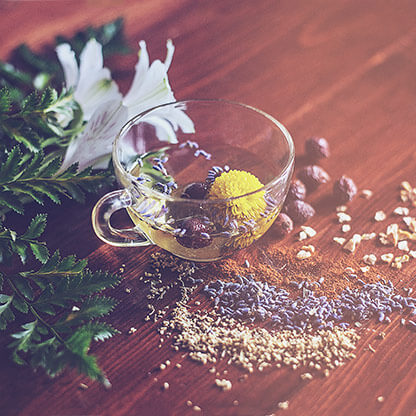
🍵 Tees für Herz und Seele
Eine Tasse am Abend. Langsam trinken. Ankommen.
- Lavender — beruhigt, kühlt, lässt den Geist landen
- Lemon balm — sanft, stimmungsaufhellend, löst Anspannung
- Chrysantheme mit Goji — kühlt den Kopf, nährt die Substanz
- Lindenblüte — öffnet, entspannt, geborgen
- Weißer Tee — sanft, nährend, für erschöpfte Tage
🚨 Note: This post is intended for informational and educational purposes only and is not a substitute for medical or therapeutic advice, diagnosis, or treatment. If you experience any health issues during pregnancy or while breastfeeding, or if you are taking any medications, please consult a doctor or a qualified therapist beforehand.
💫 The West Bridge
What TCM has observed for thousands of years has been confirmed by modern research:
Schlafhygiene. Kein Bildschirmlicht, regelmäßige Zeiten, kühle Temperatur — alles, was die Schlafforschung empfiehlt, findet sich in diesen Ritualen.
Neuroplastizität. Rituale verändern das Gehirn. Regelmäßig wiederholte Handlungen schaffen Pfade. Der Körper „erwartet“ die Ruhe — und bereitet sie vor.
Vagus nerve. Tiefes Atmen, Selbstberührung, warme Getränke — all das aktiviert den Parasympathikus. Der Körper schaltet von „Kampf“ auf „Ruhe“.
Dankbarkeit. Studien zeigen: Dankbarkeitspraktiken verbessern den Schlaf, reduzieren Angst, stärken die psychische Gesundheit.
The language is different. The wisdom is the same.
💫 The deeper message
Die Tage sind lang. Das Leben ruft. Alles drängt nach außen.
Aber irgendwo in dir — vielleicht noch leise, vielleicht schon lauter — meldet sich etwas, das nach Hause will.
Das ist Shen. Dein Geist. Der müde ist vom vielen Draußen–Sein.
Er braucht keine großen Veränderungen. Keine Kuren, keine Programme, keine Optimierungen.
Er braucht kleine Momente. Jeden Tag.
Und wenn der Herbst kommt — wenn die Blätter fallen und die Tage kürzer werden — wirst du es spüren:
Du bist nicht leer. Du bist voll.
Voll von Momenten, die dir gehörten. Von Stille, die dich genährt hat. Von Ritualen, die dich getragen haben.
📌 Even more for you
Du willst wissen, wie es um dein Yin steht?
🌿 Do the free TCM analysis 👉 www.meine-tcm.com/tcm-analyse
📜 Letter from the Yellow Emperor
Einmal im Monat schreibt er dir persönlich: praktische Tipps zu Ernährung, einfache Rezepte und östliche Weisheit — in einer Sprache, die jeder versteht. Direkt in dein Postfach. Kostenlos abonnieren:
👉 www.meine-tcm.com/newsletter-anmeldung
Want to start the week off with some exercise?
🧘 Live Qi Gong — every Monday, let's practice together:
👉 www.meine-tcm.com/live-qi-gong-klasse
„Wenn der Geist ruht, strahlt das Herz.
Wenn das Herz strahlt, strahlt das Leben.“
Ancient TCM wisdom
More interesting tips & articles

Retreats
RETREAT: Qi Gong & TAO Breathwork (May 2027)
May 5–9, 2027: 5 days of stillness in the Tyrolean Alps: Qi Gong, TAO Breath & Meditation in Leutasch. Find your way back to…
Nov

TCM tip of the week
Hair Loss in Autumn
Yesterday morning you pulled more hairs out of your comb than you did all summer and threw them away without giving them a second thought…
Nov


