





On this page, you will learn:
- What this diagnosis means from the point of view of TCM and Western medicine
- Where your symptoms come from and how they are connected
- Which specific treatment methods can help you now
- How you can rebuild your inner warmth with TCM herbs, acupressure, Qi Gong and nutrition
The good news: A Yang deficiency can be treated very well with the right measures. With warming methods and patience, you can regain your body's own warmth.
Take your time, Get to know the different treatment approaches—you don't have to implement everything at once. Choose what feels right for you and what you can easily integrate into your everyday life.
Your treatment at a glance:
Which TCM pattern is really behind your complaints?
Degree of
imbalance

Mittel bis Deutlich
Typical
treatment duration

3-6 months
self-treatment
Possible

Can be treated yourself with instructions
Treatment–
scope

2–3 methods
Proposed
methods

Extensive range
Our free TCM analysis shows you your personal TCM pattern in just 10 minutes - and which treatment will help you best.
What is a yang deficiency?
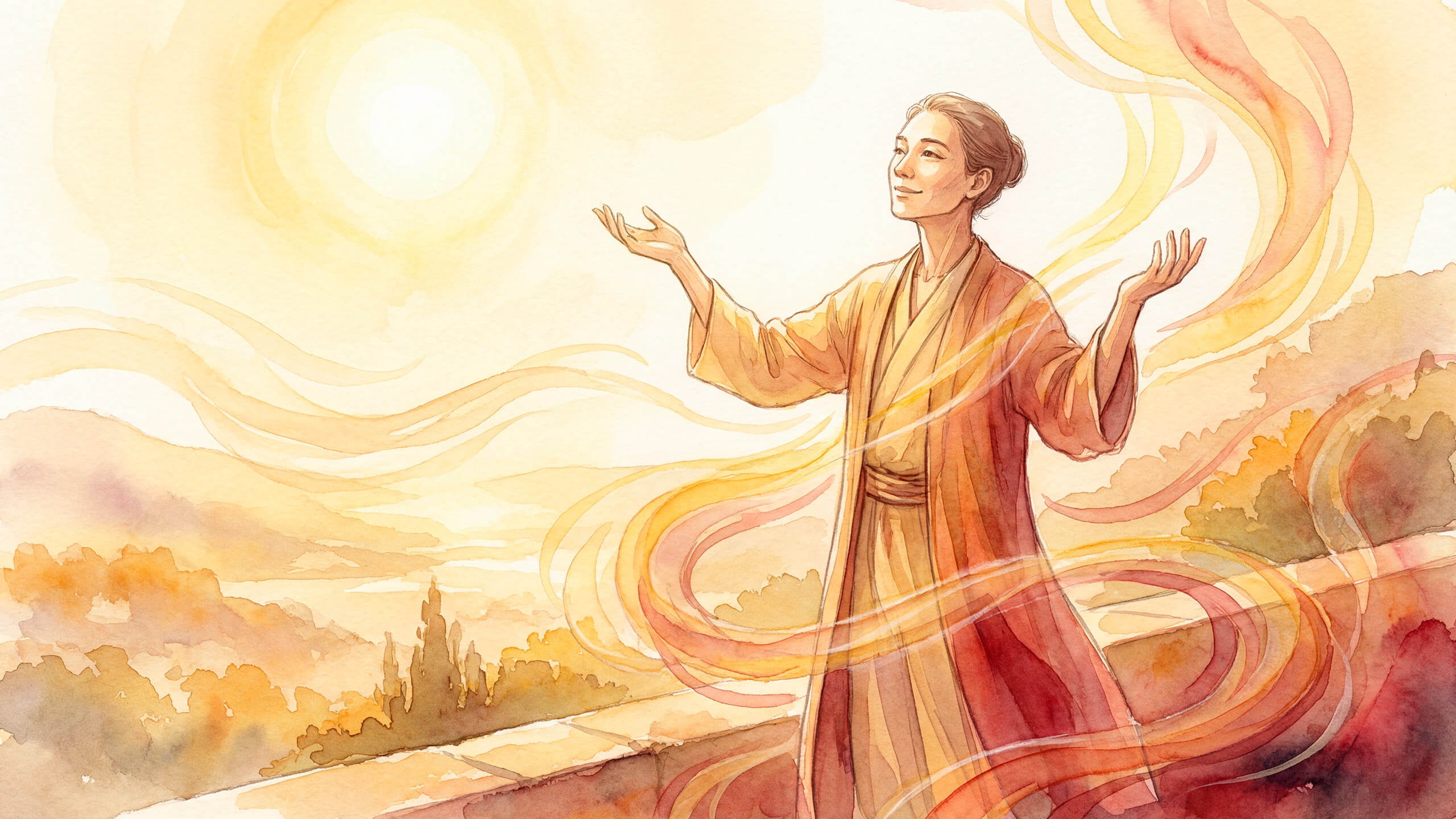
When the inner warmth fades
The TCM perspective: Nourishing the fire of life
In traditional Chinese medicine, yang is the warming, activating force of life. Yang stands for movement, warmth, transformation and activity - it is the fire that drives all life processes. Without sufficient Yang, the body freezes, digestion slows down and the metabolism slows down.
The root of yang lies in the kidneys. Kidney yang, also known as ming-men fire („fire of the gate of life“), is the source of all heat in the body. It warms the other organs, enables digestion and drives all transformation processes. If this inner fire weakens, the entire body cools down - from the inside out.
Yang and yin form an inseparable pair: yin is the cooling, preserving substance, yang is the warming, moving force. If there is a yang deficiency, yin predominates - not because there is too much yin, but because the yang is no longer strong enough to maintain the balance.
The result of a yang deficiency: The body loses its warmth and energy. Digestion becomes sluggish, the metabolism slow, and a deep inner cold spreads. There is a lack of energy to transform food, move fluids and keep the body warm.
The typical signs of a yang deficiency:
- Constant shivering and feeling cold, especially in the hands, feet and back
- Pale face with a pale or grayish undertone
- Tiredness and listlessness, especially in the morning
- Soft, mushy stools or diarrhea, often with undigested food residue
- Frequent urination with copious clear urine
- Water retention and swelling, especially in the legs
- Loss of libido and often erectile dysfunction in men
The good news: Yang can be strengthened again. Through warming nutrition, Yang-tonifying herbs, moxibustion and gentle exercise such as Qigong, you can rekindle your inner fire and bring the warmth back into your body.
The Western perspective: Metabolism and thermoregulation
From a Western perspective, yang deficiency corresponds to a condition with a slowed metabolism and impaired thermoregulation. The body does not produce enough heat and cannot distribute the available heat effectively - a condition that is often associated with an underactive thyroid gland (hypothyroidism).
Imagine your body as a house with a heating system: If there is a yang deficiency, the heating is turned down. The boiler is running on low heat, the radiators remain lukewarm and moisture collects in the corners. No matter how many blankets you use - the cold comes from inside.
The thyroid gland plays a central role in the regulation of metabolism. Its hormones control how quickly the body burns energy and produces heat. If it is underactive, the basal metabolic rate drops, the body temperature falls and all metabolic processes slow down - exactly what TCM describes as yang deficiency.
What does modern medicine show?
- Hypothyroidism: low thyroid hormones (T3, T4) slow down the metabolism
- Impaired microcirculation: cold extremities due to constricted blood vessels
- Mitochondrial dysfunction: the cellular power plants produce less heat and energy
- Adrenal exhaustion: low cortisol levels impair the energy balance
- Edema: Water retention due to slowed lymph flow and reduced metabolism
- Digestive weakness: lack of stomach acid and slowed bowel movement
Modern research confirms: Chronic cold intolerance and metabolic slowdown often have several causes - hypothyroidism, nutrient deficiencies (especially iron, iodine and B vitamins), chronic stress and lack of exercise work together.
TCM treatment for yang deficiency starts right here: It warms the body from the inside, stimulates the metabolism and supports natural heat production. Warming foods, herbs and moxibustion rekindle the inner fire - gently, deeply and sustainably.

The Yellow Emperor team explains your diagnosis
The Yellow Emperor | Qi Bo | Dr. Lisa Weber
Founder of TCM | Master of Healing Arts | Modern Physician
What happens when the legendary Yellow Emperor from TCM sits together with his advisor Qi Bo and a modern doctor? They explain YOUR diagnosis - with 4000 years of knowledge AND current science.
Yang deficiency - when the inner fire goes out
The Yellow Emperor: „Qi Bo, I see people in my realm who are constantly freezing, whose hands and feet are like ice, who sink down exhausted at every opportunity. They are pale, their faces resemble the moon without sunshine. What is the cause of this suffering?“
Qi Bo: „Majesty, these people suffer from a lack of yang - the warming, activating life force. Yang is like the sun for the body: it warms, moves, transforms and invigorates. If the yang is weak, the body lacks inner fire. It becomes cold like an oven without embers, sluggish like a river in winter. Yang is the force that enables us to wake up in the morning, digests food, circulates the blood and protects us from the cold.“
Dr. Weber: „That's a wonderful description! In modern medicine, we would say that the basal metabolic rate and thermogenesis are disturbed. The thyroid gland - our most important metabolic organ - regulates how much energy the body produces. The mitochondria, the power stations of our cells, generate heat as a by-product of ATP production. And the adrenal glands produce hormones that activate us. If these systems do not function optimally, the symptoms you describe arise: Cold, tiredness, listlessness.“
The Yellow Emperor: „Where does this yang originate in the body?“
Qi Bo: „Your Majesty, the root of all Yang lies in the kidneys. The kidney yang - also known as ming-men fire or life-gate fire - is the original source of all heat and activity in the body. It is located between the two kidneys and nourishes the yang of all other organs from there. Without the kidney yang, the spleen yang cannot transform food, the heart yang cannot move the blood, the lung yang cannot distribute the qi. The ming-men is like the sun in the sky - all life depends on it.“
Dr. Weber: „This is anatomically fascinating! Important activating hormones are actually produced right between the kidneys - i.e. in the area of the adrenal glands: adrenaline, noradrenaline and cortisol. These hormones regulate our energy metabolism, body temperature and our stress response. And the kidneys themselves produce erythropoietin (EPO) for blood formation and activate vitamin D. It's amazing how precisely TCM has recognized the central role of this region!“
The Yellow Emperor: „What leads to a weakness of the yang?“
Qi Bo: „The causes are manifold, Your Majesty. First: Chronic overwork and exhaustion - they burn the yang fire faster than it can regenerate. Second: Excessive consumption of cold and raw foods - they extinguish the digestive fire. Thirdly, too much exposure to cold - whether through weather, air conditioning or cold drinks. Fourth, constitutional weakness from birth or serious illness. Fifth: Excessive sexual activity - it depletes kidney yang. And sixthly, natural ageing - yang decreases with age.“
Dr. Weber: „This correlates with our findings! Chronic stress exhausts the adrenal glands and leads to so-called adrenal insufficiency. A cold diet requires more metabolic energy for digestion. Exposure to cold can affect thyroid function. And indeed, the metabolic rate decreases with age - the mitochondria become less efficient and hormone production decreases. The TCM observations are remarkably precise!“
The Yellow Emperor: „What signs reveal a yang deficiency?“
Qi Bo: „The signs are clear, Your Majesty. The affected person shows: A constant feeling of coldness, especially in the hands, feet, knees and lower back. Pale, dull face - sometimes with a pale, waxy complexion. Tiredness and listlessness, especially in the morning. Frequent urination with copious clear urine, often at night. Dull pain in the lower back and knees. Soft stools or diarrhea in the morning. The tongue is pale, puffy with tooth impressions and a moist coating. The pulse is deep, slow and weak - you have to press hard to feel it.“
Dr. Weber: „This constellation of symptoms is clinically highly interesting! The sensitivity to cold indicates impaired thermoregulation - possibly subclinical hypothyroidism. The frequent urination at night - nocturia - may indicate reduced kidney function or a weakness of the autonomic nervous system. The back pain could be related to osteoporosis or muscular weakness. Morning diarrhea is a classic sign of irritable bowel syndrome with autonomic imbalance. In the laboratory, we often find low TSH levels, vitamin D deficiency or low testosterone or oestrogen levels.“
The Yellow Emperor: „How does Yang deficiency differ from Qi deficiency?“
Qi Bo: „An important question, Your Majesty! Qi deficiency primarily shows weakness and fatigue - but without the pronounced coldness. In yang deficiency, coldness is added to weakness: cold extremities, cold aversion, the desire for warmth. You could say: Yang deficiency is Qi deficiency plus cold. Yang is the warming component of Qi. A Qi deficiency can develop into a Yang deficiency if it remains untreated for a long time and the warming fire goes out.“
Dr. Weber: „From a clinical point of view: In pure Qi deficiency, we see functional weakness without a temperature disorder. In yang deficiency, disturbed thermogenesis comes to the fore - measurable by low body temperature, cold body ends - i.e. mainly fingers, toes, often also hands and feet and often lowered thyroid values. This is an important diagnostic difference!“
The Yellow Emperor: „Now let's talk about the treatment. How can the yang be strengthened?“
Qi Bo: „Your Majesty, the treatment principle is: Wen Yang Bu Shen - warming the Yang and strengthening the kidneys. This is done in several ways: Firstly, through warming food - ginger, cinnamon, lamb, walnuts and warm dishes nourish the inner fire. Secondly, through moxibustion - burning mugwort over acupuncture points brings warmth directly into the depths of the body. Thirdly, through exercise - but in moderation, as too much exertion further depletes the yang. And fourthly, through heat conservation - protecting the body from the cold, especially the lower back and feet.“
Dr. Weber: „Excellent strategies! Ginger contains gingerol, which stimulates thermogenesis and promotes blood circulation. Cinnamon improves insulin sensitivity and can stimulate the metabolism. Moxibustion - heat therapy with mugwort - has been shown in studies to have positive effects on the autonomic nervous system and microcirculation. And moderate exercise activates the mitochondria and improves metabolic efficiency. The combination of these measures can measurably increase the body's own heat production!“
The Yellow Emperor: „What about the famous warming herbal formulas?“
Qi Bo: „Ah, Majesty knows the classic formulas! Jin Gui Shen Qi Wan - the Golden Casket Kidney Qi Pill - is the queen of Yang-strengthening formulas. It contains Shu Di Huang for essence strengthening, Shan Yao and Shan Zhu Yu for kidney nourishment, and above all Rou Gui - cinnamon bark - as a Yang tonic. This formula ignites the Ming Men fire and warms the entire body from the inside out.“
Dr. Weber: „Fascinating! Cinnamon bark - Rou Gui - contains cinnamaldehyde, which has thermogenic effects and can increase mitochondrial activity. The formula has been investigated in studies and shows positive effects on kidney function and energy metabolism.
The Yellow Emperor: „Wonderful! Let's turn this wisdom into a practical plan.“
THE 3-WAY METHOD FOR YANG DEFICIENCY
MORNING PROTOCOL (Awaken Yang):
- TCM: Warm breakfast with warming spices - Yang needs gentle activation in the morning
- Science: A hot breakfast with thermogenic spices activates the metabolism and raises the body temperature
- Practical: Porridge with cinnamon, ginger and walnuts. Or warm rice soup with spring onions and a dash of sesame oil
- TCM: Ginger tea with honey - ignites the digestive fire and warms from the inside
- Science: Gingerol in ginger stimulates thermogenesis and improves peripheral circulation
- Practical: Pour hot water over 3-4 slices of fresh ginger, leave to infuse for 10 minutes, sweeten with honey
- TCM: Self-moxibustion or hot water bottle on ming-men (life gate) - warm the source of kidney yang
- Science: Applying heat to the lumbar region improves blood circulation and stimulates the autonomic nervous system
- Practical: Place a hot water bottle or heating pad on the lower back for 10-15 minutes - exactly between the kidneys at navel level
DAY STRATEGY (nourish and move Yang):
- TCM: Gentle movement in the sun - the outer Yang nourishes the inner Yang
- Science: Sunlight promotes vitamin D synthesis and regulates the circadian rhythm
- Practical: 20-30 min. walk in the midday sun, Tai Chi or gentle Qi Gong outdoors
- TCM: Acupressure on kidney 3 (Taixi) - the source point of kidney yang
- Science: Stimulation of this point shows effects on adrenal function in studies
- Practical: Between the inner ankle and Achilles tendon in the hollow. Massage vigorously in a circular motion for 3 minutes on each side with a warm thumb
- TCM: Warming lunch with lamb or chicken, ginger, garlic and leek
- Science: Protein-rich, warm meals increase postprandial thermogenesis
- Practical: Lamb soup with ginger and spring onions, or chicken broth with warming vegetables
EVENING RITUAL (Preserve Yang):
- TCM: Warm foot bath with ginger - opens the kidney meridians and draws heat downwards
- Science: Warm foot baths improve circulation and promote relaxation of the autonomic nervous system
- Practical: 20 min. foot bath at 40-42 °C with 3 slices of ginger, gently massage the feet
- TCM: Moxibustion or heat on Ren 4 (Guanyuan) - the „gateway to the original energy“
- Science: Heat stimulation in the lower abdomen influences the parasympathetic nervous system and promotes regeneration
- Practical: Place the hot water bottle on the lower abdomen for 10-15 minutes - approx. 4 finger widths below the navel
- TCM: Go to bed early - the yang regenerates during the yin time of the night
- Science: Sufficient sleep promotes hormone regeneration and mitochondrial recovery
- Practical: Go to bed before 11 p.m., keep your bedroom warm, cover your feet and lower back
The Yellow Emperor: „Qi Bo, how long does it take for the yang to strengthen again?“
Qi Bo: „Majesty, the yang is like a fire that needs to be slowly rekindled - patience and consistency are the key. After 2-3 weeks of consistent practice, most people notice: the extremities become warmer, the shivering subsides. After 6-8 weeks, energy improves, morning diarrhea becomes less frequent, sleep deeper. After 3-4 months, the Yang can be noticeably strengthened - more warmth, more drive, more vitality. Particularly important: in winter, when the yang is naturally weaker, it needs special protection.“
Dr. Weber: „This is in line with our clinical experience! Improving thyroid function and mitochondrial efficiency takes time - about 2-3 months for measurable changes. The regeneration of the adrenal glands after chronic stress takes a similar amount of time. And the reference to winter makes medical sense: thermogenesis is more challenged in winter, and people with yang deficiency suffer particularly at this time of year!“
The Yellow Emperor: „Are there things that should be avoided at all costs?“
Qi Bo: „Yes, Your Majesty! Firstly: Cold and raw food - they quench the already weak digestive fire. Second: Ice-cold drinks - they are poison for the yang. Third: Excessive physical exertion - it burns the precious Yang fire. Fourth: Exposure to cold without protection - especially the lower back and feet. Fifth, going to bed too late - the yang cannot regenerate. And sixth, excessive sexual activity - it directly depletes kidney yang.“
Dr. Weber: „Everything is scientifically comprehensible! Cold food requires more metabolic energy to heat it up. Overtraining leads to a catabolic metabolic state. Cold on the lower back can impair kidney function. Lack of sleep disrupts hormone regeneration - growth hormone and testosterone are mainly produced at night. And in fact, sexual activity consumes considerable energy - if your system is already exhausted, it is important to take it easy!“
The Yellow Emperor: „Then the message is clear: Yang is the inner fire that warms and invigorates us. We can rekindle this fire with warming food, gentle exercise in the sun, heat treatments and sufficient rest.“
Qi Bo: [smiles] „That's right, Your Majesty. Yang is like the sun in the body - without it, life freezes. If we nourish and protect the inner fire, warmth, strength and joie de vivre return - and we can face even the coldest winters with an inner glow.“
About our „3 Wise Men“ story
Who are the Yellow Emperor and Qi Bo?
The Yellow Emperor (Huangdi) is said to have lived around 2600 BC and is considered the mythical founder of Chinese culture and medicine. Qi Bo was his most important advisor and personal physician. Their discussions about health, illness, and human nature were recorded in the most important fundamental work of TCM.
The book: Huangdi Neijing
The Huangdi Neijing, also known as The Yellow Emperor's Classic of Internal Medicine, was probably written between 200 BC and 200 AD. It is the oldest surviving work on Chinese medicine and consists of dialogues between the Yellow Emperor and his advisors, mainly Qi Bo.
This work is to TCM what the Bible is to Christianity: the absolute foundation. All important concepts—yin and yang, the five elements, qi, meridians, and acupuncture points—are described systematically here for the first time.
Our modern approach: The 3 wise men
In our series „The Three Sages,“ we bring together the Yellow Emperor and Qi Bo with the fictional modern doctor and microbiologist Dr. Weber.
Important note: All three characters and their conversations are purely fictitious and invented by us.
We use this narrative form, similar to the dialog form in the book Huangdi Neijing, to convey the often complex relationships of TCM in an understandable and entertaining way. When the 4000-year-old emperor is confronted with modern science, enlightening „aha moments“ arise which show that ancient wisdom and new research often speak the same language: Ancient wisdom and new research often speak the same language - just in different words.
This makes TCM lively, understandable and practically applicable for your everyday life.
The dialogs are creative interpretations - not historical documents. For medical questions, please consult a qualified TCM therapist or doctor.
Your treatment options
A Yang deficiency is very treatable! TCM offers you a variety of effective methods to restore your inner warmth and vitality. You don't have to do everything at once - choose the methods that suit you and your everyday life.
Here you will find specific treatment approaches that have been proven effective in TCM for thousands of years and that you can largely apply yourself.
TCM herbal therapy
TCM herbs are the basis every classic TCM treatment. The carefully compiled mixtures have a synergistic effect — this means that the individual herbs reinforce each other's effects and balance out any possible side effects.
What modern medicine is only just discovering—the power of plant substances—has been used successfully by TCM for over 2,500 years.
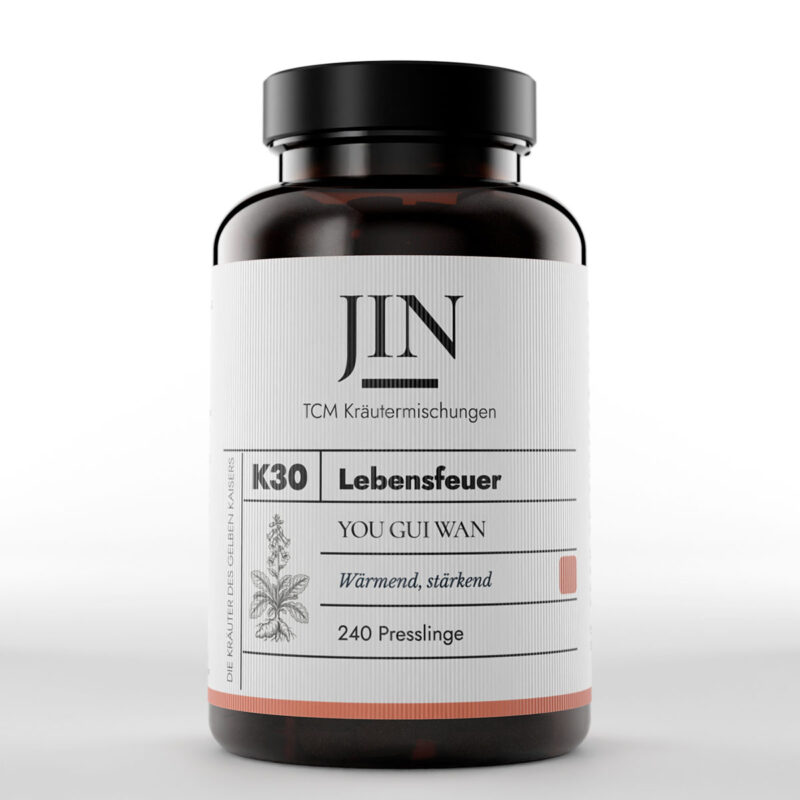
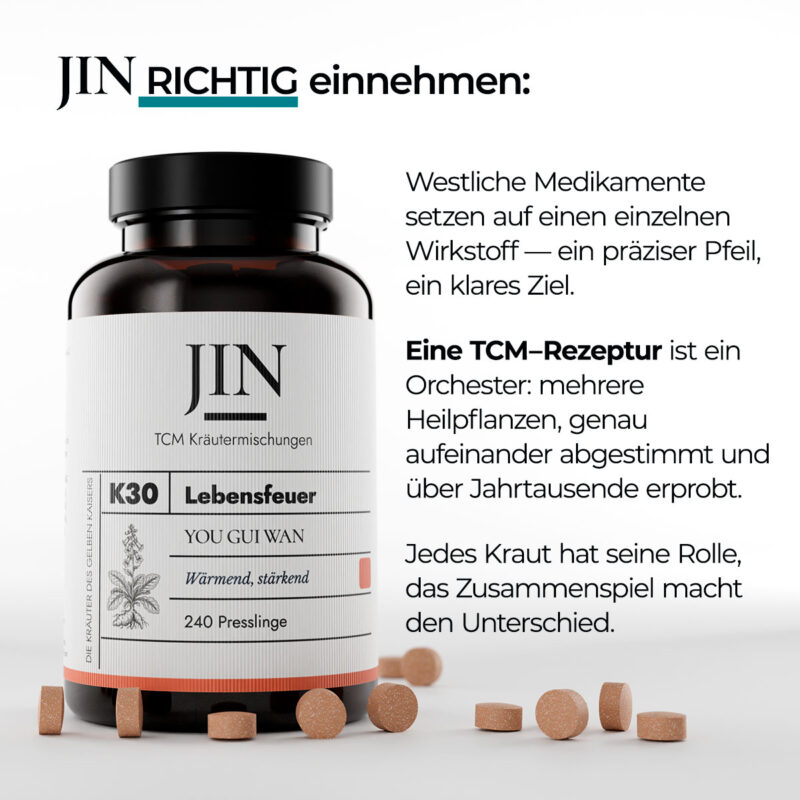
Empfohlene TCM–Kräutermischung bei Yang Mangel
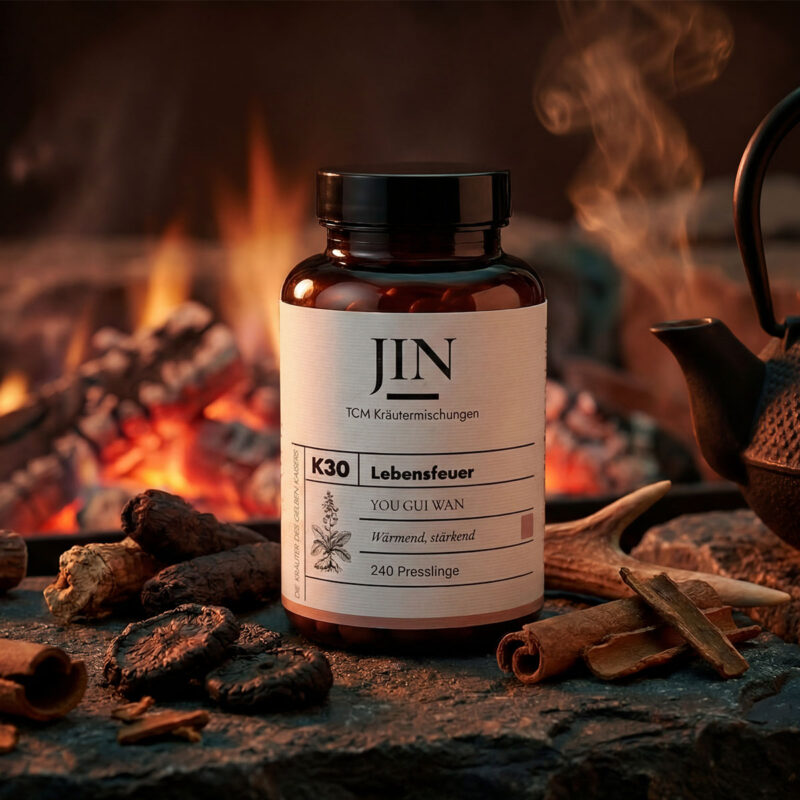
JIN K30 — Lebensfeuer
Die klassische Rezeptur You Gui Wan (右归丸) — die „Pille zur Wiederherstellung des Rechten“ (der Lebenspforte). Zehn Kräuter, die das Nieren–Yang kräftig wärmen und zugleich Jing und Blut nähren — denn ein starkes Feuer braucht einen vollen Kessel.
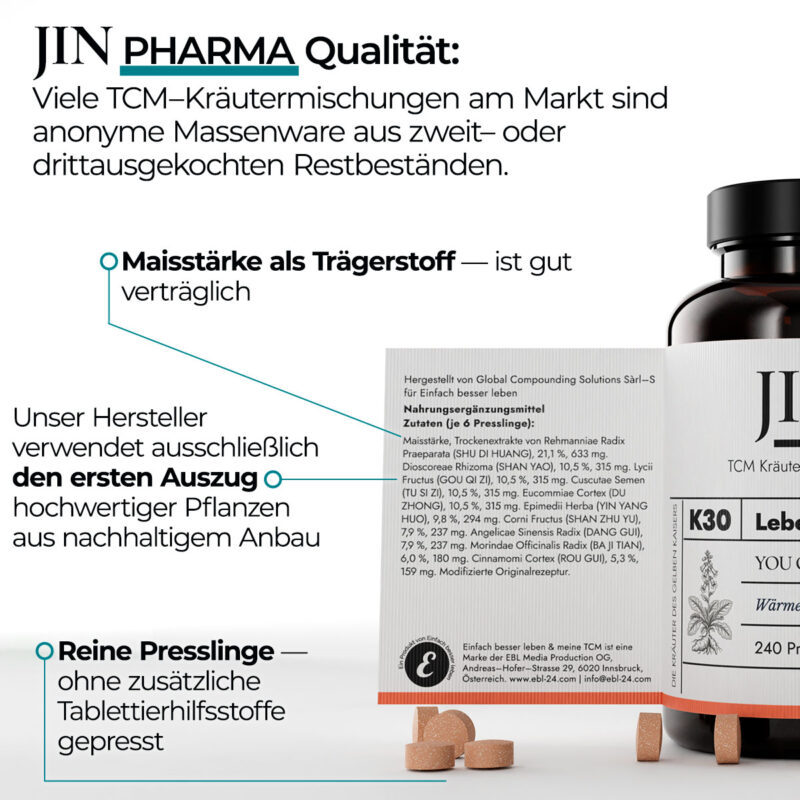
Auf einer nährenden Basis aus Shu Di Huang, Gou Qi Zi und Shan Zhu Yu entfachen Rou Gui, Yin Yang Huo und Ba Ji Tian das Ming Men–Feuer der Niere — die Wurzel des gesamten Körper–Yang. Ideal bei allgemeinem Yang Mangel mit Kältegefühl und kalten Händen und Füßen, Erschöpfung, Antriebslosigkeit, Schwäche in Rücken und Knien und nachlassender Lebenswärme.
Quantity
239,70 €
i
To the product
The herbs in this recipeRecommended reading:How TCM herbal blends are formulatedLearn more now
| Herb (Pinyin) | German designation | Function in the recipe |
|---|---|---|
| Shu Di Huang (Rehmanniae Radix Praeparata) | Prepared rehmannia root | emperor Nährt das Nieren–Yin und füllt das Jing auf — das Fundament für das Yang |
| Tu Si Zi (Cuscutae Semen) | Devil's twine seed | minister Tonisiert Nieren–Yin und –Yang zugleich, bewahrt das Jing |
| Yin Yang Huo (Epimedii Herba) | Fairy flower herb | minister Wärmt das Nieren–Yang, stärkt Knochen und Sehnen |
| Ba Ji Tian (Morindae Officinalis Radix) | Morinda root | minister Wärmt das Nieren–Yang und stärkt das Jing |
| Rou Gui (Cinnamomi Cortex) | cinnamon bark | minister Entfacht das Ming Men–Feuer von der Wurzel her |
| Shan Yao (Dioscoreae Rhizoma) | Yam root | assistant Tonisiert Milz, Lunge und Nieren, bewahrt das Jing |
| Gou Qi Zi (Lycii Fructus) | Gojibeeren | assistant Nährt Leber– und Nieren–Yin, stärkt das Jing |
| Du Zhong (Eucommiae Cortex) | Eucommia bark | assistant Stärkt Nieren und Leber, festigt Sehnen und Knochen |
| Shan Zhu Yu (Corni Fructus) | cornelian cherry | assistant Nährt Leber und Nieren, bewahrt das Jing |
| Dang Gui (Angelicae Sinensis Radix) | Chinese angelica | assistant Nährt und belebt das Blut — der Träger des Yang |
Explanation of the most important herbs
emperor Shu Di Huang (Rehmannia) — Das Fundament
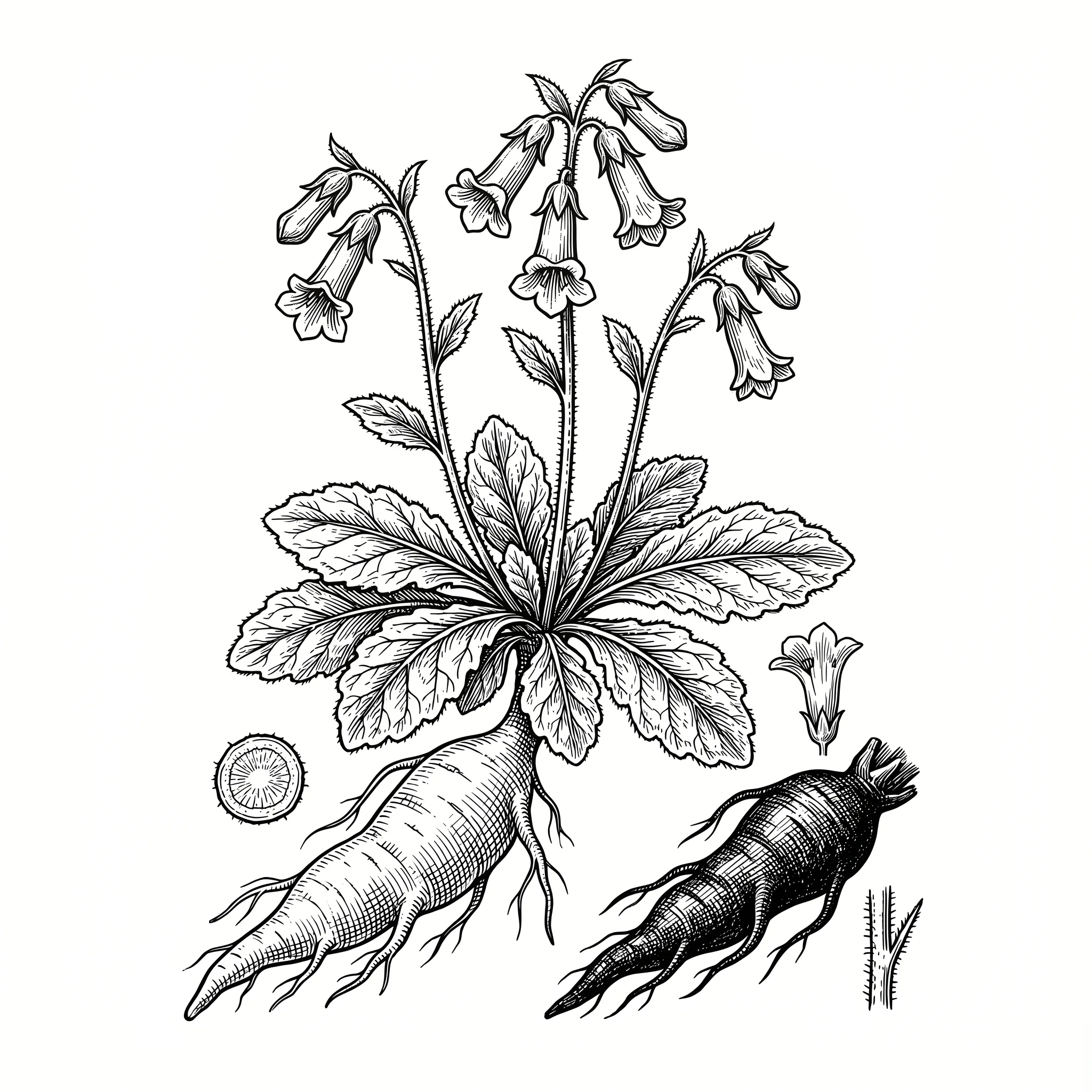
Shu Di Huang nährt das Nieren–Yin und füllt das Jing auf — das schwere, nährende Fundament, auf dem das Yang–Feuer sicher brennen kann. Als Kaiser stellt es die Substanz, die das Yang trägt. Die zubereitete Rehmanniawurzel wird traditionell zur Nährung von Blut und Yin eingesetzt.
minister Rou Gui (cinnamon bark) — Das Lebensfeuer
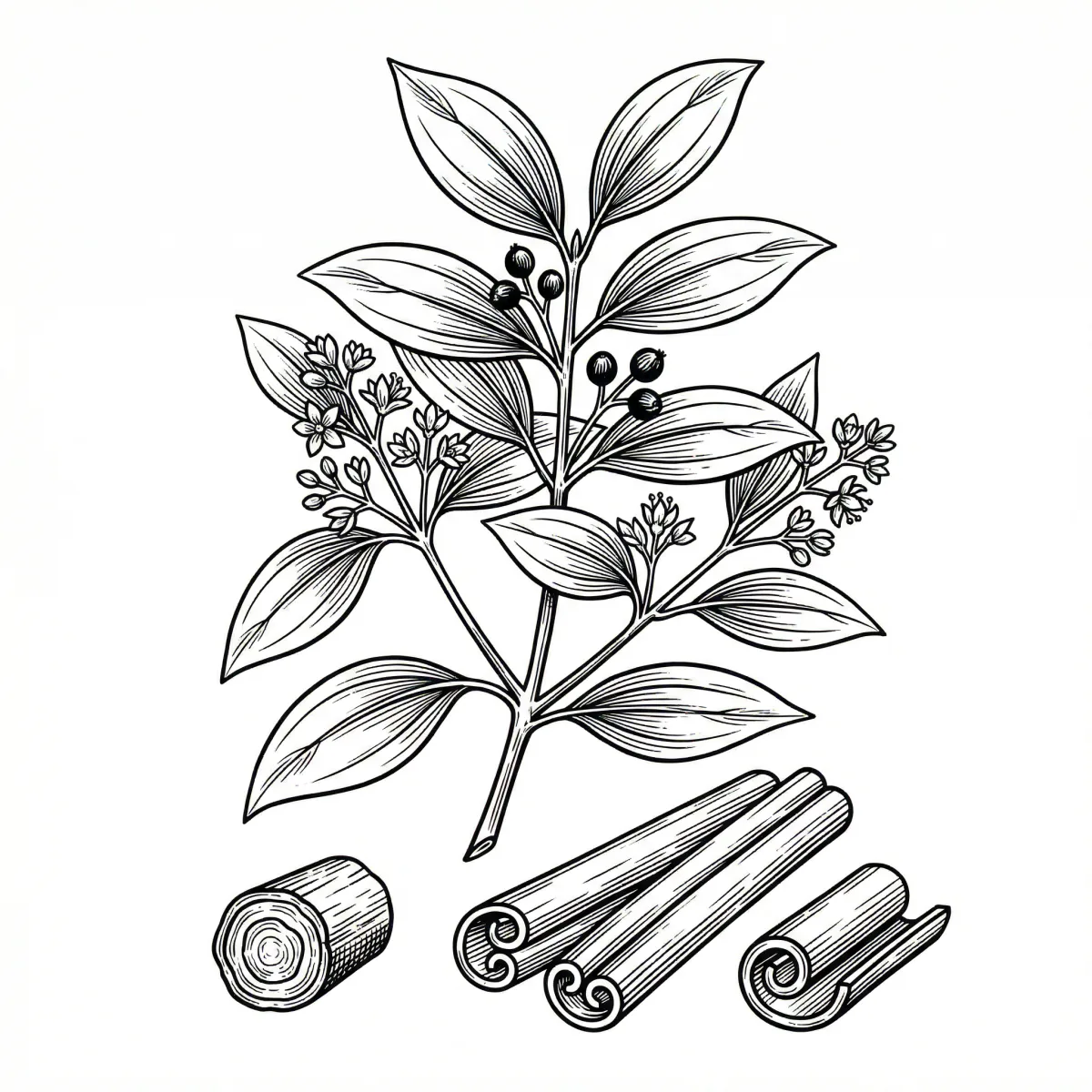
Rou Gui entfacht das Ming Men–Feuer und führt das verirrte Feuer zu seiner Quelle zurück — es wärmt das Nieren–Yang von der Wurzel her und ist der zündende Funke der Rezeptur. Zimtrinde enthält Zimtaldehyd, das in Untersuchungen mit wärmenden und durchblutungsfördernden Eigenschaften in Verbindung gebracht wird.
minister Yin Yang Huo (Elfenblume) — Der Yang–Toniker
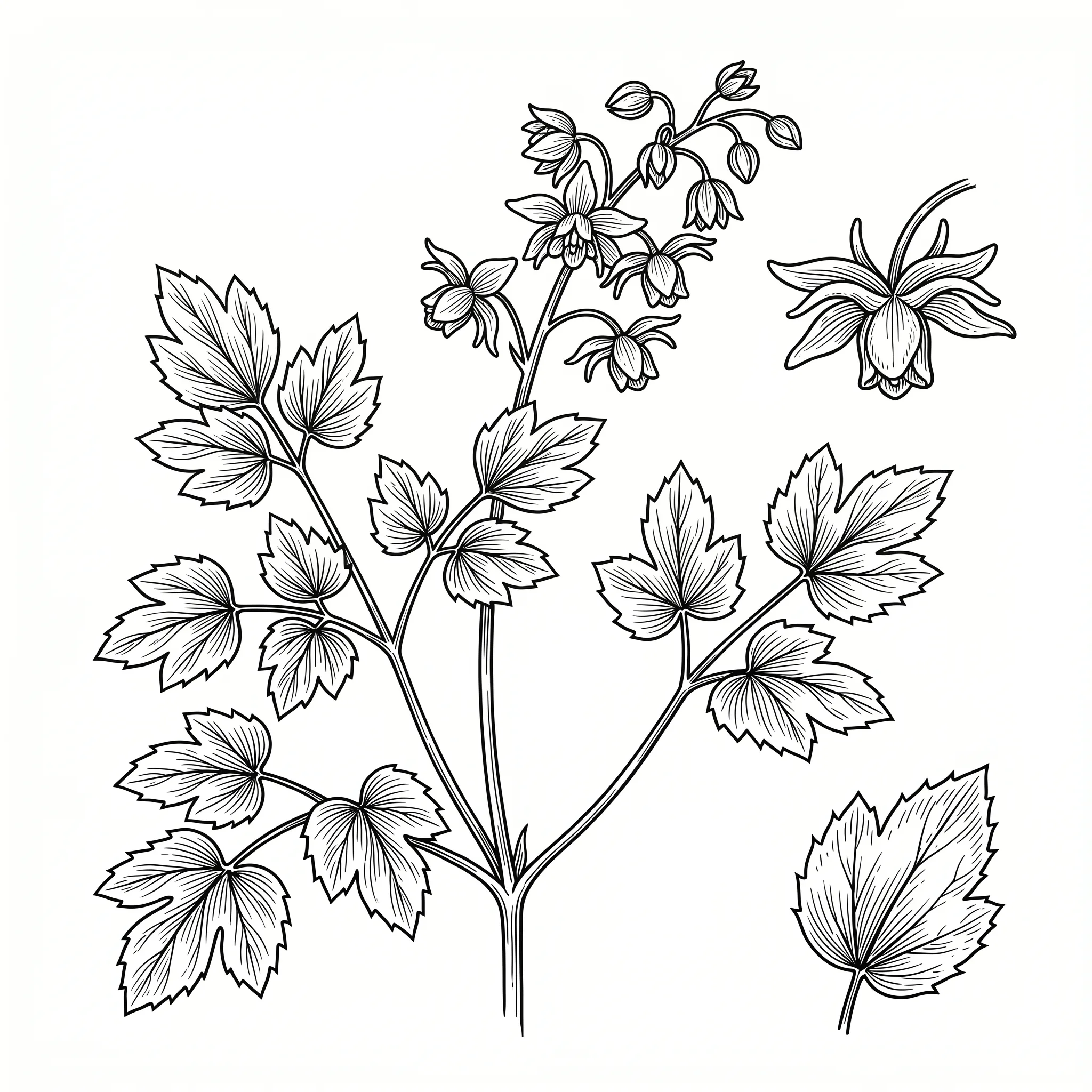
Yin Yang Huo wärmt das Nieren–Yang, stärkt Knochen und Sehnen und vertreibt Wind–Feuchtigkeit — eines der wichtigsten Yang–Tonika, das traditionell auch Lebenskraft und Libido unterstützt. Das Elfenblumen–Kraut enthält Icariin und verwandte Flavonoide, die in Untersuchungen mit antioxidativen und das Knochengewebe unterstützenden Eigenschaften in Verbindung gebracht werden.
assistant Eucommia — The back strengthener
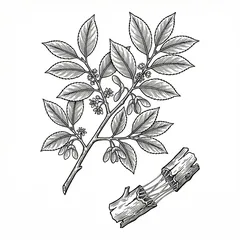
Du Zhong stärkt Nieren und Leber und festigt Sehnen und Knochen — es adressiert die Schwäche, die bei Nieren–Yang Mangel in Rücken und Knien entsteht. Aucubin und die Lignane der Eucommia–Rinde werden in Untersuchungen mit antioxidativen und das Bindegewebe unterstützenden Eigenschaften in Verbindung gebracht.
Recommended dosage
The dosage depends on the severity.
Based on your questionnaire results, we have highlighted the appropriate dosage for you below.
At light Severity:
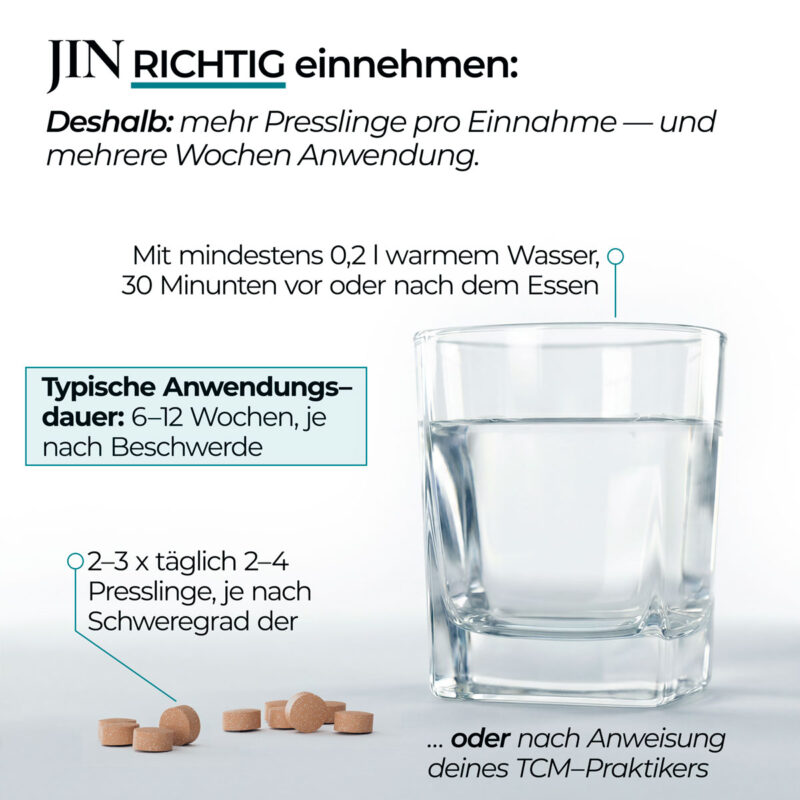
- 2 tablets 3 times a day (morning, noon, and late afternoon) = 6 tablets per day
- Optional, if taking 3 doses a day is difficult for you: 3 tablets twice a day — same daily amount
- We recommend at least 2 cans, each containing 240 tablets (enough for about 12 weeks)
At middle Severity:
- 3 tablets 3 times a day (morning, noon, and late afternoon) = 9 tablets per day
- We recommend at least 3 cans, each containing 240 tablets (enough for about 12 weeks)
- If your condition improves, switch to the dosage recommendation for mild symptoms
At significantly Severity:
- 4 tablets 3 times a day (morning, noon, and late afternoon) = 12 tablets per day
- We recommend at least 4 cans, each containing 240 tablets (enough for about 12 weeks)
- If your condition improves, switch to the dosage recommendation for moderate severity
Why 3 times a day?
This ensures that the herbs' effects are evenly distributed throughout the day.
IMPORTANT:
- Take the tablets with at least 0.2 liters of warm water
- Ideally, 30 minutes before or after a meal
- This suggestion is not a substitute for a medical diagnosis or treatment
- If you are pregnant or breastfeeding, have a chronic medical condition, or are taking medication, consult a doctor or a TCM practitioner beforehand.
- If you have a severe cold, fever, or diarrhea, stop taking this product
- Sich konsequent warm halten, Kälte und Zugluft meiden; warme, gekochte Mahlzeiten und wärmende Gewürze bevorzugen, kalte und rohe Speisen weglassen
- Bei starker Erschöpfung, Wassereinlagerungen oder anhaltender innerer Kälte ärztlich abklären
If little has changed after about 12 weeks:
Herbs are just one part of TCM. Combine taking them with other practices—acupressure, qigong, Pilates, or yoga, BS+, as well as meditation and breathing exercises. Afterward, take a two-week break from taking the herbs. Then, if needed, you can TCM analysis try again and/or compare your result with your TCM practitioner or discuss it with your doctor.
If you have any questions about how to take it, please feel free to contact us.
Want to know what dosage is right for you? Take our free TCM questionnaire—in just a few minutes, it will reveal your personal TCM pattern and the appropriate dosage of the recommended TCM herbal blend.
BS+ for your intestinal flora
A healthy gut is the basis for your well-being. Current studies show that around 80 % of people in Germany consume too little fiber - yet it is the most important food for your intestinal flora (also known as the intestinal microbiome).
BS+ was developed to support your daily fiber supply. With 11 high-quality, natural ingredients BS+ offers your intestinal flora a diverse nutrient base.
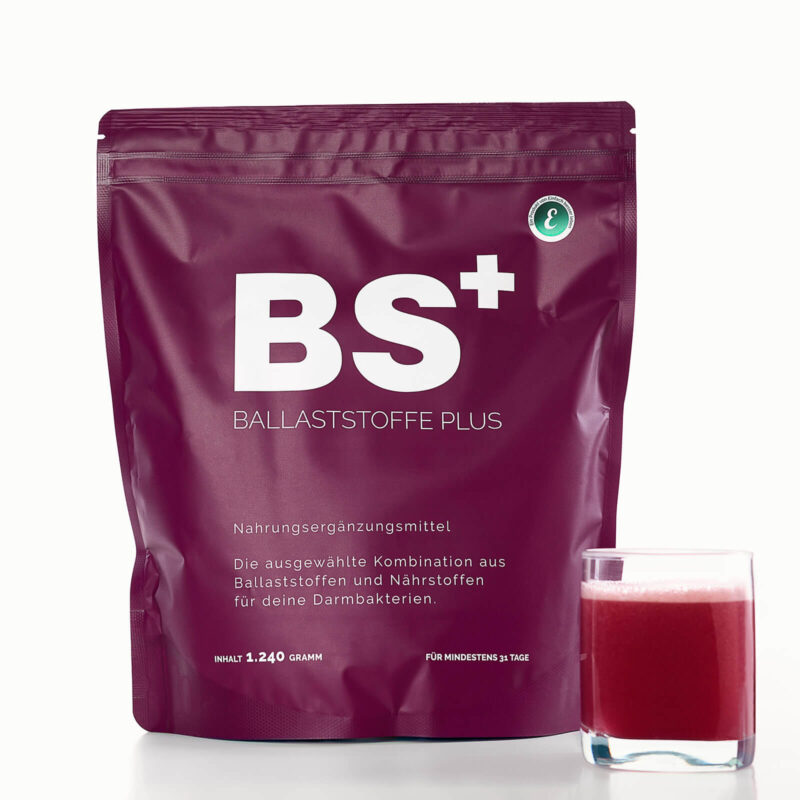
The revolutionary fiber formula
BS+ Dietary Fiber Plus
- Up to 20 g dietary fiber daily EXTRA
- Improved digestion and regular bowel movements
- Increased energy and vitality
- Better mood and mental clarity
- Support for your immune system
- Potential improvement in cholesterol and blood sugar levels
Simply stir into water twice a day - Your intestinal flora will thank you.
Why BS+ for Yang deficiency?
In TCM, yang is the warming, driving force of the body - and the spleen plays a central role in this. The spleen yang ensures that food is converted into usable qi and heat. This is where the connection to the intestines begins: if the intestinal flora is weakened, the spleen cannot fully develop its transformative power. Digestion becomes sluggish, less heat and less Qi is produced - the Yang deficiency increases. Healthy intestinal flora is therefore an important prerequisite for rebuilding yang.
BS+ delivers 11 prebiotic fibers and thus specifically supports the development of a diverse intestinal flora. Well-nourished intestinal flora strengthens the spleen in its transformation function, improves nutrient absorption and helps the body to regain heat and Qi from food - the basis for sustainably strengthening Yang.
Particularly important for yang deficiency:
- Strengthens the spleen function as a „digestive fire“ so that warming foods such as ginger, cinnamon and lamb can develop their full effect
- Promotes the absorption of nutrients in the intestine - so the body can extract more Qi and heat from food instead of accumulating undigested leftovers
- Supports the elimination of cloudy moisture and pathogenic factors, which often place an additional burden on the metabolism in cases of Yang deficiency
Acupressure
Acupressure is acupuncture without needles. - you can apply them yourself at any time. By applying gentle pressure to certain points, you activate the energy flow in the meridians and strengthen the Yang.
The following three points form the classic combination for Yang strengthening. The combination with moxibustion is particularly effective for yang deficiency - a heat treatment with mugwort, which additionally nourishes and warms the Yang.
ACUPUNCTURE POINT: Ni 03
Kidney 03
Large stream - Tài Xī
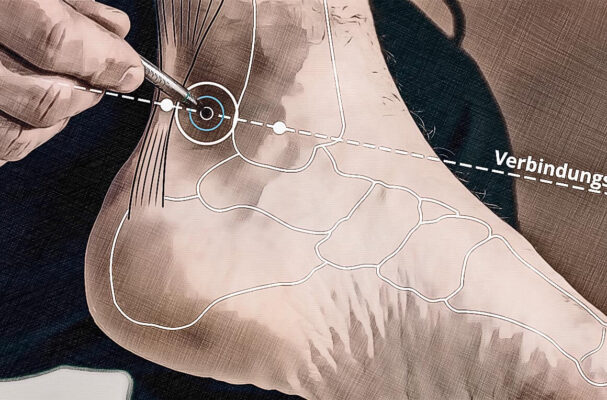
- Kidney source point - strengthens kidney yang and yin
- Nourishes the kidney essence (Jing)
- Warms the lower back
- Strengthens the bones and marrow
- Helps with feelings of cold and exhaustion
Location: Between the medial malleolus and Achilles tendon, in the hollow at the level of the highest point of the medial malleolus.
Application:
Press firmly twice a day for 30-45 seconds. Ideal in the morning and evening. Particularly effective with heat (moxibustion).
ACUPUNCTION POINT: You 04
You May 04
Gate of life - Mìng Mén
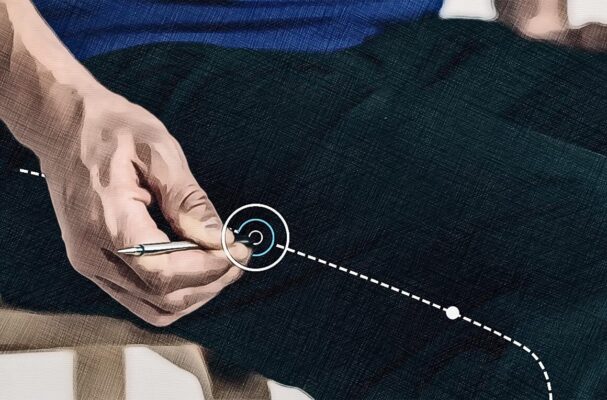
- The „life gate“ - main point for kidney yang
- Strengthens the original Yang (Yuan-Yang)
- Warms the „fire of the kidney“
- Expels cold from the body
- Helps with a cold back and weak legs
Location: On the spine between the 2nd and 3rd lumbar vertebrae (L2 and L3), at the level of the navel.
Application:
Rub or tap with the knuckles once a day for 30-45 seconds. Heat (moxibustion or hot water bottle) considerably increases the effect.
ACUPUNCTURE POINT: KG 04
Concept vessel 04
Gate of origin energy - Guān Yuán
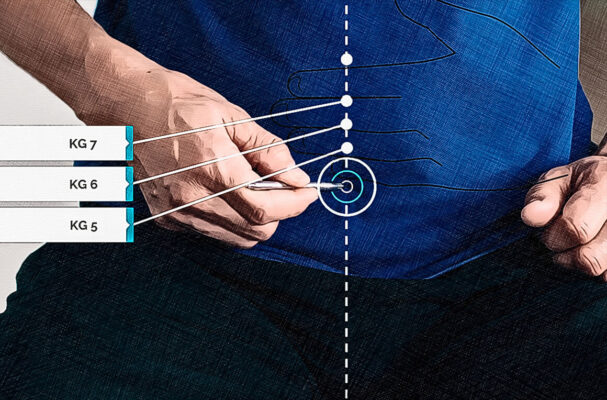
- Gate of origin energy - strengthens Yuan-Qi and Yang
- Nourishes the kidney yang
- Strengthens the life force (Jing)
- Warms the lower abdomen
- Helps with a cold feeling in the stomach and weak digestion
Location: On the midline of the abdomen, 3 cun (about 4 finger widths) below the navel.
Application:
Hold once a day for 30-45 seconds with warm pressure. Ideal in the evening. Moxibustion on this point is particularly effective for yang deficiency.
TIP
Moxibustion
Heat treatment for yang deficiency
The ideal complement to acupressure for yang deficiency. Moxibustion uses smouldering mugwort to bring heat deep into the acupuncture points. This method has been used for thousands of years to strengthen the yang and dispel internal cold.
TIP
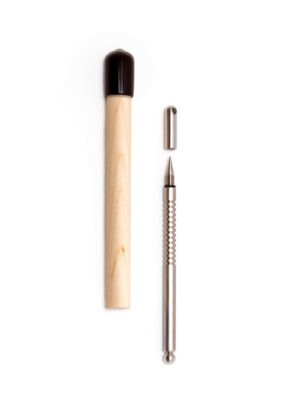
AkuPen
Acupuncture pen with video instructions
For even more intense stimulation You can use an AkuPen. The acupressure pen significantly enhances the effect of acupressure. With an extensive video library for over 80 acupuncture points.
Qi Gong
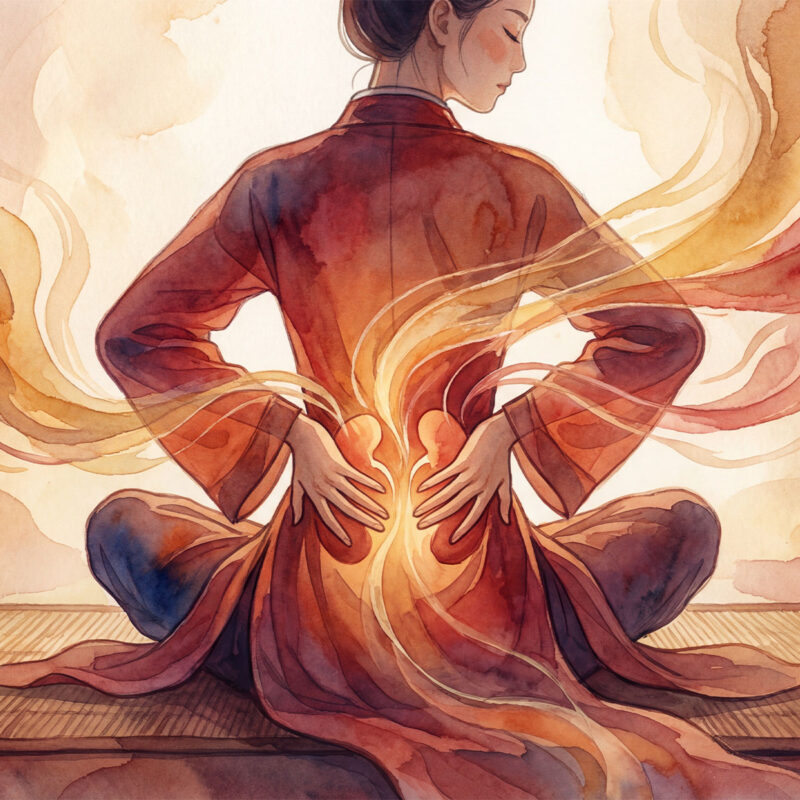
Qi Gong is moving meditation - Gentle, flowing exercises that harmonize your energy flow and strengthen your yang. If you have a yang deficiency, these exercises help to ignite your inner fire and activate the warming energy in your body.
Regular practice of Qi Gong (as little as 10-15 minutes a day) has been shown to have positive effects on heat balance, energy and general well-being.
QI GONG: Exercise 1
Activate the gate of life
Activates the Ming Men and strengthens the kidney yang
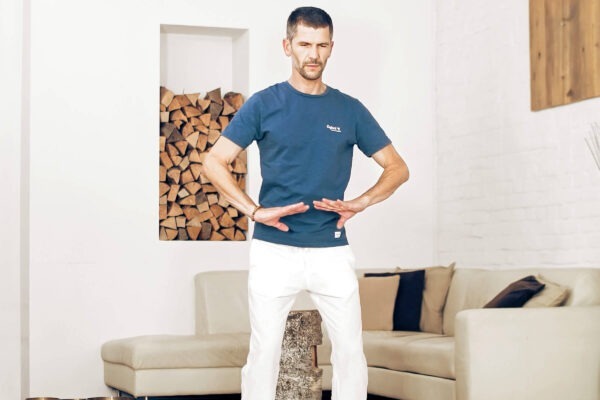
Particularly helpful for:
- Feeling of coldness in the back
- Weak lower back
- Lack of energy and exhaustion
- Cold feet
Effect:
This exercise activates the Ming Men - the „gate of life“ between the kidneys. Gentle tapping warms and strengthens the kidney yang. Ideal in the morning after getting up to warm up the body.
QI GONG: Exercise 2
Warm the center
Warms the middle and lower heater

Particularly helpful for:
- Cold belly
- Weak digestion due to cold
- Soft stools or diarrhea
- Feeling cold after eating
Effect:
This exercise brings warmth to the middle and lower warmers. It strengthens the digestive fire and helps to transform food better. Particularly effective before meals.
QI GONG: Exercise 3
Kidneys circles
Relaxes and strengthens the kidney region
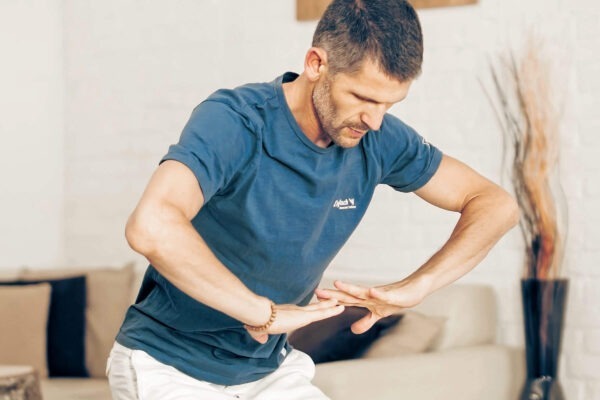
Particularly helpful for:
- Lower back pain
- Weakness in the knees
- Frequent urination
- General sensitivity to cold
Effect:
This exercise involves circular movements that massage and warm the kidney region. The kidneys are the root of Yang - this exercise strengthens them gently and sustainably.
These Qi Gong exercises are specially selected to strengthen the yang. They activate the kidney yang, warm the center and help you to rekindle your inner fire.
All exercises work particularly well if you practise them in the morning - the Yang naturally increases in the early hours. Make sure you stay warm and don't sweat.
QI GONG:
When and how often?
In the morning (ideal):
- All 3 exercises as a sequence: approx. 15–20 minutes
- Or just 1–2 exercises: approx. 5–10 minutes
- Best between 7 and 11 a.m. (Yang rises)
In between:
- Individual exercises if required (e.g. if you feel cold)
- „Activate the gateway to life“ for quick warmth
Regularity is more important than duration:
- Better to do 10 minutes every day than 60 minutes once a week.
- After 2–3 weeks, you will notice the first changes.
- After 3 months of regular practice: significant improvement
Pro tip: Practice these exercises in a warm place and dress warmly. Avoid sweating - this would further weaken your yang. Slow, deliberate movements are more effective than fast ones.
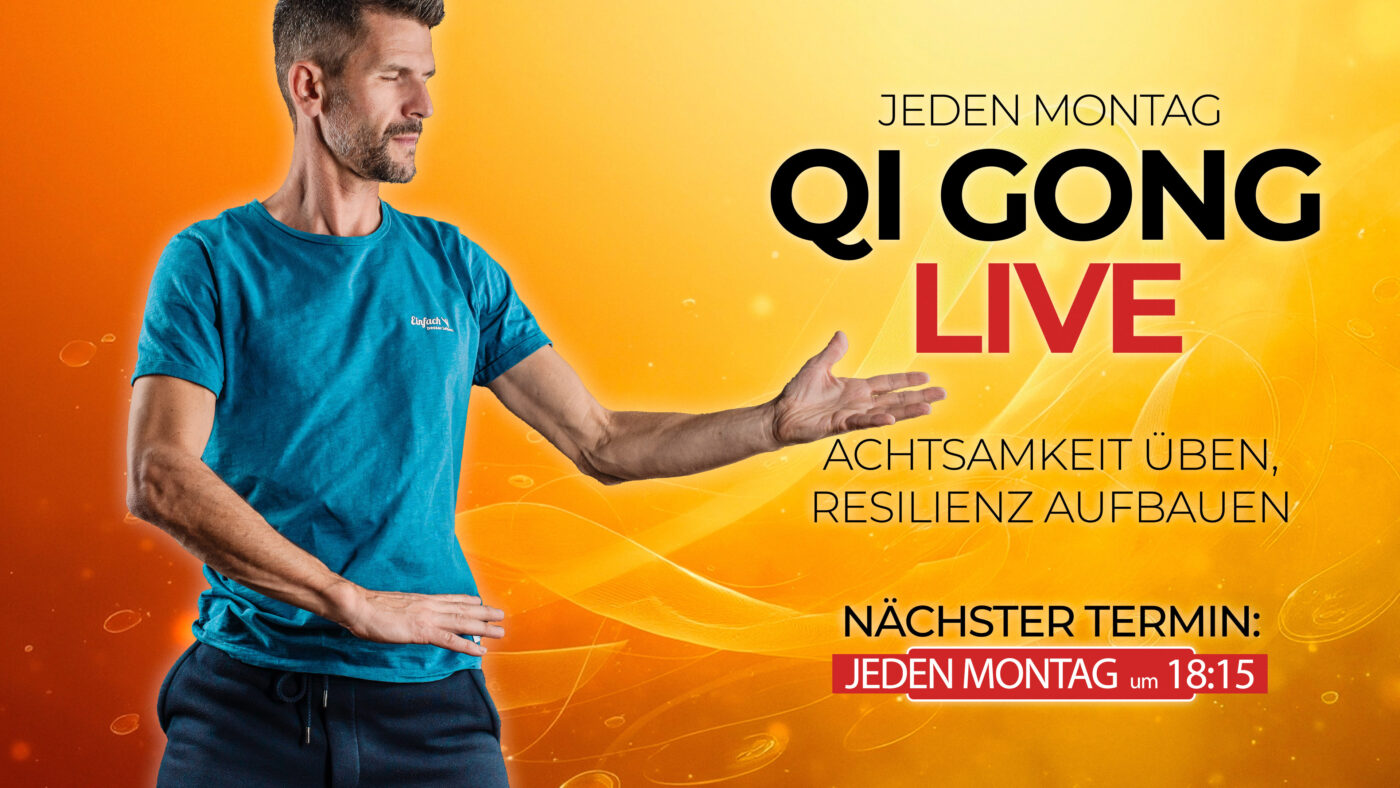
LIVE EVERY MONDAY: QI GONG WITH WOLFGANG
Every Monday at 6:00 p.m. Let's practice together live on YouTube. Among other things, Wolfgang will guide you through a complete qigong sequence — free of charge and suitable for all levels.
Why participate live? ✓ Practicing together is motivating ✓ Wolfgang explains the exercises in detail ✓ You can ask questions in the live chat ✓ Regular appointments help with your routine
More about Qi Gong LiveMeridian Yoga — The Yoga of TCM
Meridian Yoga combines yoga with traditional Chinese medicine. The result is a holistic exercise concept for better health and more energy.
The following exercises specifically activate the Governing Vessel (Du Mai) - the „mother of all Yang meridians“. The Governing Vessel runs along the spine and controls all the Yang meridians in the body. Activating it strengthens the entire Yang system.
MERIDIAN YOGA: Exercise 1
Roundback for the handlebar vessel
Activates the handlebar receptacle while standing
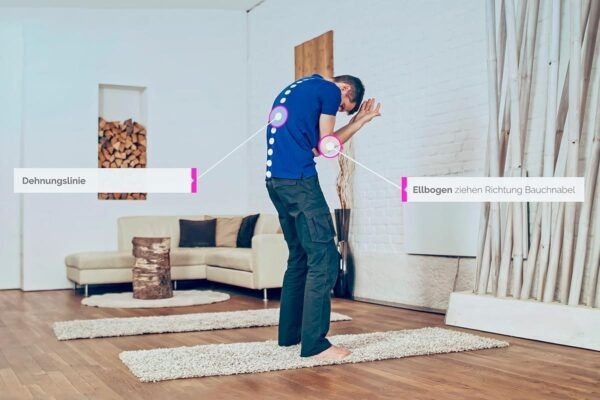
Particularly helpful for:
- Feeling cold and lack of inner fire
- Exhaustion and listlessness
- Weak back and cold knees
- Lack of resistance
Effect:
The controlled rounding of the back in a standing position activates the lumbar vessels along the entire spine. This exercise warms the back and strengthens the yang - ideal for people who are sensitive to cold and lack energy.
MERIDIAN YOGA: Exercise 2
Swivel seat for the handlebar vessel
Classic yoga exercise for yang activation
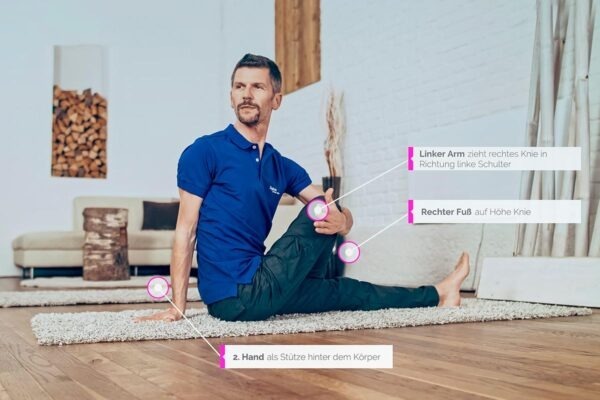
Particularly helpful for:
- Stiffness and coldness in the spine
- Lack of energy and fatigue
- Weak lower back
- Lack of inner warmth
Effect:
The twisting pose is a classic yoga exercise that activates the limb vessel by gently rotating the spine. This movement promotes the flow of yang and warms the entire back - particularly beneficial in cases of yang deficiency with feelings of cold.
Both exercises activate the Governing Vessel (Du Mai), which runs along the spine and controls all Yang meridians. As the „Sea of Yang“, it is the most important meridian for Yang development.
Particularly effective: Hold each position for 3-5 breaths, visualizing warm energy rising up your spine.
MERIDIAN YOGA:
When and how often?
Best time:
- In the morning after getting up (Yang rises naturally)
- Or at lunchtime during the most active Yang time (11 am - 1 pm)
Duration:
- Hold each position for 3-5 breaths.
- Complete sequence: 10-15 minutes
- 3-5 times per week for best results
Important:
- Practice in a warm room (avoid cold)
- Breathe deeply and evenly during the positions.
- Stretching should be comfortable, never painful.
Pro tip: Combine Meridian Yoga with warming Qi Gong exercises. The gentle movement generates inner warmth and additionally supports the Yang build-up.
Nutrition according to TCM
„Let food be your medicine.“ — this principle has been applied in TCM for thousands of years. Proper nutrition is the basis of every TCM treatment and often the key to healing.
Nutrition is particularly important in the case of a yang deficiency: your body needs warming, invigorating food, to rekindle the inner fire and banish the cold.
Thermals are crucial: Choose food with warmer to hotter thermal effect - they warm you from the inside and strengthen your yang.
The golden rules for strengthening Yang
What is good for you:
Warming spices
- Ginger (kindles the inner fire)
- Cinnamon (warms kidney yang)
- Cloves, star anise
- Cardamom, allspice
- Fennel, caraway, aniseed
Spices are natural yang tonics
Warmest meat
- Lamb (warmest)
- Game meat (venison, roe deer)
- Chicken (warming)
- Beef (tonic)
Animal protein strengthens the yang
Seafood
- Prawns (warm kidney yang)
- Mussels (nourish Yang)
- Salmon (warming)
Especially good for the kidney yang
Yang-strengthening vegetables
- Leeks, spring onions
- Onions, garlic
- Fennel (warms the center)
- Pumpkin, sweet potatoes
Warming vegetables banish the cold
Nuts and seeds
- Walnuts (strengthen kidney yang)
- Chestnuts (warm the kidneys)
- Pine nuts
- Sesame (black)
Power packs for your yang
What you should avoid:
Raw vegetables and salads
- Raw vegetables and leafy salads
- Raw food platters
- Uncooked sprouts
Raw food cools and weakens the yang!
Cold drinks and food
- Ice-cold drinks
- Ice cream and ice cream
- Smoothies from the refrigerator
- Frozen food
Extinguish the yang fire!
Cooling fruits
- tropical fruits (oranges, bananas, kiwi)
- watermelon
- Pears (raw)
- Citrus fruits
Tropical fruits are thermally cold
Cold dairy products
- Yogurt (especially cold)
- Cottage cheese, cream cheese
- Cold milk
Generates cold and moisture
Cooling food
- Tofu (thermally cooling)
- Mint, peppermint tea
- Green tea (cooling)
- Wheat, white flour
Further weakens the yang
HOW YOU SHOULD EAT:
Preparation methods
- Cook and braise for a long time
- Bake and roast
- Prefer soups and stews
- Barbecue (generates heat)
Long cooking times increase the heat!
Regular hot meals
- 3 hot meals a day
- A hot breakfast is a must!
- Never leave the house on a cold stomach
- Don't eat too late in the evening
Drink properly
- Warm or hot water
- Ginger tea (warms from the inside)
- Cinnamon tea, fennel tea
- Herbal teas with warming spices
Cold drinks are taboo!
IDEAL MENU FOR ONE DAY:
Breakfast (7–9 a.m.):
- Warm porridge with cinnamon, cardamom and roasted walnuts
- In addition: Hot ginger tea with honey
Lunch (12–1 p.m.):
- Lamb stew with root vegetables and pumpkin
- Or: Prawns with garlic, ginger and rice
- In addition: Warm broth as a starter
Dinner (6–7 p.m.):
- Chicken soup with ginger, spring onions and chestnuts
- Or: Braised beef with fennel
- In addition: cinnamon tea
Snack if needed:
- A handful of roasted walnuts or chestnuts
- Or: Warm apple compote with cinnamon and cloves
The most important rule when changing your diet is:
Start with ONE step!
Don't change everything at once.
Our suggestion for getting started:
- Hot breakfast with warming spices - 2 weeks
- Eliminate cold drinks completely - 2 weeks
- Replace raw food with cooked vegetables - 2 weeks
Step by step, you will notice how the inner coldness gives way and your energy increases.
Your yang will thank you!
RECIPE: THE WARMING YANG-BUILDING STEW
Ingredients:
For 2 people
- 300 g lamb (or chicken)
- 1 piece of ginger (approx. 5 cm, sliced)
- 3 garlic cloves
- 1 leek stalk
- 200 g pumpkin (diced)
- 100 g chestnuts (pre-cooked)
- 1 cinnamon stick
- 3 cloves
- 1 star anise
- 1 liter of bouillon
- Salt, pepper to taste
Preparation:
- Cut the meat into pieces and sear in a little oil
- Add the ginger, garlic and leek and fry briefly
- Deglaze with bouillon
- Add the cinnamon stick, cloves and star anise
- Simmer over a low heat for 45 minutes
- Add pumpkin and chestnuts
- Simmer for a further 20 minutes until everything is soft
- Season with salt and pepper to taste
Effect:
Warms deeply from the inside
Strengthens the kidney and spleen yang
Permanently dispels inner cold
Ideal on cold days or when you feel very cold!
Breathing
Breathing is the bridge between body and mind. In TCM, we say: „The lungs govern qi“ — through conscious breathing, you can directly influence your energy flow, harmonize all organ systems, and activate your self-healing powers.
Studies show: Proper breathing activates the parasympathetic nervous system (rest & regeneration), massages the internal organs from within, improves oxygen supply, and reduces stress hormones. The good news: Just 5–10 minutes a day can have a measurable effect on your overall well-being.
Recommended breathing techniques
ABDOMINAL BREATHING — The basis for every breathing technique
Natural breathing
Abdominal breathing is the most natural and effective form of breathing. With every breath, you massage your internal organs, activate the flow of energy, and bring qi to the center of your body (dantian).
Wolfgang shows you step by step, How to learn abdominal breathing correctly—lying down to start with, then later also sitting and standing.
Duration: 9 minutes

4–7–8 BREATHING — Calms you down immediately
Breathing to fall asleep and combat inner restlessness
4–7–8 breathing (inhale for 4 seconds, hold for 7 seconds, exhale for 8 seconds) is known as a „natural sedative.“ This special rhythm calms your nervous system in just a few minutes—perfect for stress, racing thoughts, or trouble falling asleep.
Perfect for the evening or whenever you want to calm down quickly.
Duration: 9 minutes
To the interactive videoBOX BREATHING — For inner coherence
Professional breathing for focus and calmness
Box Breathing (4 seconds on, 4 seconds hold, 4 seconds off, 4 seconds hold) combines activation and relaxation in perfect balance. This method is used by elite soldiers, athletes, and executives to remain calm and focused even in extremely stressful situations.
Train your CO₂ tolerance and brings the heart, breathing, and nervous system
into a harmonious state.
Duration: 9 minutes
To the interactive videoCOHERENT BREATHING — Harmonizes body & mind
Breathing against burnout
With coherent breathing You breathe in for 5.5 seconds and out for 5.5 seconds. This rhythm brings your heart and breathing into perfect synchrony—a state that science refers to as „coherence.“ This method is also used in clinics for burnout treatment and stress reduction.
Proven to improve Heart rate variability (HRV) — the most important marker for stress resistance, health, and life expectancy.
Duration: 14 minutes
To the interactive video
COHERENT BREATHING Around the clock
Our 24/7 livestream on coherent breathing runs non-stop. You can tune in at any time and join in right away.
Perfect for:
✓ Spontaneous breaks to catch your breath in between
✓ If you need help breathing
✓ As background while working
✓ For falling asleep (calms the nervous system)
✓ For regular daily practice
relaxation
When your body is relaxed, all organ systems can function optimally. Chronic tension blocks your body's self-healing powers and keeps you in a state of constant stress. Through targeted relaxation techniques, you activate the parasympathetic nervous system and send your body the signal: „Now I can regenerate, heal, and build strength.“
Progressive muscle relaxation is one of the most researched relaxation methods and has been used successfully for over 100 years. It helps you to recognize tension, actively release it, and achieve a state of deep relaxation—whenever you want.
Recommended relaxation technique
PROGRESSIVE MUSCLE RELAXATION (PMR)
The scientifically proven relaxation method
Progressive muscle relaxation according to Jacobson is one of the most widely researched relaxation techniques worldwide. By deliberately tensing and relaxing individual muscle groups, you learn to consciously perceive tension and actively release it.
Proven effect:
Lowers blood pressure, improves sleep, reduces chronic pain, relieves tension, and activates self-healing powers. Successfully used by psychologists to treat anxiety disorders, depression, and chronic pain.
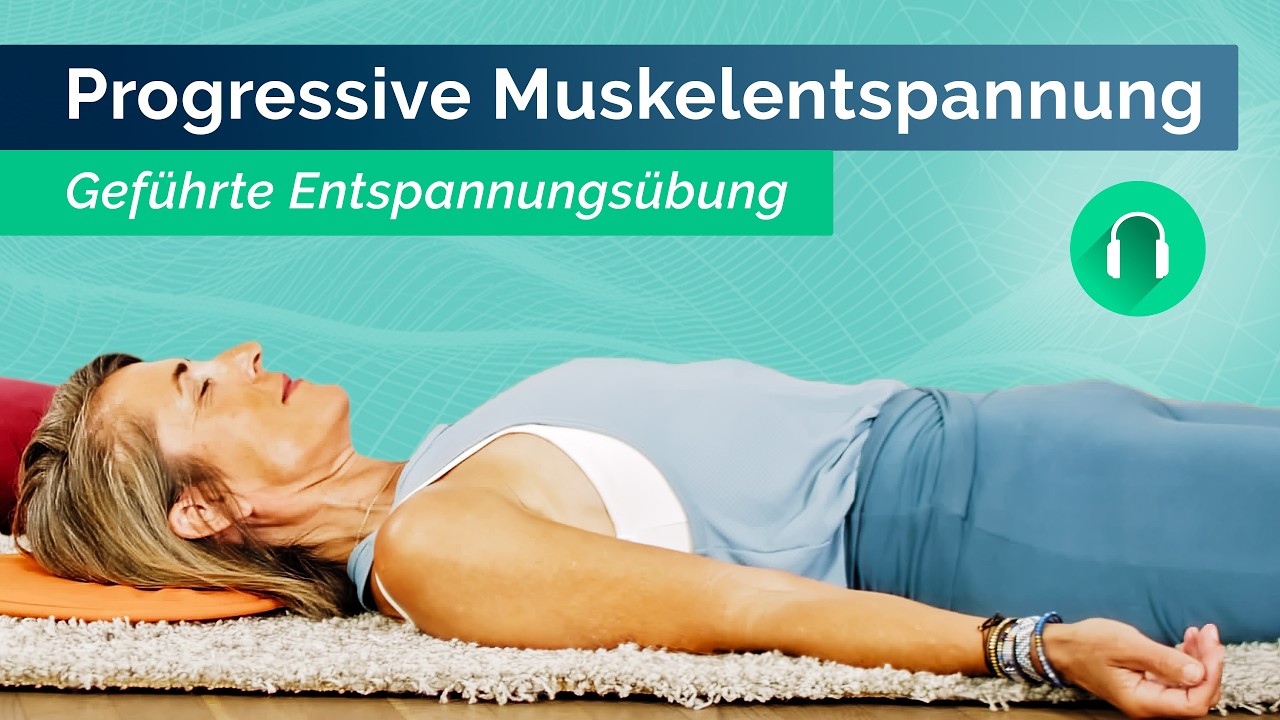
Maria guides you step by step through the entire exercise—perfect for beginners and advanced practitioners alike.
Duration: 23-minute complete guide
To the guided PMRMeditation
Meditation calms the mind — and a calm mind harmonizes the body. In TCM, we know that every emotion affects a specific organ. Through regular meditation, you learn to break out of destructive thought patterns, find emotional balance, and strengthen your inner core.
Modern studies confirm: Meditation has been proven to change brain structure, reduce stress hormones, strengthen the immune system, and improve self-healing powers. Just 10 minutes a day can change your life forever.
Recommended meditations
GUIDED MEDITATIONS FOR EVERY DAY
Your personal meditation library
We have a complete Playlist with over 60 guided meditations, breathing exercises, and relaxation techniques—from short 5-minute meditations for in between to deep 30-minute sessions for intensive practice.
In the playlist you will find:
- Morning meditations for a mindful start to the day
- Meditations for restful sleep
- Breathing meditations for inner peace
- Meditations against stress, brooding, and worries
- TCM standing meditations for all 5 elements
- Body scan and body journeys
- Healing meditations to activate self-healing powers
- Special breathing techniques (4–7–8, coherent breathing, bee breathing)
Perfect for beginners and advanced practitioners. Choose the right meditation for you depending on your time, the time of day, and your needs.
To the meditation playlistYang is like the sun in the sky. Without the warmth of the sun, the ten thousand things cannot flourish. Without yang, the body cannot live.
– From the HUANG DI NEI JING
(The Yellow Emperor's Classic of Internal Medicine)
More tips for your everyday life
In addition to traditional TCM treatment methods there are many small everyday habits that can strengthen or weaken your yang. Yang is the warming, activating force in your body - and with the right measures you can build it up in a targeted way.
Heat tips for yang deficiency
🔥 Keep the kidney area warm
The kidneys are the root of Yang:
- Place a hot water bottle on the lower back (especially in the evening)
- Wear kidney warmers or body warmers
- Never sleep with your back exposed
- In winter, pay particular attention to warm clothing on the lower back
- Dry your back immediately after showering and keep it warm
🧦 Keep your feet warm
Cold feet weaken the yang:
- Always wear warm socks (even at home)
- Warm foot baths in the evening (20 min., 38-40 °C)
- Never walk barefoot on a cold floor
- Wear shoes with good insulation
- Use warming insoles
🧥 Warm clothing
Protect your body from the cold:
- Layer principle: several thin layers instead of one thick layer
- Keep your stomach, lower back and feet warm in particular
- Wear a hat - a lot of heat is lost through the head
- Avoid drafts and air conditioning
- Put on dry, warm clothing immediately after sport
Lifestyle tips for yang deficiency
💤 Sleep and yang regeneration
Your yang regenerates during the night:
- Go to bed before 11 pm (important for Yang build-up)
- 7–8 hours of sleep per night
- Warm bedroom (don't sleep too cold)
- Warm blanket and hot water bottle if necessary
- Don't lie in bed too long in the morning - the Yang wants to be active
☀️ Fill up on sunlight
The sun is the natural Yang source:
- Spend 20-30 minutes outdoors every day
- Sunlight in the morning is particularly valuable
- In winter: Use the midday sun
- Light therapy lamp in the dark months
- Vacation in warm, sunny regions
🚶 Moderate movement
In the case of Yang deficiency: build up instead of exhaust!
- Go for a walk in the fresh air (20-30 minutes a day)
- Qi Gong or Tai Chi - perfect for Yang build-up
- Gentle yoga (no strenuous forms)
- Movement gets the yang flowing
- Don't sit for too long - stand up regularly
❌ Avoid with yang deficiency:
- Intense cardio or marathon
- Excessive sweating due to sport
- Training to exhaustion
- Cold showers or ice baths
- Sport in a cold environment without sufficient clothing
Moxibustion - TCM heat therapy
🔥 What is moxibustion?
A traditional TCM heat treatment:
- Moxibustion („moxa“ for short) is an ancient Chinese healing method
- Dried mugwort (Artemisia vulgaris) is burned
- The heat generated is directed at acupuncture points
- The heat penetrates deep into the body and strengthens the yang
- Particularly effective for cold conditions and yang deficiency
👨⚕️ Professional application
Get treatment from experts:
- TCM therapists know the right points for your pattern
- Professional treatment is safe and targeted
- Frequently used points: KG 04, KG 06, LG 04, Ma 36
- The treatment is pleasantly warm and relaxing
- Regular sessions reinforce the effect
🏠 Self-application with moxa cigars
For use at home:
- Moxa cigars are easy to use
- The glowing cigar is held over acupuncture points
- Keep your distance - pleasant warmth, no burning!
- Have a TCM therapist show you the technique
- Popular points for at home: KG 06 (below the navel)
⚠️ Important for moxibustion
- Do not use in case of fever or heat conditions
- Caution with sensitive skin
- Ensure good ventilation (smoke development)
- Always ask a therapist if you are unsure
💡 Important to know
Be patient with yourself. Yang building takes time - usually 3-6 months of consistent practice. Warmth, calm and the right habits are key. Every day with good habits is a step in the right direction.
For optimal treatment progress
TCM is not a quick fix for symptoms., but rather a holistic healing process. You will achieve the best results if you consistently integrate the treatment into your daily routine and give your body time to regenerate.
Integration into everyday life
Start with ONE step
Don't try to change everything at once! That's overwhelming and leads to
usually leads to you giving up. Instead:
- Week 1-2: Avoid cold food and drinks completely
- Week 3-4: Daily heat treatment of the lower back
- Week 5-6: Establish Qi Gong for the kidneys (10 min.)
- Week 7-8: Integrate warming herbal teas
- From week 9: Add further methods as needed
Realistic expectations
After 2–3 weeks: First improvements noticeable
- Less frost sensation
- Warmer hands and feet
- A little more energy
After 6–8 weeks: Significant improvements
- Significantly warmer body sensation
- Improved digestion
- More drive and motivation
After 3–6 months: Sustainable healing
- Yang is noticeably strengthened
- Body can retain heat
- Vitality is back
TCM vs. Western medicine
TCM and Western medicine are not mutually exclusive—they complement each other!
When Western medicine is important:
- In acute emergencies
- In case of structural damage
- In case of infections
- For accurate diagnoses (laboratory, imaging)
Where TCM has its strengths:
- In case of functional disorders
- For chronic complaints
- For prevention
- For holistic healing
Ideal: Combine both systems! Use Western medicine for
Acute treatment and accurate diagnosis, TCM for lasting healing
and strengthening the body's self-healing powers.
Important: Never stop taking prescribed medication without consulting your doctor first!
Talk to your doctor when you start TCM treatment.
TCM diagnosis for professionals
Syndrome differentiation according to TCM:
Tongue: Pale, moist, possibly swollen with tooth impressions, thin white moist coating
Pulse: Deep (Chen Mai 沉脉) and weak (Ruo Mai 弱脉), especially at the left chi position (kidney)
Pathomechanism:
Kidney Yang (Shen Yang 肾阳), also known as Ming Men Huo (命门火) - the fire of the gateway to life - is exhausted. As the root of all yang in the body, kidney yang is responsible for warming all organs and transforming fluids. If it is weakened, cold dominates (Han 寒): The body can no longer warm itself, fluids are no longer transformed (edema), and vitality decreases.
Treatment principle:
Wen Bu Shen Yang (温补肾阳) - Warming and tonifying the Kidney Yang
Classic recipe:
Jin Gui Shen Qi Wan (金匮肾气丸) as a basis
Important modifications depending on accompanying symptoms:
- In severe cold: + Fu Zi (Aconiti Radix), Rou Gui (Cinnamomi Cortex)
- For edema: + Fu Ling (Poria), Ze Xie (Alismatis Rhizoma)
- For back pain: + Du Zhong (Eucommian Cortex), Xu Duan (Dipsaci Radix)
- For impotence: + Yin Yang Huo (Epimedii Herba), Ba Ji Tian (Morinda Radix)
Every step counts
Your body WANTS to heal—you just have to create the right conditions for it to do so.
Remember:
👣 Every little step counts
You don't have to be perfect. Even one warm meal a day is better than none. Even 5 minutes of qigong is better than no exercise at all.
⏳ Patience pays off
It took years for your body to get into this state. Give it time to regenerate. Healing takes time, but it WILL happen.
🎯 Focus on what you can DO
Don't concentrate on what you are doing „wrong". Focus on every positive step you take.
💚 Be good to yourself
Perfection does not exist. It is acceptable to have an off day occasionally. Tomorrow is a new day when you can continue.
🤝 You are not alone
Thousands of people are walking this path with you. For over 2,000 years, TCM has been helping people like you who want to regain their health.
Measure your healing progress

To track your progress with treatment, we recommend that you repeat the TCM analysis after about 3 months.
Why is this important?
- You can see how your condition has improved.
- You can adjust the treatment as needed.
- It motivates you to keep going
- You recognize which measures work best
⚠️ Important: Your answers today will be stored in encrypted form in a code that you received by email. You can only measure your progress later with this code. Keep the email safe!
Activate reminder:
<>In 12 weeks, you'll receive an email with a link to the TCM analysis. When you fill it out, you can enter your personal health code—then you'll see a comparison overview at the end:
→ Your new values
→ Your scores from today's test
→ Direct changes
This allows you to see at a glance whether your symptoms
have improved!
🔒 YOUR DATA IS SAFE
We store:
✓ Only your email address for reminders
✓ The date for shipping
We do NOT store:
✗ Your analysis results
✗ Your personal health data
✗ The connection between email and diagnosis
All analysis data is completely anonymous and is not linked to your email address.
Newsletter
Stay up to date with our newsletter. Besides useful tips and tricks for training and your everyday life, you won't miss any of our new releases.
We are here for you
Do you have questions about your diagnosis or treatment?
Not sure which method is right for you?
Contact us — We're happy to help!