







Du Huo — Angelica
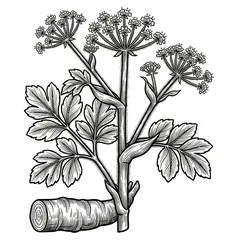
Du Huo—the „solitary“ angelica—owes its poetic name to the observation that its leaves move even in the absence of wind. In TCM, it is the primary herb for treating wind-dampness-bi in the lower part of the body.
Unlike Qiang Huo, which acts on the upper body, Du Huo primarily targets the lower body—specifically wind, dampness, and Bi in the hips, knees, legs, and lower back. Together, they form a complementary pair against systemic Bi syndrome.
Effect from a TCM perspective
Du Huo dispels wind-dampness and resolves Bi syndrome in the Lower Burner. It opens the meridians, dispels wind-cold-dampness, and is effective for chronic Bi syndrome that worsens in cold and damp conditions.
- Repels wind and moisture and relieves Bi syndrome in the hips, knees, and lower back
- Dispels Wind, Cold, and Dampness and opens the meridians in cases of chronic Bi syndrome
- Cleans the surface in windy, cold weather, with a stiff neck
- Channels the effect downward — guide herb for the lower heater
- Strengthens when combined Kidney Function in Bi with Liver-Kidney Deficiency
Application & dosage
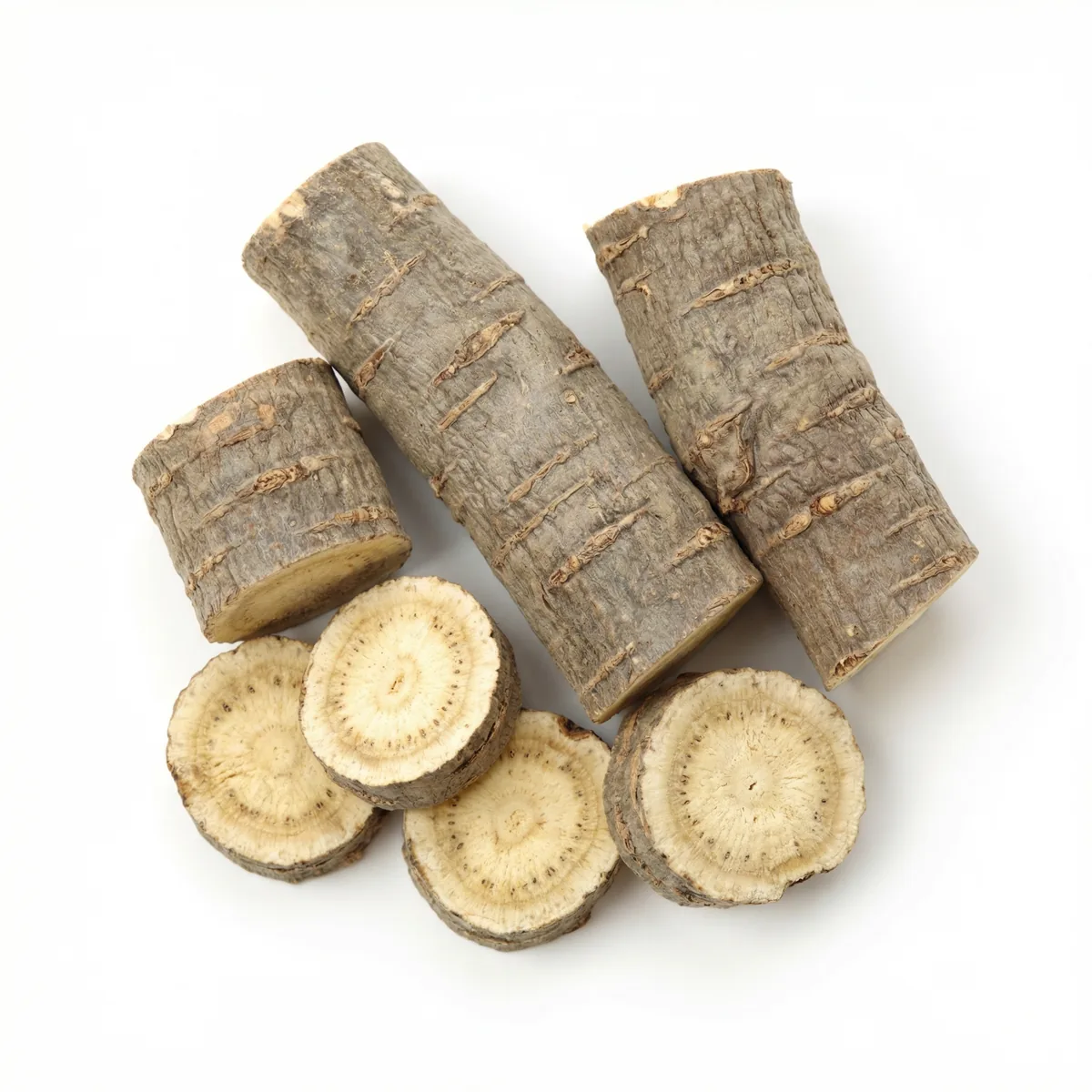
Du Huo is typically prescribed in a dose of 3–9 g Used in a decoction. In cases of severe Bi syndrome, the dose may be increased to as much as 15 g. The root is simmered for 20–30 minutes to extract the essential oils and coumarins.
To make a wine infusion (Du Huo Jiu), the root is steeped in rice wine—a traditional method used for chronic Bi conditions that enhances the meridian-opening effect. This method is particularly popular among older patients.
Dosage forms
- Decoction — Standard use: cook for 20–30 minutes
- Granules — as a ready-made preparation available at TCM pharmacies
- Wine Infusion (Du Huo Jiu) — Soak the root in rice wine; for a long-standing Bi
- Tablets — as a classic ready-made formula for long-standing wind–dampness–bi
Dosage
- Decoct: 3–9 g (standard dose)
- In cases of severe Bi Syndrome in the lower channels: up to 15 g
- Wine infusion: 10–15 g per batch
- In treatments for Bi syndrome using Liver and Kidney Weakness: according to the manufacturer's specifications
Frequent combination partners
Du Huo often does not reach its full effectiveness until it is combined with other herbs
History & Tradition
Du Huo is already listed in the *Shén Nóng Běn Cǎo Jīng* as a middle-class herb. Its name, „Dú Huó“ (独活), literally means „living alone“—a reference to the observation that the leaves of this plant move even without wind. Tao Hongjing (456–536) stated: „The plant moves on its own, without being moved by the wind“—a reference to its inner strength to break through stagnation.
The most famous formula containing Du Huo comes from the *Qiān Jīn Yào Fāng* by Sun Simiao (ca. 652 CE). This elegant formula of 15 herbs resolves chronic Bi in the lower back and knees by simultaneously dispelling wind-dampness, opening the meridians, and strengthening the liver and kidneys. To this day, it remains one of the most commonly prescribed formulas for chronic Bi in the lower back.
The distinction between Du Huo (lower body) and Qiang Huo (upper body) was made by Li Gao (1180–1251), the founder of the Spleen-Stomach School, systematized this approach. He taught that every herb has its preferred mode of action—a principle that continues to shape the precision of TCM prescriptions to this day.
In traditional Chinese medicine, Du Huo wine was a popular Home Remedies for joint pain during the cold season. Even today, older people in Sichuan and Hubei still prepare „Du Huo Jiu“—angelica root steeped in rice wine and aged for several weeks.
Contraindications & caution
Do not use if Yin Deficiency Heat with night sweats, dry mouth, and hot flashes without chills or clamminess—the warming and drying nature of Du Huo further damages the Yin.
Be careful with Anemia with Wind symptoms — in these cases, the blood must be nourished first. Not for Bi syndromes caused by pure heat, with red, hot, swollen joints. If you are taking blood thinners, consult your doctor.
Botany
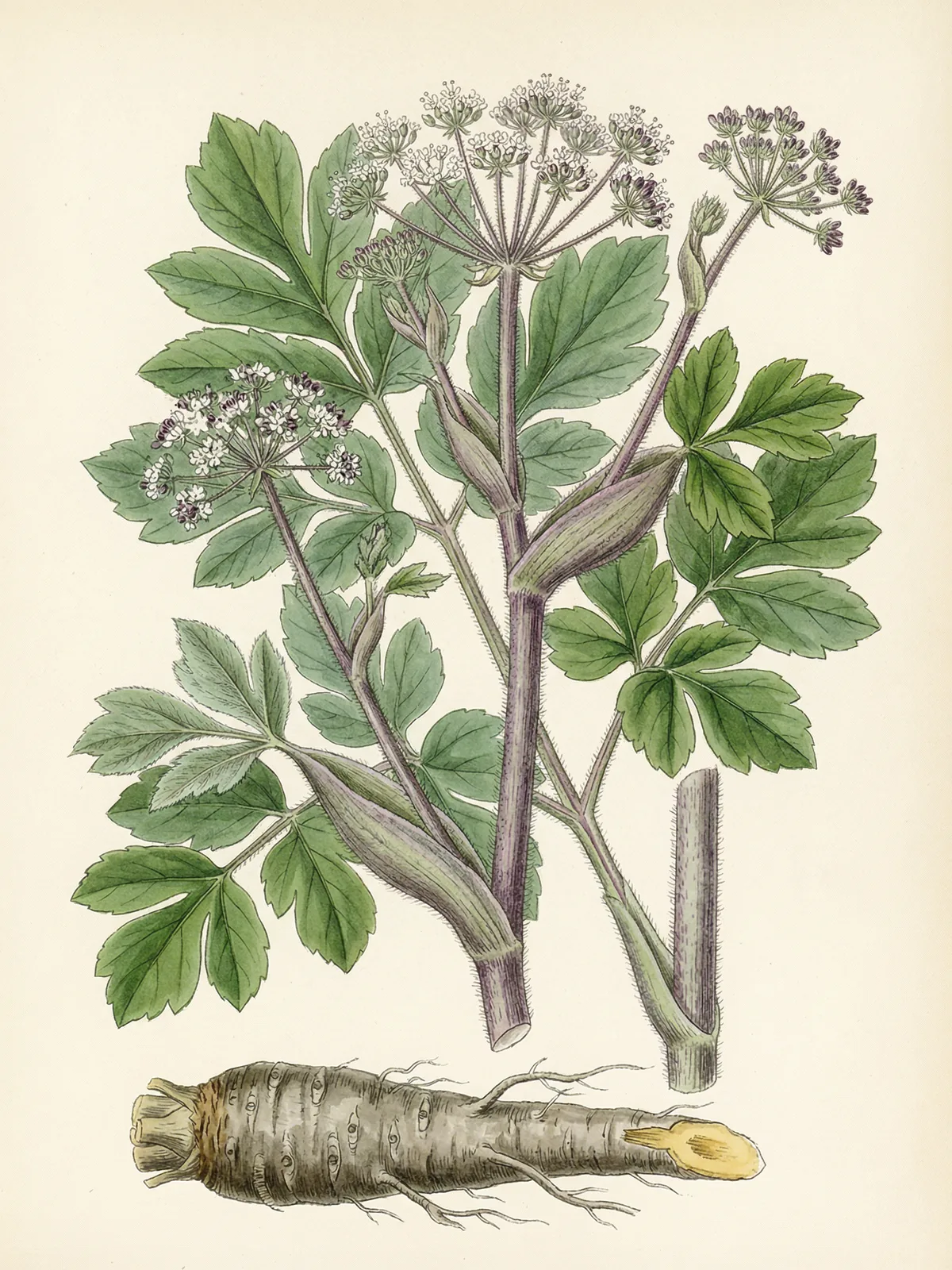
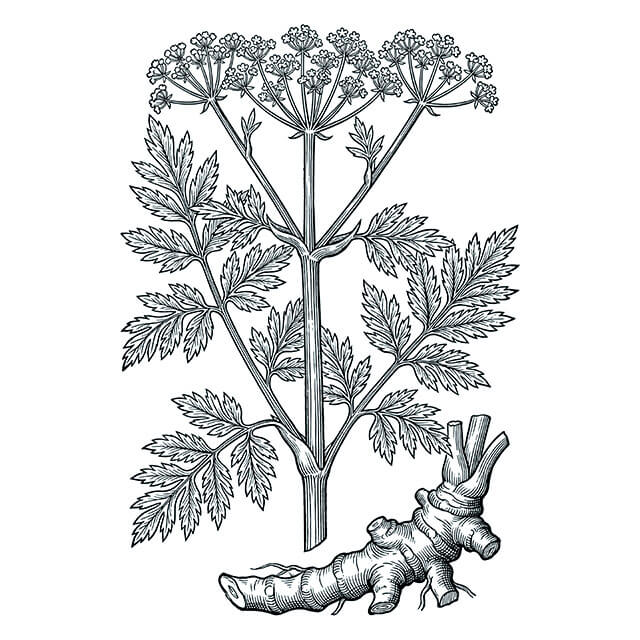
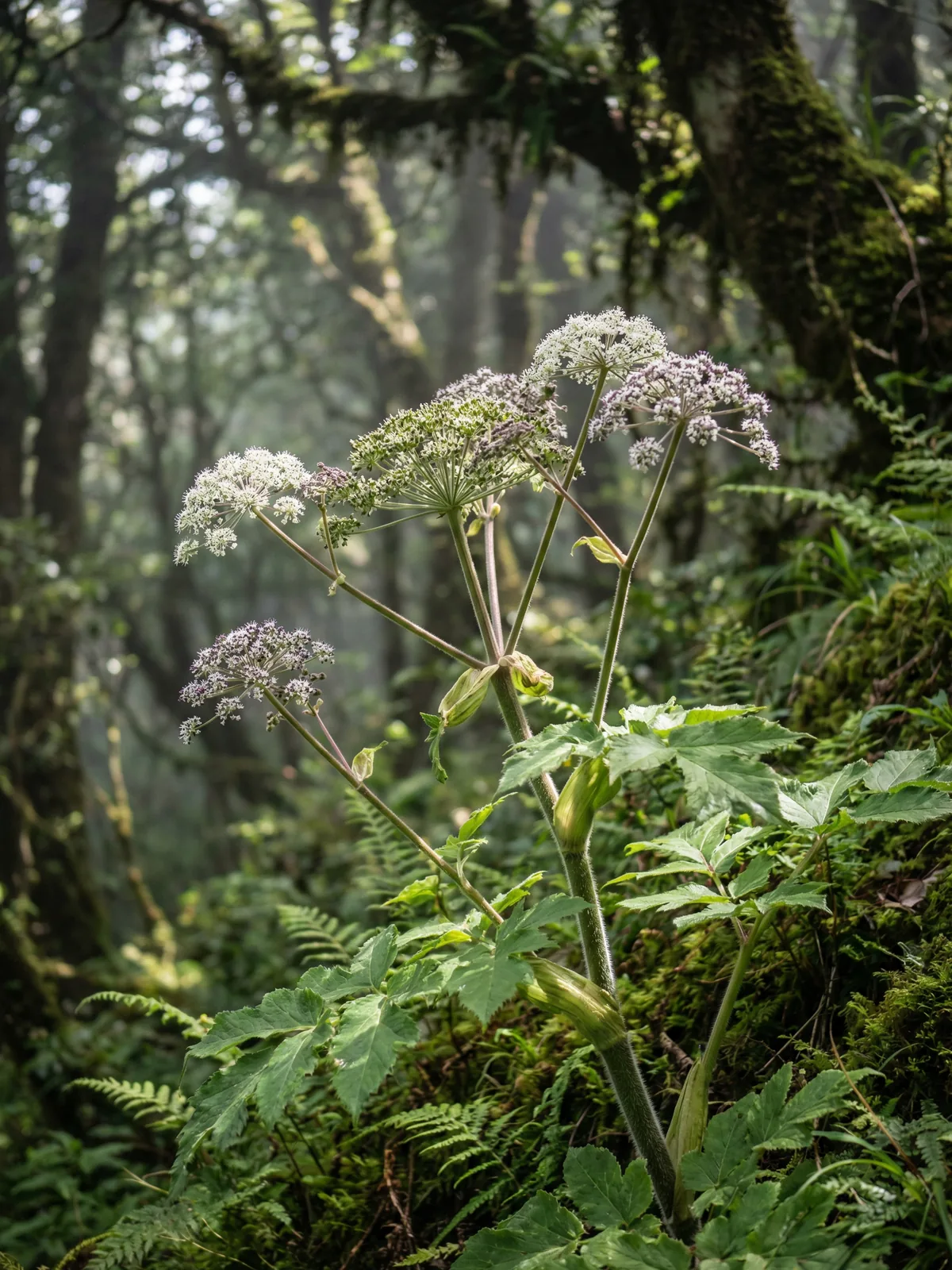
Angelica pubescens belongs to the Family of Umbellifers (Apiaceae) and is a perennial, herbaceous plant that grows to a height of 60–150 cm. The stem is grooved, hollow, and often tinged with purple. The leaves are two- to three-pinnately compound with broad, serrated leaflets and are densely hairy on the underside—hence the species name „pubescens.“.
The flowers appear in large, compound umbels and range in color from white to yellowish-white. The root, which is used medicinally, is thick, fleshy, and branched, with a yellowish-brown exterior and a strongly aromatic, slightly pungent odor. Chewing it produces a tingling sensation on the tongue—a Quality characteristic for the drug.
Occurrence
- Central China — Sichuan, Hubei, and Anhui as the main growing regions
- The variety from Enshi (Hubei) is considered „Zi Du Huo“ — premium quality
- Prefers moist mountain slopes, forest edges, and ravines at elevations of 1,000–2,500 m
- Also found in Japan and Korea
- Today, it is primarily cultivated; wild populations have declined
Harvest time
- Harvest in the Late fall (October–November) or in early spring (March–April)
- Plants starting from the 2nd–3rd year of growth harvest
- Carefully dig up the roots to preserve the lateral roots
- The fall harvest is considered richer in nutrients as a spring crop
Processing
The processing of Du Huo is intended to preserve the essential oils and coumarins that enable the herb to dispel wind, cold, and dampness and open the meridians.
- Raw Drug (Shēng Dú Huó):
- Wash fresh roots and remove any soil
- Cut large roots in half lengthwise or into quarters
- Dry slowly at a low temperature — avoid high heat
- Slice and store in a dry place
- Wine-Processed Drug (Jiǔ Dú Huó):
- Spray the dried root slices with rice wine
- Let it sit for several hours
- Sauté gently until the wine has evaporated
Wine processing enhances the meridian-opening and blood-invigorating effects and is preferred for chronic Bi with blood stasis.
Related herbs
Herbs with similar effects and related areas of application