






Plantarfaszilitis aus Sicht der chinesischen Medizin
... four points for relief


Self-Acupressure with the Akupen


Wolfgang's Qi Gong Tips
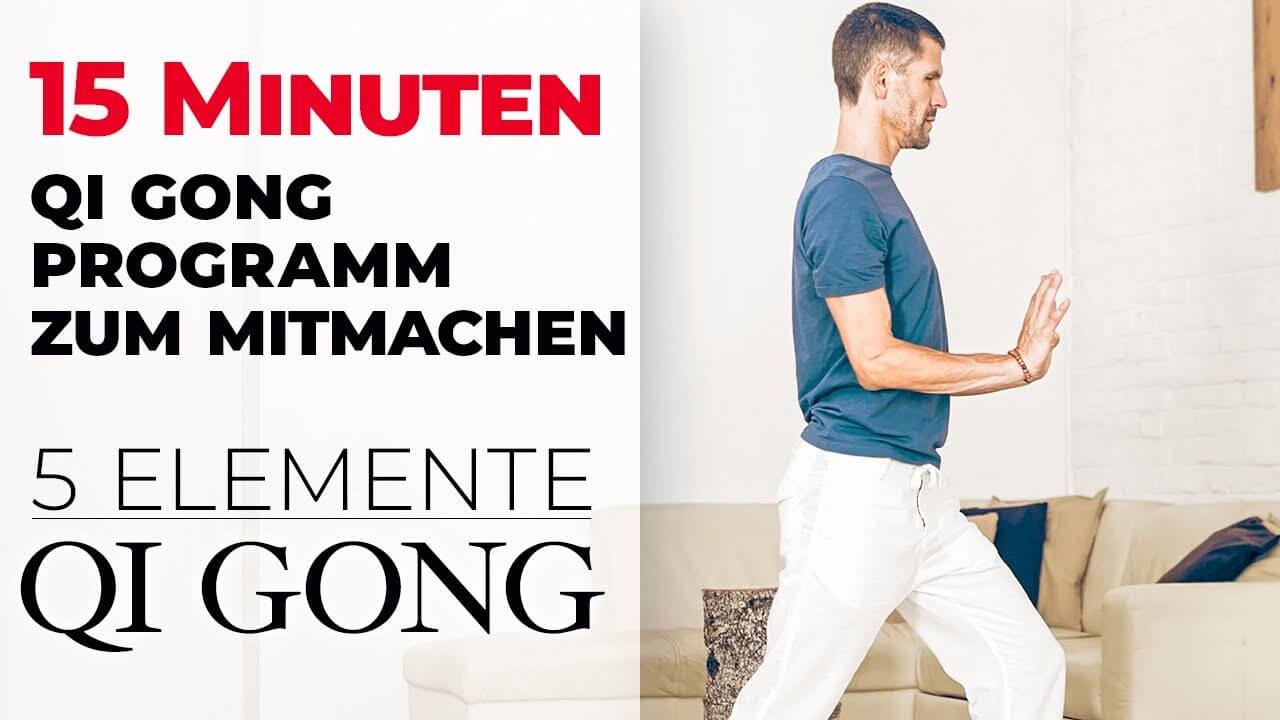
If you do Qi Gong for preventive reasons, it is quite possible to achieve good results with 15 minutes of daily practice. If you have a complaint, it is recommended to practice 2 times 15 minutes daily or 30 minutes at a time daily.
Basically, it is better to do 6 times 15 minutes Qi Gong, than once 1.5 hours. Therefore, I show you here a short variant of the 5 elements Qi Gong.

TCM background information

Ni01 "Bubbling Spring" - Yongquan
Grounding point in qigong, sedation point of the kidney meridian, strengthens kidney yin
- Location:
In a depression on the middle of the sole of the foot, between 2nd and 3rd metatarsal bones. Between the ball of the big toe and the ball of the little toe in a depression.
- Traditionally classified as:
Sleep disorders, tension in the back (with fullness condition) headache (vertex), mind calming, anxiety, panic attacks, listlessness, impotence, dizziness.
Comment:
It is through this point that one grounds oneself in Qi Gong. Here the energy system of man connects with the earth. Therefore, in qigong, one imagines deep and strong roots growing from this point down into the earth.
Ni01 is the resuscitation point for collapse and unconsciousness. It must be pressed a little harder with a pointed object such as an acupuncture.
This point has a general lowering function of qi, so if you want to bring energy from the head down to the feet, similar to the effect of Le02.
Ki 03 "Great torrent" - Taixi
Source Point of the kidney meridian, strengthens the kidney yang and kidney yin
- Location:
On the midline of the line connecting the medial malleolus and the Achilles tendon. A pulse is also palpable there.
- Traditionally classified as:
chronic low back pain, knee problems, coldness in the body, micturition disorders (problems with urination), sleep disorders, tinnitus, male and female infertility, loss of libido, fatigue, anxiety, irregular menstruation, amenorrhea, hypermenorrhea
Sp 04 "Grandson of the Duke" - Gongsun
Strengthens spleen and stomach
- Location:
The point is located at the proximal (near-body) end of the 1st metatarsal, between red and white "flesh".
- Traditionally classified as:
Menstrual problems, gynecological pain, stomach pain, abdominal pain, loss of appetite, great restlessness, indigestion, diarrhea.
Comment:
This point is mainly used for fullness patterns of the stomach and spleen. So when too much moisture blocks the stomach or rebellious stomach qi. But also with abdominal pain, which is based on fullness, the point MP4 is helpful.

The word Qi Gong consists of 2 syllables - Qi and Gong. The Chinese term "Qi" can be translated for us most likely by "life energy". But it contains more than this. It also means breath and air. In Chinese medicine, Qi is considered to be the invigorating force that flows through all living things. However, Qi is not only inside the body of a living being, but also outside. Qi also shows itself to us in nature. Thus animals, flowers and trees are flowed through by Qi. Qi is the living force that is inherent in everything and that makes life possible.
The Japanese call this force "Ki". In India it is called "Prana". It always means the same thing - the power and energy that is inherent in everything and keeps us alive. In Chinese medicine, health is only possible when the Qi in our body is pure, not polluted and can flow freely.
Due to bad living habits, in the course of time, energy blockages can occur in the body system and as a result, diseases can manifest, which can be physical or psychological in nature. Generally speaking, we can say that a living person has Qi throughout the body.
You are interested in this topic?
Then you can find even more information about it here.
You want to learn Qi Gong - easily from home?
With our modern Qi Gong online courses this is easily possible!