




Low Blood Pressure 1 from the Perspective of Chinese Medicine
... Acupuncture points against low blood pressure


Self-Acupressure with the Akupen


Wolfgang's Qi Gong Tips
Awaken Qi
Support sky
Connecting heaven and earth
View full moon
Archer
Collect Qi
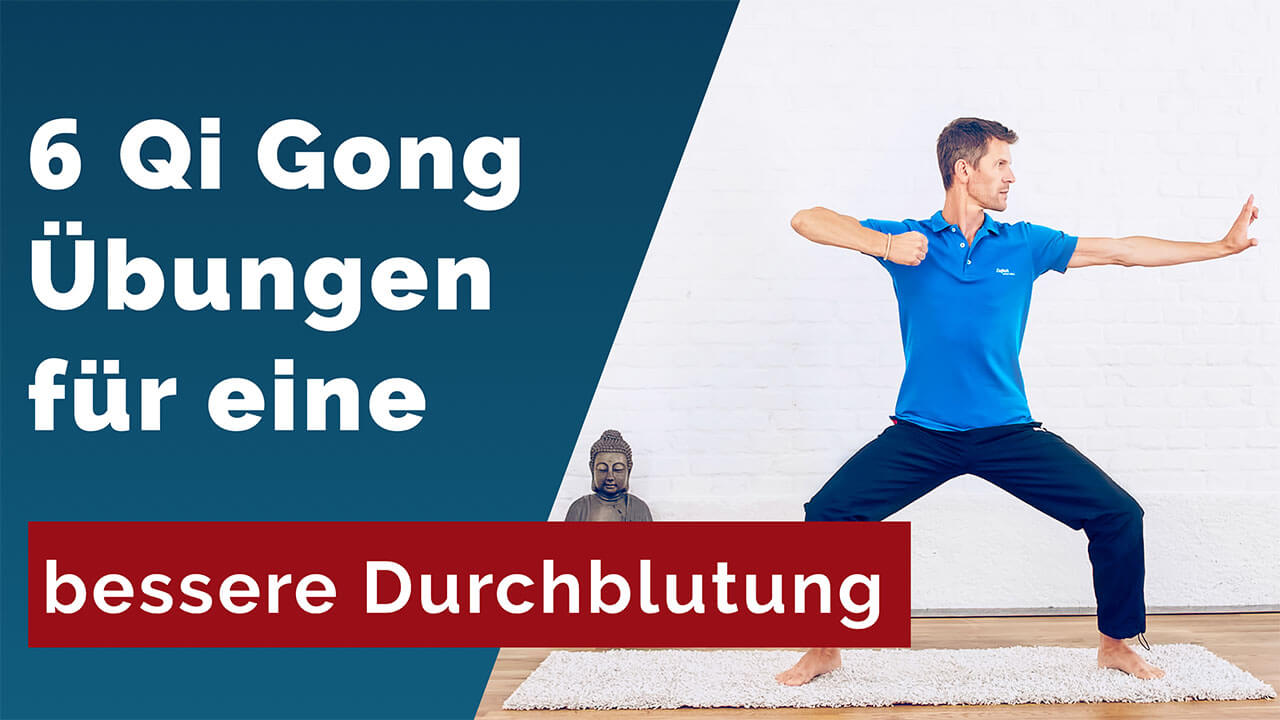
This Qi Gong program consists of 6 exercises that improve blood circulation throughout the body. Through Qi Gong, with every single movement in the body there is a stretching and subsequent relaxation of muscles. This can be compared to a pump. Muscles tense and relax in the rhythm of breathing.
The blood vessels in the muscles are of course not exempt from this pulsation and are also stretched and relaxed again. This keeps the vessels supple, provided they are not affected by plaques due to bad eating habits. The valves in the veins remain healthy and as a result the heart has less work to move the blood around the body. Because rigid blood vessels are not only a problem for the heart, but also the trigger of many other problems.
You will feel the improved blood supply after a few minutes of practicing qigong when you become warm and start to sweat slightly.

TCM background information

Ni01 "Bubbling Spring" - Yongquan
Grounding point in qigong, sedation point of the kidney meridian, strengthens kidney yin
- Location:
In a depression on the middle of the sole of the foot, between 2nd and 3rd metatarsal bones. Between the ball of the big toe and the ball of the little toe in a depression.
- Traditionally classified as:
Sleep disorders, tension in the back (with fullness condition) headache (vertex), mind calming, anxiety, panic attacks, listlessness, impotence, dizziness.
Comment:
It is through this point that one grounds oneself in Qi Gong. Here the energy system of man connects with the earth. Therefore, in qigong, one imagines deep and strong roots growing from this point down into the earth.
Ni01 is the resuscitation point for collapse and unconsciousness. It must be pressed a little harder with a pointed object such as an acupuncture.
This point has a general lowering function of qi, so if you want to bring energy from the head down to the feet, similar to the effect of Le02.
St 36 "Three miles of the foot" - Zusanli
Most important point of the stomach meridian to strengthen digestion
- Location:
4 transverse fingers (3 cun) below the lower edge of the patella (knee cap) on the tibialis muscle
- Traditionally classified as:
indigestion, bloating, constipation, stomach pain, fatigue, headache, loss of appetite, blurred vision
Comment:
This point is a prominent point in TCM because it strengthens the post-heaven qi. What is meant by this is that it strengthens the stomach and spleen, those organs that are responsible for our energy intake through food.
Ma36 is a general toning point for the whole body, but also for the psyche, and is used for all symptoms of fatigue, tiredness and weakness.
Together with MP06, Le03 and Di04, it is one of the most famous and frequently used points in Chinese medicine.
KG 4 "Gate of origin qi" - Guanyuan
Alarm point of the small intestine
- Location:
4 transverse fingers (3 cun) below the navel
- Traditionally classified as:
Diarrhea, problems urinating, period disorders, premenstrual syndrome, infertility, impotence, lack of strength.
Comment:
This is the most powerful point to tonify Qi and blood and strengthen body and soul. It strengthens the kidney and thus the original Qi. Thus, it is an important point to increase overall vitality and in chronic diseases.
KG 4 has a grounding effect on the spirit of man, in that it offers us a center in which we can gather and come to rest.
KG 5 "Stone Gate" - Shimen
Alarm point of the triple burner
- Location:
3 transverse fingers (2 cun) below the navel
- Traditionally classified as:
Diarrhea, problems urinating, period disorders, premenstrual syndrome, infertility, impotence, lack of strength.
Comment:
The effect of points KG 4,5,6 are similar and therefore we have combined them.
If we take a closer look at KG 5, it has a special effect on the 3-fold warmer. It also strengthens, like KG 4, the origin Qi. However, more by the fact that he better coordinates the "3 combustion chambers of the body".
The task of the triple burner is to regulate the absorption, transformation and elimination in the body. The better this works, the more vital the entire body.
KG 6 "Sea of Qi" - Qihai
Strengthening point of the body - the sea of energy!
- Location:
2 transverse fingers (1.5 cun) below the navel
- Traditionally classified as:
Diarrhea, problems with urination, period disorders, premenstrual syndrome, infertility, impotence, lack of strength, physical and mental exhaustion.
Comment:
The effect of the points overlap and yet can be very differentiated. While KG 6 strengthens more the Qi, KG 4 strengthens more the blood. This is explained by the fact that KG 4 acts on the small intestine, which is involved in blood production.
Furthermore, KG 6 moves qi, while KG 4 has no qi moving influence, although both strengthen qi.
KG 6 affects all abdominal organs, while KG 4 has more of an effect on the uterus.
KG 6 additionally strengthens the spleen, while KG 4 strengthens the kidneys.
CV 17 "Center of the chest" - Naohu
Master point for breathing
- Location:
In the middle of the sternum, at the level of the nipples (in men).
- Traditionally classified as:
bronchial asthma, cardiac congestion, intercostal neuralgia, cough, expectorant, congestion reliever
Comment:
This point is considered the master point for breathing. At the same time, it also has a positive influence on the cardiovascular system and therefore helps with heart problems. It is also the master point for the upper 3 fold warmer.

The word Qi Gong consists of 2 syllables - Qi and Gong. The Chinese term "Qi" can be translated for us most likely by "life energy". But it contains more than this. It also means breath and air. In Chinese medicine, Qi is considered to be the invigorating force that flows through all living things. However, Qi is not only inside the body of a living being, but also outside. Qi also shows itself to us in nature. Thus animals, flowers and trees are flowed through by Qi. Qi is the living force that is inherent in everything and that makes life possible.
The Japanese call this force "Ki". In India it is called "Prana". It always means the same thing - the power and energy that is inherent in everything and keeps us alive. In Chinese medicine, health is only possible when the Qi in our body is pure, not polluted and can flow freely.
Due to bad living habits, in the course of time, energy blockages can occur in the body system and as a result, diseases can manifest, which can be physical or psychological in nature. Generally speaking, we can say that a living person has Qi throughout the body.
The word "gong means roughly "body work" or "success through perseverance and practice". Therefore Qi Gong is called "Work with the life energy". We learn to improve the flow and distribution of Qi in our body through movement and concentration to strengthen our health and bring body and mind into harmony. At the same time we learn to stand correctly, between heaven and earth. This significantly improves posture and many aches and pains disappear on their own.
Qi Gong is a holistic healing system with a long tradition, which has been continuously developed until today. It includes health-promoting postures, movement, self-massage, breathing techniques and meditation. Through these various exercise methods, Qi is supposed to be collected and stored in the body, like in a reservoir. The goal is to expel the impure Qi and absorb fresh pure Qi.
Qi Gong is not a medicine that is prescribed for a limited time, but rather it should be practiced daily. In this regard, 20 minutes of daily practice is enough to improve health and one's well-being to a great extent.
Anyone can practice qigong. There are exercises for every age and every state of health. The exercises can be practiced standing, sitting, lying down or walking. So even physically challenged people can easily practice Qi Gong and improve your health in a sustainable way.
You are interested in this topic?
Then you can find even more information about it here.
You want to learn Qi Gong - easily from home?
With our modern Qi Gong online courses this is easily possible!