






On this page, you will learn:
- Was dein Muster aus Sicht der TCM und der westlichen Medizin bedeutet
- Where your symptoms come from and how they are connected
- Which specific treatment methods can help you now
- How to use TCM herbs, acupressure, qigong, and nutrition to strengthen your spleen qi, lift sinking qi, and stabilize your center
The good news: Dieses Muster lässt sich mit den richtigen Maßnahmen sehr gut behandeln. Mit kräftigender Ernährung, gezielter Akupressur, hebenden Qi Gong Übungen und bewährten TCM–Kräutern kannst du deine Mitte stärken und dem Körper seine tragende Kraft zurückgeben.
Take your time, Get to know the different treatment approaches—you don't have to implement everything at once. Choose what feels right for you and what you can easily integrate into your everyday life.
Your treatment at a glance:
Which TCM pattern is really behind your complaints?
Degree of
imbalance

Moderate to Significant
Typical
treatment duration

3-6 months
self-treatment
Possible

Partly self-treatable
Treatment–
scope

3-4 methods
Proposed
methods

Extensive range
Our free TCM analysis shows you your personal TCM pattern in just 10 minutes.
What is spleen qi deficiency with sinking qi?
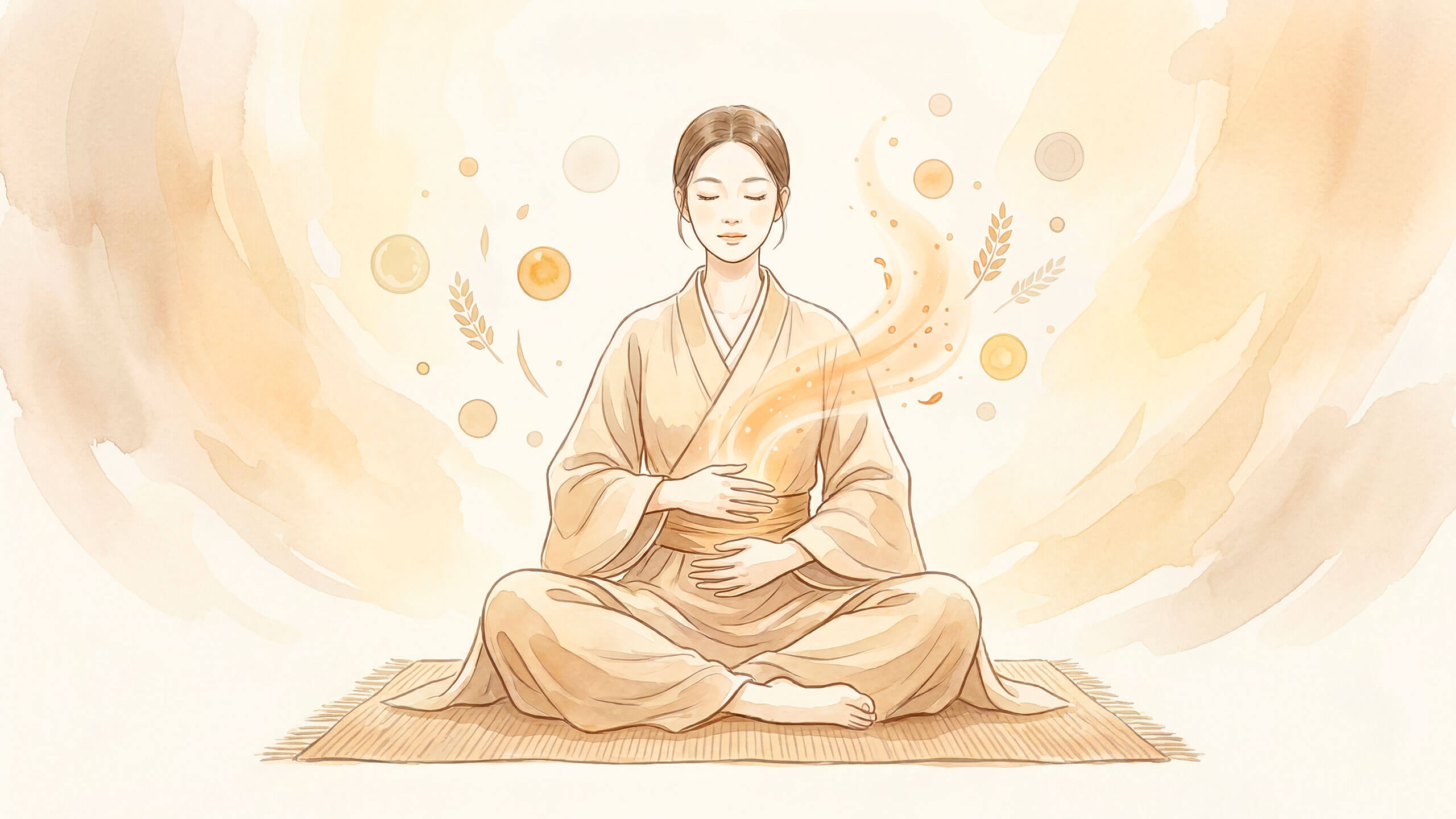
When everything feels like it's pulling you down and the feeling only subsides when you lie down
The TCM Perspective: When the Lifting Force of the Center Weakens
In Traditional Chinese Medicine, the spleen (Pí) is far more than just the small organ described in Western anatomy. It is the center of digestion, the „center“ of the body, and the source of all postnatal Qi. The spleen transforms food into vital essence and transports these nutrients to all organs and tissues.
One of the spleen's four main functions is to lifting function: It allows the „clear yang“ to rise upward and keeps the internal organs in their proper places. In TCM, it is said: „The spleen governs the rising of the clear.“ As long as this force is strong, the body is supported, the organs remain in their proper places, and we feel upright and stable.
Bei diesem Muster liegt nicht nur ein einfacher Milz–Qi Mangel vor — zusätzlich versagt diese hebende Funktion. Das Mitte–Qi sinkt ab, ein Zustand, den die TCM Zhongqi Xian (Sinking of the Central Qi). Instead of being lifted upward, everything pulls downward.
The consequence of this sinking Qi: A pulling, heavy sensation develops in the lower abdomen, often accompanied by a feeling of heaviness or sagging in the lower abdomen or pelvis. In severe cases, this can lead to organ prolapse, hemorrhoids, chronic diarrhea, or frequent urination. These symptoms are accompanied by the classic signs of Qi deficiency: profound fatigue, shortness of breath, a soft voice, and a lack of energy.
The typical signs of spleen qi deficiency with sinking qi:
- Severe fatigue and exhaustion, often accompanied by shortness of breath
- A pulling, heavy, or sinking sensation in the lower abdomen or pelvis
- Predisposition to organ prolapse (stomach, uterus, rectum)
- Hemorrhoids and chronic, loose stools
- Frequent urge to urinate or mild incontinence
- Gas, bloating, and loss of appetite
- Pale complexion, soft voice, not very talkative
- Excessive brooding and worrying
- Alles wird im Lauf des Tages schlechter — nach langem Stehen, Gehen oder Heben nimmt das Ziehen nach unten zu; im Liegen lässt es nach
- Eher niedriger Blutdruck mit Schwindel oder Flimmern beim Aufstehen
The good news: With the right measures, spleen qi can be strengthened very effectively—and with the appropriate herbs and acupuncture points, sinking qi can also be raised again. A warm, easily digestible diet, lifting exercises, and the classic formula Bǔ Zhōng Yì Qì Tāng will restore your core’s supporting strength.
The Western Perspective: Weakness, Prolapse, and Connective Tissue
From a Western perspective, this pattern combines two aspects: weakened digestive and energy functions, and a decline in the body’s ability to maintain posture and provide support. The body cannot optimally utilize food, and at the same time, the connective tissue lacks the elasticity needed to keep the organs securely in place.
Imagine your body as a well-pitched tent: as long as the poles and ropes are taut, everything stands upright. If the tension slackens, the fabric begins to sag. This is exactly what TCM describes as „sinking Qi“—the supporting, uplifting force is missing, and everything pulls downward.
Western equivalents are primarily found in conditions involving prolapse and chronic fatigue: gastric prolapse (gastroptosis), uterine or pelvic floor prolapse, hemorrhoids, chronic diarrhea, or weak pelvic floor muscles. This is often accompanied by low blood pressure with dizziness upon standing and pronounced general weakness.
What does modern medicine show?
- Gastroptosis: Prolapse of the stomach accompanied by a feeling of fullness and indigestion
- Pelvic floor and organ prolapse: decreased supportive strength of the connective tissue
- Hemorrhoids: Weakness of the supporting vascular and connective tissue
- Chronic diarrhea: impaired absorption and bowel function
- Orthostatic dysregulation: low blood pressure, dizziness upon standing
- Chronic Fatigue: Lack of Energy Due to Poor Nutrient Absorption
Modern research confirms: The TCM formula Bǔ Zhōng Yì Qì Tāng is currently the subject of intensive scientific research—studies have reported positive effects in cases of exhaustion, poor intestinal motility, and even mild organ prolapse. Herbs such as Huáng Qí (Astragalus) and Rén Shēn (Ginseng) exhibit energizing and tissue-strengthening properties.
This is exactly where TCM treatment comes in: it strengthens digestive function, systematically restores energy, and gently lifts the depleted Qi—so that your body can regain its stability and vitality.

The Yellow Emperor's team explains your pattern
Qi Bo | The Yellow Emperor | Dr. Lisa Weber
MASTER OF THE HEALING ARTS | TCM FOUNDER | MODERN PHYSICIAN
What happens when the legendary Yellow Emperor of Traditional Chinese Medicine sits down with his advisor Qi Bo and a modern doctor? They discuss your pattern—using 4,000-year-old knowledge AND the latest science.
Milz–Qi Mangel + Qi heben — Wenn alles nach unten zieht und erst im Liegen nachlässt
The Yellow Emperor: „Qi Bo, I see people who are not only constantly tired, but who seem to be weighed down by everything. They complain of a heavy, pulling sensation in the lower abdomen, of internal organs sinking, of hemorrhoids, and chronic diarrhea. Their voices are soft, their breaths short, and they feel as if they are collapsing inward. What is the cause of this suffering?“
Qi Bo: „Your Majesty, these people suffer not only from a deficiency of spleen qi, but also from its descent—we call this Zhōng Qì Xià Xiàn, the descent of central qi. The spleen has four major functions: it transforms food, transports essence, keeps the blood in the vessels—and it lifts. This lifting power allows the clear Yang to rise upward and keeps the organs in their proper places. When spleen Qi is severely weakened, this lifting function fails first. The Qi sinks instead of carrying—and with it, the organs, strength, and spirit sink.“
Dr. Weber: „That’s a remarkably accurate description! In Western medicine, we view these ‚prolapses‘ as organ ptosis—such as a prolapsed stomach or a prolapsed pelvic floor and uterus. This is often caused by weakened supportive and connective tissue combined with general exhaustion. Hemorrhoids and chronic diarrhea also fit the picture, as does low blood pressure with dizziness upon standing. The feeling of ‚sinking in on oneself‘ describes surprisingly well what happens when the body lacks the necessary supportive tone.“
The Yellow Emperor: „You say the spleen ‚lifts.‘ Explain this lifting force to me in more detail.“
Qi Bo: „Your Majesty, there is a constant movement within the body: the clear rises, and the turbid sinks. The spleen is responsible for the ascent of the clear—it sends the pure essence of food upward to the heart and lungs, where it is transformed into qi and blood. The stomach, on the other hand, allows the turbid to descend. As long as the spleen is strong, this balance prevails. If it is too weak, it can no longer lift the clear—it sinks downward with the turbid. Hence the heaviness, the sinking sensations, and the constant pulling downward. To treat this, we must not only strengthen the Qi but also lift it again—Shēng Yáng Jǔ Xiàn, “raising the Yang and lifting what has sunk.”
Dr. Weber: „It’s fascinating how TCM describes direction and movement here! Physiologically, the ‚ascent of the clear‘ actually corresponds to the transport of nutrients from the intestines into the circulatory system and to the liver. And the ‚supporting function‘ correlates with the tone of muscles and connective tissue—the pelvic floor, the ligaments suspending the organs, and vascular wall tension. When energy and tissue tone decline together, the very symptoms of prolapse described by Qi Bo occur. TCM has found an astonishingly apt term in ‚lifting‘ for something we explain today in terms of muscle tone and connective tissue tension.“
The Yellow Emperor: „What causes this decline in qi?“
Qi Bo: „The causes are similar to those of spleen-qi deficiency, but they are usually more profound and have a longer-lasting effect, Your Majesty. First: prolonged overwork and exhaustion, which deplete the qi at its root. Second: chronic illnesses and prolonged illness, which gradually deplete the Middle Qi. Third: too many childbirths or heavy physical strain, which weaken the lifting force. Fourth: a consistently poor diet—cold, raw foods, irregular eating. Fifth: constant brooding and worry, which constricts the spleen. If the spleen qi remains weak for a long time, the lifting force will eventually be lost—and the qi will begin to sink.“
Dr. Weber: „Scientifically sound! Chronic fatigue, long-term illness, and physical overexertion do indeed weaken muscles and connective tissue. Multiple childbirths put strain on the pelvic floor—one of the most common causes of pelvic organ prolapse. And chronic stress inhibits digestion and regeneration via the autonomic nervous system. All these factors take effect slowly and insidiously—exactly as TCM describes: Prolapse is usually the final stage of a long-standing weakness.“
The Yellow Emperor: „How do you treat spleen qi deficiency with sinking qi?“
Qi Bo: „Your Majesty, the principle of treatment is: Bǔ Zhōng Yì Qì—strengthening the center and increasing qi—combined with Shēng Yáng Jǔ Xiàn—raising the yang and lifting what has sunk. First, we strengthen the spleen with warm, cooked, easily digestible food. Second, we use herbs that not only build up the Qi but also lift it—above all Huáng Qí (Astragalus), supplemented by Shēng Má and Chái Hú, which guide the clear Yang upward. The classic formula for this is Bǔ Zhōng Yì Qì Tāng — the Strengthen-the-Center Decoction. Third: acupressure, especially on Bǎi Huì at the crown—the highest point of the body, which lifts the Qi—and on Stomach 36 to strengthen the center. Fourth: gentle, uplifting Qi Gong. And moxibustion warms and lifts the Qi particularly effectively.“
Dr. Weber: „Excellent! Bǔ Zhōng Yì Qì Tāng is one of the most extensively researched TCM formulas in the world. Astragalus (Huáng Qí) contains saponins and polysaccharides, which studies have shown to have immune-boosting and energizing effects. The formula is currently being studied for chronic fatigue, weak intestinal motility, and even mild organ prolapse—with promising results regarding the strengthening of muscle tone and tissue. And the Bǎi Huì acupoint has been well-researched neurophysiologically: Stimulating it influences the autonomic nervous system and circulation—which can actually help with low blood pressure and dizziness upon standing!“
The Yellow Emperor: „Tell me more about this Bǔ Zhōng Yì Qì Tāng formula.“
Qi Bo: „Your Majesty, the imperial herb is Huáng Qí (Astragalus), which powerfully strengthens and lifts the Qi. It is supported by Rén Shēn (ginseng) and Bái Zhú (Atractylodes), which nourish the spleen qi, as well as by Zhì Gān Cǎo (honey-roasted licorice), which warms and harmonizes the middle. Dāng Guī (Angelica) nourishes the blood so that the tonifying herbs do not dry out the body. Chén Pí (Mandarin peel) regulates the Qi and prevents stagnation. And the core ingredients for lifting are Shēng Má (black cohosh) and Chái Hú (bupleurum)—they guide the clear Yang upward and restore what has sunk. Thus, this formula combines tonifying and lifting in perfect harmony.“
Dr. Weber: „A well-thought-out formulation! What impresses me is that the formula combines tonifying ingredients with two herbs specifically intended to direct the ‚course‘ of the effect—Shēng Má and Chái Hú. Modern studies describe interesting effects of these two herbs on inflammation and smooth muscle. And the addition of Dāng Guī demonstrates a deep understanding of TCM: Those who strongly tonify must simultaneously nourish the blood to keep the body in balance. A formula over 700 years old that is surprisingly modern in its design!“
The Yellow Emperor: „Wonderful! Let's turn this wisdom into a practical plan.“
THE THREE-WISE METHOD FOR SPLEEN QI DEFICIENCY WITH FALLING QI
MORNING PROTOCOL (Straightening the Core):
- TCM: A warm, energizing breakfast — the spleen needs warmth in the morning to boost the clear yang
- Science: Warm food activates digestive enzymes and provides sustained energy early in the day
- Practical: Warm millet porridge with dates and walnuts, or congee with sweet potato, ginger, and a little beef
- TCM: Acupressure on Bǎi Huì (LG 20) at the crown of the head—the highest point of the body—lifts the sinking Qi
- Science: Stimulation at the crown of the head affects the autonomic nervous system and can help stabilize circulation
- Practical: Right in the center of the crown of the head, on the line connecting the tips of the ears. Gently tap or apply circular pressure for 1–2 minutes—moving slightly upward
- TCM: Warmes Wasser mit Ingwer — wärmt die Mitte und aktiviert das Milz–Qi
- Science: Ginger contains gingerols, which stimulate gastric emptying and blood circulation
- Practical: 2–3 slices of fresh ginger in warm water — in the morning on an empty stomach
TAGS STRATEGY (Focusing on the Center):
- TCM: A warm main meal at lunchtime — the spleen’s active period is from 9 to 11 a.m., and digestive power is at its peak at lunchtime
- Science: At lunchtime, digestive enzymes are most active, and nutrient absorption is optimal
- Practical: A hot main meal with cooked vegetables, grains, and some protein — not a raw vegetable salad as the main meal
- TCM: Don't stand for too long or lift heavy objects—prolonged strain pulls the sinking Qi further downward
- Science: Standing for long periods and heavy lifting increase pressure on the pelvic floor and supporting tissues
- Practical: Take breaks while lying down or with your legs elevated; avoid carrying heavy objects
- TCM: Acupressure on Stomach 36 (Zú Sān Lǐ) — the central master point, strengthens the spleen and stomach, and boosts Yang
- Science: Studies show that Ma 36 regulates digestion and strengthens the immune system
- Practical: Vier Querfinger unter der Kniescheibe, eine Daumenbreite seitlich nach außen. 3 Min. pro Seite kräftig drücken
EVENING RITUAL (Strengthening the Center):
- TCM: A light, warm dinner before 7 p.m. — the spleen needs rest at night
- Science: Eating late disrupts the circadian rhythms of digestion and sleep
- Practical: Light soup or steamed vegetables with rice; no heavy or raw foods
- TCM: Qi Gong „Connecting Heaven and Earth“ — the upward movement raises the clear Yang and strengthens the center
- Science: Gentle, upright movements activate the parasympathetic nervous system and strengthen the core and pelvic floor muscles
- Practical: 10–15 minutes of gentle qigong exercises with an emphasis on upward, stretching movements
- TCM: Gentle Pelvic Floor Awareness — Supporting the Stabilizing Force from Below
- Science: Pelvic floor exercises have been shown to strengthen the supporting tissues and relieve mild symptoms of prolapse
- Practical: Gently tighten your pelvic floor several times a day and hold for a moment—without pushing
The Yellow Emperor: „Qi Bo, how long will it take for the deficient Qi to be restored?“
Qi Bo: „Your Majesty, the spleen qi itself can be strengthened relatively quickly—after just 2–3 weeks, most people notice improved digestion, less bloating, and a bit more stability. But lifting the fallen qi requires more patience, as it is usually the result of a long-standing weakness. After 6–8 weeks, the feeling of heaviness and dragging subsides significantly, and stamina increases. After 3–6 months, the body can feel noticeably more upright and supported. The key is consistency—the spleen thrives on rhythm, and lifting the Qi can only be achieved through patient, regular care.“
Dr. Weber: „That matches our experience! Energy levels and digestion often improve after just a few weeks. But rebuilding muscle and connective tissue tone—such as in the pelvic floor—takes months of consistent training. Studies show that regular pelvic floor training over three to six months leads to significant improvements in cases of mild prolapse. Patience and consistency are indeed crucial here—just as Qi Bo says.“
The Yellow Emperor: „What must be avoided at all costs when Qi is deficient?“
Qi Bo: „Your Majesty, the most important things are: First, avoid cold and raw foods in large quantities—cold weakens the spleen’s lifting power. Second, avoid heavy physical exertion and prolonged standing—this draws the qi further downward. Third, do not overeat—large portions overwhelm the weakened center. Fourth, no constant brooding—worries bind the spleen qi. And fifth: do not strain—neither during bowel movements nor during exertion, for straining intensifies the sinking. Instead: warmth, rest, regular meals, and gentle upright posture.“
Dr. Weber: „It all makes sense! Heavy lifting and straining increase pressure in the abdominal cavity and put strain on the pelvic floor and supporting tissues—which exacerbates prolapse and hemorrhoids. Overeating and cold foods strain the already weak digestive system. And chronic stress inhibits both regeneration and digestion. The TCM recommendations here make perfect sense not only from an energetic perspective, but also mechanically and physiologically.“
The Yellow Emperor: „Then the message is clear: The spleen is the center of our body—and its uplifting power gives us stability and helps us stand tall. If we nourish it well, keep it warm, and give it time, it lifts the qi back up, and the body regains its supporting strength.“
Qi Bo: [smiles] „That is correct, Your Majesty. The spleen is like a young plant reaching for the light: with warmth, nourishment, and patience, it will stand upright again. Warm food, regular meals, gentle lifting, and loving care for the center—that is the way to raise the fallen Qi again and restore stability and strength to the body.“
About our „3 Wise Men“ story
Who are the Yellow Emperor and Qi Bo?
The Yellow Emperor (Huangdi) is said to have lived around 2600 BC and is considered the mythical founder of Chinese culture and medicine. Qi Bo was his most important advisor and personal physician. Their discussions about health, illness, and human nature were recorded in the most important fundamental work of TCM.
The book: Huangdi Neijing
The Huangdi Neijing, also known as The Yellow Emperor's Classic of Internal Medicine, was probably written between 200 BC and 200 AD. It is the oldest surviving work on Chinese medicine and consists of dialogues between the Yellow Emperor and his advisors, mainly Qi Bo.
This work is to TCM what the Bible is to Christianity: the absolute foundation. All the important concepts - yin and yang, the 5 elements, qi, meridians and acupuncture points - are systematically described here for the first time.
Our modern approach: The 3 wise men
In our series „The Three Sages,“ we bring together the Yellow Emperor and Qi Bo with the fictional modern doctor and microbiologist Dr. Weber.
Important note: All three characters and their conversations are purely fictitious and invented by us.
We use this narrative form, similar to the dialogue form in the book Huangdi Neijing, to convey the often complex interrelationships of TCM in an understandable and entertaining way. When the 4,000-year-old emperor is confronted with modern science, enlightening „aha moments“ arise that show that ancient wisdom and new research often speak the same language — just in different words.
This makes TCM lively, understandable and practically applicable for your everyday life.
The dialogs are creative interpretations - not historical documents. For medical questions, please consult a qualified TCM therapist or doctor.
Your treatment options
A spleen qi deficiency with sinking qi is very treatable! TCM offers a variety of effective methods to strengthen your spleen qi and lift the sinking qi. You don’t have to do everything at once—just choose the methods that work best for you and your daily routine.
Here you’ll find specific treatment approaches that have been proven effective in TCM over thousands of years and that you can largely apply on your own. In cases of severe organ prolapse, it’s also recommended to seek guidance from a TCM therapist or doctor.
TCM herbs
Herbal medicine (or, in modern terms, phytotherapy) is the MOST IMPORTANT tool of TCM. It is an integral part of every traditional TCM treatment. Today, there is a suitable herbal blend for every TCM pattern.

Here's how to find the right herbal blend for you
- Search online. Enter Milz–Qi Mangel + Qi heben "TCM Kräutermischung" — including the quotation marks — into the search engine of your choice. If you wish, add the following to the search term: Compressed pieces — in our experience, the easiest to take — or Granules. This way, you'll see several providers and can compare them at your leisure.
- Our Therapist Directory. In the TCM Therapist Directory You can find TCM practitioners in your area who will tailor a TCM herbal blend to your individual constitution.
- Your TCM Pharmacy. Some pharmacies carry TCM herbal blends or can order them for you. Tell them what you're looking for—or show them this page.
In any case, pay attention to the quality of the TCM herbal blend, not the price—it’s worth taking a look at the list of ingredients.
Not sure which herbal blend is right for your TCM pattern? Write to us. We'll tell you which classic recipe traditionally goes with this pattern and what you should look for when choosing one.
Request a tip on herbal blends
TCM uses many different methods. Which ones are right for you is the question we hear most often. And it’s not something that can be answered offhand.
That’s why we offer our personalized TCM support. It begins with a free, no-obligation ONLINE initial consultation with Wolfgang.
After that, you’ll receive a personalized support plan outlining all the components and costs as a proposal. If it works for you, we’ll get started: In a second online session (about 30 minutes), Wolfgang will discuss your path with you.
Acupressure
Acupressure is acupuncture without needles. — You can do this yourself at any time. By applying gentle pressure to specific points, you activate the flow of energy in the meridians and strengthen your spleen qi.
These three points form a powerful combination—they strengthen the spleen qi while simultaneously lifting the sinking middle qi. The lifting effect is particularly crucial when Yang Qi is sinking — Patient care strengthens the core and systematically restores the flow of qi.
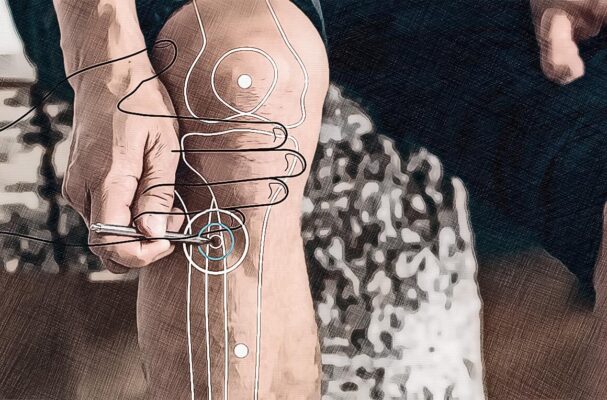
ACUPUNCTURE POINT: Ma 36
Stomach 36
Three miles on foot — Zú Sān Lǐ
- The most important point for strengthening the spleen and stomach
- Strengthens qi and boosts energy and stamina
- Promotes the transformation of the food essence
- Boosts yang energy and restores balance
- Strengthens the immune system and the digestive system
Location: Vier Querfinger (3 Cun) unterhalb der Kniescheibenunterkante, gemessen ab der Vertiefung seitlich unter der Kniescheibe; von dort eine Daumenbreite (1 Cun) nach außen, seitlich der vorderen Schienbeinkante.
Application:
Press firmly for 2–3 minutes on each side twice a day, or massage in small circles. Can also be warmed with moxibustion—particularly effective for lifting sinking Yang Qi.
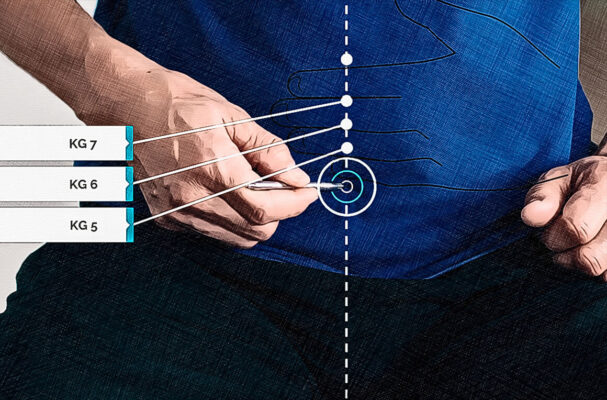
ACUPUNCTURE POINT: KG 06
Concept vessel 06
Meer des Qi — Qì Hǎi
- Das „Meer des Qi“ — einer der wichtigsten Punkte, um Qi aufzubauen
- Hebt zusammen mit Bǎi Huì (LG 20) das abgesunkene Mitte–Qi
- Klassischer Punkt bei Senkungsgefühl, Organsenkung und häufigem Harndrang aus Qi–Schwäche
- Wärmt den Unterbauch und stützt das Ursprungs–Qi (Yuán Qì), aus dem die Mitte ihre Kraft zieht
- Erste Wahl für Moxibustion, wenn alles nach unten zieht
Location: On the midline of the abdomen, about one and a half thumb widths below the navel.
Application:
2x täglich für 2–3 Min. mit sanftem bis mittlerem Druck kreisend massieren. Besonders wirksam morgens im Bett — lege danach die warmen Hände auf die Stelle. NICHT während der Schwangerschaft anwenden!
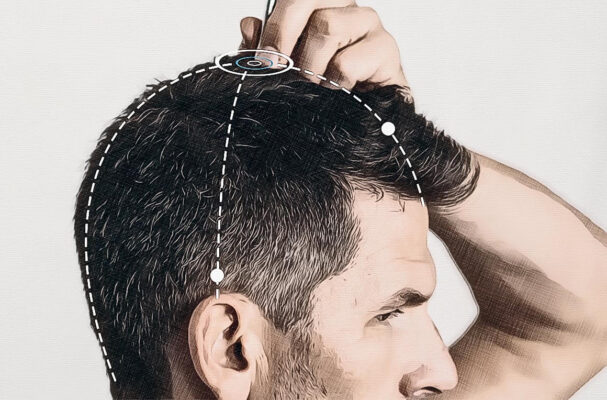
ACUPUNCTURE POINT: LG 20
Handlebar tube 20
One Hundred Assemblies — Bǎi Huì
- The highest point of the body at the crown
- Lifts sinking Qi and Yang
- A common issue with organ prolapse and hemorrhoids
- Helps with fatigue, dizziness, and low blood pressure
- Clears the mind and calms the spirit
Location: Right in the middle of the crown of the head, on the line connecting the tips of both ears.
Application:
Gently tap or apply circular pressure for 2–3 minutes twice a day, directing the pressure slightly upward. This helps specifically support the lifting effect on the sinking middle Qi.
Our App Recommendation
Atemraum: Your App for Mindful Breathing


Breathing is the foundation of physical and mental well-being—and is usually COMPLETELY underestimated in everyday life. Yet hardly anything has such a direct impact: the way we breathe shapes the way we feel.
That's why we created Atemraum: an app with guided breathing exercises that you can take with you anywhere. Wolfgang put together these exercises—along with a 35-day course, quick tips for the moment, and breathing tests that let you track your progress.
Just a few minutes a day is enough. And anyone who uses our personal support If you use it, it already comes with breathing space.


You can try the app for free for 7 days.
Qi Gong
Qi Gong is moving meditation — Gentle, flowing exercises that harmonize your energy flow and strengthen your spleen qi. In cases of spleen Qi deficiency with sinking middle Qi, these exercises are particularly helpful for activating digestive power, strengthening the center, and lifting the clear Yang back up. Upright, stretching movements carry the sinking Qi upward, where it belongs.
Regular practice of qigong (as little as 10–15 minutes a day) has been shown to have positive effects on digestion, energy production, and overall well-being.
QI GONG: Exercise 1
Warm the center
Warms and strengthens the Earth's core

Particularly helpful for:
- Feeling cold in the stomach
- Weak digestion and feeling of fullness
- Tiredness after eating
- Loose stools and loss of appetite
Effect:
This Earth Element exercise specifically warms and strengthens the center—the seat of the spleen and stomach. The gentle, circular movements activate digestive power and dispel cold from the abdominal cavity. A strong spleen center is essential for the clear Yang to be lifted again at all—for only strong spleen Qi has the power to carry upward.
QI GONG: Exercise 2
Connecting heaven and earth
Lifts the sinking clear yang

Particularly helpful for:
- A feeling of heaviness and sinking in the stomach
- Organ prolapse and a feeling of prolapse
- Lack of energy and listlessness
- Frequent urge to have a bowel movement and loose stools
Effect:
This Earth Element exercise is particularly valuable when the central Qi is sinking. Through its uplifting, stretching upward movement, it connects the energy of heaven and earth and specifically lifts the clear Yang upward. This is precisely the spleen’s most important task—to lift the pure Qi and carry the essence of nourishment to the heart and lungs. Where the Qi sinks, this exercise brings it back up, imparting lightness and an upright posture.
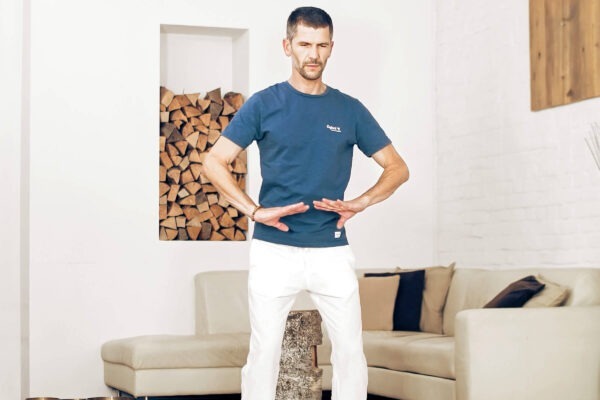
QI GONG: Exercise 3
Regulate Qi
Restore the flow of qi
Particularly helpful for:
- Flatulence and bloating
- Irregular digestion
- Feeling of tension in the stomach
- Qi Stagnation in the Middle Burner
Effect:
This Earth Element exercise regulates the flow of qi in the Middle Burner and harmonizes the interaction between the stomach and spleen. The stomach descends, the spleen ascends—when both work in harmony, digestion proceeds smoothly and qi moves freely in the right direction. Thus, this exercise supports the rising of the Middle Qi by resolving stagnations that would otherwise block the ascent of the clear Yang.
These Qi Gong exercises All of these belong to the Earth element and are therefore perfectly attuned to the spleen. They strengthen the center, stimulate digestive power, and help the body better extract qi from food—and, above all, raise the sinking clear yang back up.
All of these exercises are particularly effective when practiced between 9 and 11 a.m.—this is the peak time for the spleen in the organ clock. During this time, the most energy flows through the spleen meridian, and the exercises have their full effect.
QI GONG:
When and how often?
In the morning or in the morning (ideal):
- All 3 exercises as a sequence: approx. 15–20 min.
- Or just 1–2 exercises: approx. 5–10 min.
- Preferably between 9 and 11 am (spleen time)
In between:
- Einzelne Übungen bei Bedarf (z. B. bei Schwere– oder Absinkgefühl)
- „Connecting Heaven and Earth“ for quick restoration when Qi is sinking
Regularity is more important than duration:
- It’s better to do 10–15 minutes a day than 60 minutes once a week.
- After 2–3 weeks, you will notice the first changes.
- After 2–3 months of regular practice: a significantly stronger core and improved posture
Pro tip: When spleen qi is low, gentle, uplifting movements are ideal. During each exercise, consciously focus on the upward stretching phase—imagine your clear yang rising upward as you do so. It’s best to practice after breakfast—not on an empty stomach and not right after a large meal. The Earth Element exercises ground you, center you, and lift you up at the same time.
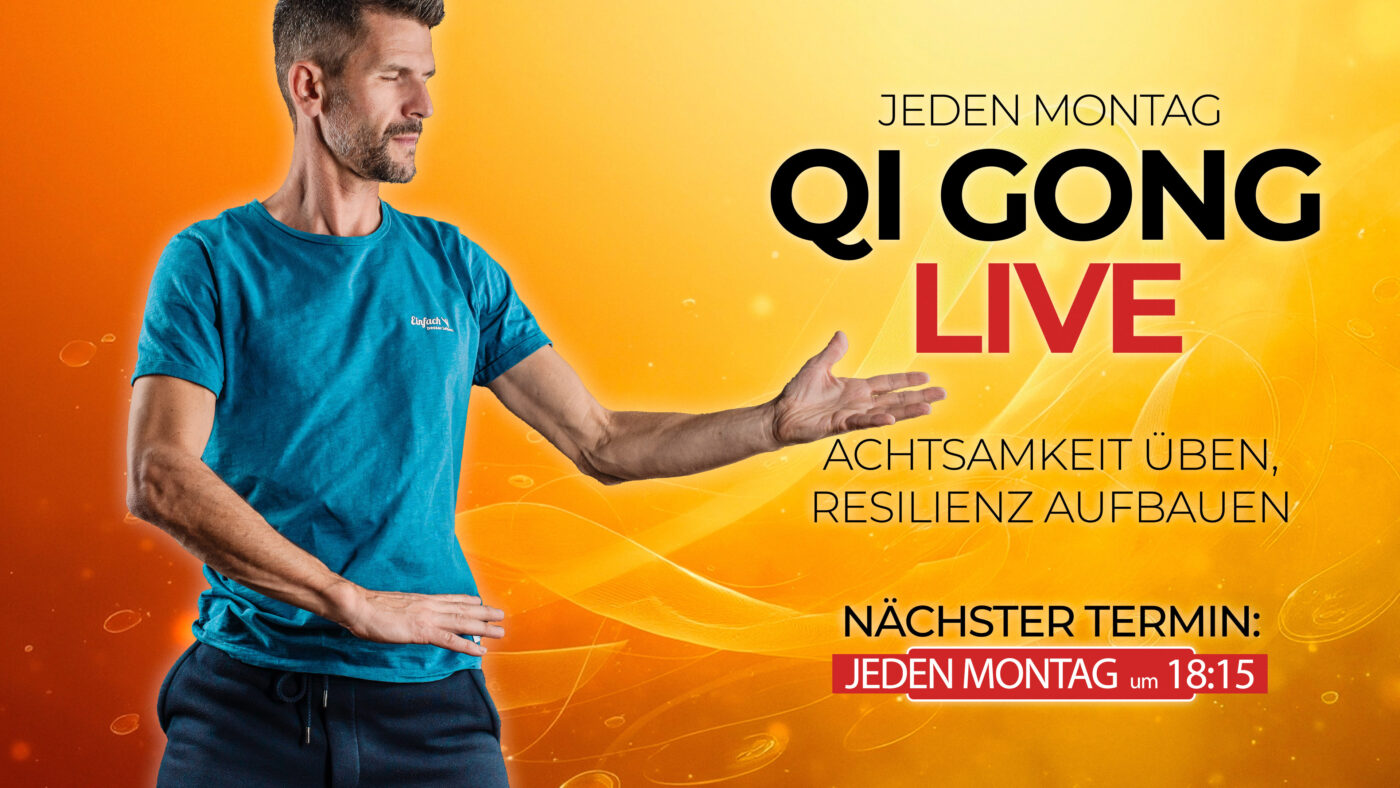
LIVE EVERY MONDAY: QI GONG WITH WOLFGANG
Every Monday at 6:00 p.m. Let's practice together live on YouTube. Among other things, Wolfgang will guide you through a complete qigong sequence — free of charge and suitable for all levels.
Why participate live? ✓ Working out together keeps you motivated ✓ Wolfgang explains the exercises in detail ✓ You can ask questions in the live chat ✓ A set time helps keep your routine on track
More about Qi Gong LiveMeridian Yoga — The Yoga of TCM
Meridian Yoga combines yoga with traditional Chinese medicine. The result is a holistic exercise concept for better health and more energy.
The following exercises specifically stretch and activate the Stomach Meridian, strengthen the center, and help lift the Qi—because the spleen and stomach are partner organs in the Earth element. When the central Qi sinks, activating the stomach meridian helps strengthen digestive power and carry the clear Yang back up. The Stomach Meridian runs along the front of the body and the legs—stretching and stimulating it strengthens the entire Earth element.
MERIDIAN YOGA: Exercise 1
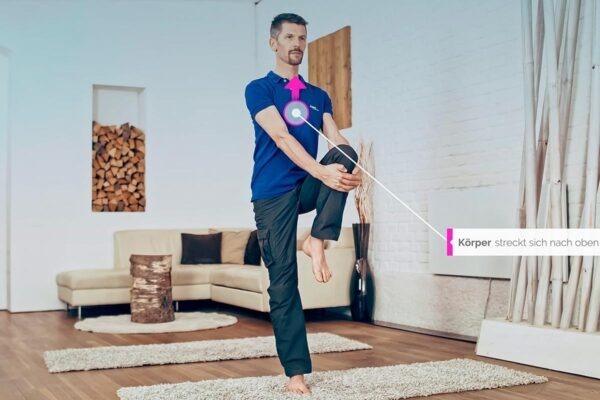
The tree with acupressure
Straightens, provides support, and elevates the clear Yang
Particularly helpful for:
- Declining central qi and a feeling of heaviness
- Tiredness after eating
- Heaviness in the legs
- Lack of grounding and stability
Effect:
The Tree Pose is an upright, stretching posture—the body reaches upward while maintaining a firm footing. This upward alignment lifts the clear Yang and provides stability, which is especially valuable when Qi is sinking. While balancing, hold the Ma 36 acupuncture point on the lower leg—one of the most important points for strengthening the spleen and stomach. It strengthens the Qi, aids digestion, and supports the lifting of the center.
MERIDIAN YOGA: Exercise 2
The bow
Opens the front of the body and the stomach meridian

Particularly helpful for:
- Lethargy and lack of energy
- Flatulence and bloating
- Feeling of heaviness in the stomach
- Tension in the upper abdomen
Effect:
The arch stretches the entire front of the body along the Stomach Meridian—from the face down through the abdomen to the legs. This backward bend opens up the abdominal cavity and stimulates the flow of Qi in the center. When central Qi is sinking, it helps activate digestion and get the Qi moving again and directed upward.
Both exercises activate the Stomach Meridian, which runs along the front of the body and the legs. Since the spleen and stomach form the center as a paired organ system, activating the stomach meridian directly supports weakened spleen qi, strengthens digestive power, and helps to lift the sinking qi back up.
Particularly effective: Hold each position for 3–5 breaths, consciously focusing on your abdomen. Imagine warm, golden light flowing through your core and gently lifting the clear yang energy upward.
MERIDIAN YOGA:
When and how often?
Best time:
- In the morning between 7 and 9 a.m. (stomach time)
- Or between 9 and 11 a.m. (spleen time)
Duration:
- Hold each position for 3–5 breaths.
- Complete sequence: 10-15 min.
- 3–5 times per week for best results
Important:
- Practice in a warm, quiet environment
- Breathe deeply and slowly during the positions
- Stretching should be comfortable, never painful.
- Den Bogen nicht direkt nach dem Essen üben — er drückt auf den Bauch; bei Schwangerschaft, Bluthochdruck, Herzerkrankungen oder Rückenbeschwerden lass ihn weg und bleib beim Baum. Und bei Organsenkung, Beckenbodenschwäche oder Hämorrhoiden ebenfalls — die kräftige Rückbeuge erhöht den Druck im Bauchraum und arbeitet damit gegen das, was diese Seite erreichen will
Pro tip: Combine Meridian Yoga with the Qi Gong exercises „Warming the Center“ and „Connecting Heaven and Earth“ for best results. When the central Qi is sinking, regular, uplifting movement is especially important—it strengthens the center and helps raise the clear Yang.
Nutrition according to TCM
„The spleen is the source of postnatal qi“ — This principle from the Huang Di Nei Jing illustrates why diet is the most important treatment method for spleen-Qi deficiency accompanied by a decline in central-Qi. This is because the spleen draws Qi directly from food—and only a strong central-Qi can lift the clear Yang back up.
Spleen Qi belongs to the element Earth and needs warm, nourishing, easily digestible food, to restore your strength. Your diet should therefore be warming and nourishing—anything that warms the center and replenishes qi gives your spleen the strength to lift the sinking yang qi back up.
What you eat, HOW you eat and WHEN What you eat—all of this determines whether your spleen is strengthened and your qi boosted, or further weakened.
The Golden Rules for Strong, Ascending Spleen Qi
What is good for you:
Warming root vegetables
- Pumpkin — strengthens the spleen and builds up the middle jiao
- Sweet potato — nourishes the Qi and gently boosts the Yang
- Carrots — nourishing and easy to digest
Root vegetables ground you and strengthen your core!
Nourishing grains
- Millet — the best grain for the spleen
- Oatmeal — warms and nourishes the qi
Grain is the basis for strong spleen qi
Sweet energy boosters
- Dates — a traditional tonic for the spleen, builds up Qi
- Chestnuts — warm and strengthen the kidneys and spleen
- Sweet potatoes — gently nourish the qi
The sweet taste in its natural form nourishes the spleen and boosts qi
Warming, qi-nourishing energy
- Beef — has a strong warming effect and helps replenish qi and blood
- Nutritious broths and congee — ancient TCM remedies
- Chicken broth — strengthens qi and warms the middle
- Vegetable soups with ginger
Warm, nourishing broths give the body the energy it needs to boost its yang energy!
What you should avoid:
Raw food in large quantities
- Salads as a main meal
- Smoothies with raw fruit
- Raw food diets
- Too many raw vegetables
Raw foods cool the spleen and weaken the rising Qi!
Cold drinks and food
- Iced drinks and ice cream
- Cold water from the fridge
- Frozen fruit
- Cold raw food in the evening
Cold extinguishes the digestive fire of your spleen!
Dairy products and mucus-forming foods
- Milk (produces moisture)
- Yogurt and cottage cheese
- Soft cheese
- Bananas (cold and moist)
Dairy products cause moisture to build up and pull the center down!
Sugar and white flour
- White sugar and sweets
- White flour products (bread, pasta)
- Soft drinks and fruit juices
- Cakes and pastries
Sugar and white flour cause dampness and weaken the spleen!
HOW YOU SHOULD EAT:
Cooked and warm
- Prefer hot meals - always!
- Nourishing broths and stews — easy to digest and qi-boosting
- Vegetables steamed or boiled
- Hot breakfast (congee or porridge!)
Regularly and at rest
- 3 fixed meals a day
- Largest meal at lunchtime (spleen time: 9–11 a.m.)
- Light and early in the evening (before 7 pm)
- Eat slowly and chew thoroughly—don’t eat standing up or in a hurry
Regularity and warmth provide stability to the center—this is how the Qi rises!
Drink properly
- Warm water—not room temperature and not cold
- Ginger tea — warms the core
- Datteltee oder Huáng Qí–Tee — bauen das Qi auf (Huáng Qí nicht bei Bluthochdruck oder aufsteigendem Leber–Yang)
- Do not drink with meals — it dilutes the digestive juices
Warm drinks support your spleen
IDEAL MENU FOR ONE DAY:
Breakfast (7–9 a.m.):
- Warm millet porridge with sweet potatoes and dates
- Or: Oatmeal Porridge with Chestnuts and Cinnamon
- In addition: Ginger tea or warm water
Lunch (12–1 p.m.):
- Rich beef broth with carrots and pumpkin
- In addition: Rice or potatoes
- Or: Braised root vegetables with beef
Dinner (6–7 p.m.):
- Light Pumpkin Soup with Ginger
- Or: Sweet Potato Congee
- In addition: Small portion of rice
Snack if needed:
- 3–5 dates
- Or: A handful of chestnuts
- Or: Warm pumpkin seeds
The most important rule when changing your diet is:
Start with ONE step!
Don't change everything at once.
Our suggestion for getting started:
- Introduce a hot breakfast (porridge or congee) — 2 weeks
- Cut back on raw foods, cold drinks, and dairy products — 2 weeks
- Eat a hearty broth or cooked vegetables for lunch — 2 weeks
Step by step, you'll notice how your digestion improves, your core strengthens, and you have more energy.
Your spleen will thank you!
RECIPE: NUTRITIOUS MILLET PORRIDGE WITH SWEET POTATO, DATES, AND GINGER
Ingredients:
For 2 portions
- 100 g millet
- 1 small sweet potato (about 150 g)
- 4 dates (pitted)
- 2 slices of fresh ginger
- 500 ml water
- 1 pinch of cinnamon
- 1 pinch of salt
- Optional: 1 handful of chestnuts, a little honey for serving
Preparation:
- Rinse the millet with hot water to remove any bitterness
- Peel the sweet potato and cut it into small cubes
- Cut the dates in half and slice the ginger into thin slices
- Bring everything to a boil with 500 ml of water and a pinch of salt
- Bring to a boil, then simmer on low heat for 20–25 minutes
- Stir occasionally; add water as needed
- Sprinkle with cinnamon and serve warm
Effect:
Millet and sweet potatoes specifically help build up spleen qi
Dates and ginger warm the middle burner and tonify the qi
A warm breakfast gives the center the strength to raise the clear yang qi
Every day for breakfast—the perfect way to strengthen your core and boost your qi!
RECIPE: QI-BOOSTING BEEF BROTH WITH PUMPKIN, CARROTS, AND HUÁNG QÍ
Ingredients:
For 4 portions
- 500 g beef (beef for soup or shank)
- 300 g Hokkaido squash (with skin)
- 2 carrots
- 1 piece of fresh ginger (about 3 cm)
- 1 small onion
- 4–6 slices of astragalus (Huáng Qí, available from TCM suppliers)
- 1.5 L water
- Salt, a pinch of pepper
Preparation:
- Cut the beef into pieces and rinse briefly under hot water
- Cut the onion in half and slice the ginger
- Place the meat in a pot with 1.5 liters of water, an onion, ginger, and astragalus
- Bring to a boil, skim off the foam, then simmer gently for 60–90 minutes
- Dice the pumpkin and carrots, then add them after about 60 minutes
- Simmer for another 20–25 minutes, until everything is tender
- Remove the astragalus slices; season with salt and pepper
Effect:
Beef provides substantial warmth and nourishes the Qi and blood of the middle jiao
Astragalus (Huáng Qí) ist das klassische Kraut, um das Milz–Qi zu stärken und das absinkende Yang anzuheben — bei Bluthochdruck oder aufsteigendem Leber–Yang (Druck im Kopf, rotes Gesicht, Ohrensausen) lass ihn weg und koche die Brühe ohne ihn
Pumpkins and carrots nourish the soil and are easy to digest
2–3 times a week — the perfect energy booster to boost your middle qi!
Breathing
Breathing is the bridge between body and mind. In TCM, it is said: „The lungs govern the qi“—according to this concept, through conscious breathing you can directly influence your qi flow and find a deeper sense of calm.
Breathe calmly and slowly: Deep abdominal breathing noticeably calms many people—their breathing becomes deeper, their shoulders relax, and their minds become clearer. The good news: Just 5–10 minutes a day can make a difference in your well-being.
Recommended breathing techniques
ABDOMINAL BREATHING — The basis for every breathing technique
Natural breathing
Abdominal breathing is the most natural and calm form of breathing. According to the teachings of TCM, with every breath you bring qi into your body’s center (Dantian).
Wolfgang shows you step by step, How to learn abdominal breathing correctly—lying down to start with, then later also sitting and standing.
Duration: 9 minutes

4–7–8 BREATHING — Find Peace
Calm Breathing for the Evening
With the 4–7–8 breathing technique, you inhale for 4 seconds, hold your breath for 7 seconds, and exhale for 8 seconds. This steady rhythm helps many people wind down in the evening—ideal when your mind won’t shut off at night.
Perfect for the evening or whenever you want to calm down quickly.
Duration: 9 minutes
To the interactive videoBOX BREATHING — For inner coherence
Professional breathing for focus and calmness
Box Breathing (4 seconds on, 4 seconds hold, 4 seconds off, 4 seconds hold) combines activation and relaxation in perfect balance. This method is used by elite soldiers, athletes, and executives to remain calm and focused even in extremely stressful situations.
A steady 4–4–4–4 rhythm A balance of activity and stillness—many people find it clarifying and grounding.
Duration: 9 minutes
To the interactive videoCOHERENT BREATHING — Brings Body and Mind into Harmony
Calm Breathing for Balance
With coherent breathing Breathe in for 5.5 seconds and out for 5.5 seconds. This rhythm brings your heart and breathing into a steady rhythm—a state known as „coherence.“ Many people use it as a regular breathing break in their daily lives.
A nice side effect: The heart and breath settle into a calm, synchronized rhythm.
Duration: 14 minutes
To the interactive video
COHERENT BREATHING Around the clock
Our 24/7 livestream on coherent breathing runs non-stop. You can tune in at any time and join in right away.
Perfect for:
✓ Spontaneous breaks to catch your breath in between
✓ If you'd like some gentle breathing guidance
✓ As background while working
✓ For the evening and to wind down
✓ For regular daily practice
relaxation
When your body is relaxed, Things tend to flow more easily. Persistent tension keeps you in a constant state of stress. By using specific relaxation techniques, you signal to your body to calm down and recharge.
Progressive muscle relaxation It is one of the best-known relaxation methods and has been practiced for over 100 years. It helps you become aware of tension, actively let go of it, and achieve a state of deep relaxation—whenever you want.
Recommended relaxation technique
PROGRESSIVE MUSCLE RELAXATION (PMR)
The Classic Relaxation Method
Progressive muscle relaxation according to Jacobson is one of the best-known relaxation techniques worldwide. By deliberately tensing and relaxing individual muscle groups, you learn to consciously recognize tension and release it.
That's what it feels like:
Step by step, the body becomes heavier and calmer, and the breathing more even. Many people make this a regular part of their evening routine to help them fall asleep easily.
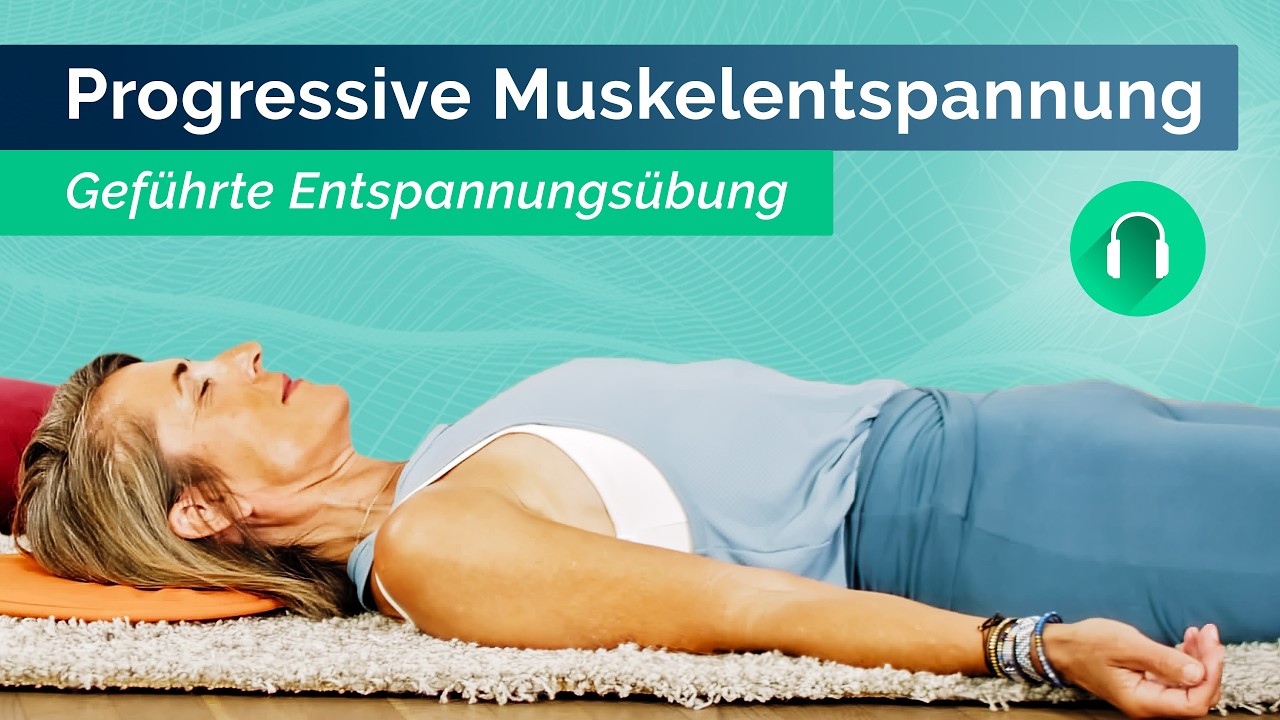
Maria guides you step by step through the entire exercise—perfect for beginners and advanced practitioners alike.
Duration: 23-minute complete guide
To the guided PMRMeditation
Meditation calms the mind — and a calm mind is good for your whole being. In TCM, it is said that every emotion affects a specific organ. Through regular meditation, you’ll learn to step away from racing thoughts, find emotional balance, and strengthen your inner center.
Just 10 minutes a day can do a lot to help you find inner peace. As a result, many people find that their daily lives become more relaxed and clear.
Recommended meditations
GUIDED MEDITATIONS FOR EVERY DAY
Your personal meditation library
We have a complete Playlist with over 60 guided meditations, breathing exercises, and relaxation techniques—from short 5-minute meditations for in between to deep 30-minute sessions for intensive practice.
In the playlist you will find:
- Morning meditations for a mindful start to the day
- Meditations for restful sleep
- Breathing meditations for inner peace
- Meditations for Moments of Calm Amid Stress and Worry
- TCM standing meditations for all 5 elements
- Body scan and body journeys
- Meditations for Peace of Mind and Body
- Special breathing techniques (4–7–8, coherent breathing, bee breathing)

Perfect for beginners and advanced practitioners. Choose the right meditation for you depending on your time, the time of day, and your needs.
To the meditation playlistThe spleen governs the rise of the clear.
When the clear Yang rises, the body is supported and nourished. When it sinks, the center loses its strength. Lift the Qi, and the body regains its balance.
- Loosely based on the HUANG DI NEI JING
(The Yellow Emperor's Classic of Internal Medicine)
More tips for your everyday life
In addition to traditional TCM treatment methods There are many small daily habits that can strengthen your spleen qi and help lift your sinking middle qi. In this pattern, the spleen’s supporting and lifting power is weakened—with the right habits, you can strengthen your middle and help carry the qi back up.
Sleep and rest
Sufficient sleep
Your qi regenerates while you sleep:
- 7–8 hours of sleep per night is ideal
- The spleen needs regular rest—try to go to bed at the same time every night
- Go to bed before 11 p.m. — the best time for Qi regeneration
- Quality is more important than quantity — deep, undisturbed sleep nourishes the qi
- No heavy meals after 7 p.m. — the spleen needs to rest at night
Resting while lying down with your legs elevated
A short rest during the day helps support the sinking Qi:
- 10-20 minutes midday rest is ideal
- Put your feet up during breaks—this relieves the strain on your core
- Even short breaks spent lying down throughout the day help relieve the decline in qi
- Your spleen works overtime at lunchtime—give it a break afterward
- No longer than 30 minutes - otherwise your night's sleep will be disturbed
Avoid revision
Exhaustion directly weakens the spleen:
- Avoid long working hours—the spleen thrives on rhythm and regularity
- Plan regular breaks - every 90 minutes.
- Don't „push through“ when you're tired—tiredness is a warning sign from your spleen
- Learning to Say No — Setting Boundaries Protects Your Qi
- Plan sufficient vacation and relaxation
Raising the Qi — lifting the center upward
What Drains Your Qi — and What You Should Avoid
When central qi is low, certain activities place a strain on one’s ability to maintain balance:
- Avoid heavy lifting—it pulls the qi downward
- Avoid standing for long periods of time — if necessary, shift your weight frequently and take breaks
- Do not strain—neither when having a bowel movement nor during physical exertion
- Ist dein Stuhl hart, hilft warme, ballaststoffreiche Kost; ist er wie bei diesem Muster häufig weich bis breiig, brauchst du keine zusätzlichen Ballaststoffe, sondern warme, gekochte Mahlzeiten zu festen Zeiten
- Take breaks from sitting for long periods — get up regularly and move around gently
Strengthen your grip and lifting power
Specific habits can help boost your qi:
- Resting with your legs elevated relieves pressure on and supports the core
- Gentle pelvic floor exercises strengthen your core from the inside out
- Activate your pelvic floor consciously and without straining — quality over effort
- Maintaining an upright posture while sitting and standing supports the upward flow of qi
- Let your abdomen relax as you breathe—avoid tense, forced breathing
Moxibustion and gentle rising
Heat lifts and supports the Yang Qi of the middle:
- Moxibustion am Scheitelpunkt LG 20 (Bǎi Huì) ist die klassische Anwendung bei abgesunkenem Qi — die Moxazigarre in einigen Zentimetern Abstand über dem Punkt halten, bis es angenehm warm wird, das Haar dabei zur Seite scheiteln
- Moxibustion am Punkt Ma 36 (Zú Sān Lǐ) wärmt und stärkt das Milz–Qi
- Nicht direkt auf Hämorrhoiden oder Krampfadern — dort verstärkt Wärme die Stauung. Und in der Schwangerschaft keine Wärme oder Moxa über dem Unterbauch
- Regelmäßige sanfte Wärme über dem Unterbauch — auf KG 06 (Qì Hǎi), anderthalb Daumenbreiten unter dem Nabel — stützt das Mitte–Qi
- If you have low blood pressure or feel dizzy, get up slowly—first sit up, then stand
- After getting up, take a moment to pause before you start moving
- Always use moxibustion gently and at a safe distance from the skin
Boosting the Spleen — Warm Foods in Your Daily Diet
Hot breakfast
The spleen loves warmth—especially in the morning:
- A hot breakfast is the most important meal for the spleen
- Porridge, congee, or warm oatmeal with cinnamon and dates
- No cold cereal, no yogurt, no smoothie in the morning
- The spleen needs the most support in the morning between 7 and 9 a.m.
- A warm cup of ginger tea for breakfast helps warm you up even more
Eat regularly and mindfully
The spleen likes rhythm and calm:
- 3 meals at set times — don't skip meals
- Eat in peace—while sitting down, without rushing, and without multitasking
- Largest meal at lunchtime (when digestive power is at its strongest)
- Eat light and early in the evening (before 7 pm)
- Chew thoroughly - digestion begins in the mouth
Avoid cold drinks and raw foods
Cold extinguishes the digestive fire:
- Avoid cold drinks — even in the summer
- Raw food only as a side dish, not as a main meal
- Warm soups and stews are ideal for the spleen
- Prefer cooked food - it is easier to digest
- Avoid ice cubes, ice cream, and frozen drinks
Avoid Brooding — The Emotion of the Spleen
Why Brooding Weakens the Spleen
In TCM, brooding is the emotion associated with the spleen:
- Excessive thinking and worrying directly deplete spleen qi
- Overthinking drains energy that the spleen needs for digestion
- People who worry a lot often have digestive problems too—the two are linked
- Students and people in intellectual professions are particularly vulnerable
- Constant planning and organizing can also put a strain on the spleen
Breaking the Cycle of Worry
Practical tips for stopping overthinking:
- Mind Break: When you find yourself overthinking, get up and move around
- Write down your worries—it clears your mind
- Solve problems instead of endlessly thinking about them
- Set aside time to worry—then consciously let it go
- Meditation and mindfulness help to calm the mind
What Strengthens the Spleen Emotionally
Positive habits for a strong core:
- Grounding: Spending time in nature — standing barefoot on the grass
- Creative activities without the pressure to perform — cooking, gardening, painting
- Fostering social connections — sharing a meal brings people together
- Gratitude exercises in the morning or evening
- Practicing self-compassion — being kind to yourself
Gentle movement — invigorating rather than exhausting
The right intensity
When spleen qi is deficient, gentle, uplifting movement is important:
- Gentle, regular exercise is ideal—it builds you up rather than wearing you out
- Walks in the fresh air (20–30 minutes daily)
- Qi Gong and Tai Chi — moving and straightening up without getting exhausted
- Gentle yoga without overexertion or straining
- Exercise with good posture supports the upward flow of qi
What you should avoid
Exhausting stress depletes qi and pulls it downward:
- Intensive endurance sports (marathon, HIIT)
- Heavy lifting and strength training to the point of exhaustion
- Heavy sweating depletes bodily fluids and qi
- Sport for tiredness or weakness
- Exercising on an empty stomach — the spleen needs food as a foundation
Exercise after eating
Ein kurzer Spaziergang unterstützt die Milz:
- 10-15 minutes of slow walking after eating
- Helps the spleen to transform food
- Do not lie down immediately after eating
- Even light housework after a meal is good
Stay warm — keep your stomach and feet covered
Keep your core warm
Heat supports the spleen's lifting function:
- Keep your core warm — wear a kidney warmer or undershirt
- Never let your stomach get cold—a hot water bottle on your stomach feels great
- Gentle warmth over the lower abdomen supports the central qi
- Avoid drafts and cold winds
- Dress warmly and stay dry in damp weather
Foot warmth
Warm feet keep the yang qi stable at the lower level:
- Warm foot baths in the evening (with ginger for extra warmth)
- Change out of wet socks and shoes immediately
- Wear warm socks or slippers indoors
- Never let your feet get cold on a cold floor
- Make sure your feet stay warm and dry, especially in winter
Avoid moisture in your diet
Diet can also put a strain on the spleen:
- Cut back on dairy products—they cause moisture
- Avoid sugar and sweets — they put additional strain on the spleen
- Cut back on white flour products
- Don't drink too much at once—it's better to take small sips throughout the day
- Avoid alcohol and greasy foods—they generate damp heat
Important to know
Strengthening the spleen qi and lifting the sinking middle qi takes time and patience. Building up Qi is like tending a garden—it happens step by step with consistent care. Pay attention to your body’s signals: a feeling of heaviness or sinking in the lower abdomen, fatigue after eating, and waning strength when standing for long periods indicate that your center needs more support. With warm foods, gentle, uplifting movement, warming heat, and mindful conservation of your sustaining energy, you will feel your energy returning.
Sofort ärztlich abklären lassen: ein sichtbar vorgefallenes Gewebe aus Scheide oder After, das sich nicht mehr zurückschieben lässt, sich verfärbt oder schmerzt — das ist ein Notfall und kein Fall für Kräuter. Ebenso eine echte Ohnmacht: ein Bewusstseinsverlust, bei dem du wegsackst, stürzt oder aufgefangen werden musst — besonders wenn er im Sitzen oder Liegen auftritt. Der kurze Schwindel oder das Flimmern vor den Augen beim schnellen Aufstehen, das nach wenigen Sekunden vorbei ist, gehört dagegen zum Bild dieses Musters — abklären lassen solltest du es erst, wenn du dabei stürzt, kurz weg bist oder es sich in kurzer Zeit deutlich häuft.
When to see a doctor? These signs need to be clarified because they not zu diesem Muster gehören: ungewollter Gewichtsverlust, starke Bauchschmerzen, hohes Fieber mit Schüttelfrost. Und Blut im Stuhl oder schwarzer Stuhl: Hämorrhoiden bluten häufig und gehören durchaus zu diesem Bild — genau deshalb muss eine andere Blutungsquelle einmal ärztlich ausgeschlossen werden. Ebenso, wenn Senkungsbeschwerden new auftreten oder sich in kurzer Zeit deutlich verschlechtern. Dass Ziehen, weicher Stuhl und Erschöpfung seit Monaten bestehen und im Tagesverlauf zunehmen, ist dagegen kein Alarmzeichen — es ist die Beschreibung dieses Musters. TCM und westliche Medizin ergänzen sich hier optimal.
For optimal treatment progress
TCM is not a quick fix for symptoms., but rather a holistic healing process. You’ll achieve the best results if you consistently incorporate the treatment into your daily routine and give your body time to regenerate. Raising depleted Qi, in particular, requires patience.
Integration into everyday life
Start with ONE step
Don't try to change everything at once! That's overwhelming and leads to
usually leads to you giving up. Instead:
- Woche 1–2: Warmes Frühstück einführen und Rohkost reduzieren; und mit deiner TCM–Kräutermischung beginnen
- Weeks 3–4: Apply acupressure to Ma 36 and LG 20 daily
- Week 5-6: Qi Gong „Connecting heaven and earth“ daily 10 min.
- Woche 7–8: Zwischenbilanz — der Tagesverlauf sollte sich zuerst bewegt haben: Das Ziehen kommt später und hält kürzer an. Vergleiche jetzt Kraft, Stimme und Ausdauer mit dem, was am Anfang stand
- From week 9: Add further methods as required
Realistic expectations
After 2–3 weeks: First improvements noticeable
- Better digestion and less bloating
- Less fatigue after eating
- A little more energy and stamina in the morning
After 6–8 weeks: Significant improvements
- Significantly more stable digestion
- Less heaviness and pulling sensation downward
- Greater endurance and resilience
After 3–6 months: Sustainable healing
- Spleen Qi noticeably strengthened and the Qi restored
- My body feels strong and upright
- Sustainable improvement in well-being
TCM vs. Western medicine
TCM and Western medicine are not mutually exclusive—they complement each other!
When Western medicine is important:
- In cases of severe organ prolapse that require further evaluation
- In cases of chronic diarrhea with blood or significant weight loss
- If serious illnesses are suspected
- For accurate diagnoses (examination, blood tests, and endoscopy if necessary)
Where TCM has its strengths:
- For functional digestive disorders and chronic fatigue
- For mild prolapse symptoms and a weak pelvic floor
- For prevention
- For the sustainable strengthening of the center and its uplifting power
Ideal: Combine both approaches! Have any significant drops in energy levels checked by a doctor, and use TCM to build up and strengthen your body’s natural healing abilities over the long term.
Important: Never stop taking prescribed medication without consulting your doctor first!
Talk to your doctor before starting TCM treatment.
Do you have any questions?

Wolfgang from meine-tcm.com
TCM is a broad field. Much of it sounds unfamiliar at first glance, and often the real question doesn't arise until you start putting some of it into practice in your daily life.
That's exactly what I'm here for. Write to me—no matter how big or small your question is, whether it’s related to this page or to something else entirely in TCM. I read every message myself and will get back to you. Calmly, clearly, and without any sales pitch.
P.S.: There are no stupid questions. So write to me.
Ask your questionEvery step counts
Your body strives for balance—you just need to create the right conditions for it.
Remember:
👣 Every little step counts
You don't have to be perfect. Even one warm meal a day is better than none. Even 5 minutes of qigong is better than no exercise at all.
⏳ Patience pays off
It took your body years to get to this point. Give it time to regain its balance. Change takes time, but it will happen.
🎯 Focus on what you can DO
Don't concentrate on what you are doing „wrong". Focus on every positive step you take.
💚 Be good to yourself
Perfection does not exist. It is acceptable to have an off day occasionally. Tomorrow is a new day when you can continue.
🤝 You are not alone
Thousands of people are walking this path with you. For over 2,000 years, TCM has been guiding people like you on their journey toward greater well-being.
Track Your Progress

To track your progress, we recommend that you repeat the TCM analysis after about 3 months.
Why does this make sense?
- You can see how your pattern has changed
- You can adjust your group as needed
- It motivates you to keep going
- You'll figure out which steps work best for you
⚠️ Important: Your answers from today will be stored in encrypted form using a code that you received via email. ONLY with this code will you be able to track your progress later. Be sure to keep the email in a safe place!
🔒 YOUR DATA IS SAFE
We store:
✓ Only your email address for reminders
✓ The date for shipping
We do NOT store:
✗ Your analysis results
✗ Your personal information
✗ The connection between email and the sample
All analysis data is completely anonymous and is not linked to your email address.
Newsletter
Stay up to date with our newsletter. Besides useful tips and tricks for training and your everyday life, you won't miss any of our new releases.