






On this page, you will learn:
- What this diagnosis means from the point of view of TCM and Western medicine
- Where your symptoms come from and how they are connected
- Which specific treatment methods can help you now
- How to Strengthen Your Spleen Qi, Drain Dampness, and Restore Your Digestive Strength Using TCM Herbs, Acupressure, Qi Gong, and Nutrition
The good news: This combination diagnosis can be treated very effectively with the right measures. With warming foods, targeted acupressure, qigong, and time-tested TCM herbs, you can strengthen your core and promote the long-term elimination of dampness.
Take your time, Get to know the different treatment approaches—you don't have to implement everything at once. Choose what feels right for you and what you can easily integrate into your everyday life.
Your treatment at a glance:
Which TCM pattern is really behind your complaints?
Degree of
imbalance

Light to moderate
Typical
treatment duration

2-4 months
self-treatment
Possible

Well self-treatable
Treatment–
scope

2–3 methods
Proposed
methods

Extensive range
Our free TCM analysis shows you your personal TCM pattern in just 10 minutes - and which treatment will help you best.
What is spleen-qi deficiency with dampness?
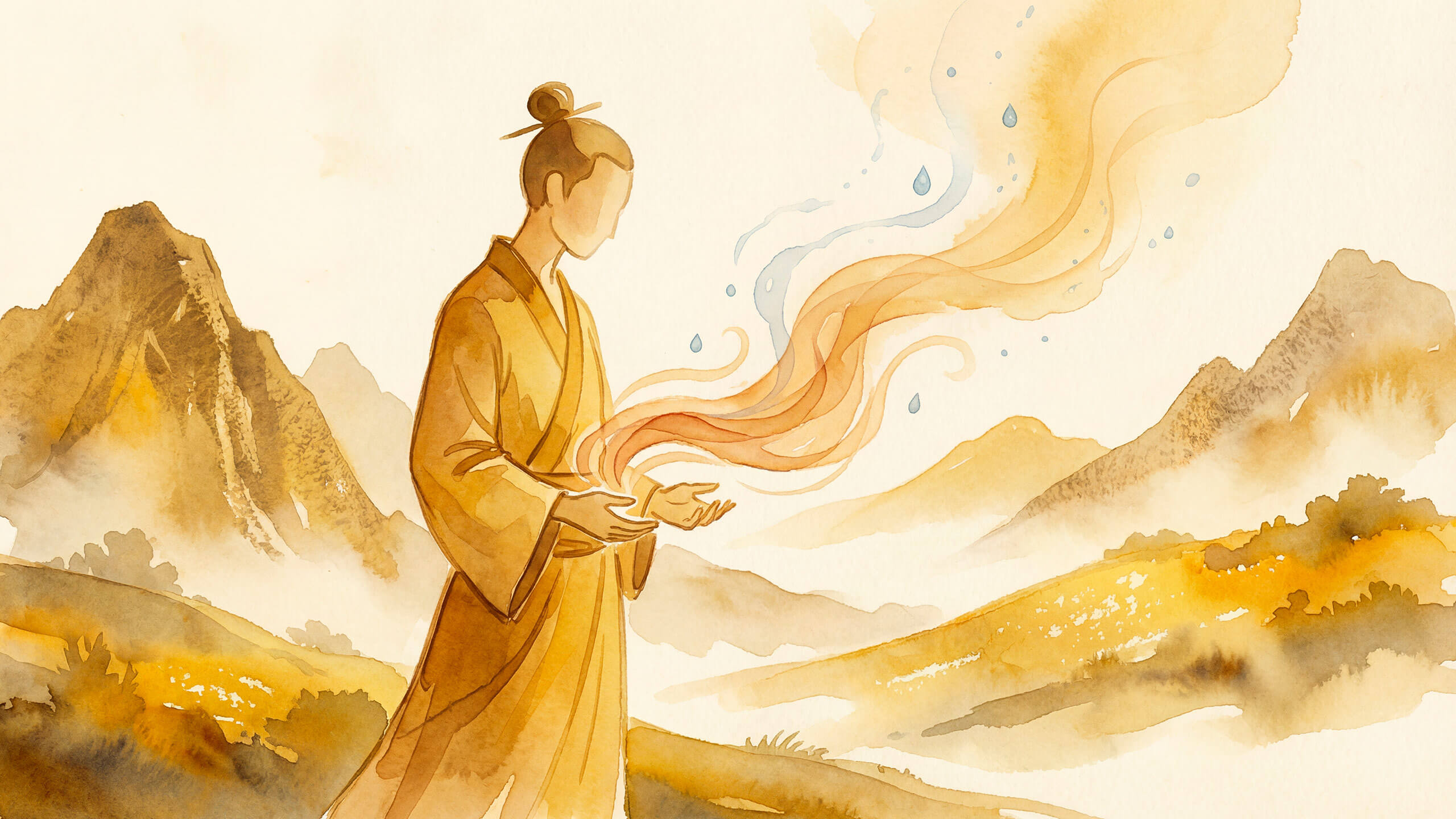
When the center is weakened and dampness burdens the body
The TCM Perspective: When the Center Fails and Dampness Arises
In Traditional Chinese Medicine, the spleen is the central organ of the „middle“—it is responsible for the transformation and transportation of food and fluids. You can think of it as a kind of internal cooking stove: it „cooks“ the food, extracts the nutrients, and distributes them throughout the body. What remains is passed downward.
When spleen qi is weakened, this “cooking center” no longer functions properly. Food is not properly transformed, fluids can no longer be properly metabolized—and dampness (Shī) develops. This dampness is like a sticky, heavy fog that settles in the body and slows everything down.
What makes this combined diagnosis unique is that spleen qi deficiency and dampness are mutually reinforcing. A weak spleen generates dampness—and the dampness places an additional burden on the spleen. This creates a vicious cycle that must be broken.
The typical signs of spleen-qi deficiency with dampness:
Signs of spleen qi deficiency:
- Fatigue and exhaustion, especially after eating
- Loss of appetite or loss of sense of taste
- Soft, mushy stools or diarrhea
- Pale face, limp limbs
- Tendency to brood and worry
Signs of moisture:
- A feeling of heaviness throughout the body — „as if wrapped in cotton“
- Gas, bloating, and nausea
- Heavy head, drowsiness, „brain fog“
- A sticky sensation in the mouth, increased saliva production
- Fluid retention and edema, especially in the legs
- Heavy, tired legs
- Cloudy, thick discharge or cloudy urine
The good news: Once you strengthen your spleen and eliminate excess dampness, the vicious cycle will break. With a warming diet, herbs, acupressure, and qigong, you can gradually rebuild your inner balance.
The Western Perspective: Indigestion and Fluid Retention
From a Western perspective, spleen-qi deficiency with dampness corresponds to a condition associated with various digestive disorders and weakened bowel function. The body can no longer efficiently process and eliminate food and fluids.
Imagine your digestive system as a wastewater treatment plant: Normally, it filters everything cleanly—nutrients are absorbed, and excess waste is eliminated. But when the plant stops functioning properly, water backs up, sediment builds up, and everything slows down. That’s exactly what happens with a spleen-Qi deficiency accompanied by dampness.
The gut microbiome is particularly affected: the composition of gut bacteria changes, the intestinal lining becomes more permeable („leaky gut“), and inflammatory processes increase. Metabolism slows down, fluids are no longer transported adequately, and they accumulate.
What does modern medicine show?
- Irritable Bowel Syndrome (IBS): Bloating, irregular bowel movements, and abdominal pain
- Dyspepsia: A functional digestive disorder characterized by a feeling of fullness and nausea
- Gut Microbiome Dysbiosis: Imbalance in the Gut Flora
- Fluid retention: Edema caused by impaired lymph flow
- Brain Fog: Cognitive Impairment Caused by an Inflammatory Gut-Brain Axis Disorder
- Chronic Fatigue Syndrome: Persistent Exhaustion Due to Nutrient Deficiency
Modern research confirms: The TCM diagnosis of „spleen qi deficiency with dampness“ correlates strongly with measurable parameters such as markers of intestinal inflammation, impaired intestinal motility, and changes in the microbiome. Studies show that TCM herbs such as Bái Zhú (Atractylodes) and Fú Líng (Poria) have positive effects on gut flora and digestive function.
This is exactly where TCM treatment comes in: It strengthens digestive function from the inside out, eliminates excess moisture, and restores balance to the gastrointestinal tract—in a holistic, sustainable, and gentle way.

The Yellow Emperor team explains your diagnosis
Qi Bo | The Yellow Emperor | Dr. Lisa Weber
MASTER OF THE HEALING ARTS | TCM FOUNDER | MODERN PHYSICIAN
What happens when the legendary Yellow Emperor from TCM sits down with his advisor Qi Bo and a modern doctor? They discuss your diagnosis - with 4000 years of knowledge AND current science.
Spleen Qi Deficiency + Dampness — When the Middle Jiao is weakened and dampness burdens the body
The Yellow Emperor: „Qi Bo, many people in my kingdom are complaining of a strange feeling of heaviness throughout their bodies. They feel tired and bloated, their heads are foggy, and they suffer from constant bloating. Some report that they feel even more tired after eating than they did before. What is causing this condition?“
Qi Bo: „Your Majesty, these people suffer from a spleen-qi deficiency with dampness—known as Pí Qì Xū jiā Shī. The spleen is the central organ of the middle jiao. It has two essential functions: it transforms food into qi and blood, and it transports bodily fluids. When spleen qi is weakened, it can no longer fulfill these functions. Food is not fully transformed; a turbid excess remains—and this excess is dampness. Dampness is like a sticky fog: heavy, viscous, and slowing everything down. It settles in the body and blocks the flow of Qi.“
Dr. Weber: „This is a remarkably precise description of what we in modern medicine know as functional digestive disorder with fluid retention! The ‚transformation‘ of the spleen corresponds to enzymatic digestion and nutrient absorption in the small intestine. When this process is disrupted—due to altered intestinal motility, enzyme deficiency, or microbiome dysbiosis—fermentation processes occur, leading to bloating and a feeling of fullness. The ‚dampness‘ in TCM correlates with measurable findings: fluid retention in the tissues, slowed lymphatic flow, and inflammatory processes in the intestine.“
The Yellow Emperor: „How does this condition develop? What weakens the spleen so much?“
Qi Bo: „Your Majesty, there are many causes. First: Poor diet—too much cold, raw, greasy, or sweet food exhausts the spleen and directly generates dampness. Second: Excessive brooding—the emotion associated with the spleen is brooding. Those who constantly think and worry directly weaken their spleen energy. Third: Irregular meals—the spleen thrives on rhythm. Eating too late, too hastily, or between meals disrupts the transformation process. Fourth: Overwork—chronic exhaustion depletes the Qi of the Middle. Fifth: Too little exercise—exercise moves the Qi and helps drain dampness. Stagnation promotes its accumulation. And sixth: The climate—damp, cold weather can attack the spleen from the outside.“
Dr. Weber: „All of these factors are scientifically proven! Cold foods and raw foods require more energy to digest and can reduce enzyme activity. Sugar and high-fat diets negatively alter the gut microbiome and promote inflammatory processes. Chronic stress increases cortisol, which disrupts intestinal motility and damages the intestinal mucosa—the well-known ‚leaky gut.‘ Irregular meals disrupt the circadian rhythm of digestive enzymes. And a lack of exercise slows down peristalsis and lymphatic flow. TCM recognized these connections long before modern gastroenterology did!“
The Yellow Emperor: „You described moisture as a sticky mist. How exactly does this moisture manifest itself?“
Qi Bo: „Your Majesty, dampness has very characteristic signs. It is heavy—hence the feeling of heaviness in the head and limbs, as if one were wearing wet clothes. It is sticky—hence the sticky tongue coating, the thick phlegm, and the sticky stools. It is turbid—hence the ‚brain fog,‘ the cloudy urine, and the lack of clarity. And it is tenacious—dampness is the most difficult pathogenic pattern to treat because it becomes deeply entrenched and recedes only slowly. On the tongue, we see: pale, swollen, with tooth marks along the edge—a classic sign of spleen deficiency. Added to this is a thick, white, or sticky coating—the sign of dampness.“
Dr. Weber: „The tongue as a diagnostic tool is fascinating! A swollen tongue with tooth indentations actually correlates with tissue edema and fluid retention—the tongue swells and presses against the teeth. A thick coating reflects changes in the oral flora, which in turn are linked to the gut microbiome. Studies show a significant correlation between tongue coating and gastrointestinal disorders. What TCM calls ‚dampness,‘ we can now measure as a combination of tissue edema, elevated inflammatory markers, a slowed metabolism, and microbiome dysbiosis!“
The Yellow Emperor: „How do we treat this condition?“
Qi Bo: „Your Majesty, the principle of treatment is: Jiàn Pí Yì Qì, Huà Shī—strengthen the spleen, increase qi, and transform dampness. Both must be done at the same time! Simply strengthening the spleen without draining dampness is not enough—the dampness would continue to burden the spleen. And simply draining dampness without strengthening the spleen is also insufficient—new dampness would constantly arise. The most important approach is diet: warm, cooked, easily digestible food strengthens the spleen. Cold, raw, sweet, and fatty foods must be avoided. In addition, there are spleen-strengthening and dampness-draining herbs, acupressure on the spleen and stomach meridians, and gentle, moving exercises such as qigong.“
Dr. Weber: „The dual approach—strengthening digestion AND regulating fluids—makes perfect therapeutic sense! Warm, cooked food is easier to digest and reduces the energy required for digestion. Studies show that traditional TCM formulas such as Shēn Líng Bái Zhú Sǎn improve intestinal motility, positively alter the gut microbiota, and reduce inflammatory markers. Fú Líng (Poria) has proven diuretic and anti-inflammatory properties. Bái Zhú (Atractylodes) improves gastric emptying and nutrient absorption. The combination of dietary changes, herbs, and exercise addresses all relevant pathophysiological mechanisms!“
The Yellow Emperor: „What are the traditional herbal formulas for this pattern?“
Qi Bo: „Your Majesty, the basic formula is Shēn Líng Bái Zhú Sǎn—the ginseng, poria, and atractylodes powder. It contains Rén Shēn (ginseng) to strengthen the qi, Bái Zhú (Atractylodes) to strengthen the spleen and dry dampness, Fú Líng (Poria) to drain dampness and strengthen the spleen, Shān Yào (yam) to gently nourish the spleen, Lián Zǐ (lotus seeds) to stabilize the middle, and Yì Yǐ Rén (pearl barley) to drain dampness. The alternative is Liù Jūn Zǐ Tāng—the Six Noble Decoction—which is particularly effective when the dampness has already condensed into phlegm.“
Dr. Weber: „Shēn Líng Bái Zhú Sǎn is one of the most extensively studied TCM formulas for digestive disorders! Clinical studies show that it is effective for functional dyspepsia and irritable bowel syndrome. Ginseng contains ginsenosides, which promote gastric emptying and have anti-inflammatory effects. Yì Yǐ Rén (pearl barley, Coix) has been shown in studies to have diuretic and anti-inflammatory effects. And Shān Yào (yam) contains diosgenin, which strengthens the mucosal barrier in the intestine. A formula over 1,000 years old backed by modern scientific evidence!“
The Yellow Emperor: „Wonderful! Let's turn this wisdom into a practical plan.“
THE "THREE WISE MEN" METHOD FOR SPLEEN QI DEFICIENCY + DAMPNESS
MORNING ROUTINE (Warm the spleen, drain dampness):
- TCM: A warm breakfast — the spleen needs warmth in the morning to kick-start the transformation
- Science: Warm food reduces the energy required for digestion and promotes enzyme activity
- Practical: Warm rice congee with ginger and cardamom, or millet porridge with cinnamon
- TCM: Ginger water in the morning — warms the center and transforms dampness
- Science: Ginger stimulates stomach acid production and peristalsis and has anti-inflammatory effects
- Practical: Steep 2–3 slices of fresh ginger in hot water and drink it before breakfast
- TCM: No cold drinks in the morning—cold extinguishes the spleen fire
- Science: Cold liquids on an empty stomach slow down gastric emptying
- Practical: Always warm or room-temperature beverages; no cold water, no orange juice
TAGS STRATEGY (Strengthening the Center):
- TCM: Lunchtime is the biggest meal - digestive power is strongest between 11 am and 1 pm
- Science: Digestive enzymes are most active at lunchtime, nutrients are optimally absorbed
- Practical: A warm main meal at lunchtime with rice, cooked vegetables, and lean protein
- TCM: Acupressure on Stomach 36 (Zu San Li) — the most important point for strengthening the center
- Science: Stimulation of Ma 36 has been shown to improve intestinal motility and nutrient absorption
- Practical: A hand's width below the kneecap, to the side of the shin. Press firmly for 3 minutes on each side
- TCM: Exercise after a meal — stimulates the flow of qi and aids the spleen in its transformative functions
- Science: A short walk after a meal improves gastric emptying and blood sugar levels
- Practical: 10–15 minutes of slow walking after each main meal
EVENING RITUAL (Transforming Moisture):
- TCM: A light dinner before 7 p.m. — digestion is slower in the evening
- Science: Eating a heavy meal late at night disrupts sleep and puts a strain on digestion
- Practical: Light soup or stew; no raw foods, no bread, no dairy products
- TCM: Qi Gong „Warming the Center“ — Strengthens the Spleen and Promotes Transformation
- Science: Gentle movement activates the parasympathetic nervous system and promotes digestive rest
- Practical: 10–15 min. of gentle qigong exercises, clockwise circular abdominal massage
- TCM: Acupressure on Spleen 09 (Yin Ling Quan) — the main point for draining dampness
- Science: Studies have shown that stimulating this point has positive effects on diuresis and edema reduction
- Practical: On the inner side of the lower leg, in the hollow below the knee. Press for 3 minutes on each side.
The Yellow Emperor: „Qi Bo, how long will it take for the dampness to be expelled and for the spleen to regain its strength?“
Qi Bo: „Your Majesty, dampness is the most stubborn of the pathogenic patterns—it requires patience. After 2–3 weeks of consistent practice, most people notice: less bloating and a feeling of fullness, digestion returns to normal, and slightly more energy. After 6–8 weeks, the improvements become more noticeable: the feeling of heaviness subsides, the mind becomes clearer, and bowel movements become regular. After 3–6 months, the dampness may be noticeably reduced—the body feels lighter and more vital, and digestive strength is sustainably enhanced. Important: The dietary change must be permanent. Anyone who returns to a cold and raw diet after seeing improvement invites the dampness back.“
Dr. Weber: „That’s consistent with our clinical experience! Functional digestive disorders take time to heal. The gut microbiota needs about 4–8 weeks to adapt to a new diet. The intestinal mucosa regenerates in 3–6 months. And inflammatory markers in the gut return to normal over a similar period of time. The TCM recommendation to undergo consistent treatment for 3–6 months is therefore entirely understandable from a physiological standpoint. And the warning about relapse is important—anyone who returns to their old dietary habits risks a recurrence!“
The Yellow Emperor: „What must be avoided at all costs?“
Qi Bo: „Your Majesty, there are clear prohibitions regarding dampness! First: No cold or raw foods—they extinguish the spleen fire and directly generate dampness. Second: No dairy products—from a TCM perspective, milk, cheese, and yogurt are cold and damp and place an enormous strain on the spleen. Third: No sugar or sweets—sweet foods generate dampness and feed pathogenic bacteria. Fourth: No wheat bread—from a TCM perspective, wheat is dampening and difficult to digest. Fifth: No large amounts of liquid with meals—this ‚drowns out‘ the digestive fire. And sixth: No excessive thinking or brooding—it directly exhausts the spleen.“
Dr. Weber: „Scientifically very plausible! Lactose intolerance is particularly common among people with functional digestive disorders—dairy products exacerbate the symptoms. Sugar promotes the growth of pathogenic gut bacteria and weakens the intestinal barrier. In addition to gluten, wheat also contains FODMAPs—fermentable carbohydrates that cause bloating and discomfort in people with a sensitive gut. And chronic stress via the gut-brain axis is one of the main factors in functional digestive disorders! TCM recommendations align perfectly with a modern low-FODMAP and gut-friendly diet!“
The Yellow Emperor: „Then the message is clear: The spleen is the foundation of our health. When the center is strong, dampness cannot arise. Strengthen the spleen with warm food, transform the dampness with the right herbs, and gently move the body—then lightness and clarity will return.“
Qi Bo: [smiles] „That is correct, Your Majesty. The spleen is like a hardworking farmer tilling the field—if you give him the right tools and protect him from rain and cold, the field will yield a bountiful harvest. Warm the center, nourish the spleen, and drain excess moisture—then energy, clarity, and well-being will return to the body and mind.“
About our „3 Wise Men“ story
Who are the Yellow Emperor and Qi Bo?
The Yellow Emperor (Huangdi) is said to have lived around 2600 BC and is considered the mythical founder of Chinese culture and medicine. Qi Bo was his most important advisor and personal physician. Their discussions about health, illness, and human nature were recorded in the most important fundamental work of TCM.
The book: Huangdi Neijing
The Huangdi Neijing, also known as The Yellow Emperor's Classic of Internal Medicine, was probably written between 200 BC and 200 AD. It is the oldest surviving work on Chinese medicine and consists of dialogues between the Yellow Emperor and his advisors, mainly Qi Bo.
This work is to TCM what the Bible is to Christianity: the absolute foundation. All the important concepts - yin and yang, the 5 elements, qi, meridians and acupuncture points - are systematically described here for the first time.
Our modern approach: The 3 wise men
In our series „The Three Sages,“ we bring together the Yellow Emperor and Qi Bo with the fictional modern doctor and microbiologist Dr. Weber.
Important note: All three characters and their conversations are purely fictitious and invented by us.
We use this narrative form, similar to the dialogue form in the book Huangdi Neijing, to convey the often complex interrelationships of TCM in an understandable and entertaining way. When the 4,000-year-old emperor is confronted with modern science, enlightening „aha moments“ arise that show that ancient wisdom and new research often speak the same language — just in different words.
This makes TCM lively, understandable and practically applicable for your everyday life.
The dialogs are creative interpretations - not historical documents. For medical questions, please consult a qualified TCM therapist or doctor.
Your treatment options
A spleen-qi deficiency with dampness is very treatable! TCM offers you a variety of effective methods to strengthen your spleen qi and eliminate dampness. You don't have to do everything at once—choose the methods that work best for you and your daily life.
Here you will find specific treatment approaches that have been proven effective in TCM for thousands of years and that you can largely apply yourself.
TCM herbal therapy
TCM herbs are the basis every classic TCM treatment. The carefully compiled mixtures have a synergistic effect — this means that the individual herbs reinforce each other's effects and balance out any possible side effects.
What modern medicine is only just discovering—the power of plant substances—has been used successfully by TCM for over 2,500 years.
Several combinations are possible for this diagnosis
In cases of spleen-qi deficiency with dampness, dampness is the primary symptom. Depending on which additional symptom is predominant for you, one of these blends may be appropriate.
In cases of spleen-qi deficiency with dampness
Fatigue accompanied by a feeling of fullness, mucus buildup, loose stools, and a sensation of heaviness.
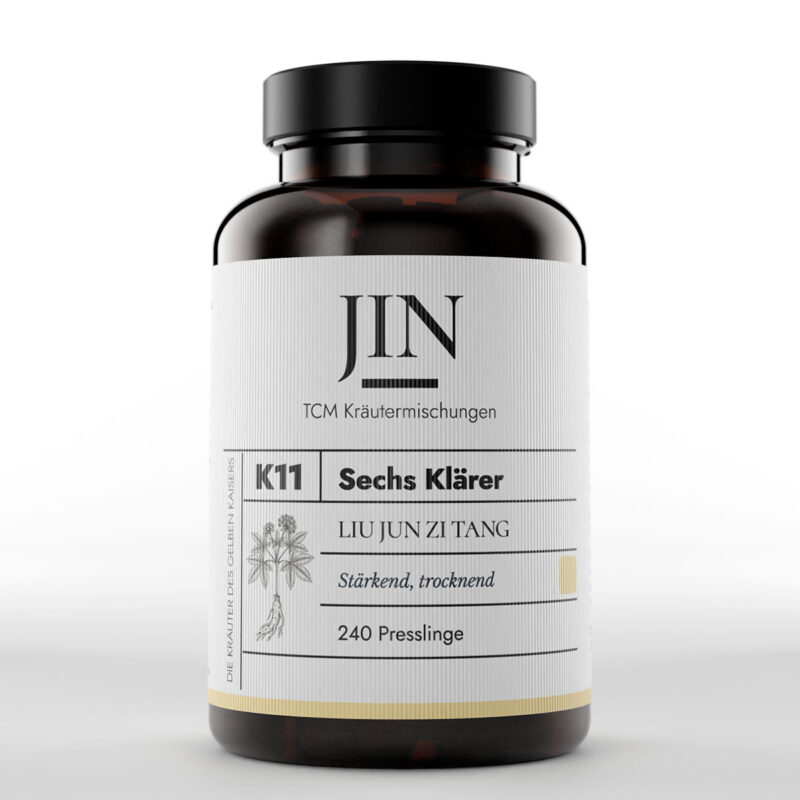
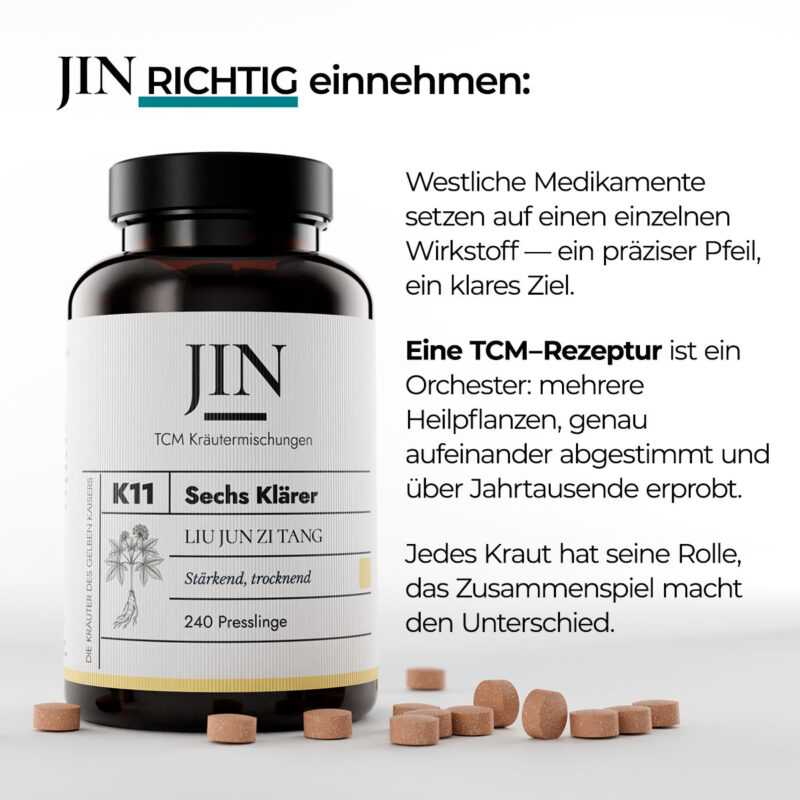
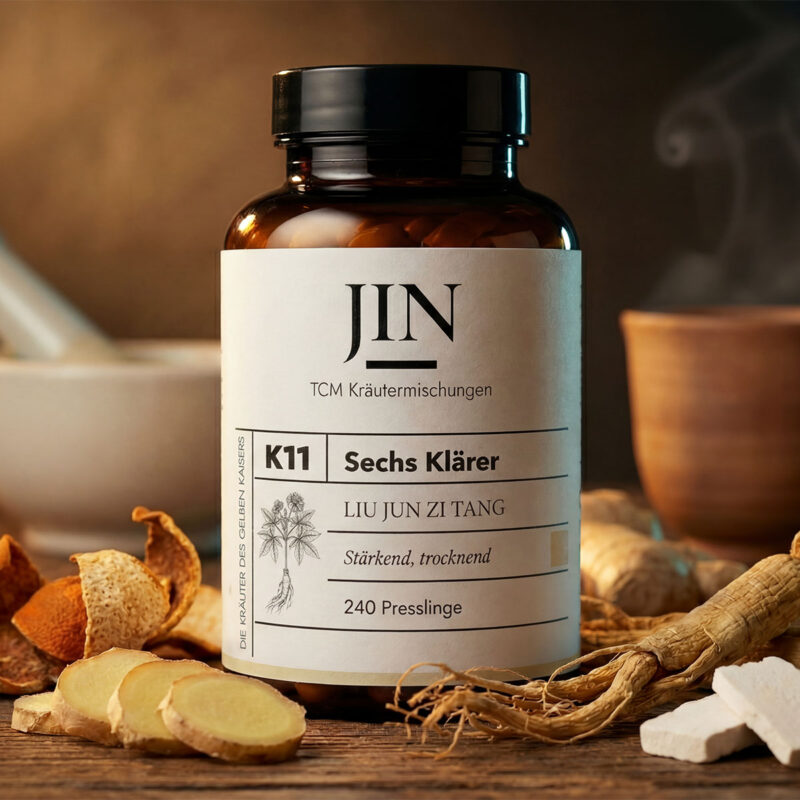
JIN K11 — Six Clarifiers
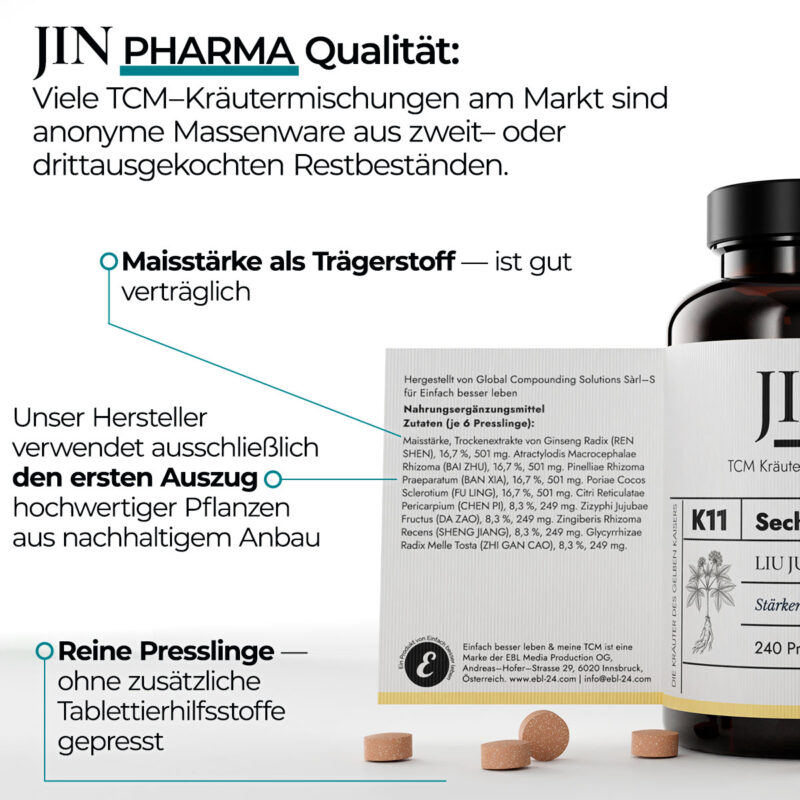
The classic Liu Jun Zi Tang (六君子汤) formula—the „Six Gentlemen.“ It adds two dampness-resolving herbs to the Four Gentlemen formula—for a weakened middle jiao that simultaneously produces dampness and phlegm.
With Ren Shen (ginseng) and Bai Zhu, this formula strengthens spleen qi, while Ban Xia and Chen Pi dry dampness, transform phlegm, and move qi.
Quantity
329,70 €
i
To the product
The herbs in this recipeRecommended reading:How TCM herbal blends are formulatedLearn more now
| Herb (Pinyin) | German designation | Function in the recipe |
|---|---|---|
| Ren Shen (Ginseng Root) | Ginseng root | emperor Powerfully tonifies spleen qi and strengthens digestive function |
| Bai Zhu (Atractylodis Macrocephalae Rhizoma) | White Atractylodes | minister Strengthens the spleen and dries moisture |
| Ban Xia (Prepared Pinellia Rhizome) | Pinellia rhizome | minister Dries dampness, transforms phlegm, and calms rebellious qi |
| Fu Ling (Poria cocos sclerotium) | Poria mushroom | assistant Drains dampness and strengthens the spleen |
| Chen Pi (Pericarp of Citrus reticulata) | Tangerine peel | assistant Regulates the Qi and dries moisture |
| Da Zao (Zizyphi Jujubae Fructus) | Jujubes | assistant Nourishes the blood and spleen; harmonizes the formula |
| Sheng Jiang (Fresh Ginger Rhizome) | Fresh ginger | assistant Warms the middle burner, relieves nausea |
| Zhi Gan Cao (Glycyrrhizae Radix Melle Tosta) | Honey–Licorice Root | harmonizer Tones the spleen qi and harmonizes all the herbs |
Explanation of the most important herbs
emperor Ren Shen (ginseng) — The energy booster
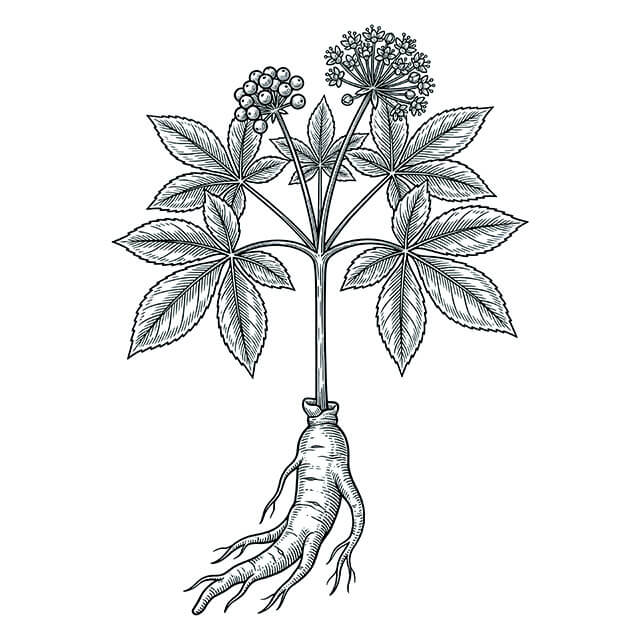
Powerfully tonifies spleen qi—the “emperor” of the formula, which strengthens digestive power from the ground up. Ginsenosides exhibit adaptogenic and immunomodulatory effects; in preclinical studies, ginseng polysaccharides have been shown to support the intestinal mucosa and nutrient absorption.
minister Bai Zhu (Atractylodes) — The spleen tonic
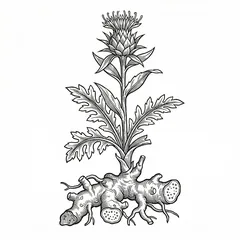
Strengthens the spleen and dries dampness — works in conjunction with Ren Shen to restore the transformative power of the Middle Jiao. In preclinical studies, atractylenolide I has been shown to have gastroprotective and anti-inflammatory effects; the polysaccharides support the gut microbiota and the gut-associated immune system.
minister Ban Xia (Pinellia) — The Slime Converter
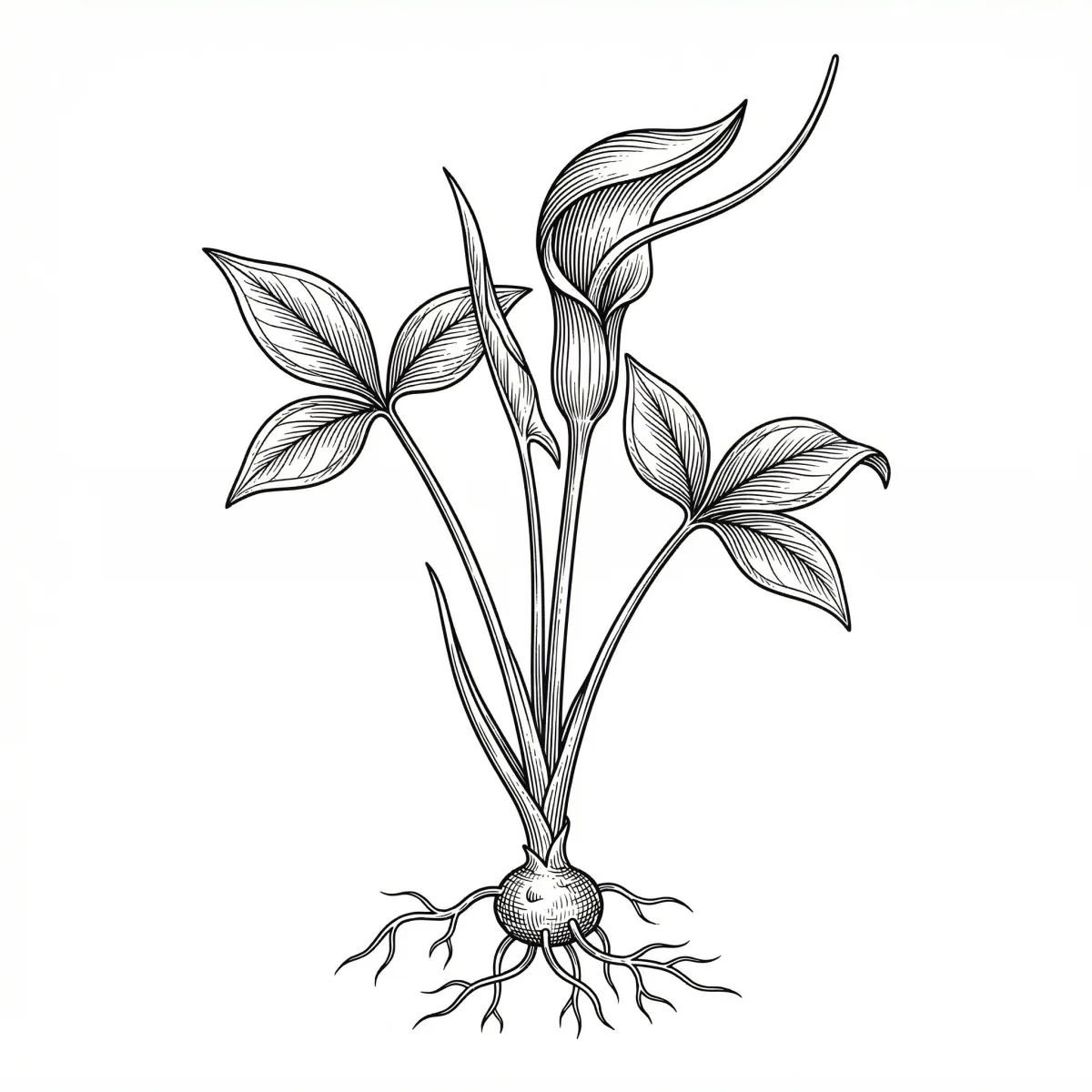
It dries dampness and transforms phlegm, and calms rebellious qi—the key herb that distinguishes the Six Clarifiers from the Four Noble Lords. The properly processed Pinellia rhizome exhibits antiemetic effects through the modulation of central serotonin receptors, as well as expectorant and antitussive effects.
assistant Chen Pi (tangerine peel) — The Qi Mover
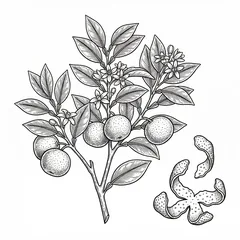
Regulates qi and dries dampness—it moves stagnant qi in the digestive tract and prevents nourishing herbs from causing stagnation. Nobiletin and other polymethoxylated flavones have anti-inflammatory effects and promote gastrointestinal motility; D-limonene from the essential oil aids in fat digestion.
If there is no noticeable moisture (yet)
Pure Spleen-Qi Deficiency: Exhaustion, weak digestion, and a feeling of inner emptiness, but without bloating, phlegm, or a sensation of heaviness.
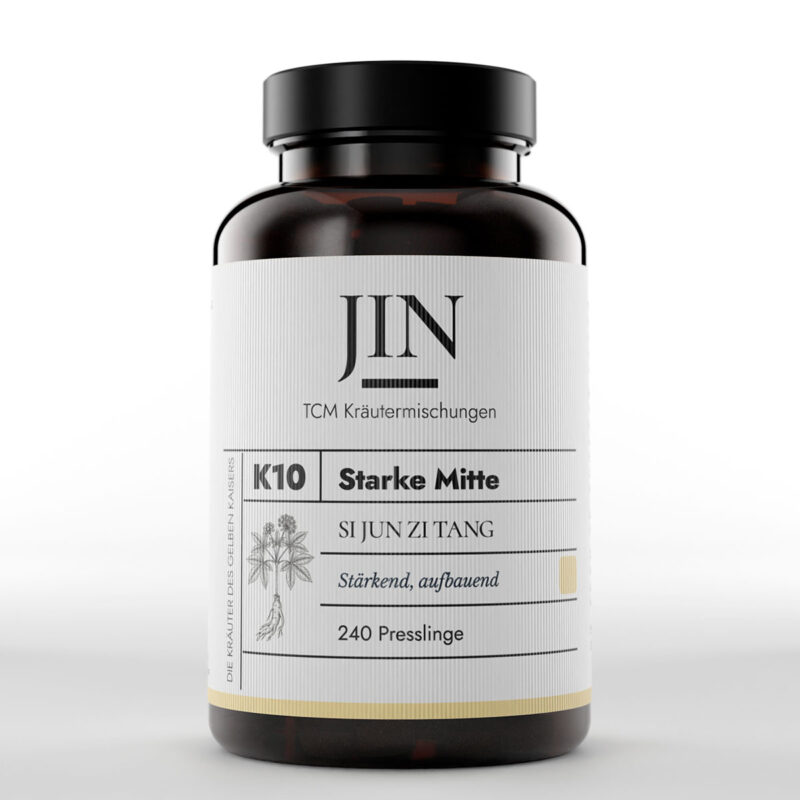
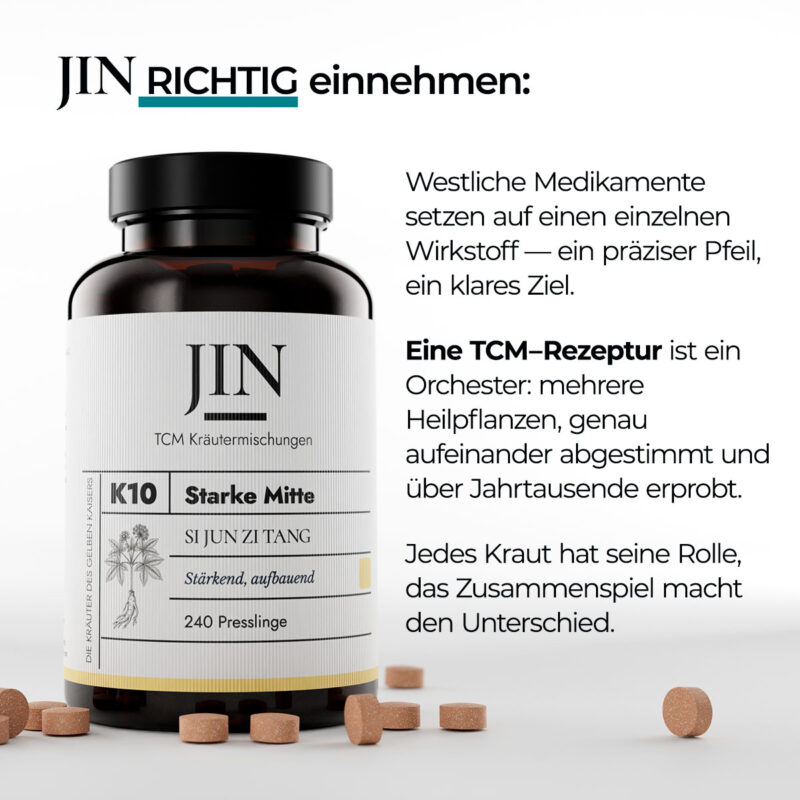
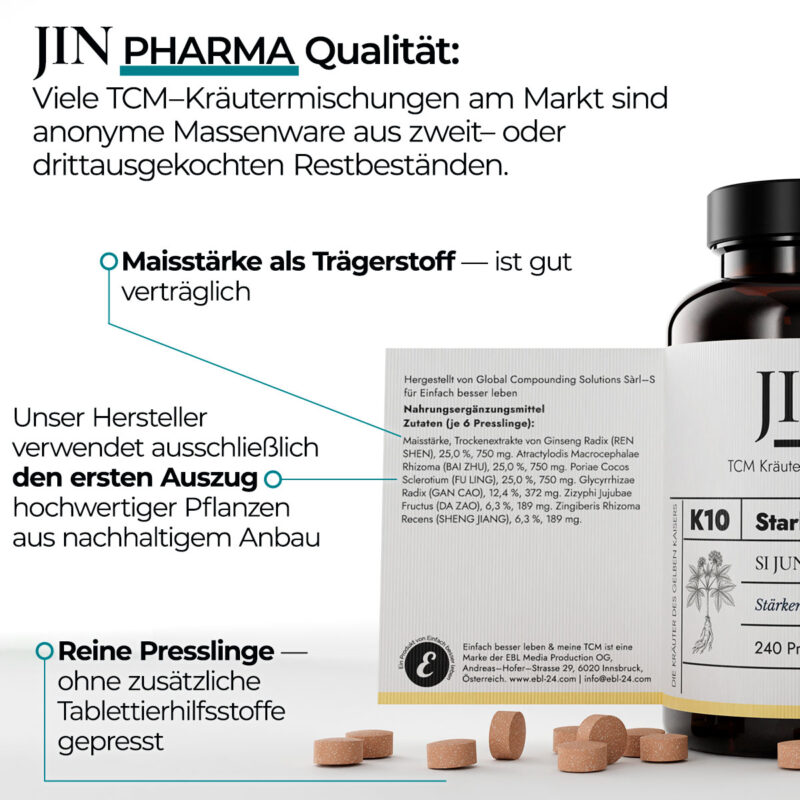
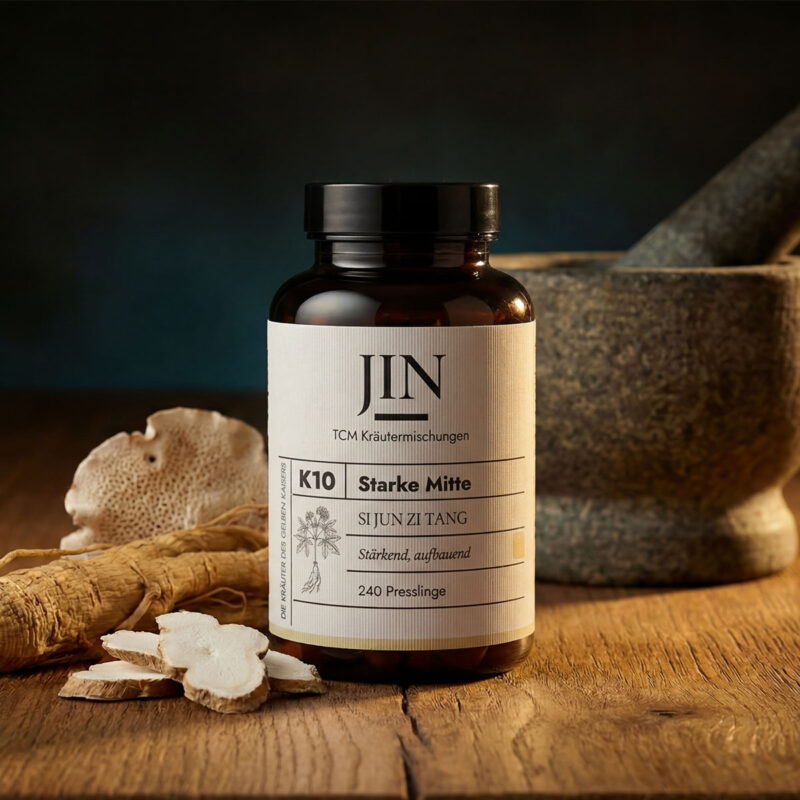

JIN K10 — Strong Core
Si Jun Zi Tang (四君子汤) — the „Four Noble Gentlemen“ — the simple, basic formula that gently tonifies spleen qi.
A simple, basic toning of the center, without introducing any additional moisture.
Quantity
329,70 €
i
To the product
When a sensation of heaviness is the predominant symptom
A pulling sensation or heaviness in the lower abdomen, organ prolapse (stomach, uterus, rectum), hemorrhoids, mild incontinence, or spotting—the Qi is no longer „holding“ things in place.
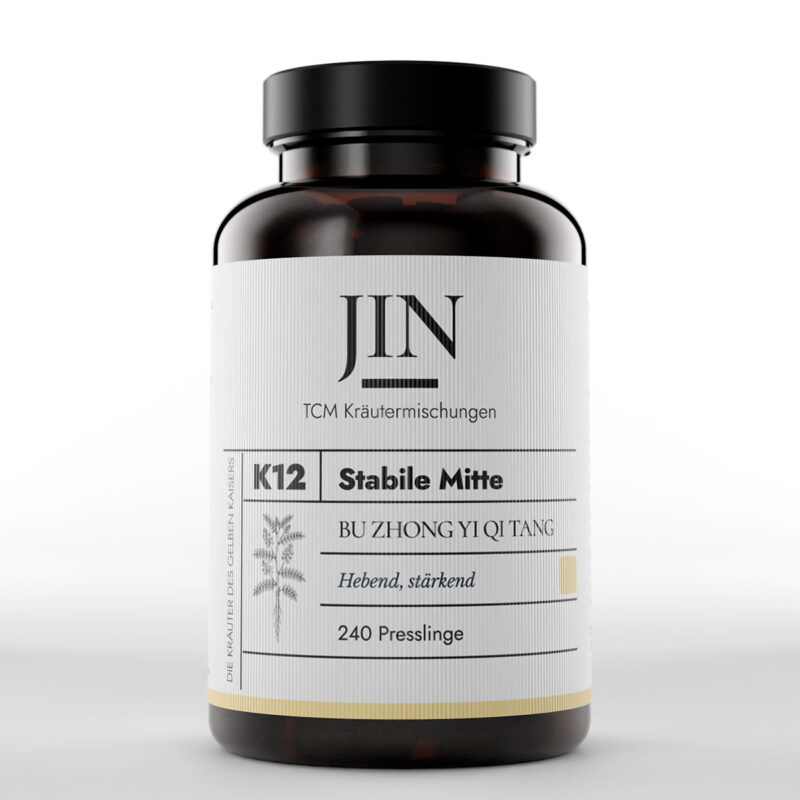
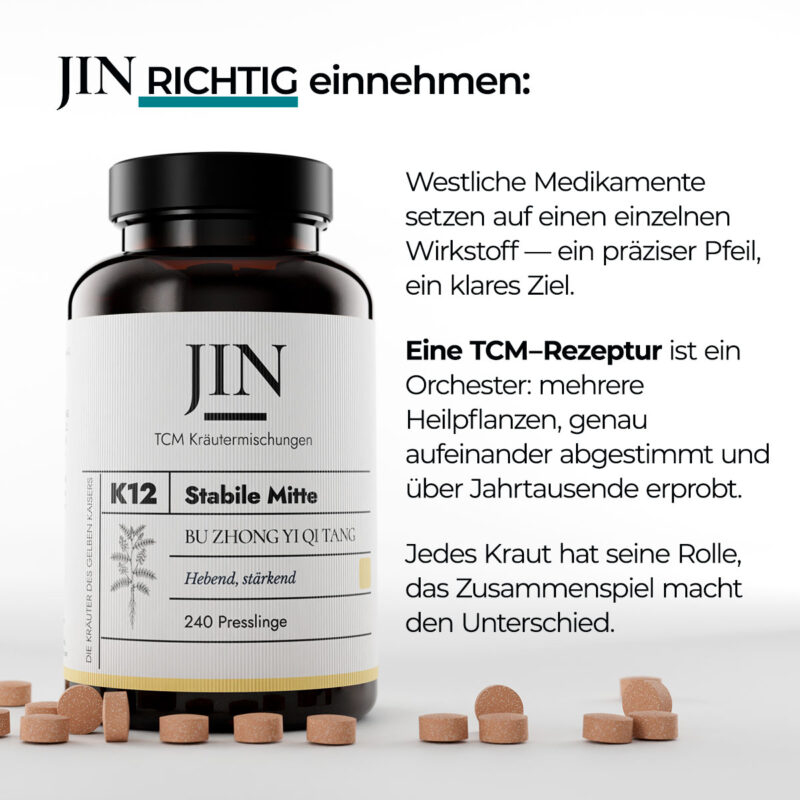
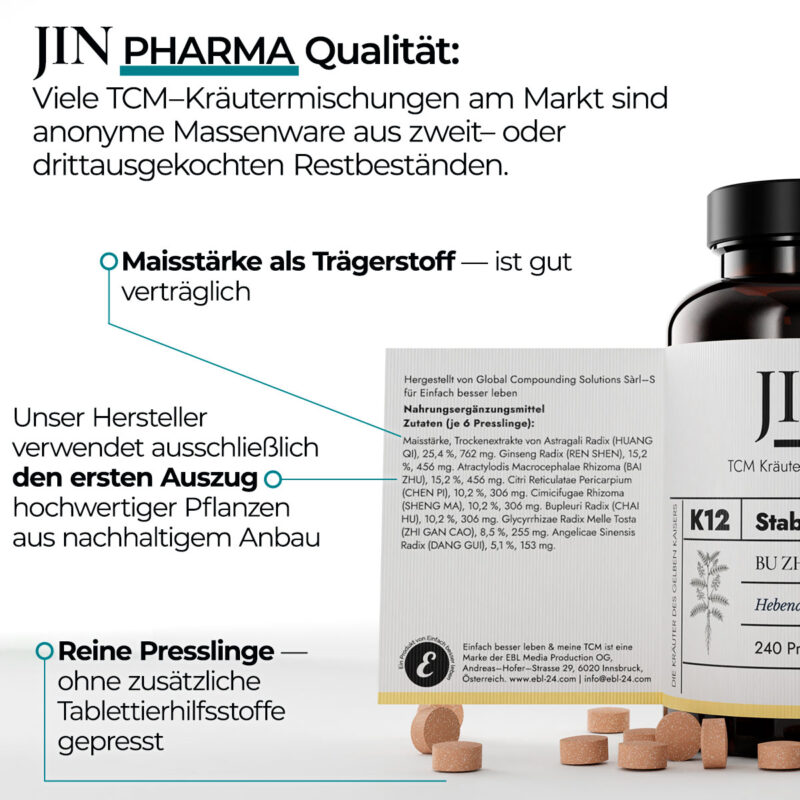
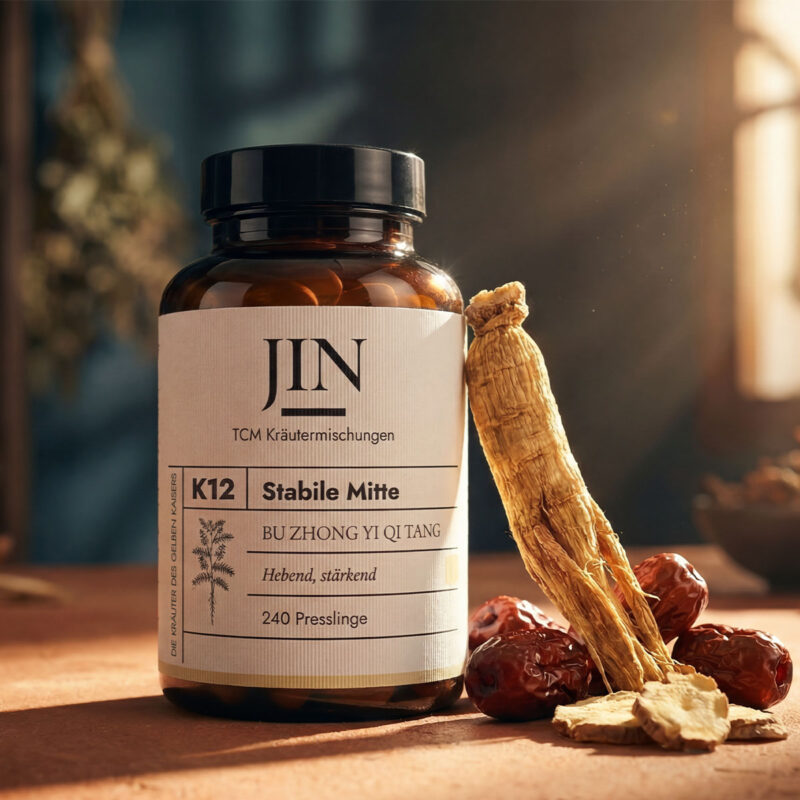
JIN K12 — Stable Center
Bu Zhong Yi Qi Tang (补中益气汤) — „tonifying the middle and raising the Qi“ — specifically raises the sinking spleen Qi.
It restores the body’s supporting, uplifting strength when „everything is pulling downward.“.
Quantity
329,70 €
i
To the product
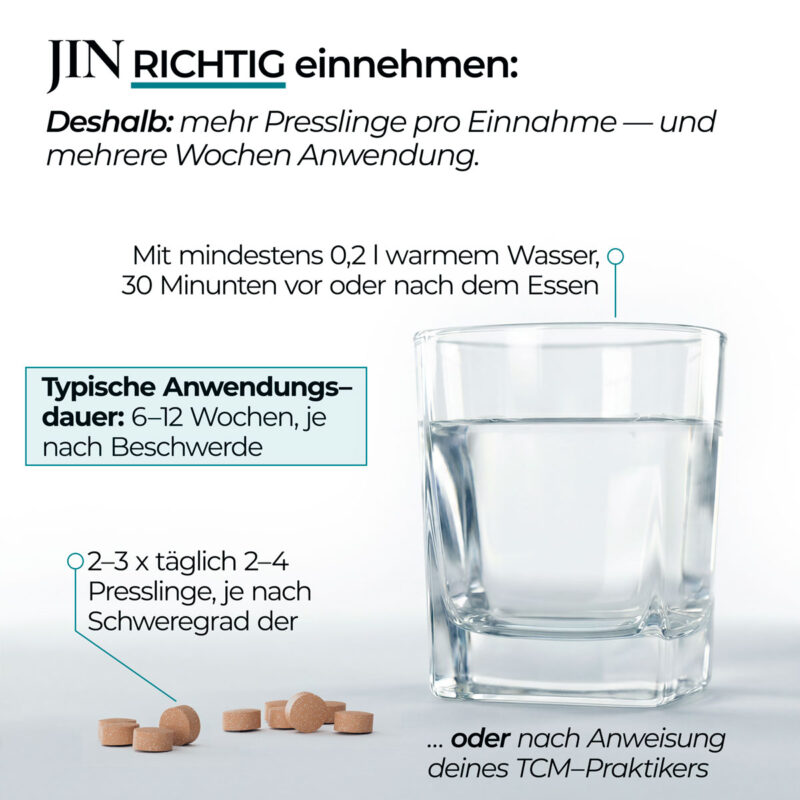
Recommended dosage
The dosage depends on the severity.
Based on your questionnaire results, we have highlighted the appropriate dosage for you below.
At light Severity:
- 2 tablets 3 times a day (morning, noon, and late afternoon) = 6 tablets per day
- Optional, if taking 3 doses a day is difficult for you: 3 tablets twice a day — same daily amount
- We recommend at least 2 cans, each containing 240 tablets (enough for about 12 weeks)
At middle Severity:
- 3 tablets 3 times a day (morning, noon, and late afternoon) = 9 tablets per day
- We recommend at least 3 cans, each containing 240 tablets (enough for about 12 weeks)
- If your condition improves, switch to the dosage recommendation for mild symptoms
At significantly Severity:
- 4 tablets 3 times a day (morning, noon, and late afternoon) = 12 tablets per day
- We recommend at least 4 cans, each containing 240 tablets (enough for about 12 weeks)
- If your condition improves, switch to the dosage recommendation for moderate severity
Why 3 times a day?
This ensures that the herbs' effects are evenly distributed throughout the day.
IMPORTANT:
- Take the tablets with at least 0.2 liters of warm water
- Ideally, 30 minutes before or after a meal
- This suggestion is not a substitute for a medical diagnosis or treatment
- If you are pregnant or breastfeeding, have a chronic medical condition, or are taking medication, consult a doctor or a TCM practitioner beforehand.
- If you have a severe cold, fever, or diarrhea, stop taking this product
- Warm, cooked meals; reduce dairy products, sweets, and cold and raw foods—they promote dampness and phlegm
- Regular exercise in the fresh air; if you experience persistent bloating or mucus buildup, consult a doctor
If little has changed after about 12 weeks:
Herbs are just one part of TCM. Combine taking them with other practices—acupressure, qigong, Pilates, or yoga, BS+, as well as meditation and breathing exercises. Afterward, take a two-week break from taking the herbs. Then, if needed, you can TCM analysis try again and/or compare your result with your TCM practitioner or discuss it with your doctor.
If you have any questions about how to take it, please feel free to contact us.
Want to know what dosage is right for you? Take our free TCM questionnaire—in just a few minutes, it will reveal your personal TCM pattern and the appropriate dosage of the recommended TCM herbal blend.
BS+ for your intestinal flora
A healthy gut is the basis for your well-being. Current studies show that around 80 % of people in Germany consume too little fiber - yet it is the most important food for your intestinal flora (also known as the intestinal microbiome).
BS+ was developed to support your daily fiber supply. With 11 high-quality, natural ingredients BS+ offers your intestinal flora a diverse nutrient base.
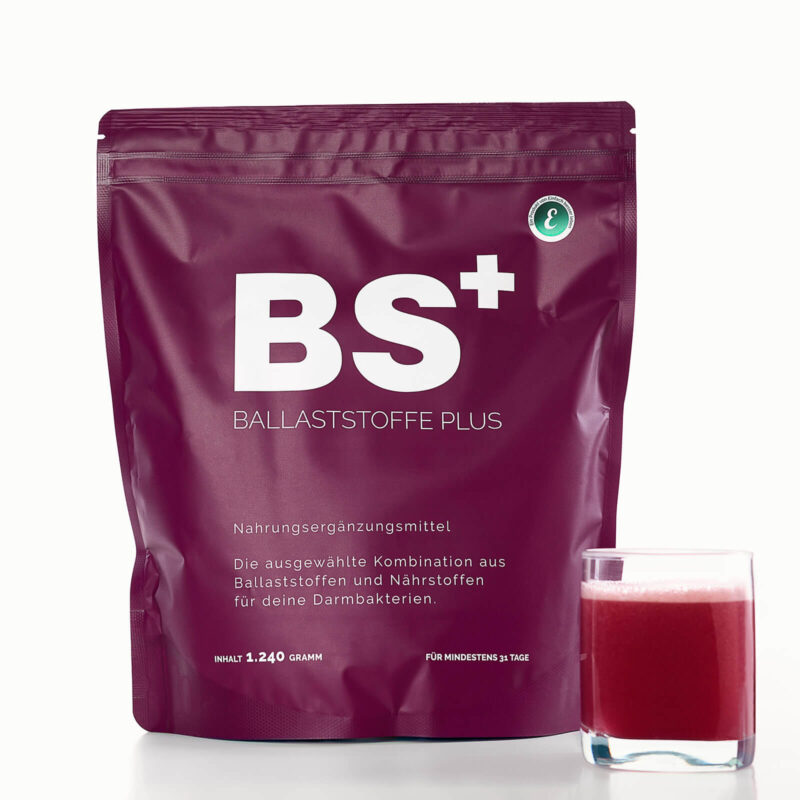
The revolutionary fiber formula
BS+ Dietary Fiber Plus
- Up to 20 g dietary fiber daily EXTRA
- Improved digestion and regular bowel movements
- Increased energy and vitality
- Better mood and mental clarity
- Support for your immune system
- Potential improvement in cholesterol and blood sugar levels
Simply stir into water twice a day - Your intestinal flora will thank you.
Why BS+ for spleen-Qi deficiency + dampness?
When spleen qi is weakened, the spleen can no longer fulfill its central function—the transformation and transportation of food. As a result, undigested food residues and turbid dampness accumulate in the middle burner. This dampness places an additional burden on the spleen and weakens it further—creating a vicious cycle. The gut flora becomes depleted because it lacks the necessary variety of nutrients, and overall digestive strength declines.
BS+ delivers 11 prebiotic fibers and thereby specifically nourishes the beneficial gut bacteria that are essential for proper digestion. A diverse gut microbiota supports the spleen in its transformative functions, helps eliminate stagnant dampness, and strengthens the center—thereby breaking the vicious cycle of a weak spleen and increasing dampness.
Particularly important in cases of spleen qi deficiency and dampness:
- Strengthens the spleen's transformative power and helps reduce the accumulation of dampness
- Promotes a diverse gut flora, which relieves pressure on the middle burner and alleviates bloating
- Helps eliminate stagnant moisture and restores a sense of lightness to the body
Acupressure
Acupressure is acupuncture without needles. — You can do this yourself at any time. By applying gentle pressure to specific points, you can strengthen your spleen qi and promote the elimination of dampness.
These three points form a powerful combination for strengthening the spleen and eliminating dampness. Regular stimulation is especially important — because only a strengthened core can effectively transform and release moisture over the long term.
ACUPUNCTURE POINT: MP 09
Spleen-Pancreas 09
Yin Hill Spring — Yin Ling Quan
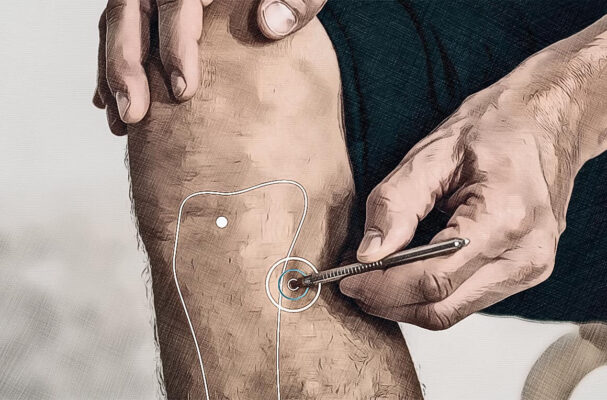
- Key point for the elimination of moisture throughout the body
- Helps with edema, water retention, and heavy legs
- Relieves gas and bloating
- Strengthens the spleen in its transformation function
- Regulates the water balance
Location: In the depression below the inner knee joint space, on the inner side of the shin.
Application:
Massage in a circular motion twice a day for 2–3 minutes per side, applying moderate pressure. This is especially effective in the morning, when moisture is most noticeable.
ACUPUNCTURE POINT: Ma 36
Stomach 36
Three Miles on Foot — To San Li
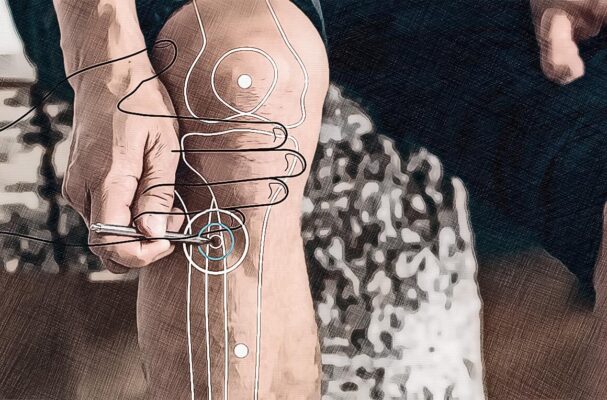
- The most effective remedy for strengthening the spleen and stomach
- Strengthens qi and aids digestion
- Lifts the clear Yang and settles the turbid
- Gives energy and stamina
- Strengthens the immune system
Location: A hand's width below the kneecap, a thumb's width to the side of the edge of the shinbone to the outside.
Application:
Press firmly twice a day for 2–3 minutes on each side, or massage in small circles. Can also be warmed with moxibustion—particularly effective for symptoms of cold.
ACUPUNCTURE POINT: MP 06
Spleen-Pancreas 06
Meeting place of the three Yin - San Yin Jiao
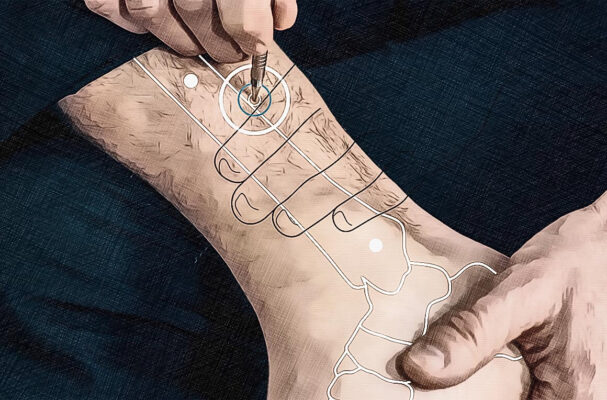
- Meeting point of the three Yin meridians (spleen, liver, kidney)
- Strengthens the spleen and promotes the transformation of dampness
- Regulates fluid balance across all three Yin meridians
- Harmonizes the digestion
- Calms the mind and promotes sleep
Location: Four finger widths above the highest point of the inner ankle, directly behind the shin.
Application:
Massage in a circular motion twice a day for 2-3 minutes per side with medium pressure. Ideal in the morning and evening. DO NOT use during pregnancy!
TIP
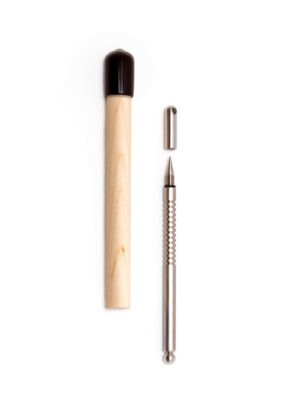
AkuPen
Acupuncture pen with video instructions
For even more intense stimulation You can use an AkuPen. The acupressure pen significantly enhances the effect of acupressure. With an extensive video library for over 80 acupuncture points.
Qi Gong
Qi Gong is moving meditation — Gentle, flowing exercises that harmonize your energy flow and strengthen your center. If you have spleen qi deficiency with dampness, these exercises help build up your spleen qi, strengthen your digestive power, and eliminate accumulated dampness.
Regular practice of qigong (as little as 10–15 minutes a day) has been shown to have positive effects on digestion, energy levels, and overall well-being.
QI GONG: Exercise 1
Warm the center
Warms and strengthens the spleen; stimulates digestion

Particularly helpful for:
- Fatigue and exhaustion
- Digestive weakness
- Feeling cold in the stomach
- Moisture and a feeling of heaviness
Effect:
This Earth Element exercise specifically warms and strengthens the center—the spleen, which is the center of transformation. The gentle, circular movements activate digestive power, allowing the spleen to better transform and eliminate dampness.
QI GONG: Exercise 2
Connecting heaven and earth
Expands the middle burner, moves qi, and transforms dampness

Particularly helpful for:
- Feeling of heaviness in the whole body
- Flatulence and bloating
- Lack of energy and listlessness
- Moisture in the middle heater
Effect:
This Earth Element exercise stretches and opens the middle burner—the seat of the spleen and stomach. The alternating upward and downward stretches vigorously move the qi and help dissolve and eliminate stagnant dampness.
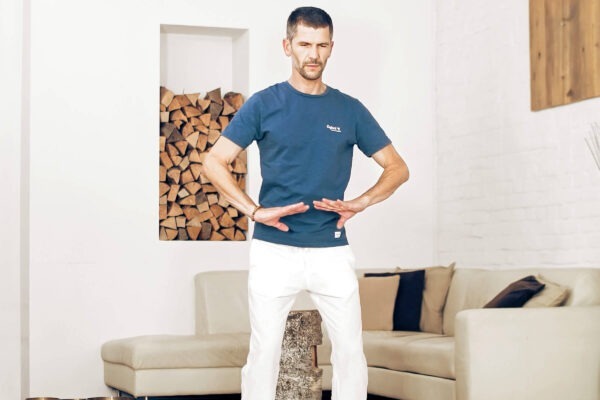
QI GONG: Exercise 3
Regulate Qi
Regulates the flow of qi, harmonizes digestion
Particularly helpful for:
- Qi Stagnation in the Middle Burner
- Bloating and flatulence
- Nausea after eating
- Irregular digestion
Effect:
This Earth Element exercise specifically regulates the flow of qi in the center and harmonizes digestion. When spleen qi is weak, stagnation and dampness can occur—this exercise restores the flow of qi and supports the spleen in its transformative functions.
These Qi Gong exercises are specifically selected to strengthen the spleen and eliminate dampness. They strengthen spleen qi, invigorate the middle burner, and help transform and eliminate dampness.
All of the exercises are particularly effective when you do them between 9 and 11 a.m.—that’s when the spleen is at its peak according to the organ clock. During this time, spleen energy is at its strongest, and the exercises have their full effect.
QI GONG:
When and how often?
In the morning or in the morning (ideal):
- All 3 exercises as a sequence: approx. 15–20 min.
- Or just 1–2 exercises: approx. 5–10 min.
- Preferably between 9 and 11 am (spleen time)
In between:
- Individual exercises if required (e.g. if you feel heavy)
- „Warming the Center“ for Rapid Activation of Digestion
Regularity is more important than duration:
- It is better to exercise for 10 minutes every day than for 60 minutes once a week.
- After 2–3 weeks, you will notice the first changes.
- After 2–3 months of regular practice: significantly more energy and less moisture
Pro tip: When there is dampness, movement is especially important—it moves the qi and helps expel dampness. Qigong is ideal because it is gentle enough not to deplete the spleen qi, yet it still gets the qi moving.
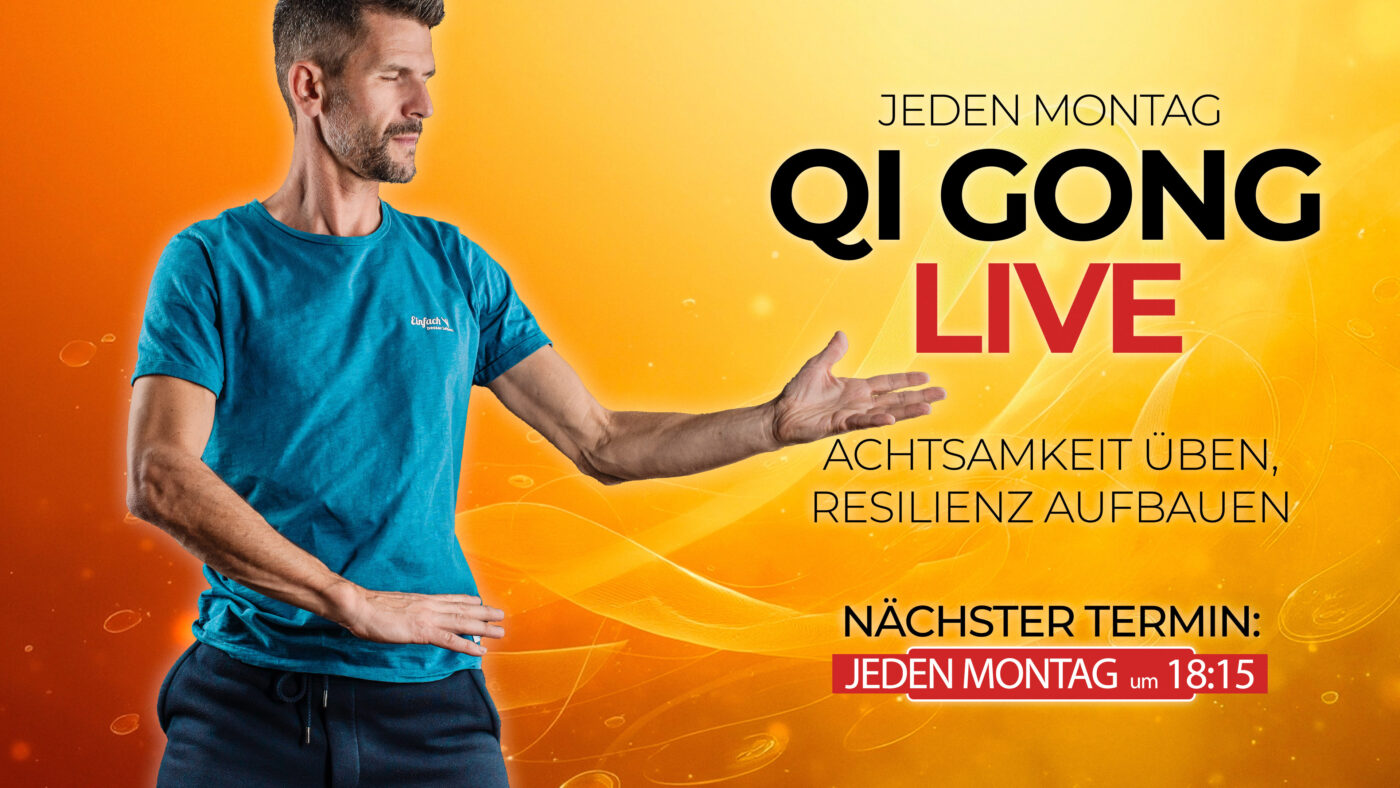
LIVE EVERY MONDAY: QI GONG WITH WOLFGANG
Every Monday at 6:00 p.m. Let's practice together live on YouTube. Among other things, Wolfgang will guide you through a complete qigong sequence — free of charge and suitable for all levels.
Why participate live? ✓ Practicing together is motivating ✓ Wolfgang explains the exercises in detail ✓ You can ask questions in the live chat ✓ Regular appointments help with your routine
More about Qi Gong LiveMeridian Yoga — The Yoga of TCM
Meridian Yoga combines yoga with traditional Chinese medicine. The result is a holistic exercise concept for better health and more energy.
The following exercises specifically activate the Stomach Meridian—because the spleen and stomach are partner organs in the Earth element. When the spleen is weakened and dampness burdens the body, activating the Stomach Meridian helps strengthen digestive power and restore balance to the center. Movement is the key here—it gets stagnant Qi flowing and helps eliminate dampness.
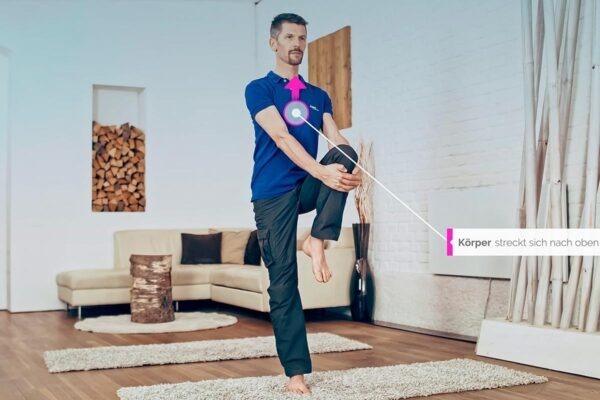
MERIDIAN YOGA: Exercise 1
The tree with acupressure for the stomach meridian
Activates the Stomach Meridian, strengthens the legs and the core
Particularly helpful for:
- Digestive weakness
- Feeling of heaviness
- Lack of grounding
- Weak legs
Effect:
The Tree Pose, combined with acupressure, activates the Stomach Meridian, which runs along the front of the leg and regulates digestive function. This exercise simultaneously strengthens the legs and the core—in cases of spleen qi deficiency with dampness, it helps dispel the feeling of heaviness and restore grounding.
MERIDIAN YOGA: Exercise 2
The bow for the stomach meridian
Deep stretch of the front of the body along the Stomach Meridian

Particularly helpful for:
- Flatulence
- Inertia
- energy shortage
- Heavy Legs
Effect:
This stretch extends across the entire front of the body along the Stomach Meridian—from the face down through the abdomen to the toes. This intense stretch relieves stagnation in the digestive tract and gets the qi moving. When there is dampness, it helps overcome lethargy and release new energy.
Both exercises activate the Stomach Meridian, which runs along the front of the body and legs and is closely linked to digestive strength. Since the spleen and stomach form the center as a paired organ system, activating the Stomach Meridian directly supports the weakened spleen and helps transform and eliminate dampness.
Particularly effective: Hold each position for 3–5 breaths, consciously focusing on your abdomen. Imagine warm, golden light flowing through your core and dissolving the moisture.
MERIDIAN YOGA:
When and how often?
Best time:
- In the morning between 7 and 9 a.m. (stomach time)
- Or between 9 and 11 a.m. (spleen time)
Duration:
- Hold each position for 3–5 breaths.
- Complete sequence: 10-15 min.
- 3–5 times per week for best results
Important:
- Practice in a warm environment—cold weather increases humidity
- Breathe deeply and slowly during the positions
- Stretching should be comfortable, never painful.
Pro tip: Combine Meridian Yoga with the qigong exercises „Warming the Center“ and „Connecting Heaven and Earth“ for the best results. Movement is the most important factor in dealing with dampness—it gets stagnant qi flowing and helps the body actively expel dampness.
Nutrition according to TCM
„Let food be your medicine.“ — This principle has been followed in TCM for thousands of years. In cases of spleen-Qi deficiency with dampness, proper nutrition is the MOST IMPORTANT treatment approach of all — because dampness is primarily caused by an improper diet.
Spleen Qi is part of the Element earth and needs warm, cooked, drying food, to transform and eliminate dampness. The spleen thrives on warmth, rhythm, and simple food.
What you eat, HOW you eat and WHEN What you eat—all of that determines whether your spleen is strengthened or whether dampness continues to increase.
The Golden Rules for Spleen-Qi Deficiency + Dampness
What is good for you:
Warming vegetables
- Pumpkin (warms the center, transforms moisture)
- Sweet potato (nourishes qi, strengthens the spleen)
- Fennel (gently warms the body, relieves bloating)
- Carrots (sweet and warming, strengthen the center)
Always cooked—never raw!
Cooked cereals
- Rice (strengthens the spleen, easily digestible)
- Millet (gently warms and dries)
- Oats cooked as porridge (tonifies the Qi)
- Congee (the TCM classic for the middle!)
Grain is the basis for strong spleen qi
Legumes and Proteins
- Lentils (warming, nourishing, easy to digest)
- Adzuki beans (draw out moisture)
- Chicken (warms and strengthens the Qi)
- Beef (strengthens the spleen and blood)
Lean meat powerfully builds up qi
Aromatic spices
- Ginger (warms the center, dries moisture)
- Cardamom (aromatic drying)
- Cinnamon (strengthens the digestive fire)
- Fennel, caraway, cilantro
Aromatic spices are the strongest dehumidifiers!
What you should avoid:
Raw food
- Salads as a main meal
- Raw vegetables in large quantities
- Smoothies with raw fruit
- Raw food diets
Raw food cools the spleen and produces moisture!
Dairy products
- Cow's milk (produces moisture directly)
- Cheese (especially soft cheese)
- Yoghurt (cold and moist)
- Cream and quark
Dairy products are the number 1 source of moisture!
Sugar and sweets
- White sugar and sweets
- Cakes, Cookies, and Pastries
- Soft drinks and sweetened beverages
- Ice cream
Sugar weakens the spleen and produces moisture!
Bread, Wheat, and Cold Drinks
- Bread and rolls (especially white bread)
- Pasta made from wheat flour
- Bananas (cold and moist)
- Ice-cold drinks and ice cream
Wheat sticks together and creates moisture!
Fatty foods and alcohol
- Fried and breaded food
- Fatty Meat and Fast Food
- Beer (particularly moisture-generating)
- Wine and spirits
Fats and alcohol produce moisture and put a strain on the spleen!
HOW YOU SHOULD EAT:
Cooked and warm
- Prefer hot meals - always!
- Soups and stews - ideal in damp conditions
- Vegetables steamed or boiled
- Also breakfast warm (congee or porridge)
Light and digestible
- Small to medium portions
- Not too many different ingredients
- Chew well (at least 20 times per bite)
- Do not eat too late (before 7 pm)
The spleen loves warmth, rhythm, and simple food!
Drink properly
- Warm or room temperature water
- Don't drink too much at once
- Do not drink during meals
- Prefer ginger tea or fennel tea
Too much liquid also creates moisture!
AN IDEAL DAY FOR SPLEEN-QI DEFICIENCY:
Breakfast (7–9 a.m.):
- Warm Congee with Pumpkin and Ginger
- Or: Millet Porridge with Cinnamon and Cardamom
- In addition: ginger tea
Lunch (12–1 p.m.):
- Rice with Steamed Vegetables and Chicken
- Or: Fennel and Carrot Soup with Cardamom
- In addition: Aromatic spices (ginger, cardamom)
Dinner (5-6 p.m.):
- Light vegetable soup with rice
- Or: Pumpkin Soup with Ginger
- In addition: fennel tea
Important:
- Eat very little in the evening
- No snacks between meals
- Drink warm water throughout the day
The most important rule for spleen qi deficiency + dampness is:
Warm your core!
Warm, cooked food strengthens the spleen—and a strong spleen naturally dispels dampness.
Our suggestion for getting started:
- Cut back on dairy products, sugar, and wheat — 2 weeks
- Introduce a hot breakfast (congee or porridge) - 2 weeks
- Drink ginger tea daily and use aromatic spices - 2 weeks
Step by step, you will notice how the heaviness subsides, digestion improves and you feel lighter.
Your spleen will thank you!
RECIPE: CONGEE WITH PUMPKIN AND GINGER
Ingredients:
For 2-3 portions
- 100 g short-grain rice
- 200 g Hokkaido squash, cut into small cubes
- 3–4 cm of fresh ginger, thinly sliced
- 1 pinch of cinnamon
- 1 L water or vegetable broth
- 1 spring onion, finely chopped
- salt to taste
- Optional: 1 tsp sesame oil, for serving
Preparation:
- Wash the rice thoroughly and bring it to a boil in water or broth
- Add the ginger slices and bring to a boil
- Simmer over low heat for 40 minutes, stirring regularly
- Add the diced pumpkin and cook for another 20–30 minutes
- The rice should be very soft and mushy
- Season to taste with cinnamon and salt
- Serve with scallions and, if desired, sesame oil
Effect:
Strengthens spleen qi and warms the middle jiao
Gently removes moisture
Extremely easy to digest and nutritious
3–4 times a week — the best breakfast for a weak spleen!
RECIPE: FENNEL AND CARROT SOUP WITH CARDAMOM
Ingredients:
For 4 portions
- 2 fennel bulbs, cut into pieces
- 3 large carrots, sliced
- 1 small onion, finely chopped
- 2–3 cm of fresh ginger, finely chopped
- 1/2 tsp cardamom (ground)
- 1 tablespoon olive oil or ghee
- 1 l vegetable or chicken stock
- Salt and pepper to taste
- Optional: Some fennel greens for garnish
Preparation:
- Heat oil or ghee in a large pot
- Sauté the onion and ginger briefly
- Add the fennel and carrots and sauté for 2–3 minutes
- Stir in the cardamom and toast briefly
- Pour in the broth and bring to a boil
- Simmer on low heat for 25–30 minutes.
- Puree until creamy
- Season with salt and pepper to taste
- Garnish with fennel greens
Effect:
Wicks away moisture and warms the core
Strengthens the spleen's digestive power
Easy to digest and beneficial for the whole body
2–3 times a week — aromatic, warming, and healing!
Breathing
Breathing is the bridge between body and mind. In TCM, we say: „The lungs govern qi“ — through conscious breathing, you can directly influence your energy flow, harmonize all organ systems, and activate your self-healing powers.
Studies show: Proper breathing activates the parasympathetic nervous system (rest & regeneration), massages the internal organs from within, improves oxygen supply, and reduces stress hormones. The good news: Just 5–10 minutes a day can have a measurable effect on your overall well-being.
Recommended breathing techniques
ABDOMINAL BREATHING — The basis for every breathing technique
Natural breathing
Abdominal breathing is the most natural and effective form of breathing. With every breath, you massage your internal organs, activate the flow of energy, and bring qi to the center of your body (dantian).
Wolfgang shows you step by step, How to learn abdominal breathing correctly—lying down to start with, then later also sitting and standing.
Duration: 9 minutes

4–7–8 BREATHING — Calms you down immediately
Breathing to fall asleep and combat inner restlessness
4–7–8 breathing (inhale for 4 seconds, hold for 7 seconds, exhale for 8 seconds) is known as a „natural sedative.“ This special rhythm calms your nervous system in just a few minutes—perfect for stress, racing thoughts, or trouble falling asleep.
Perfect for the evening or whenever you want to calm down quickly.
Duration: 9 minutes
To the interactive videoBOX BREATHING — For inner coherence
Professional breathing for focus and calmness
Box Breathing (4 seconds on, 4 seconds hold, 4 seconds off, 4 seconds hold) combines activation and relaxation in perfect balance. This method is used by elite soldiers, athletes, and executives to remain calm and focused even in extremely stressful situations.
Train your CO₂ tolerance and brings the heart, breathing, and nervous system
into a harmonious state.
Duration: 9 minutes
To the interactive videoCOHERENT BREATHING — Harmonizes body & mind
Breathing against burnout
With coherent breathing You breathe in for 5.5 seconds and out for 5.5 seconds. This rhythm brings your heart and breathing into perfect synchrony—a state that science refers to as „coherence.“ This method is also used in clinics for burnout treatment and stress reduction.
Proven to improve Heart rate variability (HRV) — the most important marker for stress resistance, health, and life expectancy.
Duration: 14 minutes
To the interactive video
COHERENT BREATHING Around the clock
Our 24/7 livestream on coherent breathing runs non-stop. You can tune in at any time and join in right away.
Perfect for:
✓ Spontaneous breaks to catch your breath in between
✓ If you need help breathing
✓ As background while working
✓ For falling asleep (calms the nervous system)
✓ For regular daily practice
relaxation
When your body is relaxed, all organ systems can function optimally. Chronic tension blocks your body's self-healing powers and keeps you in a state of constant stress. Through targeted relaxation techniques, you activate the parasympathetic nervous system and send your body the signal: „Now I can regenerate, heal, and build strength.“
Progressive muscle relaxation is one of the most researched relaxation methods and has been used successfully for over 100 years. It helps you to recognize tension, actively release it, and achieve a state of deep relaxation—whenever you want.
Recommended relaxation technique
PROGRESSIVE MUSCLE RELAXATION (PMR)
The scientifically proven relaxation method
Progressive muscle relaxation according to Jacobson is one of the most widely researched relaxation techniques worldwide. By deliberately tensing and relaxing individual muscle groups, you learn to consciously perceive tension and actively release it.
Proven effect:
Lowers blood pressure, improves sleep, reduces chronic pain, relieves tension, and activates self-healing powers. Successfully used by psychologists to treat anxiety disorders, depression, and chronic pain.
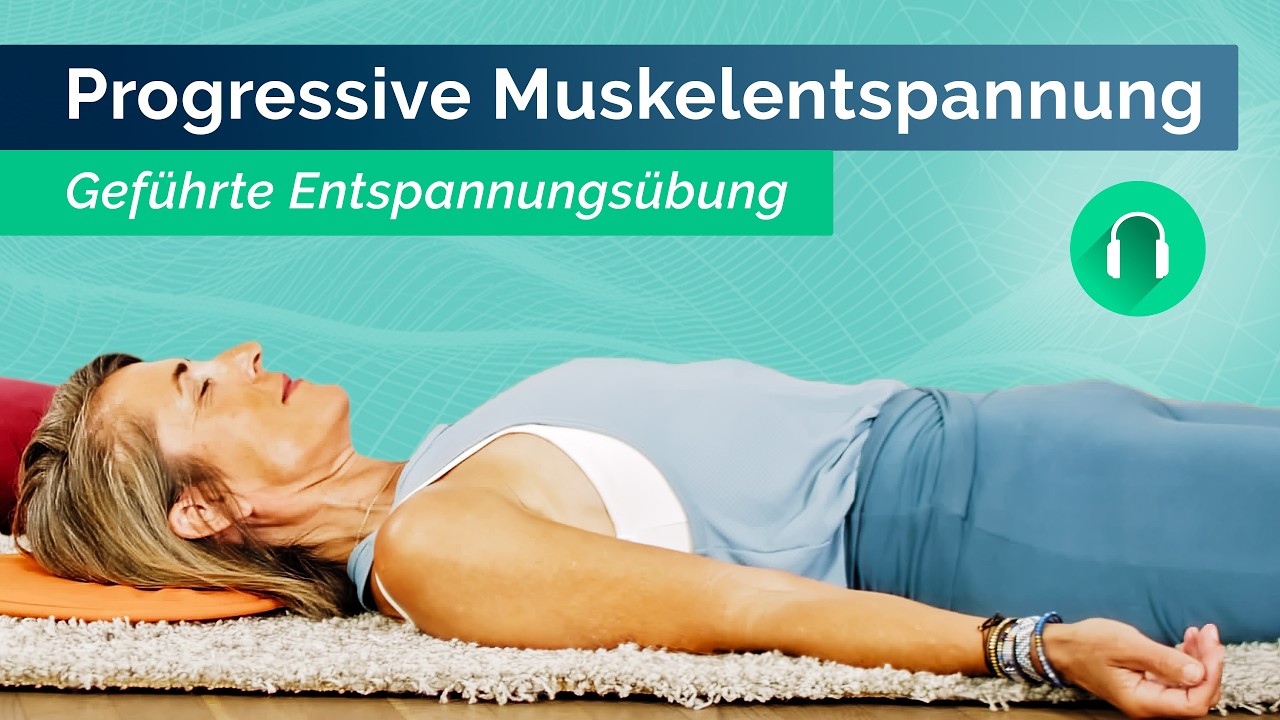
Maria guides you step by step through the entire exercise—perfect for beginners and advanced practitioners alike.
Duration: 23-minute complete guide
To the guided PMRMeditation
Meditation calms the mind — and a calm mind harmonizes the body. In TCM, we know that every emotion affects a specific organ. Through regular meditation, you learn to break out of destructive thought patterns, find emotional balance, and strengthen your inner core.
Modern studies confirm: Meditation has been proven to change brain structure, reduce stress hormones, strengthen the immune system, and improve self-healing powers. Just 10 minutes a day can change your life forever.
Recommended meditations
GUIDED MEDITATIONS FOR EVERY DAY
Your personal meditation library
We have a complete Playlist with over 60 guided meditations, breathing exercises, and relaxation techniques—from short 5-minute meditations for in between to deep 30-minute sessions for intensive practice.
In the playlist you will find:
- Morning meditations for a mindful start to the day
- Meditations for restful sleep
- Breathing meditations for inner peace
- Meditations against stress, brooding, and worries
- TCM standing meditations for all 5 elements
- Body scan and body journeys
- Healing meditations to activate self-healing powers
- Special breathing techniques (4–7–8, coherent breathing, bee breathing)
Perfect for beginners and advanced practitioners. Choose the right meditation for you depending on your time, the time of day, and your needs.
To the meditation playlistThe spleen is the source of postnatal qi.
If the center is strong, dampness cannot develop. If the center is weak, dampness accumulates and puts a strain on the entire body. Strengthen the spleen—and the dampness will dissipate on its own.
- Loosely based on the HUANG DI NEI JING
(The Yellow Emperor's Classic of Internal Medicine)
More tips for your everyday life
In addition to traditional TCM treatment methods There are many small daily habits that can strengthen your spleen qi and help eliminate dampness. In TCM, the spleen is considered the center of the body—with the right habits, you can strengthen it and prevent dampness from accumulating.
Digestion and Eating Habits
Prefer warm, cooked meals
The spleen loves warmth—and heat causes dampness to dissipate:
- Cooked foods are easier to digest and put less strain on the spleen
- Eat a hot breakfast as well (porridge, congee, millet porridge)
- Raw foods should be eaten only in small amounts as a side dish—never as a main meal
- Soups and stews are ideal for spleen-qi deficiency with dampness
- Spices such as ginger, cardamom, and fennel warm the core
3 regular meals at set times
The spleen needs rhythm and regularity:
- 3 meals at set times — the spleen loves routine
- Biggest meal at lunchtime, when digestive power is at its strongest
- Don't snack between meals—the spleen needs breaks
- Eat light and early in the evening (before 7 pm)
- Don't eat too late - the spleen needs rest at night
Eat slowly and chew thoroughly
Mindful eating greatly aids digestion:
- Chew each bite at least 20 times—digestion begins in the mouth
- Do not work, read or watch the news while eating
- Don't eat while standing or in a hurry
- No cold drinks with meals—at most, warm tea in small sips
- Take a short break after eating before you continue
Eliminate Dampness — Relieve the Spleen
Consistently reduce dairy products
Dairy products produce moisture—the most common source of moisture:
- Avoid cow's milk, yogurt, quark, and cheese as much as possible
- Choose plant-based alternatives such as oat milk or rice milk
- Butter in small amounts is less of a problem
- Sheep and goat milk products are easier to digest than cow's milk
- Avoid dairy products, especially in the evening—they put a strain on the spleen overnight
Avoid sugar and white flour
Sugar and white flour promote moisture:
- Consistently reduce your intake of refined sugar—it directly weakens the spleen
- Replace white flour products (bread, pasta, pastries) with whole-grain or rice products
- Millet and rice are the best grains for humid conditions
- Replace sweet flavors with natural sweeteners (sweet potatoes, pumpkin, dates)
- Fruit juices and smoothies also cause bloating—stick to fruit compote instead
Replace cold drinks with warm ones
Cold paralyzes the spleen and promotes dampness:
- Avoid cold drinks — even in the summer
- Drink warm water or ginger tea throughout the day
- Fennel Tea for Edema and Water Retention
- If your legs are swollen: Elevate your legs and drink warm fennel tea
- Sweat regularly (sauna, warm baths)—but don't overdo it
Movement — Moving Moisture
Daily exercise is essential
Moisture thrives in stagnation—movement dispels it:
- Daily exercise is absolutely essential in humid conditions
- Even just 20–30 minutes of moderate walking each day makes a big difference
- Qi Gong and gentle yoga move energy without causing exhaustion
- Swimming in warm water promotes lymphatic flow
- Sitting too much and a lack of exercise can lead to moisture buildup—get up regularly
Walks After Meals
Exercise after a meal supports digestion:
- 10-15 minutes of slow walking after eating
- Helps the spleen break down food
- Prevents moisture from food from accumulating
- Don't lie down right after eating—it promotes moisture buildup
- Even light housework after a meal is good
What you should avoid
Too much exertion weakens the already weakened qi:
- Intense endurance sports (marathons, HIIT) can further weaken spleen qi
- Heavy sweating depletes body fluids
- If you're feeling very tired or sluggish, it's better to replace exercise with a walk
- Find the right balance: regular, moderate exercise instead of infrequent, intense workouts
Avoid Brooding — The Emotion of the Spleen
Overthinking weakens the spleen
In TCM, brooding is the emotion associated with the spleen:
- Excessive thinking and brooding directly weaken the spleen
- Worries and constant fretting block the flow of qi in the center
- Circular thought patterns promote the accumulation of moisture
- Particularly harmful: worrying while eating—it severely disrupts digestion
- People who brood a lot weaken the spleen and increase dampness
Breaking the Cycle of Worry
Practical Strategies for Dealing with Overthinking:
- Don't work or watch the news while eating
- Break the Cycle of Worry Through Exercise or Distraction
- Actively solve problems instead of endlessly brooding over them
- Schedule specific „times for worrying“ — then consciously let go afterward
- Talking with trusted individuals helps you organize your thoughts
Meditation and Mindfulness
Calming the mind strengthens the spleen:
- Regular meditation helps calm the flow of thoughts
- Mindfulness Exercises While Eating — Tasting and Chewing Consciously
- Qi Gong combines movement with mindfulness — ideal for the spleen
- Breathing Exercises: 5 minutes of conscious abdominal breathing calms the core
- In the evening: Write down your thoughts and then consciously set them aside
Important to know
Strengthening the spleen and eliminating dampness take time and consistency. Dampness has often built up over months or years—it cannot be resolved overnight. Pay attention to your body’s signals: a feeling of heaviness, fatigue after eating, and a foggy head are signs that dampness is still present. With consistent care, you’ll feel the heaviness lift and a sense of lightness return.
When to see a doctor? If you experience severe swelling, persistent diarrhea, unintentional weight loss, blood in your stool, or persistent extreme fatigue, you should see a doctor. It’s also a good idea to seek medical evaluation if you have digestive problems that last longer than 4 weeks. TCM and Western medicine complement each other perfectly in this regard.
For optimal treatment progress
TCM is not a quick fix for symptoms., but rather a holistic healing process. You will achieve the best results if you consistently integrate the treatment into your daily routine and give your body time to regenerate.
Integration into everyday life
Start with ONE step
Don't try to change everything at once! That's overwhelming and leads to
usually leads to you giving up. Instead:
- Weeks 1–2: Change your diet — eat warm, cooked meals; avoid foods that cause moisture retention
- Weeks 3–4: Acupressure on MP 09 and Ma 36 daily
- Week 5-6: Qi Gong „Warming the center“ daily 10 min.
- Week 7-8: Supplement TCM herbal mixture
- From week 9: Add further methods as required
Realistic expectations
After 2–3 weeks: First improvements noticeable
- Less flatulence and bloating
- Improved digestion
- A little more energy
After 6–8 weeks: Significant improvements
- Significantly less feeling of heaviness
- More Regular Bowel Movements
- More clarity of mind
After 3–6 months: Sustainable healing
- Moisture noticeably reduced
- My body feels lighter and more energetic
- Long-term improvement of digestive function
TCM vs. Western medicine
TCM and Western medicine are not mutually exclusive—they complement each other!
When Western medicine is important:
- In acute emergencies
- In case of structural damage
- In case of infections
- For accurate diagnoses (laboratory, imaging)
Where TCM has its strengths:
- In case of functional disorders
- For chronic complaints
- For prevention
- For holistic healing
Ideal: Combine both systems! Use Western medicine for
Acute treatment and accurate diagnosis, TCM for lasting healing
and strengthening the body's self-healing powers.
Important: Never stop taking prescribed medication without consulting your doctor first!
Talk to your doctor when you start TCM treatment.
TCM diagnosis for professionals
Syndrome differentiation according to TCM:
Tongue: Pale, swollen, with tooth marks along the edges, thick white or sticky coating
Pulse: Weak (Xu Mai), slippery (Hua Mai), possibly deep (Chen Mai)
Pathomechanism:
Spleen Qi is weakened and can no longer adequately perform its transforming and transporting functions. Body fluids are not properly transformed and accumulate. This results in dampness (Shī), which blocks the flow of Qi in the Middle Burner. The dampness places an additional burden on the spleen, creating a vicious cycle: weak spleen → more dampness → even weaker spleen. The swollen tongue with tooth marks indicates fluid accumulation, while the sticky coating indicates dampness.
Treatment principle:
Jiàn Pí Yì Qì, Huà Shī (健脾益气,化湿) — Strengthen the spleen, boost qi, and transform dampness
Classic recipe:
Shēn Líng Bái Zhú Sǎn (Ginseng, Poria, and Atractylodes Powder) for spleen qi deficiency with dampness
Liù Jūn Zǐ Tāng (Decoction of the Six Noble Herbs) when dampness has condensed into phlegm
Important modifications depending on accompanying symptoms:
- In cases of severe dampness with edema: + Zé Xiè (Alismatis Rhizoma), Yì Yǐ Rén (Coicis Semen)
- For dampness accompanied by cold: + Gān Jiāng (Zingiberis Rhizoma), Cāng Zhú (Atractylodis Rhizoma)
- For loss of appetite and nausea: + Huò Xiāng (Pogostemonis Herba), Shā Rén (Amomi Fructus)
- In cases of concomitant blood stasis: + Dāng Guī (Angelicae Sinensis Radix), Chuān Xiōng (Chuanxiong Rhizoma)
- If accompanied by liver qi stagnation: + Chái Hú (Bupleuri Radix), Xiāng Fù (Cyperi Rhizoma)
Every step counts
Your body WANTS to heal—you just have to create the right conditions for it to do so.
Remember:
👣 Every little step counts
You don't have to be perfect. Even one warm meal a day is better than none. Even 5 minutes of qigong is better than no exercise at all.
⏳ Patience pays off
It took years for your body to get into this state. Give it time to regenerate. Healing takes time, but it WILL happen.
🎯 Focus on what you can DO
Don't concentrate on what you are doing „wrong". Focus on every positive step you take.
💚 Be good to yourself
Perfection does not exist. It is acceptable to have an off day occasionally. Tomorrow is a new day when you can continue.
🤝 You are not alone
Thousands of people are walking this path with you. For over 2,000 years, TCM has been helping people like you who want to regain their health.
Measure your healing progress

To track your progress with treatment, we recommend that you repeat the TCM analysis after about 3 months.
Why is this important?
- You can see how your condition has improved.
- You can adjust the treatment as needed.
- It motivates you to keep going
- You recognize which measures work best
⚠️ Important: Your answers today will be stored in encrypted form in a code that you received by email. You can only measure your progress later with this code. Keep the email safe!
Activate reminder:
<>In 12 weeks, you'll receive an email with a link to the TCM analysis. When you fill it out, you can enter your personal health code—then you'll see a comparison overview at the end:
→ Your new values
→ Your scores from today's test
→ Direct changes
This allows you to see at a glance whether your symptoms
have improved!
🔒 YOUR DATA IS SAFE
We store:
✓ Only your email address for reminders
✓ The date for shipping
We do NOT store:
✗ Your analysis results
✗ Your personal health data
✗ The connection between email and diagnosis
All analysis data is completely anonymous and is not linked to your email address.

Newsletter
Stay up to date with our newsletter. Besides useful tips and tricks for training and your everyday life, you won't miss any of our new releases.
We are here for you
Do you have questions about your diagnosis or treatment?
Not sure which method is right for you?
Contact us — We're happy to help!