






On this page, you will learn:
- What this diagnosis means from the point of view of TCM and Western medicine
- Where your symptoms come from and how they are connected
- Which specific treatment methods can help you now
- How you can use TCM herbs, acupressure, qi gong and nutrition to nourish your kidney yin again and find inner coolness
The good news: A kidney yin deficiency can be treated very well with the right measures. With nourishing methods, sufficient rest and patience, you can rebuild your kidney yin and regain your inner balance.
Take your time, Get to know the different treatment approaches—you don't have to implement everything at once. Choose what feels right for you and what you can easily integrate into your everyday life.
Your treatment at a glance:
Which TCM pattern is really behind your complaints?
Degree of
imbalance

Mittel bis Deutlich
Typical
treatment duration

3-6 months
self-treatment
Possible

Can be treated yourself with instructions
Treatment–
scope

2–3 methods
Proposed
methods

Extensive range
Our free TCM analysis shows you your personal TCM pattern in just 10 minutes - and which treatment will help you best.
What is kidney yin deficiency?
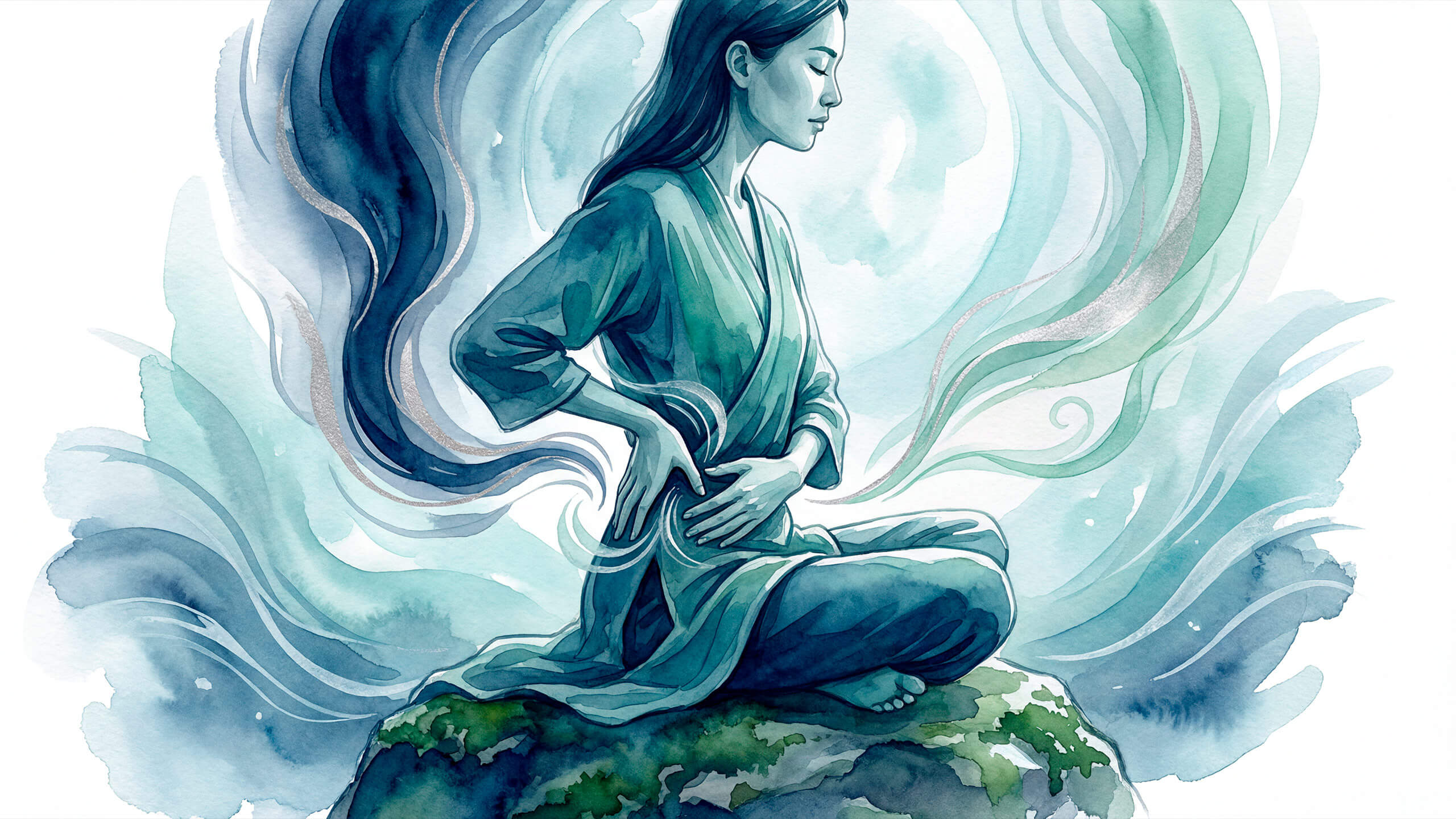
When the cooling juices of the kidneys are exhausted
The TCM perspective: Nourishing the essence of the kidneys
In traditional Chinese medicine, the kidneys are the root of all life. They store the Jing (the essence) and control the water in the body. Kidney Yin is the cooling, moisturizing and nourishing force - it is the deep water that nourishes the marrow, bones, brain and ears and cools and regenerates the entire body.
Kidney yin is also known as the „water of life“. It is the source of all yin energy in the body and nourishes all other organs from below. When this inner water is exhausted, empty heat rises - like a pot on the stove in which the water has evaporated and which is now overheating. The body dries out, the marrow is no longer moisturized and the essence disappears.
In TCM, the kidneys have far-reaching functions: They control the bones and marrow, open into the ears, manifest themselves in the hair and control willpower. A kidney yin deficiency therefore not only affects the kidneys themselves, but also the back and knees, hearing, hair quality and mental clarity.
The result of a kidney yin deficiency: The deep yin that cools and moisturizes the entire body is exhausted. Empty heat rises, the marrow dries up and the essence is no longer nourished. The body shows signs of dryness, internal heat and premature ageing.
The typical signs of kidney yin deficiency:
- Pain and weakness in the lower back and knees
- Tinnitus (ringing in the ears) and dizziness
- Night sweats and hot flushes, especially in the afternoon and evening
- Dry mouth and throat
- Decreased libido, premature ejaculation in men
- Premature graying of the hair and hair loss
- Poor memory and lack of concentration
The good news: Kidney yin can be rebuilt with patience and the right measures. With a nourishing diet, yin-tonifying herbs, sufficient sleep and gentle exercise such as qigong, you can replenish your inner water and strengthen the essence of your kidneys.
The Western perspective: adrenal exhaustion and hormonal balance
From a Western perspective, kidney yin deficiency corresponds to a complex state of chronic exhaustion with particular involvement of the adrenal glands, the endocrine system and the autonomic nervous system. The body has used up its regeneration reserves and is in a state of overheating with a simultaneous lack of substance.
Think of your kidneys as your body's cooling system and battery: If there is a kidney yin deficiency, the cooling water is used up and the battery is deeply discharged. The engine overheats, while at the same time there is a lack of energy to optimally supply all systems. The areas that are regulated by the kidneys are particularly affected: Bones, hearing, reproduction and mental clarity.
The adrenal glands play a central role: chronic stress leads to exhaustion of the adrenal cortex, which produces important hormones such as cortisol, DHEA and aldosterone. These hormones regulate the mineral balance, the stress response and have an influence on the sex hormones - a condition that TCM has described for thousands of years as kidney yin deficiency.
What does modern medicine show?
- Adrenal exhaustion: low DHEA and cortisol levels after chronic stress
- Hormonal imbalance: reduced sex hormones lead to loss of libido and dryness
- Risk of osteoporosis: low oestrogen and vitamin D deficiency weaken bones
- Vegetative dysregulation: night sweats and hot flushes due to disturbed temperature control
- Tinnitus: circulatory disorders and exhaustion of the inner ear
- Cognitive limitations: Memory and concentration problems due to hormone deficiency
Modern research confirms: Kidney yin deficiency syndrome clearly overlaps with adrenal exhaustion, hormonal changes in midlife and chronic fatigue syndrome. Minerals such as zinc and selenium as well as omega-3 fatty acids play a particularly important role in regeneration.
The TCM treatment of kidney yin deficiency starts right here: It nourishes the essence, moistens the marrow and cools the empty heat. Through nourishing foods such as black sesame and goji berries, herbs such as rehmannia and sufficient rest, the inner water of the kidneys is replenished - deeply, sustainably and gently.

The Yellow Emperor team explains your diagnosis
Qi Bo | The Yellow Emperor | Dr. Lisa Weber
MASTER OF THE HEALING ARTS | TCM FOUNDER | MODERN PHYSICIAN
What happens when the legendary Yellow Emperor from TCM sits down with his advisor Qi Bo and a modern doctor? They discuss your diagnosis - with 4000 years of knowledge AND current science.
Kidney Yin deficiency - When the cooling juices of the kidneys are exhausted and empty heat rises
The Yellow Emperor: „Qi Bo, I observe people in my realm who complain of weakness in their lower back and knees. They hear a roaring in their ears, feel dizzy, sweat at night and their mouths are as dry as desert sand. What is the cause of this deep suffering?“
Qi Bo: „Your Majesty, these people suffer from a deficiency of Kidney Yin - the deepest source of all cooling and moisturizing substances in the body. Kidney yin is like a deep well in the earth: it is the root of all yin, the source of essence, the origin of life force. If this well dries up, the kidneys can no longer fulfill their tasks: They can no longer nourish the marrow, which strengthens the bones, brain and spinal cord. Hence the weakness in the back and knees. They can no longer nourish the ears - hence the tinnitus. And without the cooling kidney yin, empty heat rises unchecked and causes night sweats and dryness.“
Dr. Weber: „This is a remarkable anatomical correlation! The kidneys are actually central to the body's fluid and mineral balance. They regulate calcium and phosphate - important for bone health. The adrenal glands, which sit directly on top of the kidneys, produce hormones such as cortisol and DHEA, which are often out of balance in chronic fatigue. The connection with the lower back is also orthopaedically relevant: The kidney region is located at the level of the lumbar spine. And interestingly, a vitamin D deficiency - the kidneys activate vitamin D - can lead to both bone weakness and increased sensitivity to stress.“
The Yellow Emperor: „You're talking about the essence. What exactly is this essence that is stored in the kidneys?“
Qi Bo: „Your Majesty, the essence - the Jing - is the body's most precious treasure. It is transmitted from the parents at conception and is nourished or consumed through food and lifestyle. Jing determines our constitution, our fertility, our growth and our ageing. It is the substance that carries us through life - like an inheritance that we receive at birth and that we must manage wisely. Kidney Yin is the fluid, cooling aspect of this essence. When Kidney Yin is depleted, Jing is also weakened - and with it our overall vitality and ability to regenerate.“
Dr. Weber: „The concept of essence has amazing parallels with modern genetics and epigenetics! The substance transmitted from parents could be understood as a genetic predisposition. The fact that it is influenced by lifestyle corresponds to epigenetic mechanisms - how our genes are regulated by environmental factors. And the role of the kidneys in fertility is well documented hormonally: The adrenal glands produce precursors of sex hormones, and kidney function influences overall hormone balance. A fascinating concept!“
The Yellow Emperor: „You mentioned emotional signs. How does kidney yin deficiency affect the mind?“
Qi Bo: „Majesty, the kidney yin has a special relationship with the mind. It nourishes the marrow, and the marrow nourishes the brain - the ‚Sea of Marrow‘. When the kidney yin is exhausted, the brain is no longer sufficiently nourished. Therefore, these people show inner restlessness - the mind finds no anchorage. Anxiety - the kidneys are the seat of willpower, and if they are weak, fear and forgetfulness arise - the brain is not nourished. Lack of concentration - the mind cannot gather itself. It is like a boat drifting on a stormy sea without an anchor - without the nourishing yin, the mind has no hold.“
Dr. Weber: „This constellation of symptoms is highly interesting from a neurological point of view! The link between kidney health and cognitive function is well documented in nephrology - chronic kidney disease is often associated with cognitive impairment. The inner restlessness and anxiety could be related to a dysregulation of the hypothalamic-pituitary-adrenal axis - chronic stress depletes the adrenal glands. And the lack of concentration fits in with increased oxidative stress and reduced blood flow to the brain, which we often find in exhausted patients.“
The Yellow Emperor: „What leads to depletion of kidney yin?“
Qi Bo: „The causes are manifold, Your Majesty. Firstly, natural ageing - from middle age onwards, kidney yin naturally declines, especially in women after the fertile period. Secondly, chronic overwork and too little rest - they deplete the deepest reserves. Thirdly, prolonged illness and fever - they burn Yin. Fourth: Excessive sexual activity - it directly depletes the essence. Fifth: Lack of nutrition - when the body is not nourished, it draws on the reserves. Sixth: Chronic emotional stress, especially anxiety and fear - they directly deplete the kidneys. And seventh, constitutional weakness - some people inherit less essence from their parents.“
Dr. Weber: „This correlates remarkably with our findings on chronic fatigue syndrome! Ageing is accompanied by a natural decline in hormones such as DHEA, oestrogen and testosterone. Chronic stress permanently increases cortisol, which depletes the adrenal glands in the long term - we call this adrenal insufficiency or burnout. Feverish illnesses increase the metabolism and deplete reserves. And the genetic component - the constitutional weakness - corresponds to the individual variation in hormone sensitivity and stress resilience. It's all understandable!“
The Yellow Emperor: „What signs on the body reveal a kidney yin deficiency?“
Qi Bo: „The signs are characteristic, Your Majesty. The tongue is red - it shows the empty heat. It has little or no coating - the lack of yin and juices. It is dry - no moisture present. It often shows cracks in the middle - the kidney is reflected there. And it is thin - the substance is missing. The pulse is thin like a fine thread - called Xi Mai - and fast - Shuo Mai. It is particularly weak at the left chi position, the kidney place on the wrist. This shows: The substance is exhausted, the heat has spread.“
Dr. Weber: „Tongue diagnostics are fascinating! A red, dry tongue with little coating is actually a clinical sign of dehydration and possible systemic diseases. The cracks can indicate vitamin B deficiency or chronic inflammation. And the pulse quality - thin and fast - corresponds to what we find in dehydrated or anemic patients: Blood volume is reduced, the heart compensates with faster freq. Traditional diagnostics capture real physiological conditions!“
The Yellow Emperor: „Now let's talk about the treatment. How can kidney yin be nourished?“
Qi Bo: „Majesty, the treatment principle is: Zi Shen Yin - nourish and moisturize the Kidney Yin. This is a gentle, patient process. You can't fill a well overnight. First: Yin-nourishing food - black sesame seeds, goji berries, walnuts, mulberries strengthen the essence. Seafood such as oysters and mussels deeply nourish kidney yin. Duck is the meat of choice - cooling and moisturizing. Secondly, get enough rest and sleep - go to bed before 11pm because between 11pm and 1am the gallbladder time regenerates yin. Third: Gentle, nourishing exercises - Qi Gong and Tai Chi, which strengthen the kidneys without exhausting them.“
Dr. Weber: „The nutritional recommendations have a solid basis! Black sesame seeds are rich in calcium, magnesium and healthy fats - important for bones and the nervous system. Goji berries contain antioxidants and can support adrenal function. Walnuts provide omega-3 fatty acids for brain health. Oysters are one of the best sources of zinc - zinc is essential for hormone production and the immune system. And early sleep is important hormonally: the growth hormone, which is crucial for regeneration, is mainly released in the first few hours of sleep!“
The Yellow Emperor: „What about the classic herbal formulas for kidney yin?“
Qi Bo: „Ah, Majesty addresses the queen of yin-nourishing formulas! Liu Wei Di Huang Wan - the six-ingredient pill with Rehmannia - is the basic formula for Kidney Yin deficiency. It contains Shu Di Huang - prepared Rehmannia root - as the main herb to deeply nourish Kidney Yin and essence. It also contains Shan Zhu Yu for the liver and Shan Yao for the spleen. For strong Empty Heat with night sweats, we add Zhi Mu and Huang Bai - this results in Zhi Bai Di Huang Wan. For tinnitus and dizziness, we add Ci Shi and Shi Chang Pu. For dry eyes, Gou Qi Zi and Ju Hua - this is called Qi Ju Di Huang Wan.“
Dr. Weber: „Liu Wei Di Huang Wan is one of the best-researched TCM formulas! Studies show positive effects on kidney function, the immune system and hormone balance. Rehmannia contains Catalpol and other iridoid glycosides with nephroprotective and antioxidant properties. The formula can regulate elevated cortisol levels and relieve menopausal symptoms. Huang Bai contains berberine - a natural alkaloid with anti-inflammatory and cooling properties. An impressively well-documented formula!“
The Yellow Emperor: „Wonderful! Let's turn this wisdom into a practical plan.“
THE 3-WAY METHOD FOR KIDNEY YIN DEFICIENCY
MORNING PROTOCOL (Preserve Kidney Yin):
- TCM: Gentle start - the kidney yin needs special care in the morning after the night's regeneration
- Science: A calm morning prevents an early cortisol spike and protects the adrenal glands
- Practical: Get up 10 minutes earlier, wake up slowly, no immediate exertion or stressful activities
- TCM: Kidney-nourishing breakfast - black sesame seeds and walnuts directly strengthen the essence
- Science: These foods provide zinc, selenium, omega-3 and antioxidants for hormone production
- Practical: Rice congee with black sesame seeds and walnuts. Or porridge with goji berries and mulberries
- TCM: Lukewarm water with goji berries - moisturizes and nourishes the kidney yin at the same time
- Science: Sufficient hydration in the morning and antioxidants from goji support kidney function
- Practical: Steep 5-10 goji berries in warm water and drink first thing in the morning
DAILY STRATEGY (protect kidney yin):
- TCM: Honor midday rest - protects the kidney yin and prevents exhaustion of the essence
- Science: A short power nap lowers cortisol and supports adrenal regeneration
- Practical: 10-20 minutes midday rest, even just sitting with your eyes closed
- TCM: Acupressure on kidney 3 (Taixi) - the source point of the kidney, nourishes yin and essence directly
- Science: Stimulation of this point shows positive effects on kidney function and stress regulation in studies
- Practical: Between the inner ankle and Achilles tendon in the hollow. Gently massage in a circular motion for 3 minutes per side
- TCM: Yin-nourishing lunch - fish, tofu, dark leafy vegetables nourish without heating
- Science: Light, protein-rich meals with omega-3 support regeneration without metabolic stress
- Practical: Steamed fish with spinach and black beans, or tofu and vegetable soup
EVENING RITUAL (regenerate kidney yin):
- TCM: Gentle Qi Gong „Kidney Circles“ - strengthens the kidney region and collects the essence
- Science: Gentle movement of the lumbar region improves circulation and activates the parasympathetic nervous system
- Practical: 10 minutes of gentle circling of the hips and kidney massage in the evening
- TCM: Acupressure on kidney 6 (Zhaohai) - the master point for Yin nourishment throughout the body
- Science: This point influences the parasympathetic nervous system and promotes restful sleep
- Practical: Below the inner ankle in the hollow. Massage gently for 3 minutes on each side before going to bed
- TCM: Go to bed early - before 11 pm so that the kidney yin can regenerate during the night
- Science: The deepest sleep phases with maximum growth hormone release are before midnight
- Practical: In bed before 10:30 p.m., avoid screens an hour before, keep the bedroom cool and dark
The Yellow Emperor: „Qi Bo, how long does it take for the kidney yin to be nourished again?“
Qi Bo: „Your Majesty, kidney yin is the deepest substance in the body - it regenerates more slowly than all the others. It is like a deep well that needs to be filled drop by drop. After 2-3 weeks of consistent practice, most people notice: night sweats subside, the mouth is less dry, sleep becomes a little deeper. After 6-8 weeks, the improvements become clearer: the tinnitus becomes quieter, the lower back feels stronger, the inner restlessness decreases. After 3-6 months, the kidney yin can be noticeably nourished - more strength in the back and knees, clearer mind, deeper inner peace. Patience is the key, Majesty - the essence cannot be forced.“
Dr. Weber: „This corresponds to our clinical experience with chronic fatigue states! The recovery of adrenal function takes months, not weeks. Hormonal imbalances correct themselves slowly - DHEA and other adrenal hormones regenerate over longer periods of time. Improving bone health and connective tissue also takes months. And shifting the autonomic nervous system from chronic over-activation to more balance requires continuous practice. The time frame of 3-6 months is realistic and evidence-based!“
The Yellow Emperor: „What must be avoided at all costs in the event of kidney yin deficiency?“
Qi Bo: „Majesty, the most important thing is: Firstly, avoid spicy and heating foods - chili, pepper, ginger, garlic in large quantities burn the already scarce Yin. Secondly, greatly reduce alcohol and coffee - they dry out and exhaust the kidneys. Thirdly, don't stay up too late - every hour after 11pm depletes kidney yin. Fourth, avoid excessive physical exertion and profuse sweating - they deplete juices and essence. Fifth, reduce emotional stress, especially anxiety - it directly depletes the kidneys. And sixth, avoid lamb and grilled foods - they are too heating for this condition.“
Dr. Weber: „All scientifically verifiable! Hot spices and alcohol increase the metabolism and fluid loss. Coffee activates the adrenal glands in the short term, but exhausts them in the long term. Lack of sleep prevents hormone regeneration at night. Intensive training increases oxidative stress and cortisol levels. Chronic stress keeps the hypothalamic-pituitary-adrenal axis permanently activated. And grilled meat contains heterocyclic amines, which have a pro-inflammatory effect. These recommendations protect the body's own regeneration processes!“
The Yellow Emperor: „Then the message is clear: kidney yin is the deepest well of our life force. It nourishes the marrow, strengthens the back and knees, calms the mind and cools the body. With patient care - nourishing food, sufficient sleep, gentle exercise and avoiding depleting influences - we can refill this well.“
Qi Bo: [smiles] „That's right, Your Majesty. The kidney yin is like the deep groundwater of the earth - invisible, but vital for everything that grows above it. If we protect and nourish it, strength, clarity and inner peace return - and we can face the natural ageing process with dignity and vitality.“
About our „3 Wise Men“ story
Who are the Yellow Emperor and Qi Bo?
The Yellow Emperor (Huangdi) is said to have lived around 2600 BC and is considered the mythical founder of Chinese culture and medicine. Qi Bo was his most important advisor and personal physician. Their discussions about health, illness, and human nature were recorded in the most important fundamental work of TCM.
The book: Huangdi Neijing
The Huangdi Neijing, also known as The Yellow Emperor's Classic of Internal Medicine, was probably written between 200 BC and 200 AD. It is the oldest surviving work on Chinese medicine and consists of dialogues between the Yellow Emperor and his advisors, mainly Qi Bo.
This work is to TCM what the Bible is to Christianity: the absolute foundation. All the important concepts - yin and yang, the 5 elements, qi, meridians and acupuncture points - are systematically described here for the first time.
Our modern approach: The 3 wise men
In our series „The Three Sages,“ we bring together the Yellow Emperor and Qi Bo with the fictional modern doctor and microbiologist Dr. Weber.
Important note: All three characters and their conversations are purely fictitious and invented by us.
We use this narrative form, similar to the dialogue form in the book Huangdi Neijing, to convey the often complex interrelationships of TCM in an understandable and entertaining way. When the 4,000-year-old emperor is confronted with modern science, enlightening „aha moments“ arise that show that ancient wisdom and new research often speak the same language — just in different words.
This makes TCM lively, understandable and practically applicable for your everyday life.
The dialogs are creative interpretations - not historical documents. For medical questions, please consult a qualified TCM therapist or doctor.
Your treatment options
A kidney yin deficiency is very treatable! TCM offers you a variety of effective methods to rebuild your kidney yin and find inner coolness. You don't have to do everything at once - choose the methods that suit you and your everyday life.
Here you will find specific treatment approaches that have been proven effective in TCM for thousands of years and that you can largely apply yourself.
TCM herbal therapy
TCM herbs are the basis every classic TCM treatment. The carefully compiled mixtures have a synergistic effect — this means that the individual herbs reinforce each other's effects and balance out any possible side effects.
What modern medicine is only just discovering—the power of plant substances—has been used successfully by TCM for over 2,500 years.
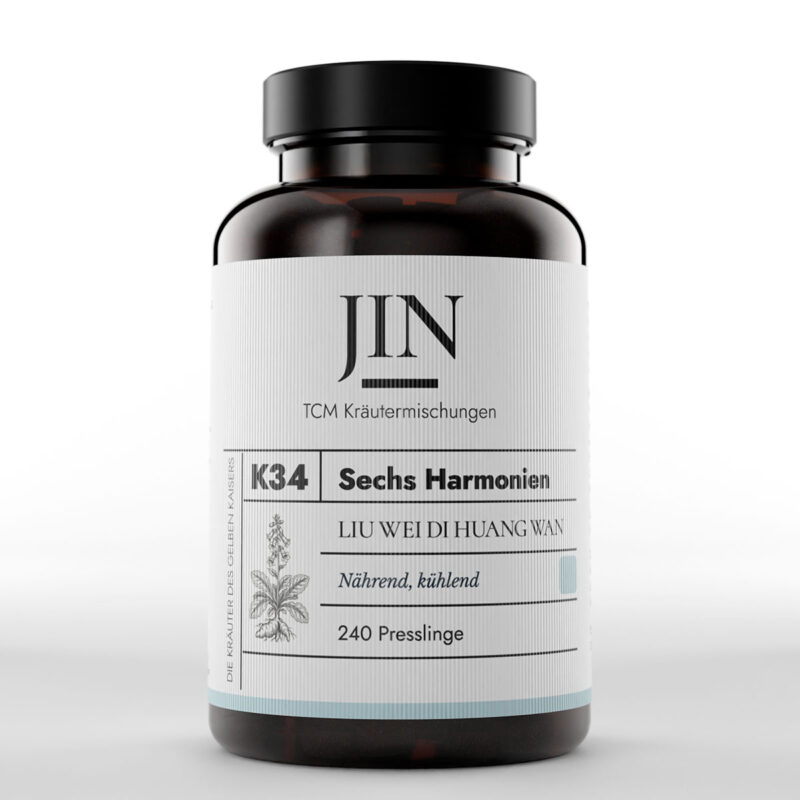
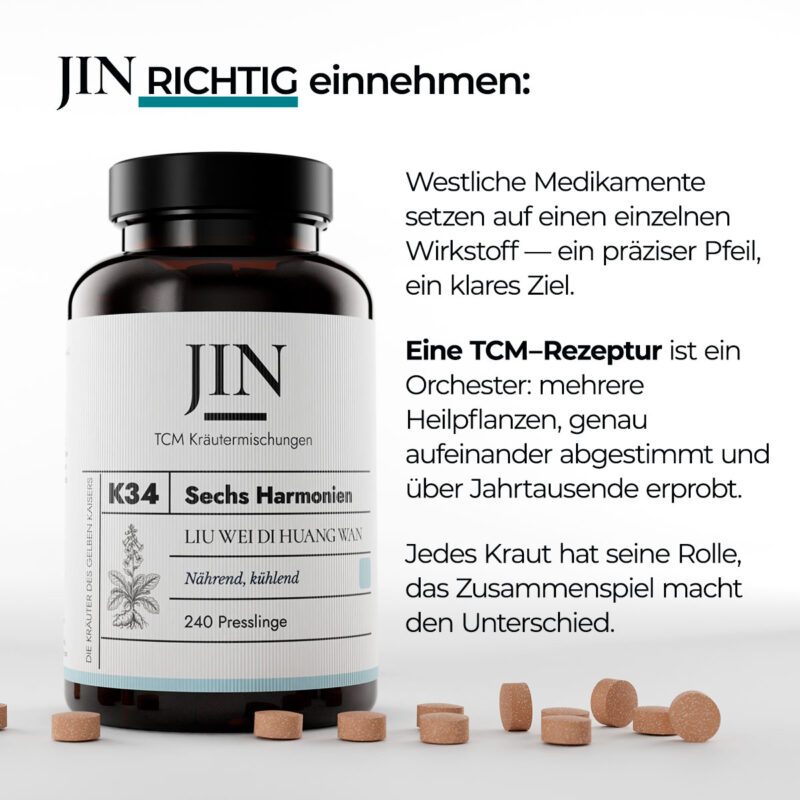

Empfohlene TCM–Kräutermischung bei Nieren–Yin Mangel
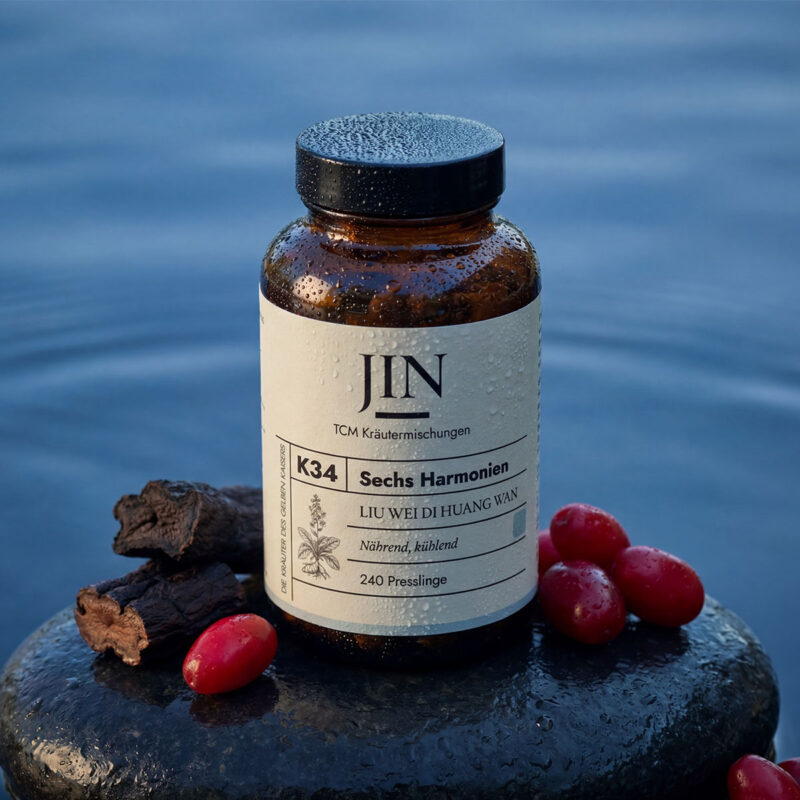
JIN K34 — Sechs Harmonien
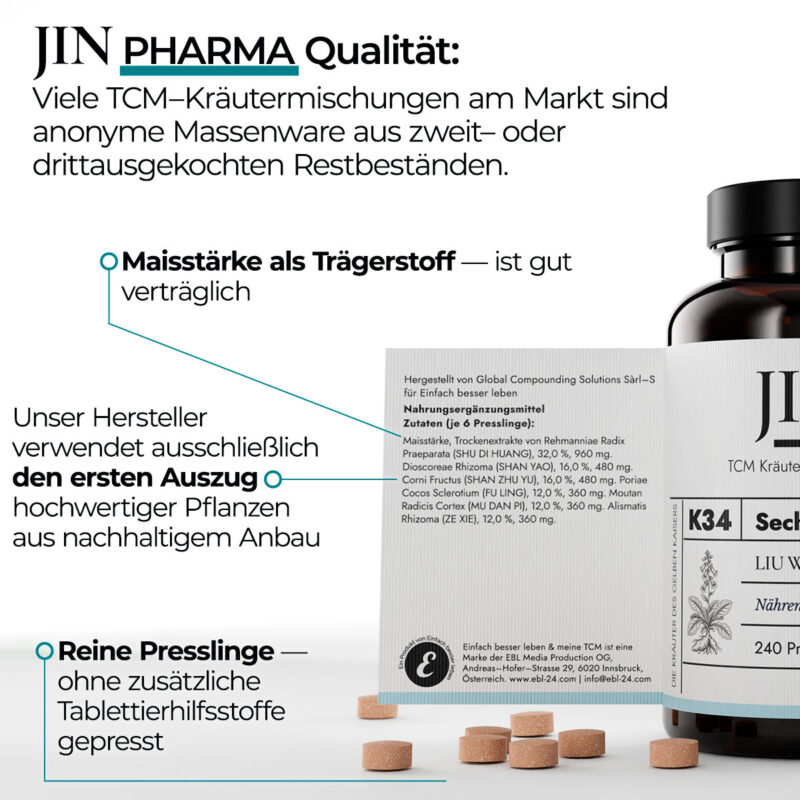
Die klassische Rezeptur Liu Wei Di Huang Wan (六味地黄丸) — die „Sechs–Kräuter–Rehmannia–Pille“. Die Mutterformel aller Yin–Tonika: Drei nährende Kräuter füllen Nieren–, Leber– und Milz–Yin auf, drei ausleitende halten die Mischung leicht und klar.
Mit Shu Di Huang als Hauptkraut nährt diese Mischung das Nieren–Yin und das Jing, ausgewogen durch Shan Zhu Yu und Shan Yao, während Ze Xie, Fu Ling und Mu Dan Pi überschüssige Feuchtigkeit und Leerhitze sanft ausleiten. Ideal bei Nachtschweiß, Hitzegefühl in Handflächen und Fußsohlen, Schwindel, Tinnitus und trockenem Mund.
Quantity
209,70 €
i
To the product
The herbs in this recipeRecommended reading:How TCM herbal blends are formulatedLearn more now
| Herb (Pinyin) | German designation | Function in the recipe |
|---|---|---|
| Shu Di Huang (Rehmanniae Radix Praeparata) | Prepared rehmannia root | emperor Nährt das Nieren–Yin, füllt Jing und Mark auf |
| Shan Yao (Dioscoreae Rhizoma) | Yam root | minister Tonisiert Milz, Lunge und Nieren, bewahrt das Jing |
| Shan Zhu Yu (Corni Fructus) | cornelian cherry | minister Bewahrt austretendes Jing, nährt Leber und Nieren |
| Fu Ling (Poria cocos sclerotium) | Poria mushroom | assistant Leitet Feuchtigkeit sanft aus und beruhigt den Geist |
| Mu Dan Pi (Moutan Radicis Cortex) | Strauchpäonienrinde | assistant Kühlt das Blut und klärt Leerhitze |
| Ze Xie (Alismatis Rhizoma) | Wasserwegerich | assistant Leitet trübe Feuchtigkeit und Leerhitze über die Blase aus |
Explanation of the most important herbs
emperor Shu Di Huang (Rehmannia) — Das Fundament
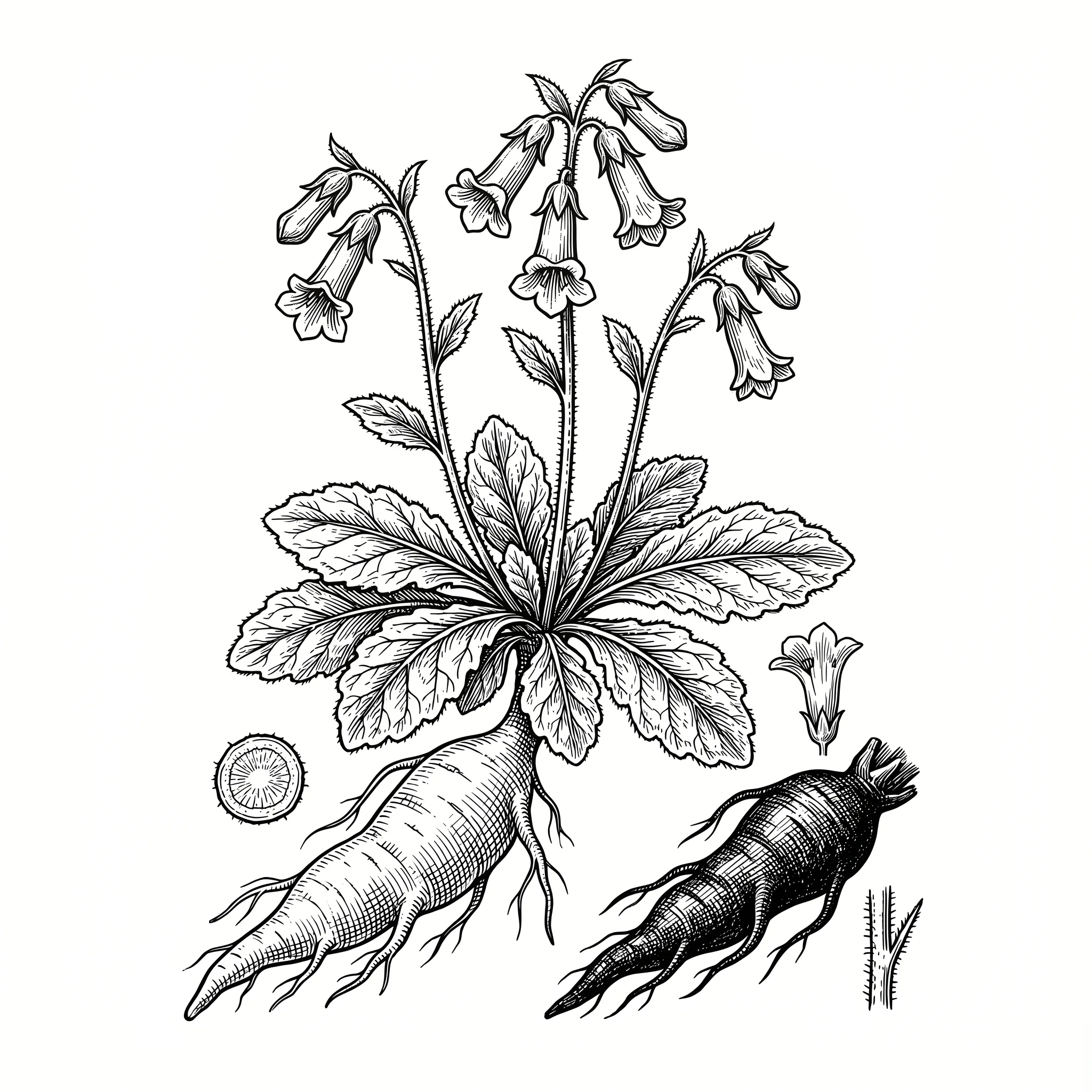
Shu Di Huang ist der König der Yin–nährenden Kräuter — es füllt das Nieren–Jing auf, nährt das Blut und befeuchtet das Mark. Als Kaiser bildet es mit 32 % das nährende Herz der Rezeptur. Die zubereitete Rehmanniawurzel ist reich an Catalpol und Iridoidglykosiden, die in Untersuchungen antioxidative Eigenschaften zeigen; traditionell gilt sie als wichtigstes Yin– und Blut–Tonikum.
minister Shan Zhu Yu (cornelian cherry) — Der Essenz–Hüter
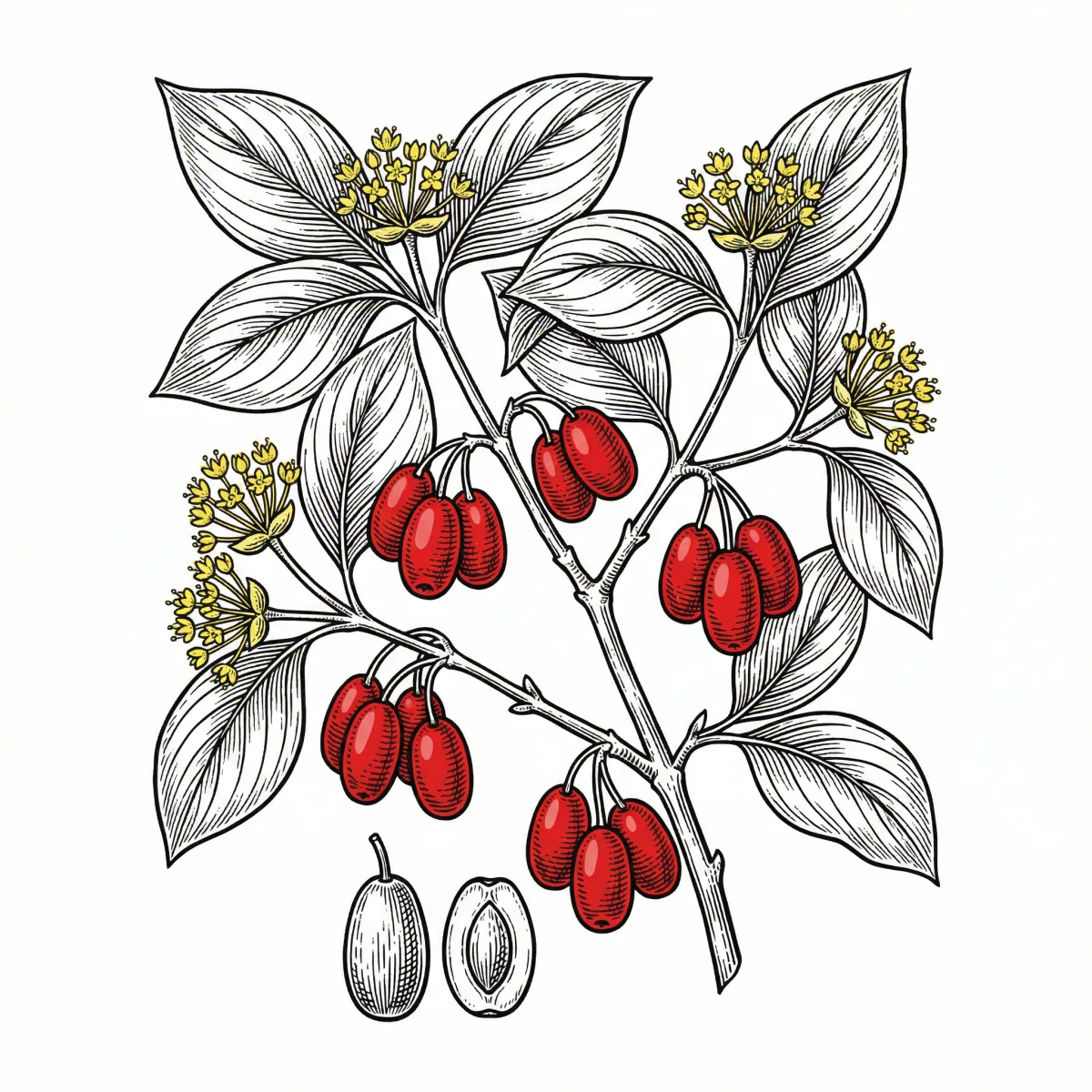
Die saure Kornelkirsche bewahrt austretendes Jing — sie wirkt wie ein Schloss, das die kostbare Essenz in den Nieren festhält. Morroniside und die Triterpensäuren der Kornelkirsche werden in Untersuchungen mit antioxidativen Eigenschaften in Verbindung gebracht.
minister Shan Yao (yam root) — Der Dreifach–Toniker
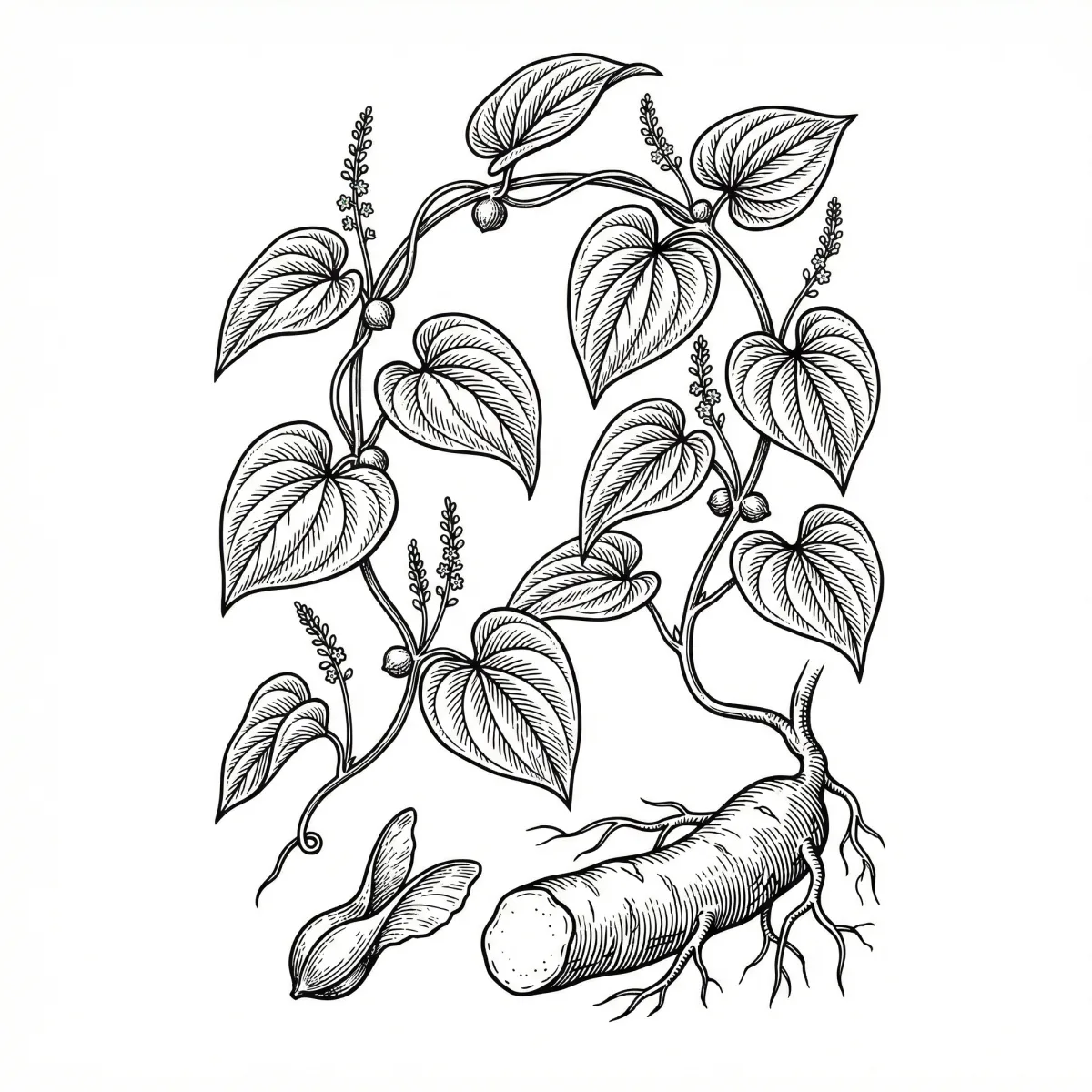
Shan Yao tonisiert Milz, Lunge und Nieren zugleich und bewahrt das Jing — das verbindende Glied, das die drei Yin–Organe harmonisiert. Diosgenin und die Polysaccharide der Yamswurzel werden in Untersuchungen mit antioxidativen und verdauungsunterstützenden Eigenschaften in Verbindung gebracht.
assistant Mu Dan Pi (peony bark) — Der Hitze–Kühler
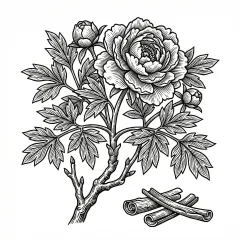
Mu Dan Pi kühlt das Blut und klärt Leerhitze — es verhindert, dass die nährenden Kräuter Stauungshitze erzeugen. Paeonol zeigt in Untersuchungen antioxidative und entzündungshemmende Eigenschaften.
Recommended dosage
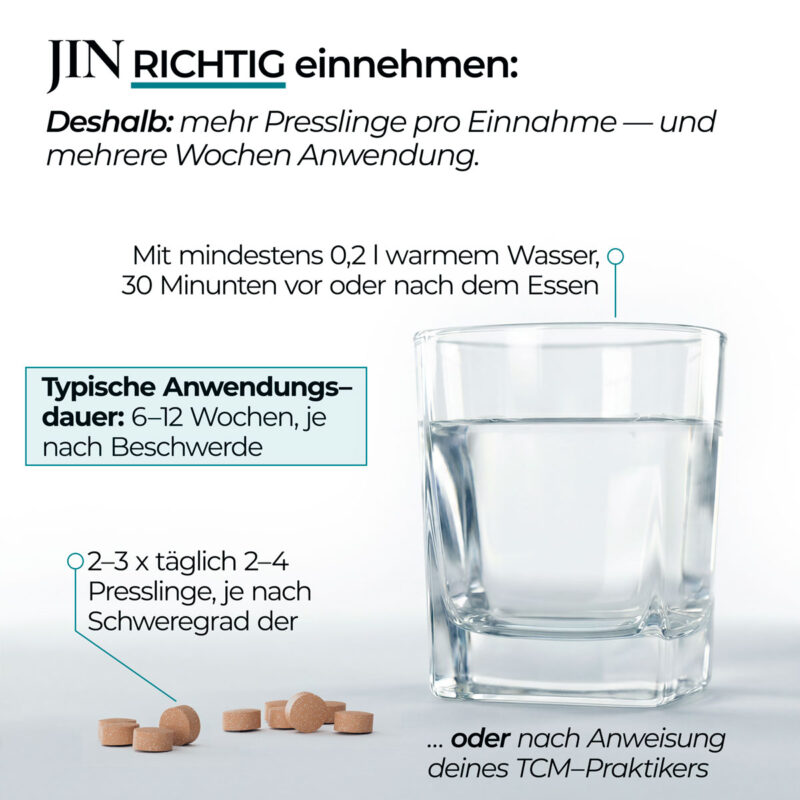
The dosage depends on the severity.
Based on your questionnaire results, we have highlighted the appropriate dosage for you below.
At light Severity:
- 2 tablets 3 times a day (morning, noon, and late afternoon) = 6 tablets per day
- Optional, if taking 3 doses a day is difficult for you: 3 tablets twice a day — same daily amount
- We recommend at least 2 cans, each containing 240 tablets (enough for about 12 weeks)
At middle Severity:
- 3 tablets 3 times a day (morning, noon, and late afternoon) = 9 tablets per day
- We recommend at least 3 cans, each containing 240 tablets (enough for about 12 weeks)
- If your condition improves, switch to the dosage recommendation for mild symptoms
At significantly Severity:
- 4 tablets 3 times a day (morning, noon, and late afternoon) = 12 tablets per day
- We recommend at least 4 cans, each containing 240 tablets (enough for about 12 weeks)
- If your condition improves, switch to the dosage recommendation for moderate severity
Why 3 times a day?
This ensures that the herbs' effects are evenly distributed throughout the day.
IMPORTANT:
- Take the tablets with at least 0.2 liters of warm water
- Ideally, 30 minutes before or after a meal
- This suggestion is not a substitute for a medical diagnosis or treatment
- If you are pregnant or breastfeeding, have a chronic medical condition, or are taking medication, consult a doctor or a TCM practitioner beforehand.
- If you have a severe cold, fever, or diarrhea, stop taking this product
- Übermäßige Hitze, scharfe und frittierte Speisen, Alkohol und Überarbeitung meiden — sie zehren am Yin
- Auf ausreichend Schlaf und Ruhe achten; anhaltenden Nachtschweiß und innere Hitze ärztlich abklären
If little has changed after about 12 weeks:
Herbs are just one part of TCM. Combine taking them with other practices—acupressure, qigong, Pilates, or yoga, BS+, as well as meditation and breathing exercises. Afterward, take a two-week break from taking the herbs. Then, if needed, you can TCM analysis try again and/or compare your result with your TCM practitioner or discuss it with your doctor.
If you have any questions about how to take it, please feel free to contact us.
Want to know what dosage is right for you? Take our free TCM questionnaire—in just a few minutes, it will reveal your personal TCM pattern and the appropriate dosage of the recommended TCM herbal blend.
BS+ for your intestinal flora
A healthy gut is the basis for your well-being. Current studies show that around 80 % of people in Germany consume too little fiber - yet it is the most important food for your intestinal flora (also known as the intestinal microbiome).
BS+ was developed to support your daily fiber supply. With 11 high-quality, natural ingredients BS+ offers your intestinal flora a diverse nutrient base.
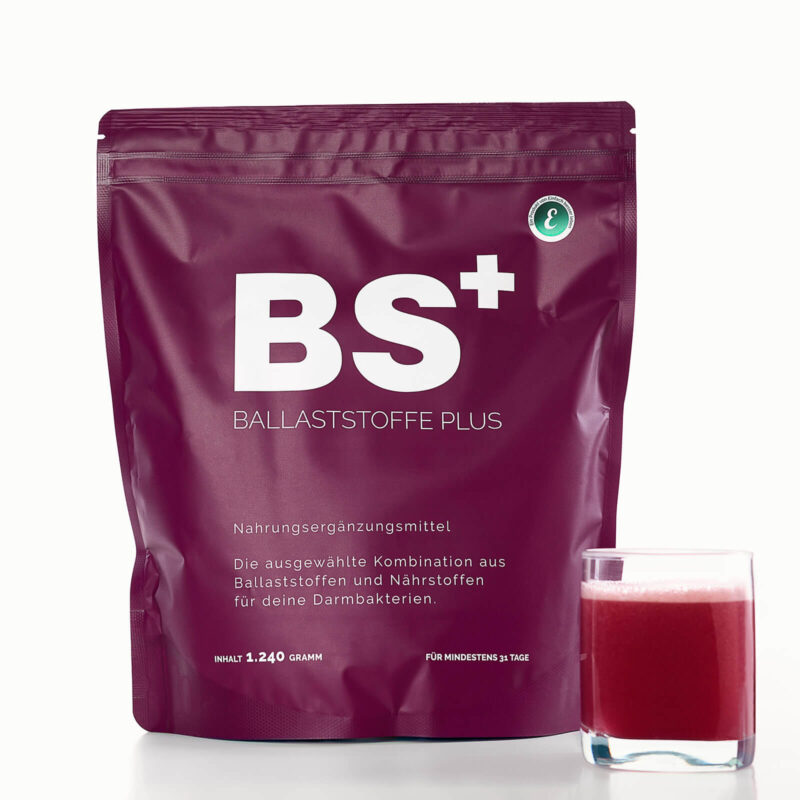
The revolutionary fiber formula
BS+ Dietary Fiber Plus
- Up to 20 g dietary fiber daily EXTRA
- Improved digestion and regular bowel movements
- Increased energy and vitality
- Better mood and mental clarity
- Support for your immune system
- Potential improvement in cholesterol and blood sugar levels
Simply stir into water twice a day - Your intestinal flora will thank you.
Warum BS+ bei Nieren–Yin Mangel?
Beim Nieren–Yin Mangel sind die kühlenden, befeuchtenden Säfte der Nieren erschöpft — leere Hitze steigt auf und trocknet den Körper von innen aus. In der TCM nährt das Nieren–Yin auch die Säfte im gesamten Verdauungstrakt. Fehlt diese Befeuchtung, trocknen die Schleimhäute im Darm aus, der Stuhlgang wird hart und unregelmäßig, und die Darmflora verliert ihre schützende Vielfalt. Ein ausgetrockneter Darm kann Nährstoffe schlechter aufnehmen — genau jene Nährstoffe, die der Körper bräuchte, um das Yin wieder aufzubauen.
BS+ delivers 11 prebiotic fibers und unterstützt so gezielt den Aufbau einer vielfältigen Darmflora. Eine gut genährte Darmflora fördert die Befeuchtung der Darmschleimhaut, verbessert die Nährstoffaufnahme und schafft die Grundlage dafür, dass der Körper das Nieren–Yin Schritt für Schritt wieder aufbauen kann.
Besonders wichtig bei Nieren–Yin Mangel:
- Fördert die Befeuchtung der Darmschleimhaut und wirkt der Yin–Mangel–bedingten Trockenheit im Verdauungstrakt entgegen
- Unterstützt die Nährstoffaufnahme — damit Yin–nährende Lebensmittel wie schwarzer Sesam und Goji–Beeren ihre volle Wirkung entfalten können
- Stärkt die Darmflora als Basis für den Aufbau von Säften und Essenz — den Grundlagen des Nieren–Yin
Acupressure
Acupressure is acupuncture without needles. - you can apply them yourself at any time. By applying gentle pressure to certain points, you activate the energy flow in the meridians and nourish the kidney yin.
These three points form the classic combination for nourishing the kidney yin. Regular, gentle stimulation is particularly important for kidney yin deficiency - Patient care rebuilds the exhausted juices and essence.
ACUPUNCTURE POINT: Ni 03
Kidney 03
Big torrent - Tài Xī
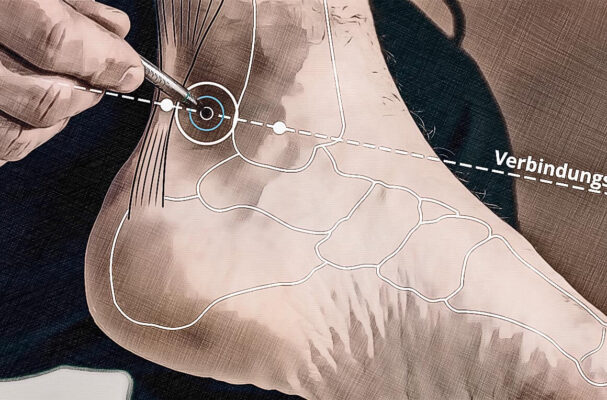
- Kidney source point - nourishes kidney yin and essence (jing)
- Strengthens the kidney qi
- Cools empty heat
- Acts on the knees and lower back
- Helps with exhaustion and tiredness
Location: On the midline between the most prominent part of the medial malleolus and the Achilles tendon, in the hollow where a pulse can be felt.
Application:
Press firmly twice a day for 30-45 seconds. Ideal in the morning and evening. Use without moxibustion in case of Yin deficiency.
ACCESSION POINT: Ni 06
Kidney 06
Shining sea - Zhào Hǎi
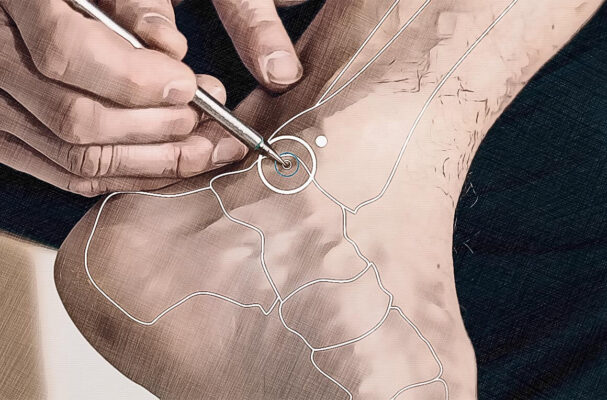
- Master point of Yin Qiao Mai - moisturizes the body
- Deeply nourishes the yin
- Calms the mind (Shen)
- Improves sleep
- Helps with dry eyes and throat
Location: Directly under the tip of the inner ankle in a slight depression.
Application:
Hold twice a day for 30-45 seconds with medium pressure. Particularly effective in the evening before going to bed.
ACUPUNCTURE POINT: Ni 07
Kidney 07
The returning stream - Fù Liū

- Tonifying point - strengthens the kidney qi
- Regulates sweating (for night sweats)
- Strengthens the lower back
- Removes moisture from the bottom heater
- Helps with severe fatigue
Location: On the anterior edge of the Achilles tendon, 2 cun (3 Qürfinger) above Ni 03 in a palpable depression.
Application:
Hold twice a day for 30-45 seconds with medium pressure. Can be used several times a day for night sweats.
TIP
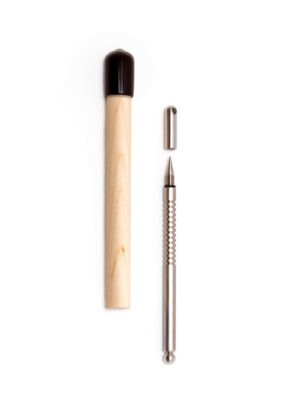
AkuPen
Acupuncture pen with video instructions
For even more intense stimulation You can use an AkuPen. The acupressure pen significantly enhances the effect of acupressure. With an extensive video library for over 80 acupuncture points.
Qi Gong
Qi Gong is moving meditation - Gentle, flowing exercises that harmonize your energy flow and nourish your Yin. In the case of kidney yin deficiency, these exercises help to strengthen your kidney energy, find inner peace and calm the empty heat.
Regular practice of Qi Gong (as little as 10-15 minutes a day) has been shown to have positive effects on the regeneration of kidney yin, internal cooling and general well-being.
QI GONG: Exercise 1
Kidneys circles
Strengthens the kidney yin, relaxes the lower back

Particularly helpful for:
- Exhaustion and weakness
- Lower back pain
- Hormonal imbalances
- Anxiety and insecurity
Effect:
This water element exercise specifically strengthens the kidney energy and relaxes the fascia of the lower back. The circular arm movements and forward bend nourish the kidney yin and strengthen the essence (jing).
QI GONG: Exercise 2
Collect Qi
Calms the mind, nourishes the yin
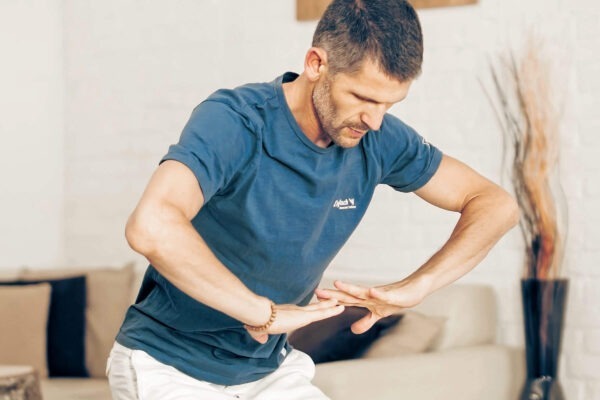
Particularly helpful for:
- Inner restlessness and nervousness
- Sleep disorders
- Night sweats
- Exhaustion and stress
Effect:
This exercise collects vital energy from all directions and stores it in the body. It is perfect for calming down and reducing stress - particularly important in the case of kidney yin deficiency, as stress further depletes yin.
QI GONG: Exercise 3
Open heart
Calms the Shen, opens the chest

Particularly helpful for:
- Inner restlessness and restlessness
- Hot flashes
- Sleep problems
- Nervousness and tension
Effect:
This exercise expands the chest and calms the Shen (mind). The expansion improves the breathing function and has a positive influence on the heart and lungs - important in the case of kidney yin deficiency, as the rising empty heat often disturbs the heart spirit.
These Qi Gong exercises are specially selected to nourish the kidney yin. They strengthen the kidney energy, calm the mind and help to cool the empty heat.
All exercises work particularly well if you practise them between 5 and 7 p.m. - this is the kidney's peak time in the organ clock. The time between 3 and 5 pm (bladder time) is also ideal, as the bladder is the yang organ of the kidney and the two form a pair.
QI GONG:
When and how often?
In the evening (ideal):
- All 3 exercises as a sequence: approx. 15–20 min.
- Or just 1–2 exercises: approx. 5–10 min.
- Best between 5 and 7 pm (kidney time) or in the late afternoon
In between:
- Individual exercises as required (e.g. for hot flushes or restlessness)
- „Collect Qi“ for quick calming of the mind
Regularity is more important than duration:
- It is better to exercise for 10 minutes every day than for 60 minutes once a week.
- After 2–3 weeks, you will notice the first changes.
- After 3 months of regular practice: significantly strengthened kidney yin
Pro tip: Practice Qi Gong in a calm, cool environment. If you have Kidney Yin deficiency, you should avoid intense physical exertion and sweating - gentle, slow movements are ideal. Also avoid the hot midday sun, as this can intensify the empty heat.
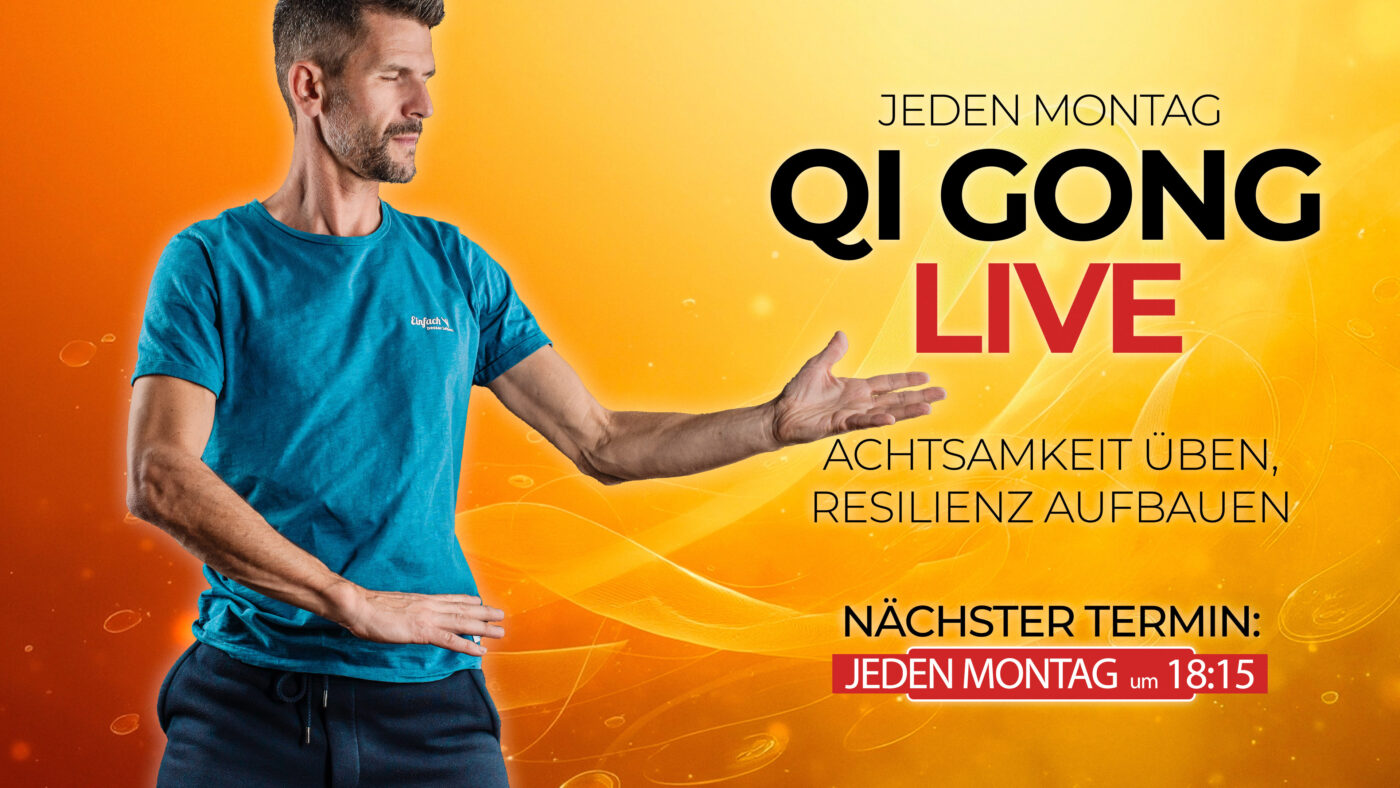
LIVE EVERY MONDAY: QI GONG WITH WOLFGANG
Every Monday at 6:00 p.m. Let's practice together live on YouTube. Among other things, Wolfgang will guide you through a complete qigong sequence — free of charge and suitable for all levels.
Why participate live? ✓ Practicing together is motivating ✓ Wolfgang explains the exercises in detail ✓ You can ask questions in the live chat ✓ Regular appointments help with your routine
More about Qi Gong LiveMeridian Yoga — The Yoga of TCM
Meridian Yoga combines yoga with traditional Chinese medicine. The result is a holistic exercise concept for better health and more energy.
The following exercises specifically activate the conception vessel (Ren Mai) - the „mother of all Yin meridians“. The Conception Vessel runs along the anterior midline of the body and nourishes all Yin organs, especially the kidneys. Its activation strengthens the Kidney Yin and nourishes the cooling, moisturizing juices.
MERIDIAN YOGA: Exercise 1
Fish for the conception vessel
Opens the conception vessel while lying down

Particularly helpful for:
- Hot flushes and night sweats
- Dry skin and mucous membranes
- Inner restlessness and sleep disorders
- Tinnitus and dizziness
Effect:
The fish is a classic yoga exercise that opens the conception vessel along the entire front of the body. This gentle backbend stretches the chest and nourishes Kidney Yin - ideal for empty heat and dryness symptoms due to Kidney Yin deficiency.
MERIDIAN YOGA: Exercise 2
Backward bend for the conception vessel
Activates the conception vessel while standing

Particularly helpful for:
- Lower back pain
- Exhaustion and lack of energy
- Emotional imbalance
- Headaches and neck tension
Effect:
The backward bend opens the conception vessel by gently stretching the front of the body. This exercise harmonizes the flow of yin and calms the nervous system - particularly beneficial in cases of kidney yin deficiency with rising empty heat and inner restlessness.
Both exercises activate the Conception Vessel (Ren Mai), which runs along the front of the body and nourishes all Yin organs. As the „Sea of Yin“, it has a special connection to the kidneys and is the most important meridian for the development of kidney yin.
Particularly effective: Hold each position for 3-5 breaths, visualizing cooling, nourishing energy that strengthens your Kidney Yin and calms the empty heat.
MERIDIAN YOGA:
When and how often?
Best time:
- In the evening before going to bed (Yin time begins)
- Or in the afternoon between 5pm and 7pm (kidney time)
Duration:
- Hold each position for 3–5 breaths.
- Complete sequence: 10–15 minutes
- 3–5 times per week for best results
Important:
- Practice in a calm, cool atmosphere
- Breathe deeply and slowly during the positions
- Stretching should be comfortable, never painful.
Pro tip: Combine Meridian Yoga with calming Qi Gong exercises such as „Kidney Circles“ or „Gathering Qi“. The gentle, slow movement promotes kidney yin nourishment and supports inner coolness.
Nutrition according to TCM
„Let food be your medicine.“ - This principle has been valid in TCM for thousands of years. In the case of kidney yin deficiency, the right diet is particularly important for nourishing your essence and inner juices.
The kidney yin belongs to the Element Water and needs Cooling to neutral, moisturizing food, to rebuild substance. Black foods and yin-nourishing foods have a special relationship with the kidneys.
What you eat, HOW you eat and WHEN you eat - all this influences your kidney yin and your inner coolness.
The golden rules for a strong kidney yin
What is good for you:
Yin-nourishing seeds and nuts
- Black sesame (nourishes kidney yin/jing)
- Walnuts (strengthen the kidneys)
- Goji berries (nourish yin and blood)
- Mulberries (moisturize and nourish)
Black sesame is the king of kidney yin food
Yin-nourishing meats
- Duck (cooling, nourishes Yin)
- Pork (moistened)
- Oysters (nourish yin and essence)
- Mussels (strengthen the kidneys)
Seafood nourishes the kidney yin particularly well
Black legumes
- Black beans (kidney tonic)
- Kidney beans (strengthen the kidneys)
- Black rice (nourishes essence)
- Black lentils
Black is the color of the kidneys
Sea vegetables and algae
- Seaweed (cooling, rich in minerals)
- Wakame (nourishes Yin)
- Nori (moistened)
- Kombu (strengthens the kidneys)
The sea nourishes the water element
What you should avoid:
Hot spices
- Chili (dries out)
- Hot pepper in large quantities
- Ginger in large quantities
- Cayenne, Tabasco
Spiciness dries out the yin!
Heating stimulants
- Alcohol (especially schnapps)
- Coffee in large quantities
- Black tea (strong)
- Energy drinks
Consume the yin and generate heat!
Meats to be warmed
- Lamb (too warming)
- Game (too hot)
- Mutton
- Goat
Generate empty heat
Fried and grilled food
- Fried foods
- Heavily grilled
- Roasted snacks
- Potato chips and deep-fried snacks
Dry heat damages the yin!
HOW YOU SHOULD EAT:
Regular meals
- 3 fixed meals a day
- Dinner before 7 p.m.
- Do not eat too late (protects the yin)
- Light evening meals
Mindful eating
- Chew slowly (protects the essence!)
- Eat calmly, don't rush
- Avoid stress when eating
- Cozy atmosphere
Kidney Yin loves rest and relaxation!
Drink properly
- Sufficient liquid (not ice cold!)
- Goji tea (daily)
- Warm water with goji berries
- Chrysanthemum tea (cools empty heat)
Moisturizing nourishes the yin
IDEAL MENU FOR ONE DAY:
Breakfast (7–9 a.m.):
- Black sesame rice porridge with walnuts
- In addition: Goji berry tea
Lunch (12–1 p.m.):
- Steamed fish with seaweed
- In addition: Black rice with kidney beans
- Or: Duck soup with black beans
Dinner (6–7 p.m.):
- Light vegetable soup with tofu
- Or: Steamed vegetables with oyster mushrooms
- In addition: Chrysanthemum tea
Snack if needed:
- Handful of goji berries and walnuts
- Or: Mulberries with black sesame seeds
The most important rule when changing your diet is:
Start with ONE step!
Don't change everything at once.
Our suggestion for getting started:
- Reduce hot spices and alcohol - 2 weeks
- Eat black sesame seeds or goji berries daily - 2 weeks
- Yin-nourishing soups 2-3 times a week - 2 weeks
Step by step, you will notice how your kidney yin is nourished again and you will find more inner peace.
Your kidney yin will thank you!
RECIPE: BLACK SESAME WALNUT PURÉE
Ingredients:
For approx. 300 g
- 150 g black sesame seeds
- 100 g walnuts
- 3 tbsp honey (or maple syrup)
- 1 pinch of salt
- Optional: 1 tbsp black sesame oil
Preparation:
- Toast the black sesame seeds in a dry pan without oil over a medium heat for 3-5 mins. until fragrant
- Lightly toast the walnuts separately in a pan, approx. 3 mins.
- Allow both to cool
- Finely grind the sesame seeds and walnuts in a high-speed blender or grinder
- Add the honey and salt, continue to mix until a creamy paste is formed
- If necessary, add a little sesame oil for a smoother consistency
- Pour into a clean jar and store in the fridge
Effect:
Nourishes the kidney yin and the essence (jing)
Strengthens bones, hair and teeth
Moisturizes intestines and skin
1-2 tablespoons daily in the morning - ideal on porridge, bread or pure!
RECIPE: GOJI MULBERRY TEA
Ingredients:
For 2 cups
- 2 tbsp goji berries
- 1 tbsp dried mulberries
- 500 ml hot water
- Optional: 3-4 chrysanthemum blossoms
- Optional: 1 teaspoon honey
Preparation:
- Put the goji berries and mulberries in a teapot
- Optional: add chrysanthemum flowers (cools empty heat)
- Pour hot water (approx. 80-90 °C) over it
- Leave to infuse for 10-15 minutes
- Sweeten with honey to taste
- The berries can also be eaten - they are very nutritious!
Effect:
Moisturizes and nourishes the yin
Strengthens the liver and kidneys
Clears the eyes and calms the mind
1-2 cups a day - ideal in the afternoon or evening!
Breathing
Breathing is the bridge between body and mind. In TCM, we say: „The lungs govern qi“ — through conscious breathing, you can directly influence your energy flow, harmonize all organ systems, and activate your self-healing powers.
Studies show: Proper breathing activates the parasympathetic nervous system (rest & regeneration), massages the internal organs from within, improves oxygen supply, and reduces stress hormones. The good news: Just 5–10 minutes a day can have a measurable effect on your overall well-being.
Recommended breathing techniques
ABDOMINAL BREATHING — The basis for every breathing technique
Natural breathing
Abdominal breathing is the most natural and effective form of breathing. With every breath, you massage your internal organs, activate the flow of energy, and bring qi to the center of your body (dantian).
Wolfgang shows you step by step, How to learn abdominal breathing correctly—lying down to start with, then later also sitting and standing.
Duration: 9 minutes

4–7–8 BREATHING — Calms you down immediately
Breathing to fall asleep and combat inner restlessness
4–7–8 breathing (inhale for 4 seconds, hold for 7 seconds, exhale for 8 seconds) is known as a „natural sedative.“ This special rhythm calms your nervous system in just a few minutes—perfect for stress, racing thoughts, or trouble falling asleep.
Perfect for the evening or whenever you want to calm down quickly.
Duration: 9 minutes
To the interactive videoBOX BREATHING — For inner coherence
Professional breathing for focus and calmness
Box Breathing (4 seconds on, 4 seconds hold, 4 seconds off, 4 seconds hold) combines activation and relaxation in perfect balance. This method is used by elite soldiers, athletes, and executives to remain calm and focused even in extremely stressful situations.
Train your CO₂ tolerance and brings the heart, breathing, and nervous system
into a harmonious state.
Duration: 9 minutes
To the interactive videoCOHERENT BREATHING — Harmonizes body & mind
Breathing against burnout
With coherent breathing You breathe in for 5.5 seconds and out for 5.5 seconds. This rhythm brings your heart and breathing into perfect synchrony—a state that science refers to as „coherence.“ This method is also used in clinics for burnout treatment and stress reduction.
Proven to improve Heart rate variability (HRV) — the most important marker for stress resistance, health, and life expectancy.
Duration: 14 minutes
To the interactive video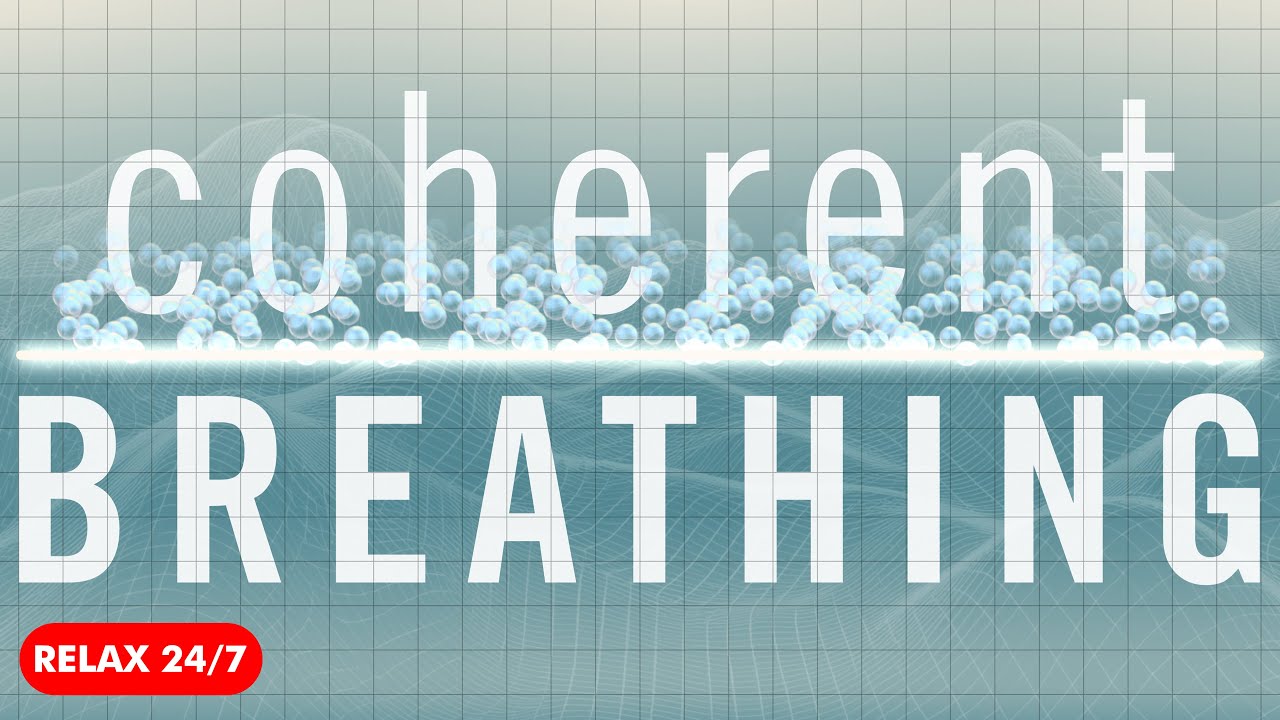
COHERENT BREATHING Around the clock
Our 24/7 livestream on coherent breathing runs non-stop. You can tune in at any time and join in right away.
Perfect for:
✓ Spontaneous breaks to catch your breath in between
✓ If you need help breathing
✓ As background while working
✓ For falling asleep (calms the nervous system)
✓ For regular daily practice
relaxation
When your body is relaxed, all organ systems can function optimally. Chronic tension blocks your body's self-healing powers and keeps you in a state of constant stress. Through targeted relaxation techniques, you activate the parasympathetic nervous system and send your body the signal: „Now I can regenerate, heal, and build strength.“
Progressive muscle relaxation is one of the most researched relaxation methods and has been used successfully for over 100 years. It helps you to recognize tension, actively release it, and achieve a state of deep relaxation—whenever you want.
Recommended relaxation technique
PROGRESSIVE MUSCLE RELAXATION (PMR)
The scientifically proven relaxation method
Progressive muscle relaxation according to Jacobson is one of the most widely researched relaxation techniques worldwide. By deliberately tensing and relaxing individual muscle groups, you learn to consciously perceive tension and actively release it.
Proven effect:
Lowers blood pressure, improves sleep, reduces chronic pain, relieves tension, and activates self-healing powers. Successfully used by psychologists to treat anxiety disorders, depression, and chronic pain.
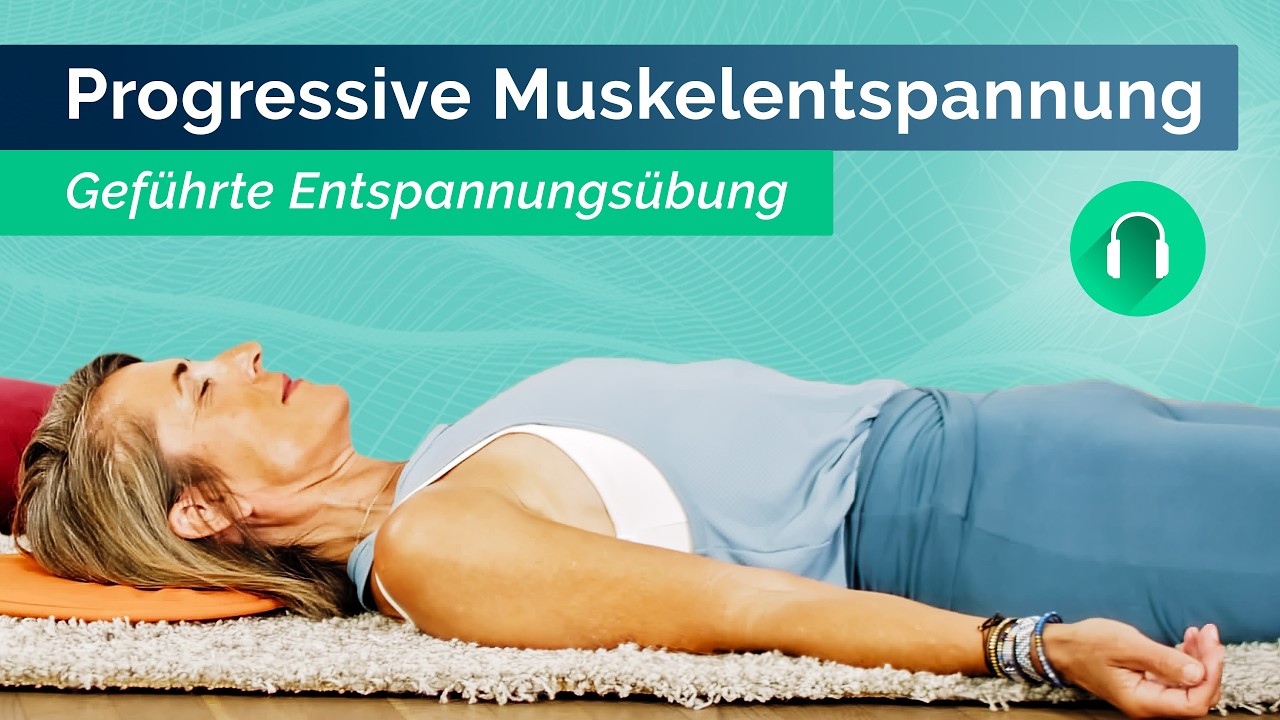
Maria guides you step by step through the entire exercise—perfect for beginners and advanced practitioners alike.
Duration: 23-minute complete guide
To the guided PMRMeditation
Meditation calms the mind — and a calm mind harmonizes the body. In TCM, we know that every emotion affects a specific organ. Through regular meditation, you learn to break out of destructive thought patterns, find emotional balance, and strengthen your inner core.
Modern studies confirm: Meditation has been proven to change brain structure, reduce stress hormones, strengthen the immune system, and improve self-healing powers. Just 10 minutes a day can change your life forever.
Recommended meditations
GUIDED MEDITATIONS FOR EVERY DAY
Your personal meditation library
We have a complete Playlist with over 60 guided meditations, breathing exercises, and relaxation techniques—from short 5-minute meditations for in between to deep 30-minute sessions for intensive practice.
In the playlist you will find:
- Morning meditations for a mindful start to the day
- Meditations for restful sleep
- Breathing meditations for inner peace
- Meditations against stress, brooding, and worries
- TCM standing meditations for all 5 elements
- Body scan and body journeys
- Healing meditations to activate self-healing powers
- Special breathing techniques (4–7–8, coherent breathing, bee breathing)

Perfect for beginners and advanced practitioners. Choose the right meditation for you depending on your time, the time of day, and your needs.
To the meditation playlistThe kidney stores the Jing and controls the water.
Kidney yin is the source of all moisturizing in the body. Without kidney yin, the marrow dries up and the essence disappears.
— From the HUANG DI NEI JING
(The Yellow Emperor's Classic of Internal Medicine)
More tips for your everyday life
In addition to traditional TCM treatment methods there are many small everyday habits that can strengthen your Kidney Yin. In TCM, kidney yin is the source of all moisturizing and cooling in the body - with the right habits you can effectively build and maintain it.
Sleep and rest
🌙 Go to bed early
Sleep before midnight is particularly valuable for Yin:
- Go to bed before 11 pm - the gallbladder time begins
- The kidney yin regenerates best during the yin time (11-3 pm)
- Going to bed late depletes the essence and exhausts the Yin
- Maintain regular bedtimes
- Maintain the rhythm at the weekend too
😴 Sufficient sleep
The kidney yin regenerates during sleep:
- 7–8 hours of sleep per night is ideal
- Yin deficiency may also require more sleep
- Quality is more important than quantity - deep sleep nourishes the yin
- Keep the bedroom cool, dark and quiet
- No screens 1 hour before sleep - they generate internal heat
⏸️ Avoid overworking
Exhaustion drains the kidney yin:
- Avoid long working hours - especially night work
- Schedule regular breaks — every 90 minutes
- Don't push yourself when you're tired
- Exhaustion is a warning sign — take it seriously
- Plan sufficient vacation and relaxation
Keep cool - avoid heat
🔥 Äußere Hitze meiden
In the case of Yin deficiency, the body reacts sensitively to heat:
- Avoid strong sunlight - especially at midday
- Avoid overheated rooms
- Avoid hot baths and saunas - they intensify the empty heat
- It's better to go to cool rooms when it's hot
- Wear light, breathable clothing
🧊 Prefer a cool environment
A cool environment relieves the Yin:
- Keep the bedroom cool - 16-18 degrees is ideal
- Ventilate regularly - especially in the evening
- For hot flushes: cooling compresses on the forehead and wrists
- Walks in the cool morning or evening air
- Spending time by the water can have a cooling effect
🌡️ Innere Hitze vermeiden
Internal factors can also generate heat:
- Avoid hot spices (chili, pepper, ginger)
- Avoid alcohol - it generates a lot of heat
- Limit coffee - it dries out and heats up
- Avoid fried and grilled foods
- Lamb and game are too hot
Preserving the essence
💎 Sexuelle Mäßigung
Excessive sexual activity depletes kidney yin:
- TCM considers sexual energy to be part of the kidney essence
- Excessive activity can further weaken Yin
- Moderation helps to preserve and build the essence
- Especially with severe yin deficiency: rest recommended
- Quality over quantity - mindful intimacy instead of exhaustion
😌 Stress reduzieren
Chronic stress burns the yin:
- Constant stress generates inner heat and drains the yin
- Incorporate daily relaxation exercises (meditation, Qi Gong)
- Setting boundaries — learning to say no
- Not everything has to be perfect - letting go of perfectionism
- Avoid anger and frustration - they generate heat
⚡ Preserve energy
Protect your resources:
- Avoid extreme physical exertion
- Competitive sport and overtraining weaken the yin
- Prefer gentle, regular exercise (Qi Gong, yoga, swimming)
- Regenerate sufficiently after activity
- Listen to the body's signals - take exhaustion seriously
Moisturizing - from the inside and outside
💧 Genug trinken
Sufficient fluids support the Yin:
- Drink 1.5-2 liters a day - but not ice cold
- Prefer room temperature water or lukewarm drinks
- Herbal teas: chrysanthemum, peppermint, goji berry tea
- Small sips throughout the day - not all at once
- For dry mouth: water with a squeeze of lemon
🍲 Befeuchtende Nahrung
These foods nourish the yin:
- Soups and stews - particularly nourishing for the yin
- Black sesame seeds, walnuts, goji berries
- Pears, grapes, mulberries - juicy fruit
- Duck, oysters, fish - moisturize and cool
- Tofu, mung beans, black beans
🏠 Trockene Umgebung meiden
The external environment also influences the Yin:
- Avoid dry heating air - use a humidifier
- Ventilate regularly in winter, but don't turn the heating up too high
- Air conditioning systems dry out the air - avoid if possible
- Plants in the room improve the indoor climate
- Place bowls of water on the radiator
💡 Important to know
Strengthening kidney yin takes time and patience. Building up the yin is like filling a reservoir - it happens slowly and steadily. Pay attention to your body's signals: dryness, hot flushes and sleep disorders show that you need more rest and moisturizing. With consistent care, you will feel your inner coolness and serenity return.
For optimal treatment progress
TCM is not a quick fix for symptoms., but rather a holistic healing process. You will achieve the best results if you consistently integrate the treatment into your daily routine and give your body time to regenerate.
Integration into everyday life
Start with ONE step
Don't try to change everything at once! That's overwhelming and leads to
usually leads to you giving up. Instead:
- Week 1-2: Avoid spicy and hot foods, sleep early (before 11 pm)
- Week 3-4: Integrate yin-nourishing foods (black sesame, goji)
- Week 5-6: Qi Gong „Kidney Circles“ and „Gather Qi“ 10 min. daily.
- Week 7-8: Acupressure Ni 03 and Ni 06 daily
- From week 9: Add further methods as required
Realistic expectations
After 2–3 weeks: First improvements noticeable
- Fewer hot flushes
- Better sleep
- Less night sweats
After 6–8 weeks: Significant improvements
- Less tinnitus
- Stronger lower back
- More inner peace
After 3–6 months: Sustainable healing
- Kidney Yin is noticeably strengthened
- Body feels moisturized and cooled
- Balance and vitality are back
TCM vs. Western medicine
TCM and Western medicine are not mutually exclusive — they complement each other!
When Western medicine is important:
- In acute emergencies
- In case of structural damage
- In case of infections
- For accurate diagnoses (laboratory, imaging)
Where TCM has its strengths:
- In case of functional disorders
- For chronic complaints
- For prevention
- For holistic healing
Ideal: Combine both systems! Use Western medicine for
Acute treatment and accurate diagnosis, TCM for lasting healing
and strengthening the body's self-healing powers.
Important: Never stop taking prescribed medication without consulting your doctor first!
Talk to your doctor when you start TCM treatment.
TCM diagnosis for professionals
Syndrome differentiation according to TCM:
Tongue: Red, little or no coating, dry, possibly cracks in the middle of the tongue, thin tongue body
Pulse: Thin (Xi Mai 细脉) and fast (Shuo Mai 数脉), weak at the left chi position (kidney)
Pathomechanism:
The kidney yin, the root of all yin energy in the body, is exhausted. The essence (Jing 精) is no longer sufficiently nourished. Without sufficient Kidney Yin, Empty Heat (Xu Re 虚热) rises, the marrow is not moistened and the bones, ears and brain suffer. Typical signs such as tinnitus, dizziness, back pain and night sweats develop.
Treatment principle:
Zi Bu Shen Yin (滋补肾阴) - Nourish and tonify the Kidney Yin
Classic recipe:
Liu Wei Di Huang Wan (六味地黄丸) - Six-ingredient pill with rehmannia
Important modifications depending on accompanying symptoms:
- With strong empty heat: + Zhi Mu (Anemarrhenä Rhizoma), Huang Bai (Phellodendri Cortex) = Zhi Bai Di Huang Wan
- For night sweats: + Wu Wei Zi (Schisandrä Fructus), Mu Li (Ostreä Concha), Long Gu (Fossilia Ossis Mastodi)
- For tinnitus/dizziness: + Ci Shi (Magnetitum), Shi Chang Pu (Acori Tatarinowii Rhizoma)
- For dry eyes: + Gou Qi Zi (Lycii Fructus), Ju Hua (Chrysanthemi Flos) = Qi Ju Di Huang Wan
Every step counts
Your body WANTS to heal—you just have to create the right conditions for it to do so.
Remember:
👣 Every little step counts
You don't have to be perfect. Even one warm meal a day is better than none. Even 5 minutes of qigong is better than no exercise at all.
⏳ Patience pays off
It took years for your body to get into this state. Give it time to regenerate. Healing takes time, but it WILL happen.
🎯 Focus on what you can DO
Don't concentrate on what you are doing „wrong". Focus on every positive step you take.
💚 Be good to yourself
Perfection does not exist. It is acceptable to have an off day occasionally. Tomorrow is a new day when you can continue.
🤝 You are not alone
Thousands of people are walking this path with you. For over 2,000 years, TCM has been helping people like you who want to regain their health.
Measure your healing progress

To track your progress with treatment, we recommend that you repeat the TCM analysis after about 3 months.
Why is this important?
- You can see how your condition has improved.
- You can adjust the treatment as needed.
- It motivates you to keep going
- You recognize which measures work best
⚠️ Important: Your answers today will be stored in encrypted form in a code that you received by email. You can only measure your progress later with this code. Keep the email safe!
Activate reminder:
<>In 12 weeks, you'll receive an email with a link to the TCM analysis. When you fill it out, you can enter your personal health code—then you'll see a comparison overview at the end:
→ Your new values
→ Your scores from today's test
→ Direct changes
This allows you to see at a glance whether your symptoms
have improved!
🔒 YOUR DATA IS SAFE
We store:
✓ Only your email address for reminders
✓ The date for shipping
We do NOT store:
✗ Your analysis results
✗ Your personal health data
✗ The connection between email and diagnosis
All analysis data is completely anonymous and is not linked to your email address.
Newsletter
Stay up to date with our newsletter. Besides useful tips and tricks for training and your everyday life, you won't miss any of our new releases.
We are here for you
Do you have questions about your diagnosis or treatment?
Not sure which method is right for you?
Contact us — We're happy to help!