








On this page, you will learn:
- What this diagnosis means from the point of view of TCM and Western medicine
- Where your symptoms come from and how they are connected
- Which specific treatment methods can help you now
- How you can restore your kidney energy and vitality with TCM herbs, acupressure, qi gong, and nutrition
The good news: Kidney qi deficiency can be treated effectively with the right measures. You can rebuild your kidney qi with targeted exercises, warming foods, and acupressure.
Take your time, Get to know the different treatment approaches—you don't have to implement everything at once. Choose what feels right for you and what you can easily integrate into your everyday life.
Your treatment at a glance:
Which TCM pattern is really behind your complaints?
Degree of
imbalance

Light to moderate
Typical
treatment duration
4–6 months
self-treatment
Possible

Can be treated yourself with instructions
Treatment–
scope

2–3 methods
Proposed
methods

Extensive range
Our free TCM analysis shows you your personal TCM pattern in just 10 minutes - and which treatment will help you best.
What is kidney qi deficiency?

When the root of life loses its strength
The TCM perspective: Strengthening the root of life
In traditional Chinese medicine, the kidneys are considered the „root of life“ — they are the storehouse of our life essence, or jing. This precious essence is given to us at birth and determines our basic constitution, vitality, and longevity.
Kidney qi controls our willpower (zhi) and governs the bones, bone marrow, and brain. The kidneys are the source of our original life force—they warm and activate all other organs. When kidney qi becomes weak, the entire body loses drive and stability.
The kidney belongs to the water element and opens to the ears. It works closely with the bladder—both belong to the same element and work together in the body's water balance. The kidney stores and the bladder excretes.
The consequence of kidney qi deficiency: The lower back loses its support, the knees become weak, the ears start to ring, and the body feels cold easily. The life energy that should be nourished by the kidneys becomes thin and weak.
The typical signs of kidney qi deficiency:
- Deep exhaustion and fatigue, especially in the legs
- Weak, painful lower back and lumbar spine area
- Cold feet and general feeling of coldness in the lower body
- Frequent urination, especially at night (nocturia)
- Weak or painful knees
- Ringing in the ears (tinnitus) or hearing problems
- Lack of willpower and motivation
The good news: Kidney qi can be rebuilt. Through a warming diet, sufficient rest, acupressure on the kidney and bladder meridians, and gentle exercise such as qigong, you can strengthen the power of your kidneys and nourish your life energy from the root.
The Western perspective: Focus on the adrenal glands and endocrine system
From a Western perspective, kidney qi deficiency often corresponds to adrenal fatigue—a condition caused by chronic stress. The adrenal glands, small glands located on top of the kidneys, produce vital stress hormones such as cortisol and adrenaline.
Imagine your adrenal glands as a battery: prolonged stress causes this battery to be constantly discharged without being sufficiently recharged. The result is chronic exhaustion that cannot be remedied simply by sleeping—typical of what we now refer to as burnout.
Another important aspect is the connection between the adrenal glands and the entire endocrine system. The so-called HPA axis (hypothalamic–pituitary–adrenal axis) controls our stress response and influences sleep, energy, metabolism, and even reproductive hormones.
What does modern medicine show?
- Adrenal fatigue: Low cortisol levels, especially in the morning
- Chronic fatigue syndrome: Persistent tiredness despite rest
- Osteoporosis and bone weakness: The kidney controls calcium metabolism
- Chronic back pain: Especially in the lumbar spine area
- Hormonal imbalance: thyroid, sex hormones, adrenal glands work together
- Circulatory disorders: Cold extremities due to insufficient heat production
Modern research confirms: Chronic stress leads to measurable changes in adrenal gland function. Regeneration requires more than just rest—it needs targeted support through nutrition, stress reduction, and gentle exercise.
TCM treatment for kidney qi deficiency addresses precisely this issue: it warms and strengthens the essence of life, supports the adrenal glands, and restores balance to the exhausted system—slowly, profoundly, and sustainably. The kidneys need time to regenerate, but the investment is worthwhile.

The Yellow Emperor team explains your diagnosis
The Yellow Emperor | Qi Bo | Dr. Lisa Weber
Founder of TCM | Master of Healing Arts | Modern Physician
What happens when the legendary Yellow Emperor from TCM sits down with his advisor Qi Bo and a modern doctor? They explain YOUR diagnosis—using 4,000 years of knowledge AND the latest science.
Kidney qi deficiency — When the root of life weakens
The Yellow Emperor: „Qi Bo, in my kingdom I see people who are constantly exhausted. Their backs ache, their knees are weak, and they complain of cold feet and ringing in their ears. What is the cause of this deep fatigue?“
Qi Bo: „Your Majesty, these people suffer from a deficiency of kidney qi. The kidney is no ordinary organ—it is the root of life itself. We call it the ‚storehouse of essence‘ because it is where jing resides—the precious essence of life that was given to us by our parents. The kidney governs water, bones, marrow, and ears. It is the source of yin and yang throughout the body. When kidney qi is weak, a person lacks deep, fundamental strength — like a tree whose roots are withering.“
Dr. Weber: „That's a remarkable description! We see interesting parallels in modern medicine. The adrenal glands, which are anatomically located on top of the kidneys, produce vital hormones such as cortisol and adrenaline. Chronic stress can lead to what is known as adrenal fatigue — a condition that has strikingly similar symptoms: deep exhaustion, back pain, sensitivity to cold. The hypothalamic-pituitary-adrenal axis, our central stress axis, also plays a crucial role here.“
The Yellow Emperor: „So the kidney is also of such fundamental importance in your science?“
Qi Bo: „That's exactly right, Your Majesty. The kidneys store prenatal jing—the essence we receive at conception. This jing is like an inheritance that we manage throughout our lives. It determines our constitution, our vitality, and how we age. In addition, the kidney stores postnatal Jing, which we can replenish through food, sleep, and lifestyle. If the kidney Qi is weak, this precious inheritance is depleted prematurely.“
The Yellow Emperor: „What causes this weakness of kidney qi?“
Qi Bo: „There are many causes, Your Majesty. First: overwork and too little sleep—they rob the kidneys of the time they need to regenerate. Second: chronic anxiety and fear—these emotions directly weaken the kidneys, because fear is the emotion of the kidneys. Thirdly: excessive sexual activity — this consumes precious jing. Fourthly: chronic illnesses that put strain on the body over a long period of time. Fifthly: excessive exposure to cold — cold penetrates the kidneys and weakens their yang. And sixthly: natural aging — kidney qi naturally declines with age.“
Dr. Weber: „This correlates remarkably with our findings! Chronic stress leads to adrenal exhaustion and disrupts the HPA axis. Lack of sleep prevents nighttime hormone regeneration—growth hormone and melatonin in particular are mainly released at night. The connection to anxiety is particularly interesting: chronic anxiety disorders permanently increase cortisol levels, which exhausts adrenal function in the long term. And what about aging? In fact, hormone production — DHEA, testosterone, estrogen — decreases significantly with age. TCM recognized these connections thousands of years ago!“
The Yellow Emperor: „What signs would indicate that someone is suffering from kidney qi deficiency?“
Qi Bo: „The signs are characteristic, Your Majesty. The affected person shows: Deep exhaustion, which is hardly improved by rest. Pain and weakness in the lower back and knees—where the kidneys rule. Cold feet and a general sensitivity to cold. Tinnitus or hearing loss—because the kidneys open up to the ears. Frequent urination, especially at night. Premature graying of the hair. The tongue is pale and swollen, often with teeth marks on the edges. The pulse is deep and weak, especially at the kidney position.“
Dr. Weber: „This combination of symptoms is clinically highly relevant! Lumbar back pain can indicate weakness in the back muscles due to lack of exercise or mineral deficiencies. Cold extremities indicate peripheral circulatory disorders or hypothyroidism. Nocturnal urination, known as nocturia, can be related to a deficiency in antidiuretic hormone. Tinnitus is often stress-related or circulation-dependent. And premature graying? This can actually indicate oxidative stress and nutrient deficiencies, especially B vitamins and copper.“
The Yellow Emperor: „Now let's talk about treatment. How can kidney qi be strengthened?“
Qi Bo: „Your Majesty, the treatment principle is: Bu Shen — tonify the kidneys and nourish the Jing. This is achieved in several ways: Firstly, through sufficient sleep — the kidneys regenerate between 5 and 7 p.m. and especially at night. Secondly, through warmth — the kidneys love warmth and detest cold. Moxa on the Kidney 3 point on the ankle warms and strengthens. Thirdly, through nourishing foods: walnuts strengthen the kidney essence, black beans nourish the kidney yin, and lamb warms the kidney yang. And fourthly, through rest and meditation — the kidneys need silence to recover.“
Dr. Weber: „Wonderful recommendations! From a scientific point of view: sufficient sleep is crucial for hormone regeneration. The adrenal glands recover best with 7-8 hours of sleep, ideally starting before midnight. Warmth promotes blood circulation and relaxes the muscles. Walnuts contain omega-3 fatty acids, which have anti-inflammatory properties, and magnesium, which is often lacking when you are exhausted. Black beans are rich in antioxidants and plant protein. And meditation? Studies show that regular meditation lowers cortisol levels and regulates the HPA axis!“
The Yellow Emperor: „Qi Bo, what specific exercises do you recommend for the kidneys?“
Qi Bo: „The most important exercise is warming the kidneys, Your Majesty. Rub your hands together to warm them up and place them on your lower back, where the kidneys are located — stay there and let the warmth penetrate. ‚Kidney-strengthening breathing‘ is also valuable: while sitting or lying down, breathe deeply into your lower abdomen and consciously let the qi sink into your lower back. From the Baduanjin, I particularly recommend ‚bringing the hands to the feet‘ — this exercise stretches the kidney meridian and strengthens the loins. And ‚clattering the teeth‘ in the morning — clattering the teeth together 36 times — strengthens the bones associated with the kidneys.“
Dr. Weber: „These exercises have tangible physiological effects! Warming the lower back promotes local blood circulation and can relieve muscle tension—the heat actually reaches the adrenal gland region. Deep abdominal breathing activates the parasympathetic nervous system, which calms the stress axis. The stretching exercises keep the spine flexible and strengthen the back muscles. And the teeth chattering? It actually stimulates the jaw muscles and can improve blood circulation in the head area via nerve connections!“
The Yellow Emperor: „Wonderful! Let's turn this wisdom into a practical plan.“
THE 3-WISE METHOD FOR KIDNEY QI DEFICIENCY
MORNING PROTOCOL (awaken kidney qi):
- TCM: Rub your hands together to warm them up and place them on your lower back (Ming Men area).
- Science: Heat promotes blood circulation in the adrenal gland region and activates the metabolism.
- Practical: Immediately after waking up in bed: rub your hands together 20 times, then place them on both sides of your lower back. Allow the warmth to take effect for 2-3 minutes.
- TCM: Warm breakfast with kidney-strengthening ingredients
- Science: Warm meals in the morning stabilize blood sugar and are gentle on the digestive system.
- Practical: Oatmeal with walnuts and black sesame seeds, accompanied by a glass of warm water. Avoid cold foods and beverages in the morning.
- TCM: Teeth chattering (Kou Chi) — Clack your teeth together 36 times.
- Science: Stimulates the chewing muscles and promotes saliva production
- Practical: Standing or sitting, gently clench your teeth together 36 times. Then slowly swallow the saliva that has collected—it is considered ‚jade nectar.‘
TAGS STRATEGY (nourishing kidney qi):
- TCM: Walnut snack to strengthen kidney essence
- Science: Walnuts contain omega-3 fatty acids, magnesium, and antioxidants.
- Practical: 5-7 walnut halves as an afternoon snack, ideally between 3 and 5 p.m. (kidney time)
- TCM: Acupressure on Kidney 3 (Taixi) — the source point of the kidney
- Science: Stimulation of this point can improve blood circulation in the feet.
- Practical: In the hollow between the inner ankle and Achilles tendon. Massage gently in a circular motion for 2-3 minutes on each side. Particularly helpful for cold feet.
- TCM: Protect your lower back and feet from the cold
- Science: Cooling of the lumbar region can promote muscle tension and circulatory disorders.
- Practical: Wear a kidney belt or undershirt, do not sit on cold surfaces, wear warm socks if your feet are cold.
EVENING RITUAL (regenerate kidney qi):
- TCM: Warm foot bath to strengthen kidney energy
- Science: Warm water promotes peripheral blood circulation and activates the parasympathetic nervous system.
- Practical: 15-20 min foot bath in warm water (38-42 degrees). Optional: add ginger slices or salt. Then wrap your feet up warmly.
- TCM: Soup with black beans or lamb to strengthen the kidneys
- Science: Black beans provide plant-based protein and iron, while lamb is rich in B vitamins and zinc.
- Practical: Black bean soup with ginger and spring onions, or lamb broth with vegetables. Serve warm.
- TCM: Go to bed early — your kidneys regenerate at night.
- Science: Sleeping before midnight maximizes the release of growth hormone and melatonin.
- Practical: Be in bed by 10:30 p.m. at the latest. Aim for 7-8 hours of sleep. Keep your bedroom warm and dark.
The Yellow Emperor: „Qi Bo, how long will it take for the kidney qi to regain its strength?“
Qi Bo: „Your Majesty, the kidneys are the deepest root of the body — strengthening them takes time and patience. After 4-6 weeks of consistent practice, most people notice that their back feels stronger and their feet feel warmer. After 2-3 months, sleep and energy levels improve significantly. After 6 months to a year, kidney qi can be fundamentally strengthened — ringing in the ears subsides and deep exhaustion recedes. Important: Prenatal jing cannot be increased, but we can slow down its consumption and nourish postnatal jing.“
Dr. Weber: „This corresponds to our clinical experience with adrenal fatigue! Recovery of the HPA axis is a slow process — it often takes 3-6 months to see significant improvements. Hormone levels normalize gradually. Sleep quality usually improves first, followed by energy and stress resilience. And the reference to ‚prenatal jing‘? Medically speaking, this corresponds to our genetic constitution — it is a given, but we can influence how well we age with it through our lifestyle!“
The Yellow Emperor: „What should people pay particular attention to in winter when it's cold?“
Qi Bo: „Winter is the season of the kidney, Your Majesty! During this time, the kidney needs special protection and nourishment. People should: Go to bed early and get up later than in summer. Keep the lower back and feet especially warm. Eat more warming foods—soups, stews, lamb. Sweat less by avoiding excessive exercise. Gather energy inwardly, like nature itself. Those who take care of their kidneys in winter will have the strength to blossom in spring.“
Dr. Weber: „These are valuable seasonal recommendations! In winter, the body actually produces more melatonin—the natural call for more sleep. Cold weather puts strain on the immune system and requires more energy to produce heat. Warm, nutritious meals support this. And the advice to exercise moderately is wise: excessive sweating in winter can weaken the immune system and flush out minerals. The body should regenerate during the cold season, not be exhausted!“
The Yellow Emperor: „Then the message is clear: the kidneys, the root of our life, deserve our deepest attention. With warmth, rest, nourishing food, and wise use of our reserves, kidney qi can flourish and give us a long, vital life.“
Qi Bo: [smiles] „That's right, Your Majesty. The kidney is the treasure our ancestors left us. Those who guard this treasure like a precious gem will live long and bright lives. Because the secret to a long life isn't doing more—it's wasting less.“
About our „3 Wise Men“ story
Who are the Yellow Emperor and Qi Bo?
The Yellow Emperor (Huangdi) is said to have lived around 2600 BC and is considered the mythical founder of Chinese culture and medicine. Qi Bo was his most important advisor and personal physician. Their discussions about health, illness, and human nature were recorded in the most important fundamental work of TCM.
The book: Huangdi Neijing
The Huangdi Neijing, also known as The Yellow Emperor's Classic of Internal Medicine, was probably written between 200 BC and 200 AD. It is the oldest surviving work on Chinese medicine and consists of dialogues between the Yellow Emperor and his advisors, mainly Qi Bo.
This work is to TCM what the Bible is to Christianity: the absolute foundation. All the important concepts - yin and yang, the 5 elements, qi, meridians and acupuncture points - are systematically described here for the first time.
Our modern approach: The 3 wise men
In our series „The 3 Sages“, we bring the Yellow Emperor and Qi Bo together with the fictional modern doctor and microbiologist Dr. Weber.
Important note: All three characters and their conversations are purely fictitious and invented by us.
We use this narrative form, similar to the dialogue form in the book Huangdi Neijing, to convey the often complex interrelationships of TCM in an understandable and entertaining way. When the 4,000-year-old emperor is confronted with modern science, enlightening „aha moments“ arise that show that ancient wisdom and new research often speak the same language—just in different words.
This makes TCM lively, understandable and practically applicable for your everyday life.
The dialogs are creative interpretations - not historical documents. For medical questions, please consult a qualified TCM therapist or doctor.
Your treatment options
Kidney qi deficiency is easily treatable! TCM offers you a variety of effective methods to rebuild your kidney energy and vitality. You don't have to do everything at once — choose the methods that suit you and your everyday life.
Here you will find specific treatment approaches that have been proven effective in TCM for thousands of years and that you can largely apply yourself.
TCM herbal therapy
TCM herbs are the basis every classic TCM treatment. The carefully compiled mixtures have a synergistic effect — this means that the individual herbs reinforce each other's effects and balance out any possible side effects.
What modern medicine is only just discovering—the power of plant substances—has been used successfully by TCM for over 2,500 years.
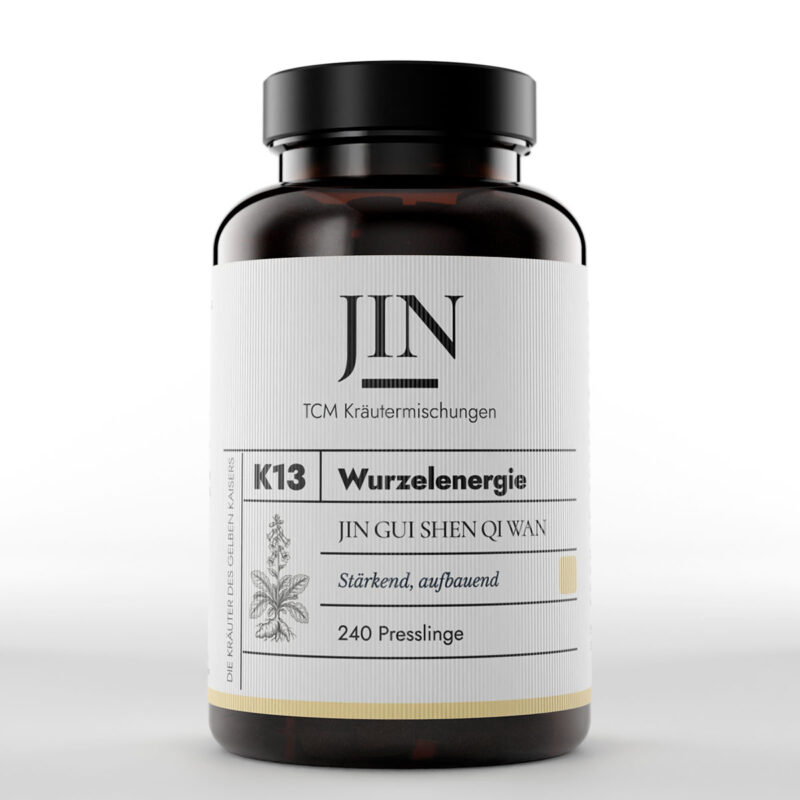
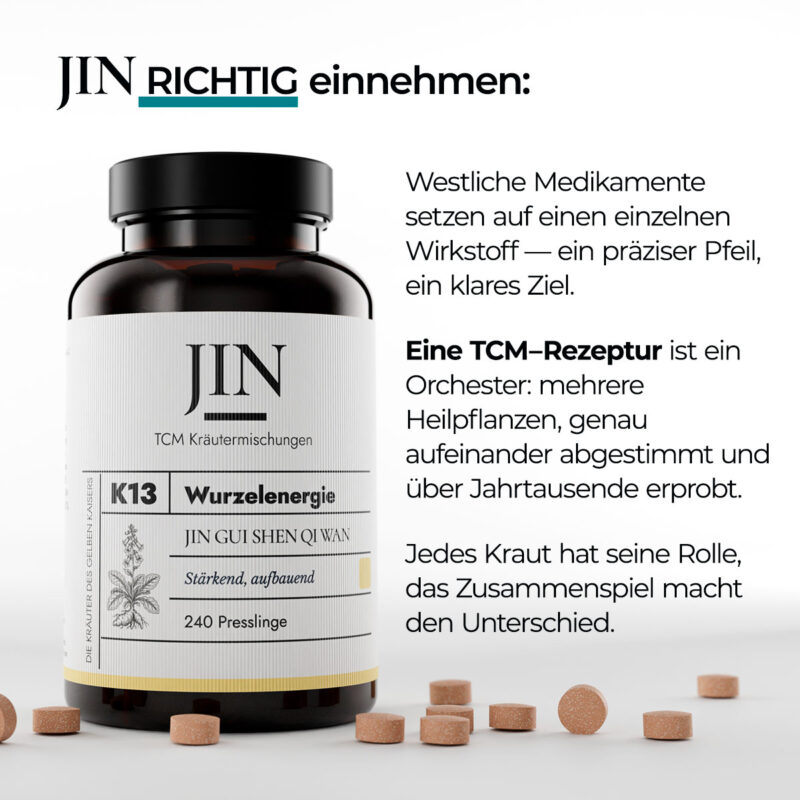


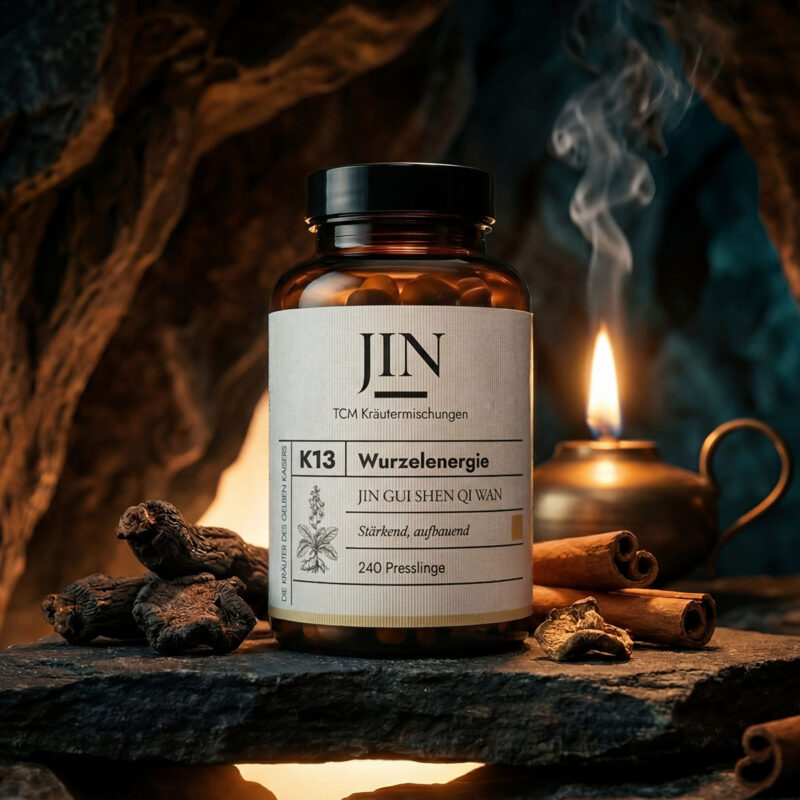

Empfohlene TCM–Kräutermischung bei Nieren–Qi Mangel
JIN K13 — Wurzelenergie
Die klassische Rezeptur Jin Gui Shen Qi Wan (金匮肾气丸) — die „Nieren–Qi Pille aus der Goldenen Truhe“. Acht aufeinander abgestimmte Kräuter, die eine nährende Yin–Basis schaffen und mit einem kleinen Funken Wärme das Nieren–Qi wieder entfachen.
Auf einer Basis aus Shu Di Huang und Shan Zhu Yu, die Nieren–Yin und Jing nähren, entfachen Gui Zhi und Rou Gui das Ming Men–Feuer — denn „aus einem kleinen Funken Feuer entsteht Qi“. Ideal bei Erschöpfung, Kältegefühl in der Lendenregion, häufigem nächtlichem Wasserlassen und schwachem Rücken.
Quantity
209,70 €
i
To the product
The herbs in this recipeRecommended reading:How TCM herbal blends are formulatedLearn more now
| Herb (Pinyin) | German designation | Function in the recipe |
|---|---|---|
| Shu Di Huang (Rehmanniae Radix Praeparata) | Prepared rehmannia root | emperor Nährt das Nieren–Yin und füllt das Jing auf |
| Shan Zhu Yu (Corni Fructus) | cornelian cherry | minister Nährt Leber und Nieren, bewahrt das Jing |
| Shan Yao (Dioscoreae Rhizoma) | Yam root | minister Tonisiert Milz, Lunge und Nieren zugleich |
| Gui Zhi (Cinnamomi Ramulus) | cinnamon sticks | minister Wärmt das Nieren–Yang, fördert die Qi–Umwandlung |
| Ze Xie (Alismatis Rhizoma) | Wasserwegerich | assistant Leitet Feuchtigkeit und trübe Hitze über den Urin aus |
| Fu Ling (Poria cocos sclerotium) | Poria mushroom | assistant Drains dampness and strengthens the spleen |
| Mu Dan Pi (Moutan Radicis Cortex) | Strauchpäonienrinde | assistant Kühlt das Blut und klärt pathologische Hitze |
| Rou Gui (Cinnamomi Cortex) | cinnamon bark | assistant Entfacht das Ming Men–Feuer, wärmt das Nieren–Yang |
Explanation of the most important herbs
emperor Shu Di Huang (Rehmannia) — Das Fundament
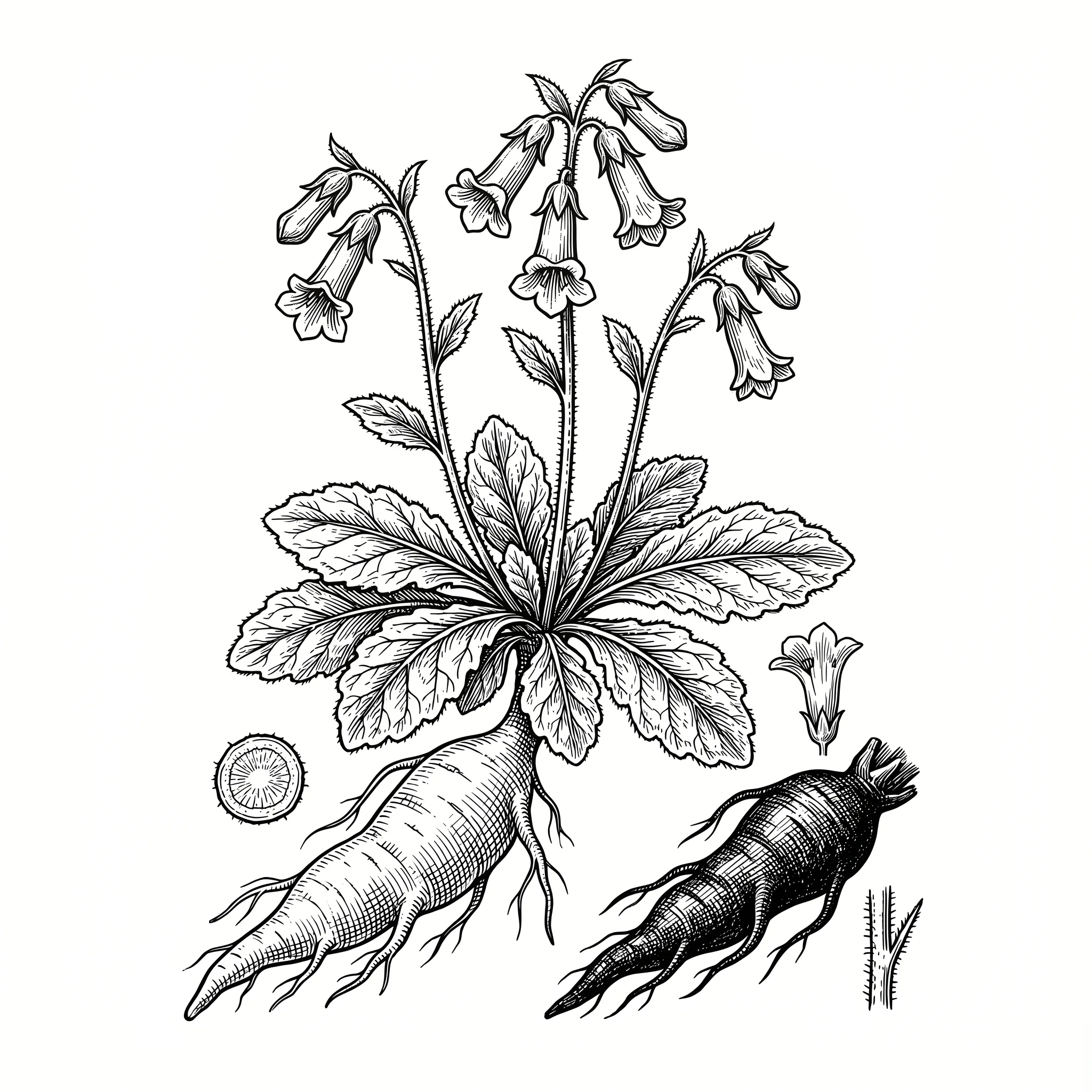
Nährt das Nieren–Yin und füllt das Jing auf — die materielle Grundlage, auf der Nieren–Qi und Nieren–Yang aufbauen. Die zubereitete Rehmanniawurzel fördert die Hämatopoese und zeigt nephroprotektive Eigenschaften.
minister Shan Zhu Yu (cornelian cherry) — Der Essenz–Hüter
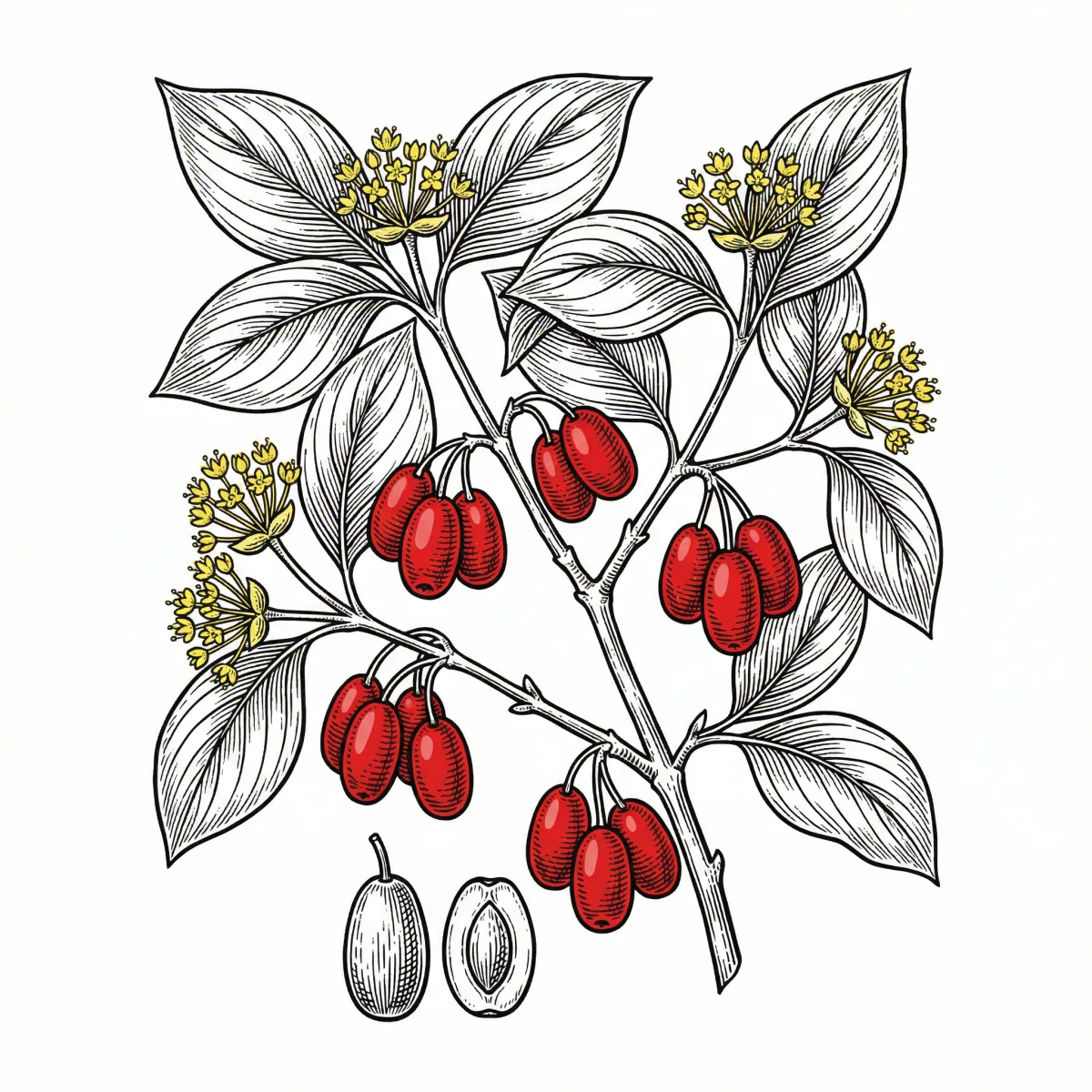
Nährt Leber und Nieren, bewahrt das Jing — hält die aufgebaute Essenz im Körper und verhindert Verlust durch Schweiß, häufiges Wasserlassen oder Emissionen. Morroniside zeigt nephroprotektive und antidiabetische Wirkung.
minister Gui Zhi (cinnamon twig) — Der Yang–Funke
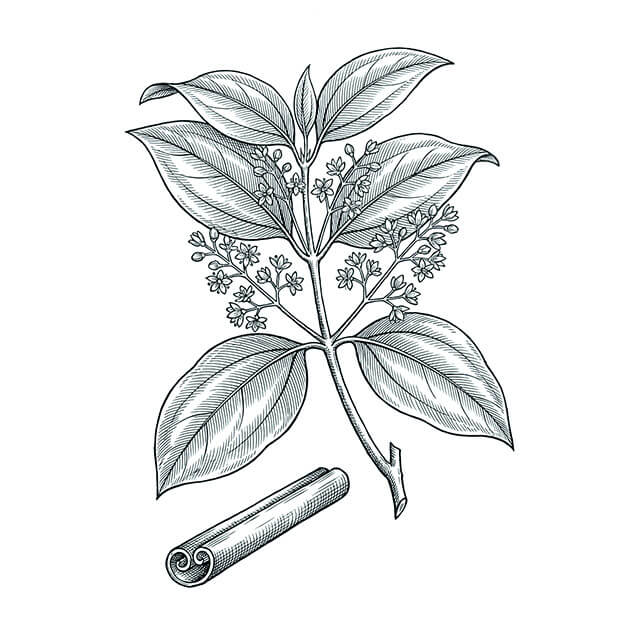
Wärmt das Nieren–Yang und fördert die Qi–Transformation — eine der beiden wärmenden Säulen, die das Yang–Feuer der Niere entzünden. Zimtzweige enthalten Cinnamaldehyd, das die periphere Durchblutung fördert und wärmend wirkt.
assistant Rou Gui (cinnamon bark) — Das Lebensfeuer
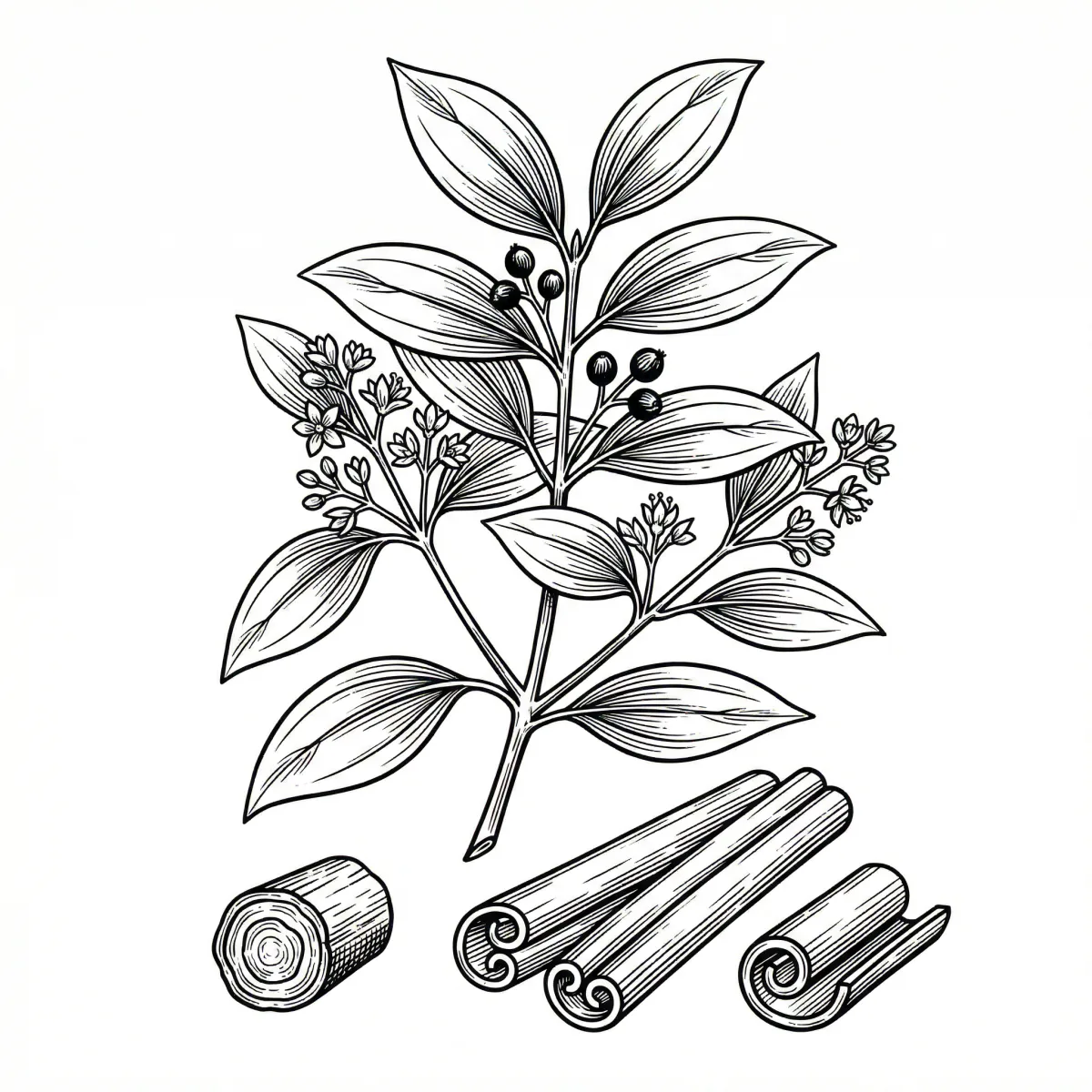
Entfacht das Ming Men–Feuer und wärmt das Nieren–Yang — arbeitet mit Gui Zhi zusammen, um das Yang zu stärken, ohne das Yin zu verbrauchen. Zimtrinde enthält Zimtaldehyd, das die periphere Durchblutung fördert und wärmt.
Recommended dosage
The dosage depends on the severity.
Based on your questionnaire results, we have highlighted the appropriate dosage for you below.
At light Severity:
- 2 tablets 3 times a day (morning, noon, and late afternoon) = 6 tablets per day
- Optional, if taking 3 doses a day is difficult for you: 3 tablets twice a day — same daily amount
- We recommend at least 2 cans, each containing 240 tablets (enough for about 12 weeks)
At middle Severity:
- 3 tablets 3 times a day (morning, noon, and late afternoon) = 9 tablets per day
- We recommend at least 3 cans, each containing 240 tablets (enough for about 12 weeks)
- If your condition improves, switch to the dosage recommendation for mild symptoms
At significantly Severity:
- 4 tablets 3 times a day (morning, noon, and late afternoon) = 12 tablets per day
- We recommend at least 4 cans, each containing 240 tablets (enough for about 12 weeks)
- If your condition improves, switch to the dosage recommendation for moderate severity
Why 3 times a day?
This ensures that the herbs' effects are evenly distributed throughout the day.
IMPORTANT:
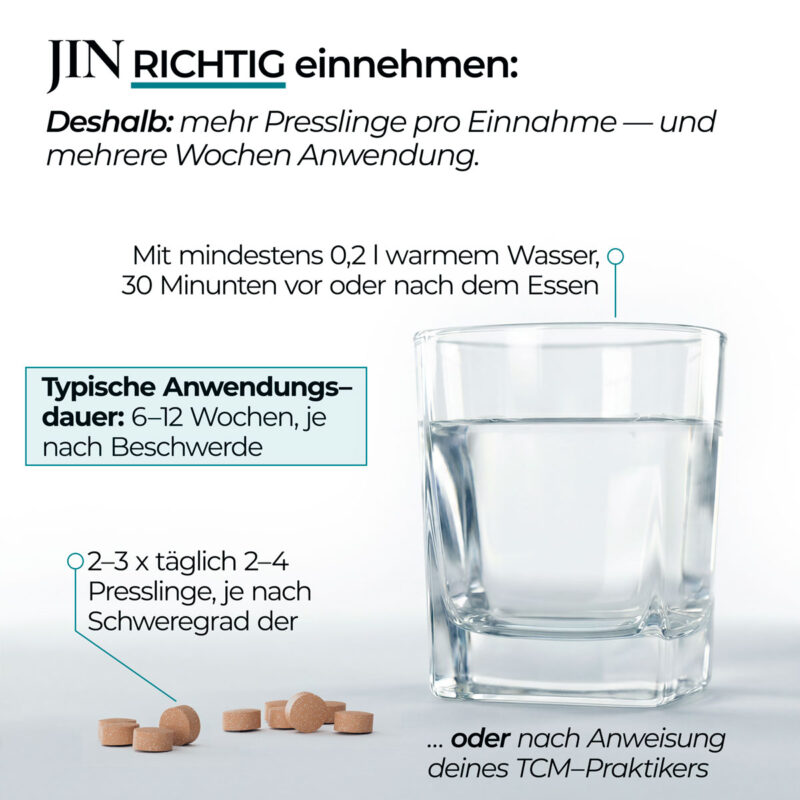
- Take the tablets with at least 0.2 liters of warm water
- Ideally, 30 minutes before or after a meal
- This suggestion is not a substitute for a medical diagnosis or treatment
- If you are pregnant or breastfeeding, have a chronic medical condition, or are taking medication, consult a doctor or a TCM practitioner beforehand.
- If you have a severe cold, fever, or diarrhea, stop taking this product
- Den unteren Rücken und die Füße warm halten — Kälte schwächt das Nieren–Yang
- Kalte und rohe Speisen meiden; warm und nährend essen
If little has changed after about 12 weeks:
Herbs are just one part of TCM. Combine taking them with other practices—acupressure, qigong, Pilates, or yoga, BS+, as well as meditation and breathing exercises. Afterward, take a two-week break from taking the herbs. Then, if needed, you can TCM analysis try again and/or compare your result with your TCM practitioner or discuss it with your doctor.
If you have any questions about how to take it, please feel free to contact us.
Want to know what dosage is right for you? Take our free TCM questionnaire—in just a few minutes, it will reveal your personal TCM pattern and the appropriate dosage of the recommended TCM herbal blend.
BS+ for your intestinal flora
A healthy gut is the basis for your well-being. Current studies show that around 80 % of people in Germany consume too little fiber - yet it is the most important food for your intestinal flora (also known as the intestinal microbiome).
BS+ was developed to support your daily fiber supply. With 11 high-quality, natural ingredients BS+ offers your intestinal flora a diverse nutrient base.
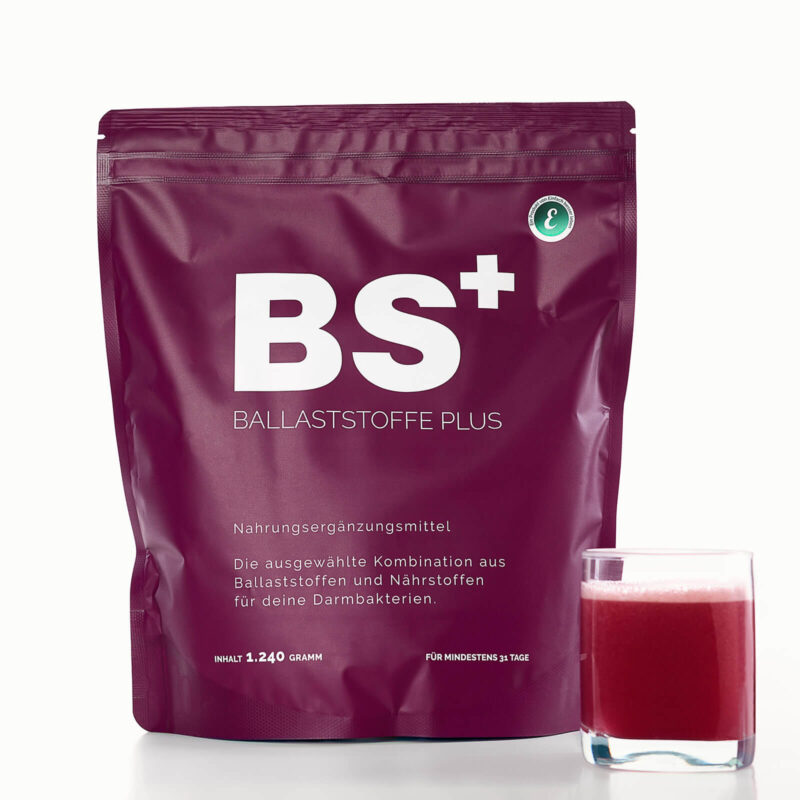
The revolutionary fiber formula
BS+ Dietary Fiber Plus
- Up to 20 g dietary fiber daily EXTRA
- Improved digestion and regular bowel movements
- Increased energy and vitality
- Better mood and mental clarity
- Support for your immune system
- Potential improvement in cholesterol and blood sugar levels
Simply stir into water twice a day - Your intestinal flora will thank you.
Warum BS+ bei Nieren–Qi Mangel?
In der TCM sind Niere und Darm eng miteinander verbunden: Die Niere steuert die untere Körperöffnung und reguliert die Ausscheidung. Bei einem Nieren–Qi Mangel fehlt die Kraft, die der Darm für eine gesunde Verdauung braucht — Nahrung wird nicht mehr vollständig transformiert, der Stuhlgang wird unregelmäßig und die Darmflora verliert ihr Gleichgewicht. Ein geschwächtes Nieren–Qi kann sich zudem als frühmorgendlicher Durchfall oder als Gefühl der Schwäche im unteren Rücken und in den Knien zeigen.
BS+ delivers 11 prebiotic fibers und unterstützt so gezielt den Aufbau einer vielfältigen Darmflora. Eine gut genährte Darmflora entlastet die Niere, indem sie die Verdauungsarbeit übernimmt, die das geschwächte Nieren–Qi nicht mehr leisten kann — so bleibt mehr Energie für die Erholung der Nierenessenz und die Stärkung der Lebenskraft.
Besonders wichtig bei Nieren–Qi Mangel:
- Entlastet das geschwächte Nieren–Qi, indem die Darmflora die Nährstoffaufnahme verbessert
- Unterstützt eine regelmäßige Verdauung und stärkt die Ausscheidungsfunktion des unteren Erwärmers
- Fördert ein stabiles Darmmilieu als Grundlage für den Wiederaufbau der Nierenenergie
Acupressure
Acupressure is acupuncture without needles. — you can apply them yourself at any time. By gently pressing on specific points, you activate the flow of energy in the meridians and strengthen the corresponding organs.
The following three points are specifically tailored to the kidney meridian and specifically strengthen kidney qi.
ACUPUNCTURE POINT: Ni 03
Kidney 03
Great Torrent — Tai Xi
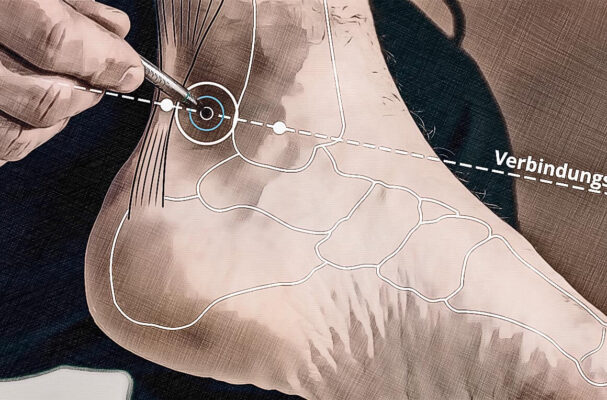
- Source point of the kidney meridian — strengthens kidney qi
- Strengthens the essence (Jing)
- Acts on the knees and lower back
- Strengthens kidney yang and kidney yin
- Helps with severe general fatigue
Location:
On the midline between the inner ankle and the Achilles tendon, where a pulse can be felt.
Application:
Hold twice daily for 30–45 seconds with firm pressure. Ideal in the morning and evening.
ACUPUNCTURE POINT: Ni 07
Kidney 07
Recurring River — Fu Liu

- Tonifies the kidney qi
- Eliminates leg edema
- Strengthens the lower back
- Helps with severe fatigue caused by kidney qi deficiency
Location:
At the front edge of the Achilles tendon, 2 cun (3 finger widths) above Ni 03 in a palpable depression.
Application:
Hold twice daily for 30–45 seconds with moderate pressure. Ideal in combination with Ni 03.
ACUPUNCTURE POINT: KG 04
Concept vessel 04
Gateway to the Origin — Guan Yuan
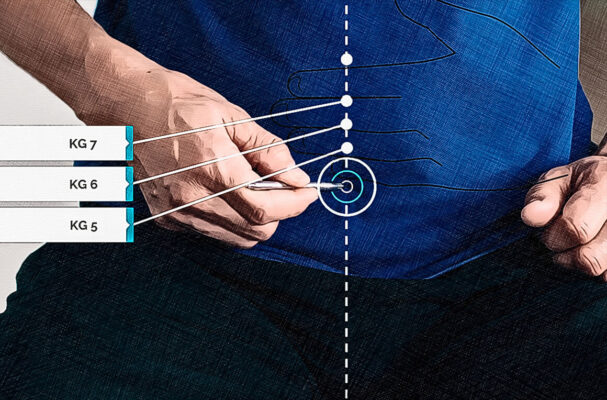
- Strengthens the original qi (yuan qi)
- Tonifies the kidneys and kidney qi
- Nourishes the blood and essence
- Warms the uterus and regulates menstruation
- Helps with exhaustion and feeling cold
Location:
On the midline of the lower abdomen, 3 cun (4 transverse fingers) below the navel.
Application:
Hold gently for 30–45 seconds once a day. Ideal in the evening before bedtime.
TIP
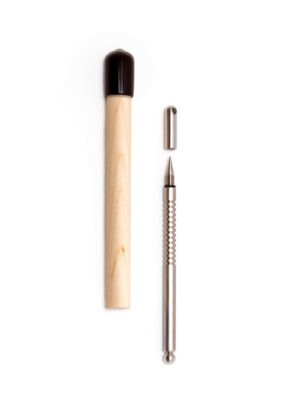
AkuPen
Acupuncture pen with video instructions
For even more intense stimulation You can use an AkuPen. The acupressure pen significantly enhances the effect of acupressure. With an extensive video library for over 80 acupuncture points.
Qi Gong
Qi Gong is moving meditation — gentle, flowing exercises that harmonize your energy flow and strengthen your qi. If you have kidney qi deficiency, these exercises help to build up kidney energy, nourish the essence of life (jing), and strengthen the lower back.
Regular practice of qigong (even just 10–15 minutes a day) has been shown to have positive effects on kidney energy, vitality, and general well-being.
QI GONG: Exercise 1
Collect Qi
Gathers qi in the lower dantian, strengthens the essence of life

Particularly helpful for:
- Exhaustion and lack of energy
- Weakness in the lower back
- Lack of vitality
- Inner coldness
Effect:
This exercise collects and condenses qi in the lower dantian—the energy center in the lower abdomen that is closely connected to kidney energy. It nourishes the essence of life (jing) and strengthens the foundation of your vitality.
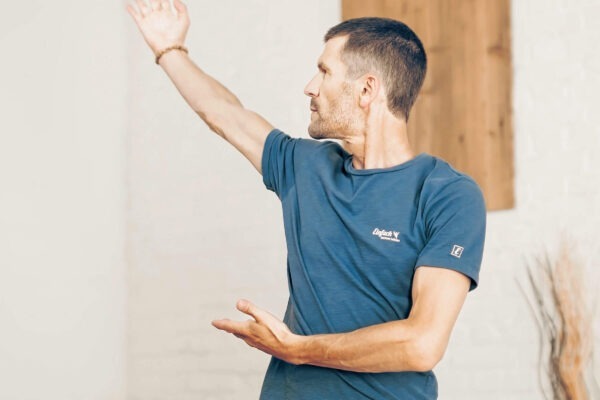
QI GONG: Exercise 2
Watch the full moon
Strengthens and nourishes the earth element
Particularly helpful for:
- Inner restlessness and anxiety
- Sleep problems
- Exhausted kidney essence
- Emotional instability
Effect:
This gentle exercise calms the mind and nourishes the earth element and thus the post-natal energy. The calm, meditative quality of this exercise also strengthens the kidney essence and brings the Qi into balance - particularly valuable in cases of exhaustion due to overwork.
QI GONG: Exercise 3
Look backwards
Stretches the lower back, activates Ming Men

Particularly helpful for:
- Lower back pain
- Stiffness in the lumbar spine
- Weakness in legs and knees
- Blocked energy flow in the kidney area
Effect:
This exercise gently stretches the lower back and activates the Ming Men point (Gate of Life) — an important acupuncture point for kidney energy. The twisting motion promotes blood circulation in the kidney area and strengthens kidney qi.
These Qi Gong exercises are specially selected to strengthen the kidney energy. They nourish the Jing (life essence), strengthen the lower back and activate the earth element and the water element.
All exercises are particularly effective when practiced between 5 and 7 p.m. — this is the peak time for the kidneys in the organ clock. The time between 3 and 5 p.m. (bladder time) is also suitable, as the kidneys and bladder form a pair of organs.
QI GONG:
When and how often?
In the evening (ideal):
- All 3 exercises as a sequence: approx. 15–20 minutes
- Or just 1–2 exercises: approx. 5–10 minutes
- Preferably between 5 and 7 p.m. (kidney time)
In between:
- Individual exercises as needed (e.g., for back pain or exhaustion)
- „Gathering qi“ for rapid energy replenishment
Regularity is more important than duration:
- Better to do 10 minutes every day than 60 minutes once a week.
- After 2–3 weeks, you will notice the first changes.
- After 3 months of regular practice: significant improvement
Pro tip: Combine qi gong with warmth in the lower back. If you have kidney qi deficiency, it is particularly important to keep the kidney area warm—this supports kidney yang and promotes vitality.

LIVE EVERY MONDAY: QI GONG WITH WOLFGANG
Every Monday at 6:00 p.m. Let's practice together live on YouTube. Among other things, Wolfgang will guide you through a complete qigong sequence — free of charge and suitable for all levels.
Why participate live? ✓ Practicing together is motivating ✓ Wolfgang explains the exercises in detail ✓ You can ask questions in the live chat ✓ Regular appointments help with your routine
More about Qi Gong LiveMeridian Yoga — The Yoga of TCM
Meridian Yoga combines classic yoga poses with the energy concept of traditional Chinese medicine. — more dynamic than traditional yoga and focused on improving health and energy levels.
Targeted stretches along the twelve main meridians open blocked energy pathways, strengthen organ functions, and increase permeability in fascia, joints, and muscles.
Accompanied by calm breathing and mindful body awareness, Meridian Yoga has a particularly balancing effect on stress, exhaustion, and inner restlessness. The gentle style is suitable for all ages—even without prior experience—and helps you strengthen your core, become more flexible, and let your life energy flow more freely again.
MERIDIAN YOGA: Exercise 1
Butterfly for the kidney meridian
Opens the hips and kidney area

Particularly helpful for:
- Tension in the lower back
- Stiff hips and groin
- Fatigue and exhaustion
- Feeling of coldness in legs and feet
Effect:
The butterfly position gently opens the hips and stretches the inner thighs, where the kidney meridian runs. This exercise promotes blood circulation in the kidney area and activates kidney qi.
MERIDIAN YOGA: Exercise 2
Hero position for the kidney meridian
Strengthens the lower back, activates the Ming Men

Particularly helpful for:
- Weak lower back
- Lack of willpower and drive
- Cold feet and knee problems
- Anxiety and insecurity
Effect:
The hero pose strengthens the lower back and activates the Ming Men (gate of life) — the most important acupuncture point for kidney yang. This powerful exercise warms the kidneys and strengthens the essence (Jing).
Both exercises activate the kidney meridian, which begins at the sole of the foot, runs up the inside of the legs, and ends in the chest. Stretching stimulates the flow of qi and strengthens kidney function.
Particularly effective: Hold each position for 3–5 breaths, breathing deeply into your abdomen.
MERIDIAN YOGA:
When and how often?
Best time:
- In the evening between 5 and 7 p.m. (kidney meridian time)
- Or in the early evening to relax
Duration:
- Hold each position for 3–5 breaths.
- Complete sequence: 10-15 minutes (with relaxation)
- 3–5 times per week for best results
Important:
- Practice in a warm room — cold temperatures are harmful to the kidneys.
- Breathe deeply and evenly during the positions.
- Stretching should be comfortable, never painful.
Pro tip: Combine Meridian Yoga in the evening with Qi Gong — first the flowing Qi Gong movements, then the Meridian Yoga exercises for maximum kidney Qi build-up.
Nutrition according to TCM
„Let food be your medicine.“ — this principle has been applied in TCM for thousands of years. If you have kidney qi deficiency, proper nutrition is particularly important for strengthening your vitality.
The kidney belongs to the Element Water and needs warm, nourishing food, to regain strength. Black and dark foods have a special relationship with the kidneys.
What you eat, HOW you eat and WHEN What you eat—all of this affects your kidney strength and vitality.
The golden rules for strong kidneys
What is good for you:
Black foods (element of water)
- Black beans (classic kidney tonic)
- Black sesame (nourishes the Jing)
- Black rice (strengthens the essence)
- Black lentils
- Dark mushrooms (shiitake, mu–err)
Black is the color of the kidney.
Kidney tonics
- Walnuts (classic kidney tonic)
- Chestnuts (strengthen kidney yang)
- Goji berries (nourish yin and yang)
- Dates (tonic)
Nourish the kidney essence
Warming foods
- Ginger (warms the lower body)
- Cinnamon (warms Ming Men)
- Star anise, cloves
- Fennel
Heat strengthens kidney yang
Protein-rich foods
- Lamb (warms Ming Men)
- Shrimp (strengthens kidney yang)
- Bone broth (nourishes the essence)
- Beef (strengthens qi)
Builds up kidney strength
What you should avoid:
Cold food and drinks
- Ice-cold drinks
- Ice cream, frozen food
- Raw food (especially in winter)
- Cold salads
Weakens kidney yang!
Coffee and stimulants
- Coffee (exhausts the adrenal glands)
- Black tea in large quantities
- Energy drinks
- cola
Steals energy from the kidneys!
Too much salt
- Heavily salted foods
- ready meals
- Chips, salty snacks
- sausages
Stresses the kidneys
Cooling and moisturizing
- Tropical fruits (bananas, oranges)
- Yogurt (cold)
- Cucumbers, raw tomatoes
- watermelon
Cools the kidney fire
HOW YOU SHOULD EAT:
Regular meals
- 3 fixed meals a day
- Breakfast between 7-9 am
- Prefer a hot breakfast
- Dinner before 7 p.m. and light
Mindful eating
- Chew slowly
- Eat calmly, don't rush
- Prefer warm meals
- Don't eat too late
The kidney loves peace and warmth!
Drink properly
- Warm or lukewarm water
- Ginger tea with cinnamon
- Walnut milk (warm)
- Bone broth as a beverage
Warm liquids strengthen the kidneys
IDEAL MENU FOR ONE DAY:
Breakfast (7–9 a.m.):
- Warm walnut and sesame porridge with goji berries
- In addition: Ginger tea with honey
Lunch (12–1 p.m.):
- Chestnut soup with lamb
- In addition: Black rice with steamed vegetables
- Or: Bone broth with black beans
Dinner (6–7 p.m.):
- Shrimp with ginger and spring onions
- Or: Vegetable and rice soup
- In addition: cinnamon tea
Snack if needed:
- Handful of walnuts and goji berries
- Or: Roasted chestnuts
The most important rule when changing your diet is:
Start with ONE step!
Don't change everything at once.
Our suggestion for getting started:
- Cut down on coffee or replace it with ginger tea — 2 weeks
- Warm water instead of cold drinks — 2 weeks
- Eat walnuts or black sesame seeds every day — 2 weeks
Step by step, you will notice how your energy returns and your back becomes stronger.
Your kidneys will thank you!
RECIPE: WALNUT AND SESAME PORRIDGE
Ingredients:
For 2 people
- 50 g walnuts
- 2 tablespoons black sesame seeds
- 80 g oatmeal or rice
- 500 ml water or plant-based milk
- 1–2 tablespoons honey
- Optional: Goji berries, dates
Preparation:
- Chop the walnuts coarsely.
- Lightly toast the sesame seeds in a pan without oil.
- Bring oatmeal and water to a boil.
- Simmer on low heat for 10–15 minutes.
- Stir in walnuts and sesame seeds.
- Allow to cool slightly, then sweeten with honey.
- Serve warm
Effect:
Strengthens kidney essence
Nourishes the yin
Warms the lower body
Perfect as a warming breakfast in winter!
RECIPE: CHESTNUT SOUP
Ingredients:
For 2 people
- 200 g chestnuts (peeled)
- 1 piece of ginger (approx. 3 cm)
- 2 spring onions
- 500 ml chicken or bone broth
- 1 cinnamon stick
- Salt, white pepper
Preparation:
- Cut the chestnuts in half
- Slice the ginger
- Bring the broth to a boil with ginger and cinnamon stick.
- Add chestnuts
- Simmer on low heat for 25–30 minutes.
- Season with salt and pepper to taste
- Garnish with spring onions
Effect:
Strengthens kidney yang
Warms the center
Strengthens the lower back
Perfect for when you feel cold and exhausted!
Breathing
Breathing is the bridge between body and mind. In TCM, we say: „The lungs govern qi“ — through conscious breathing, you can directly influence your energy flow, harmonize all organ systems, and activate your self-healing powers.
Studies show: Proper breathing activates the parasympathetic nervous system (rest & regeneration), massages the internal organs from within, improves oxygen supply, and reduces stress hormones. The good news: Just 5–10 minutes a day can have a measurable effect on your overall well-being.
Recommended breathing techniques
ABDOMINAL BREATHING — The basis for every breathing technique
Natural breathing
Abdominal breathing is the most natural and effective form of breathing. With every breath, you massage your internal organs, activate the flow of energy, and bring qi to the center of your body (dantian).
Wolfgang shows you step by step, How to learn abdominal breathing correctly—lying down to start with, then later also sitting and standing.
Duration: 9 minutes

4–7–8 BREATHING — Calms you down immediately
Breathing to fall asleep and combat inner restlessness
4–7–8 breathing (inhale for 4 seconds, hold for 7 seconds, exhale for 8 seconds) is known as a „natural sedative.“ This special rhythm calms your nervous system in just a few minutes—perfect for stress, racing thoughts, or trouble falling asleep.
Perfect for the evening or whenever you want to calm down quickly.
Duration: 9 minutes
To the interactive videoBOX BREATHING — For inner coherence
Professional breathing for focus and calmness
Box Breathing (4 seconds on, 4 seconds hold, 4 seconds off, 4 seconds hold) combines activation and relaxation in perfect balance. This method is used by elite soldiers, athletes, and executives to remain calm and focused even in extremely stressful situations.
Train your CO₂ tolerance and brings the heart, breathing, and nervous system
into a harmonious state.
Duration: 9 minutes
To the interactive videoCOHERENT BREATHING — Harmonizes body & mind
Breathing against burnout
With coherent breathing You breathe in for 5.5 seconds and out for 5.5 seconds. This rhythm brings your heart and breathing into perfect synchrony—a state that science refers to as „coherence.“ This method is also used in clinics for burnout treatment and stress reduction.
Proven to improve Heart rate variability (HRV) — the most important marker for stress resistance, health, and life expectancy.
Duration: 14 minutes
To the interactive video
COHERENT BREATHING Around the clock
Our 24/7 livestream on coherent breathing runs non-stop. You can tune in at any time and join in right away.
Perfect for:
✓ Spontaneous breaks to catch your breath in between
✓ If you need help breathing
✓ As background while working
✓ For falling asleep (calms the nervous system)
✓ For regular daily practice
relaxation
When your body is relaxed, all organ systems can function optimally. Chronic tension blocks your body's self-healing powers and keeps you in a state of constant stress. Through targeted relaxation techniques, you activate the parasympathetic nervous system and send your body the signal: „Now I can regenerate, heal, and build strength.“
Progressive muscle relaxation is one of the most researched relaxation methods and has been used successfully for over 100 years. It helps you to recognize tension, actively release it, and achieve a state of deep relaxation—whenever you want.
Recommended relaxation technique
PROGRESSIVE MUSCLE RELAXATION (PMR)
The scientifically proven relaxation method
Progressive muscle relaxation according to Jacobson is one of the most widely researched relaxation techniques worldwide. By deliberately tensing and relaxing individual muscle groups, you learn to consciously perceive tension and actively release it.
Proven effect:
Lowers blood pressure, improves sleep, reduces chronic pain, relieves tension, and activates self-healing powers. Successfully used by psychologists to treat anxiety disorders, depression, and chronic pain.
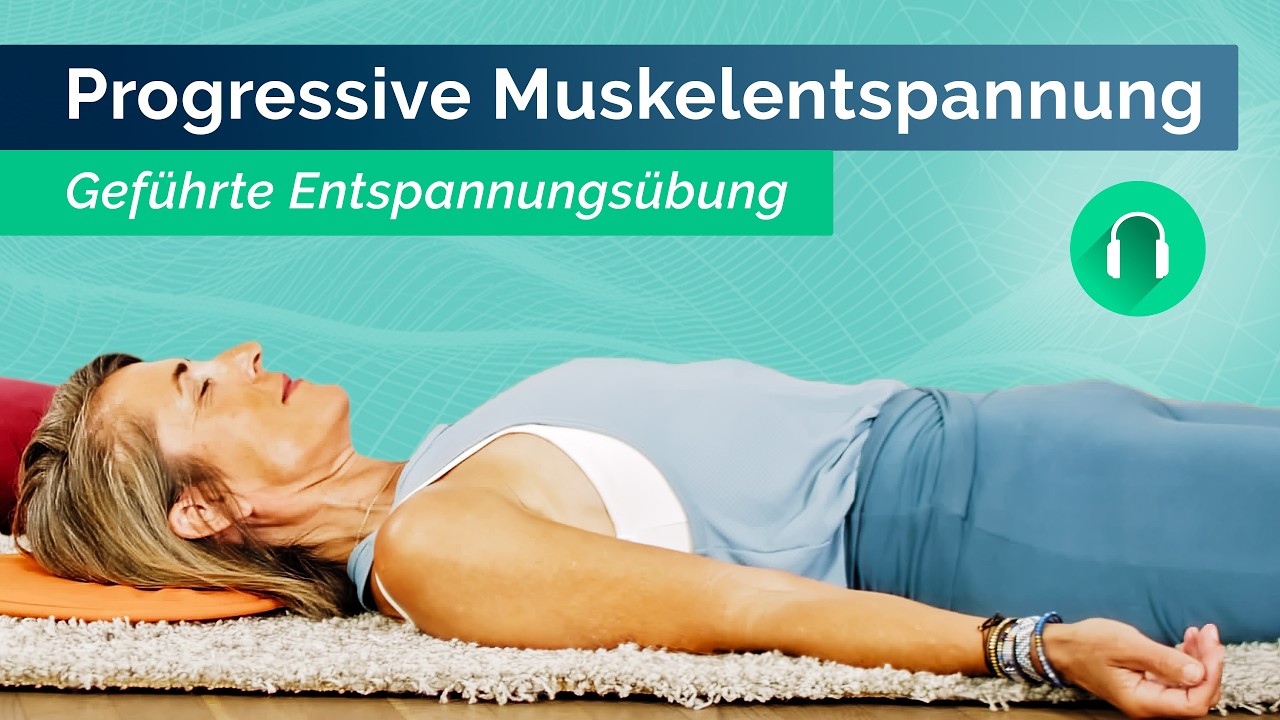
Maria guides you step by step through the entire exercise—perfect for beginners and advanced practitioners alike.
Duration: 23-minute complete guide
To the guided PMRMeditation
Meditation calms the mind — and a calm mind harmonizes the body. In TCM, we know that every emotion affects a specific organ. Through regular meditation, you learn to break out of destructive thought patterns, find emotional balance, and strengthen your inner core.
Modern studies confirm: Meditation has been proven to change brain structure, reduce stress hormones, strengthen the immune system, and improve self-healing powers. Just 10 minutes a day can change your life forever.
Recommended meditations
GUIDED MEDITATIONS FOR EVERY DAY
Your personal meditation library
We have a complete Playlist with over 60 guided meditations, breathing exercises, and relaxation techniques—from short 5-minute meditations for in between to deep 30-minute sessions for intensive practice.
In the playlist you will find:
- Morning meditations for a mindful start to the day
- Meditations for restful sleep
- Breathing meditations for inner peace
- Meditations against stress, brooding, and worries
- TCM standing meditations for all 5 elements
- Body scan and body journeys
- Healing meditations to activate self-healing powers
- Special breathing techniques (4–7–8, coherent breathing, bee breathing)

Perfect for beginners and advanced practitioners. Choose the right meditation for you depending on your time, the time of day, and your needs.
To the meditation playlistThe kidney is the root of life.
It stores the Jing and houses the willpower. It opens to the ears and manifests itself in the bones.
— From the HUANG DI NEI JING
(The Yellow Emperor's Classic of Internal Medicine)
More tips for your everyday life
In addition to traditional TCM treatment methods There are many small everyday habits that can strengthen your kidney qi. In TCM, the kidneys are the root of all energy—with the right habits, you can preserve and build up your vitality.
Sleep and rest — The kidneys regenerate at night
🌙 Go to bed early
The best time for kidney regeneration:
- Go to bed before 10 p.m. — the kidneys regenerate between 5 and 7 p.m.
- The deepest rest occurs between 11 p.m. and 3 a.m.
- Going to bed late exhausts kidney qi.
- Regular bedtimes support the natural rhythm
- Yin is built up at night — lack of sleep leads to yin deficiency.
😴 Sufficient sleep
Enough rest for strong kidneys:
- At least 7–8 hours of sleep per night
- If you have kidney weakness, you may need more sleep.
- Quality is more important than quantity — deep sleep counts
- A 20–30 minute nap can help
- Don't sleep too long — this can also weaken your qi.
🛏️ Optimale Schlafumgebung
How to sleep more restfully:
- Bedrooms cooler than living rooms, but not cold
- Darkness promotes melatonin production
- No screens one hour before bedtime
- Develop calming rituals (tea, light stretching)
- Leave worries and brooding outside the bedroom
Retain heat — The kidneys love warmth
🔥 Unteren Rücken warm halten
This is where the kidney is located — protect this area:
- Wear a kidney belt or warm underwear
- Place a hot water bottle on your lower back.
- Never sit with your back exposed (especially on cold surfaces)
- Put on dry clothes immediately after exercising.
- Body candle or moxibustion on Ming Men (gate of life)
🧦 Kalte Füße vermeiden
The kidney meridians begin at the feet:
- Wear warm socks and slippers
- Never walk barefoot on cold floors
- Evening foot baths with warm water (possibly with ginger)
- Warm your feet before going to bed
- For cold feet: Kidney qi is already weakened
❄️ Take extra care in winter
Winter is the season of the kidney:
- Rest and sleep more during the cold season
- Less strenuous activities in winter
- Prefer warm, nutritious foods
- Avoid the cold — dress warmly, even indoors
- Nature shows us: time to retreat and store up
🛁 Wärmende Anwendungen
External heat supports the kidneys:
- Warm baths (not too hot, as this is exhausting)
- Sauna in moderation — followed by plenty of rest
- Moxibustion on kidney points (learn from the therapist)
- Heat patch on the lower back
- Infrared lamp on the lumbar region
Emotional aspects — fear and willpower
😨 Die Niere und Angst in der TCM
In TCM, the kidney is the organ of fear:
- Chronic anxiety weakens kidney qi
- Shock and trauma can directly damage the kidneys.
- Existential fears place particular strain on the kidneys
- Fear „causes the qi to sink“ — hence bladder weakness when afraid.
- Conversely: Weak kidneys make you more anxious
💪 Willenskraft und Entschlossenheit
The kidney is the seat of zhi — willpower:
- Strong kidneys = strong will and stamina
- Weak kidneys = listlessness and despondency
- Setting and pursuing realistic goals strengthens the kidneys.
- Celebrate small successes — this builds confidence
- However, excessive ambition exhausts the kidneys.
🧘 Vertrauen und Mut kultivieren
Positive emotions for strong kidneys:
- Developing basic trust — everything has its place
- Courage grows through small steps outside your comfort zone.
- Find security within, not just without
- Grounding and stability through routines
- Trust in the natural course of life
🧘 Meditation für innere Ruhe
Practices for calming the mind:
- Silent meditation — 10–20 minutes daily
- Body scan — pay particular attention to the lower back
- Visualization: Deep blue light (color of the kidney) in the kidney area
- The healing kidney sound „Chui“ (like blowing) from Qi Gong
- Breathing meditation focusing on the lower dantian (below the navel)
Lifestyle — Conserving energy
⚖️ Do not overwork
Overwork is a major cause of kidney fatigue:
- Schedule regular breaks — every 90 minutes
- The end of the workday truly means the end of the workday
- Take vacations and days off seriously
- Learning to say no — setting boundaries protects the kidneys
- Exhaustion lasting several days is a warning sign
🔋 Energiereserven schonen
The kidney stores our life essence:
- Don't constantly live at your limit
- Build up reserves through rest and good nutrition
- Stimulants (caffeine, energy drinks) cause long-term exhaustion.
- Sexual moderation — excessive sexual activity weakens the kidneys.
- Listen to your body's signals
🚶 Moderate Bewegung statt Extremsport
Gentle exercise strengthens, extremes exhaust:
- Qi Gong — exercises specifically for the kidneys
- Tai Chi — strengthens the root and lower dantian
- Gentle yoga — no overly strenuous flows
- Walks in nature — grounding and tranquility
- Swimming in warm water (not too cold!)
🌿 Natürlicher Lebensrhythmus
Living in harmony with nature:
- Get up early, go to bed early — follow the sunlight
- Rest more in winter, be more active in summer
- Regular meals at fixed times
- Rituals and routines provide stability
- Nature as a role model: Everything has its time
💡 Important to know
Strengthening kidney qi takes time and patience—the kidneys recover more slowly than other organs. Winter is the best time to nourish the kidneys and preserve your life energy. With consistent practice, you will develop more vitality, inner peace, and resilience. Be patient with yourself and respect your body's limits.
For optimal treatment progress
TCM is not a quick fix for symptoms., but rather a holistic healing process. You will achieve the best results if you consistently integrate the treatment into your daily routine and give your body time to regenerate.
Integration into everyday life
Start with ONE step
Don't try to change everything at once! That's overwhelming and leads to
usually leads to you giving up. Instead:
- Weeks 1–2: Warm breakfast, go to bed early
- Weeks 3–4: Qi Gong „Gathering Qi“ daily for 10 minutes
- Weeks 5–6: Integrate acupressure Ni 03 and KG 04
- Weeks 7–8: Kidney-strengthening foods such as walnuts and sesame seeds
- From week 9: Add kidney-strengthening herbs
Realistic expectations
After 2–3 weeks: First improvements noticeable
- Less tired and exhausted
- Better sleep
- Warmer body sensation
After 6–8 weeks: Significant improvements
- Significantly more energy
- Stronger back
- Better concentration
After 3–6 months: Sustainable healing
- Kidney qi is significantly strengthened
- Strong willpower
- Deep vitality
TCM vs. Western medicine
TCM and Western medicine are not mutually exclusive—they complement each other!
When Western medicine is important:
- In acute emergencies
- In case of structural damage
- In case of infections
- For accurate diagnoses (laboratory, imaging)
Where TCM has its strengths:
- In case of functional disorders
- For chronic complaints
- For prevention
- For holistic healing
Ideal: Combine both systems! Use Western medicine for
Acute treatment and accurate diagnosis, TCM for lasting healing
and strengthening the body's self-healing powers.
Important: Never stop taking prescribed medication without consulting your doctor first!
Talk to your doctor when you start TCM treatment.
TCM diagnosis for professionals
Syndrome differentiation according to TCM:
Tongue: Pale, possibly swollen with teeth marks, moist coating
Pulse: Deep (Chen Mai 沉脉) and weak, especially at the Chi position (kidney)
Pathomechanism:
The kidneys cannot store jing. The ming men (gate of life) is weakened. Willpower (zhi) is lacking. The bones and brain are not nourished.
Treatment principle:
Bu Shen Qi (补肾气) — Tonify kidney qi
Classic recipe:
Jin Gui Shen Qi Wan (金匮肾气丸) or You Gui Wan (右归丸) as a base
Important modifications depending on accompanying symptoms:
- For coldness in the lower back: + Du Zhong, Xu Duan
- For ringing in the ears: + Ci Shi, Wu Wei Zi
- For weak knees: + Niu Xi, Sang Ji Sheng
- For frequent urination: + Yi Zhi Ren, Sang Piao Xiao
Every step counts
Your body WANTS to heal—you just have to create the right conditions for it to do so.
Remember:
👣 Every little step counts
You don't have to be perfect. Even one warm meal a day is better than none. Even 5 minutes of qigong is better than no exercise at all.
⏳ Patience pays off
It took years for your body to get into this state. Give it time to regenerate. Healing takes time, but it WILL happen.
🎯 Focus on what you can DO
Don't concentrate on what you are doing „wrong". Focus on every positive step you take.
💚 Be good to yourself
Perfection does not exist. It is acceptable to have an off day occasionally. Tomorrow is a new day when you can continue.
🤝 You are not alone
Thousands of people are walking this path with you. For over 2,000 years, TCM has been helping people like you who want to regain their health.
Measure your healing progress

To track your progress with treatment, we recommend that you repeat the TCM analysis after about 3 months.
Why is this important?
- You can see how your condition has improved.
- You can adjust the treatment as needed.
- It motivates you to keep going
- You recognize which measures work best
⚠️ Important: Your answers today will be stored in encrypted form in a code that you received by email. You can only measure your progress later with this code. Keep the email safe!
Activate reminder:
<>In 12 weeks, you'll receive an email with a link to the TCM analysis. When you fill it out, you can enter your personal health code—then you'll see a comparison overview at the end:
→ Your new values
→ Your scores from today's test
→ Direct changes
This allows you to see at a glance whether your symptoms
have improved!
🔒 YOUR DATA IS SAFE
We store:
✓ Only your email address for reminders
✓ The date for shipping
We do NOT store:
✗ Your analysis results
✗ Your personal health data
✗ The connection between email and diagnosis
All analysis data is completely anonymous and is not linked to your email address.

Newsletter
Stay up to date with our newsletter. Besides useful tips and tricks for training and your everyday life, you won't miss any of our new releases.
We are here for you
Do you have questions about your diagnosis or treatment?
Not sure which method is right for you?
Contact us — We're happy to help!