







Niu Bang Zi — Burdock Seeds
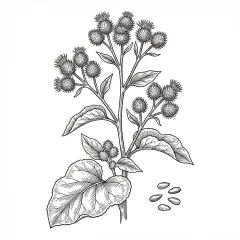
Niu Bang Zi — der Samen der Großen Klette — ist ein wichtiges Kraut bei Wind–Hitze, die den Rachen reizt und in der Haut nach außen drängt. Er vertreibt äußere Wind–Hitze, klärt Hitze–Toxine im Rachen und fördert das Nach–außen–Drängen von Wind–Hitze über die Haut.
Die Inhaltsstoffe Arctiin und Arctigenin gelten als Träger der Hitze–Toxin–klärenden und Wind–Hitze–vertreibenden Wirkung. In der modernen TCM–Praxis wird Niu Bang Zi häufig bei Wind–Hitze mit Rachenreizung, geschwollenen Mandeln und Hitze–Toxinen eingesetzt, die in der Haut nach außen drängen.
Effect from a TCM perspective
Niu Bang Zi is an important herb in the wind-heat category with a particular affinity for the upper burner. Its pungent, cold nature dispels external wind-heat and relieves the throat, while its gliding, descending quality directs heat downward.
- Wards off wind and heat und befreit den Rachen — bei geschwollenen, druckempfindlichen Mandeln und rauer Stimme
- Klärt Hitze–Toxine und fördert den vollständigen Ausbruch von Hautblüten bei äußerer Wind–Hitze
- Entlastet den oberen Erwärmer durch die gleitende, absenkende Natur und leitet Hitze nach unten ab
- Vertreibt Wind und transformiert Feuchtigkeit — bei Wind in der Haut mit geröteten Hautblüten
- Löst Lungen–Qi–Stagnation und senkt das rebellierende Lungen–Qi bei Wind–Hitze–Mustern mit zähem Schleim ab
Application & dosage
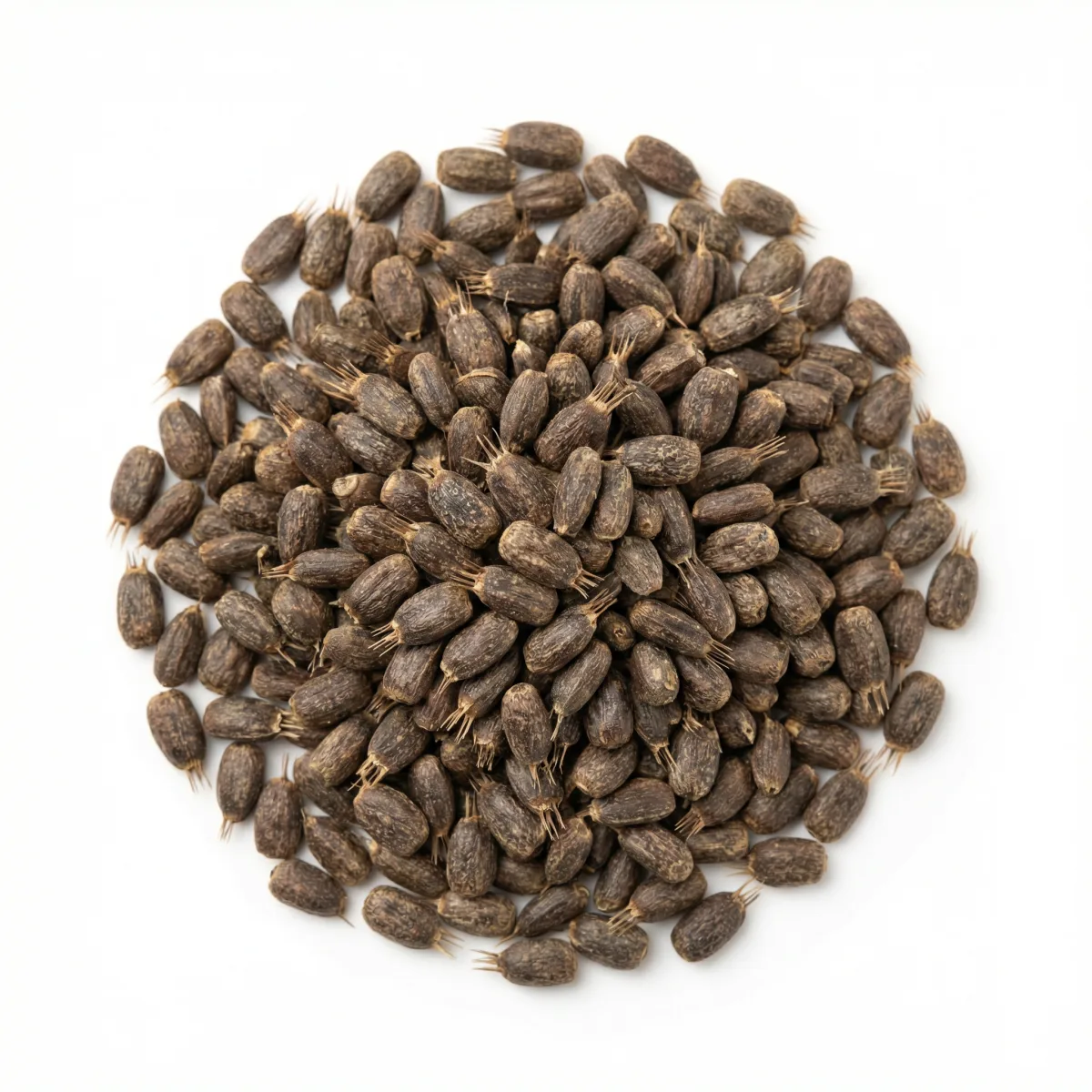
Niu Bang Zi wird im klassischen Dekokt in einer Standarddosis von 6–12 g eingesetzt. Bei ausgeprägter Wind–Hitze im Hals mit Schwellung kann die Dosis auf bis zu 15 g erhöht werden. Die Samen sollten vor dem Kochen leicht angestoßen werden, damit die Inhaltsstoffe beim Sieden besser freigesetzt werden.
Eine besondere Zubereitungsform ist das leichte Anrösten (Chǎo Niú Bàng Zǐ): Die Röstung mildert die kalte Natur des Krauts und macht es magenfreundlicher — empfehlenswert bei Patienten mit schwächerer Milz–Qi–Funktion. Roh bleibt die Wirkung kräftiger und stärker nach unten absenkend.
Dosage forms
- Decoct: Traditional method of preparation; press down on the seeds before cooking, then let simmer for 20–30 minutes
- Granules: Concentrated ready-to-use preparation, dissolved in warm water — convenient for daily use
- Tablets/Capsules: Standardized dosage for ready-to-use preparations, often in combination with other wind-heat herbs
- Powder (Chong Ji): Ground seeds, dissolved in hot water or taken as is
- External use: Selten, gelegentlich als Aufguss bei Wind–Hitze–Mustern der Haut
Dosage
- Standard dose: 6–12 g in a decoction
- Increased dose: Bis 15 g bei ausgeprägtem Hitze–Toxin im Rachenraum
- Roasted (Chǎo): Same dosage, but gentler on the stomach
- Granules: According to the manufacturer's instructions, typically 3–6 g of concentrated granules
Frequent combination partners
Niu Bang Zi often only reaches its full potential when combined with other herbs
History & Tradition
Niu Bang Zi wird im Míng Yī Bié Lù erstmals als Kraut beschrieben und im On the Nature of Desire der Tang–Dynastie ausführlich dargestellt. Der Name Niú Bàng Zǐ (牛蒡子) — wörtlich „Ochsen–Klette–Samen“ — verweist auf die Robustheit der Pflanze und die klettenartigen Fruchtstände, die sich hartnäckig an allem festhalten, was ihnen nahekommt.
Der große Arzt der Wēn Bìng–Schule (Lehre der Wärme–Muster), Wú Jūtōng, machte Niu Bang Zi zu einem zentralen Bestandteil seiner berühmtesten Rezeptur. Diese Formel — erstmals im Wēn Bìng Tiáo Biàn (1798) beschrieben — revolutionierte den Umgang mit Wind–Hitze auf der Wei–Ebene und ist bis heute eine der am häufigsten verschriebenen Rezepturen der TCM weltweit.
In the Pediatric Traditional Chinese Medicine nimmt Niu Bang Zi eine besondere Stellung ein. Beim Má Zhěn–Muster — Wind–Hitze mit Ausbruch nach außen — galt es als entscheidend, dass die Hitze vollständig an die Oberfläche tritt: eingeschlossene Hitze konnte zu schwereren Verläufen führen. Niu Bang Zi fördert diesen Prozess und wird daher in klassischen pädiatrischen Formeln häufig eingesetzt. Die alten Ärzte verglichen seine Wirkung mit dem Öffnen eines Fensters: Die Hitze kann entweichen, statt sich im Inneren zu stauen. Interessanterweise kennt auch die japanische Tradition die Klette gut — dort wird die Wurzel unter dem Namen Gobō als alltägliches Gemüse geschätzt, während in der Kampo–Medizin die Samen als Mittel eingesetzt werden.
Contraindications & caution
- Do not use if Durchfall durch Milz–Qi Mangel — die gleitende, absenkende Natur kann den Durchfall verschlimmern.
- Vorsicht bei allgemeinem Qi deficiency, da Niu Bang Zi Qi–zerstreuend wirkt.
- Bei bereits vollständig ausgebrochenen Masern nicht weiter verwenden.
- In the Pregnancy nur nach Rücksprache mit einem erfahrenen TCM–Praktiker einsetzen.
- When taken at the same time as Antidiabetika ist Vorsicht geboten, da Arctium lappa den Blutzuckerspiegel beeinflussen kann — ärztliche Rücksprache wird empfohlen.
Botany
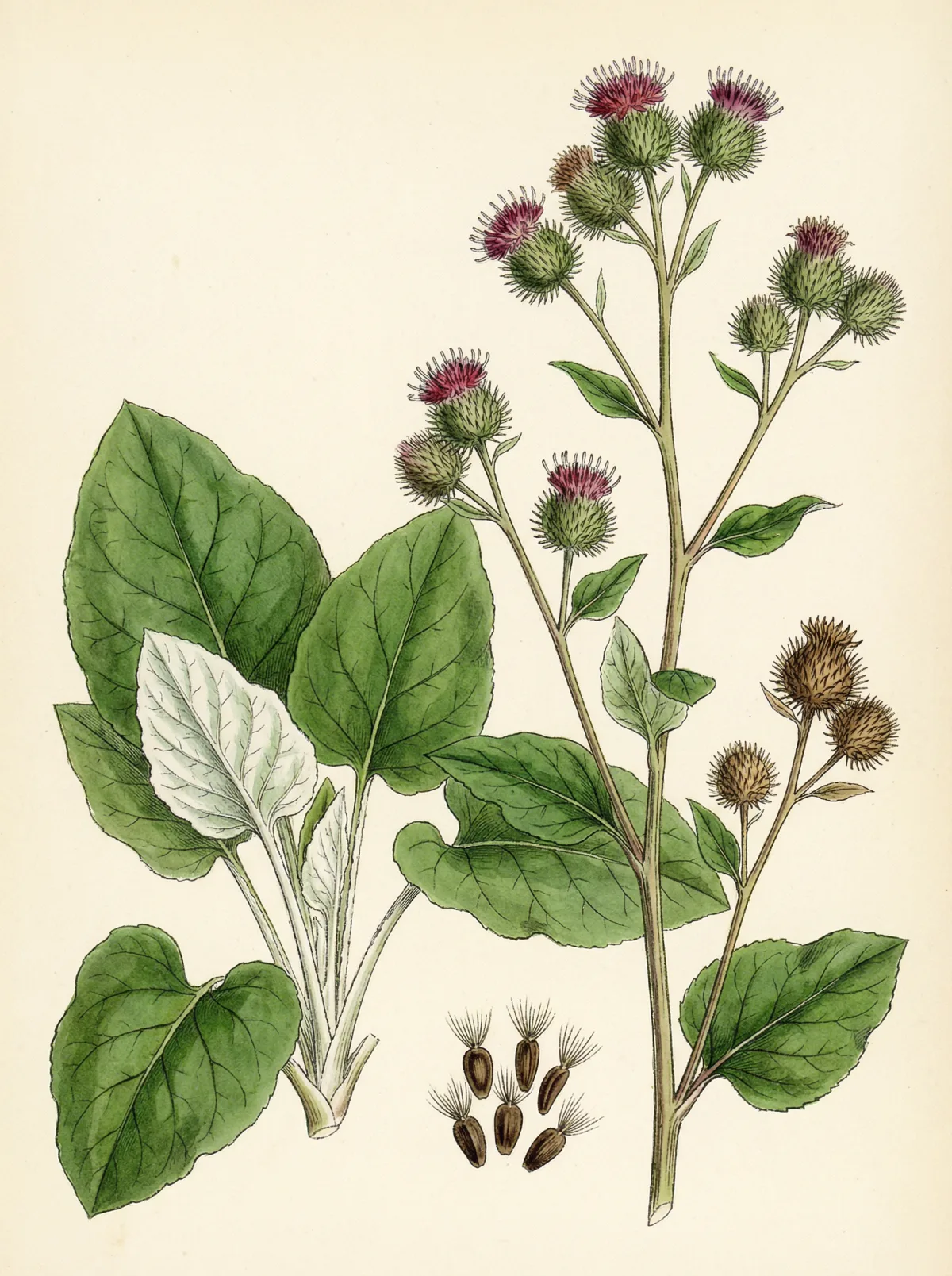
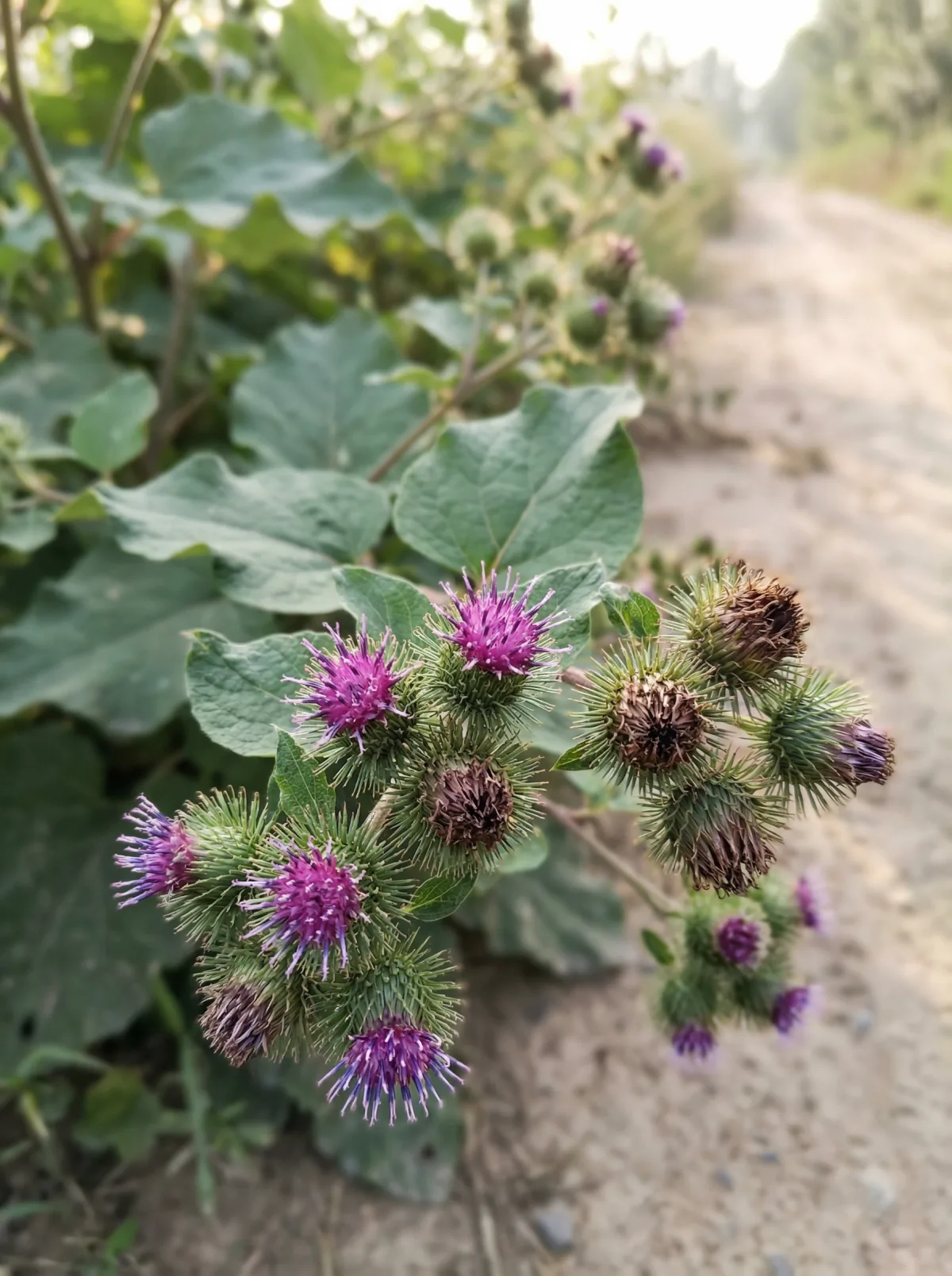
Arctium lappa (Große Klette) ist eine zweijährige Pflanze aus der Familie der Korbblütler (Asteraceae), die Wuchshöhen von 1–2 m erreicht. Im ersten Jahr bildet sie eine kräftige Pfahlwurzel und eine Rosette aus großen, herzförmigen Blättern mit filziger Unterseite. Im zweiten Jahr treibt ein stark verzweigter Stängel aus, an dem die charakteristischen kugelförmigen Blütenköpfe erscheinen.
Die Blütenköpfe tragen Hakenborsten, die an Fell und Kleidung haften — sie dienten dem Schweizer Ingenieur George de Mestral als Inspiration für den Klettverschluss. Die medizinisch verwendeten Samen (Achänen) reifen im Herbst des zweiten Jahres und werden nach dem Trocknen der Blütenköpfe geerntet. Jeder Samen ist länglich, graubraun und etwa 5–7 mm lang.
Occurrence
- China: Hauptanbaugebiete in Heilongjiang, Liaoning und Zhejiang; dort gezielt als Kraut/Droge kultiviert
- Japan: Unter dem Namen Gobō (牛蒡) sowohl als Gemüse (Wurzel) als auch als Kraut weit verbreitet
- Europe: Found in the wild along roadsides, in rubble piles, and on fallow land throughout Central and Southern Europe
- Nordamerika: Als eingebürgerte Art verbreitet, stellenweise als invasiv eingestuft
Harvest time
- Main harvest time: Late summer through fall of the second year (August–October)—when the flower heads are fully mature and dry
- Distinguishing features: The spherical fruit clusters turn brown and begin to open; the seeds come loose easily
- Harvesting method: Cut off the entire fruit clusters, let them dry, and remove the seeds by threshing or rubbing them
- Qualitätsmerkmal: Hochwertige Samen sind prall, graubraun, glänzend und riechen leicht aromatisch
Processing
Die geernteten Samen werden gereinigt, von Spelzen und Pflanzenresten befreit und getrocknet. Je nach gewünschter Wirkrichtung kommen zwei Verarbeitungsformen zum Einsatz — roh für maximale Wind–Hitze–vertreibende Wirkung oder geröstet für eine magenfreundlichere Anwendung.
- Raw Processing (Shēng Niú Bàng Zǐ):
- Threshing fruit clusters and separating the seeds from the husks
- Remove impurities by sieving and air separation
- Air-dry or dry at a maximum temperature of 40 °C until the moisture content falls below 10 %.
- Before making the decoction, tap them lightly to crack open the seed coats
- Roasted Preparation (Chǎo Niú Bàng Zǐ):
- Toast the dried seeds in a dry wok over medium heat
- Heat while stirring constantly until the seeds pop slightly and give off a nutty aroma
- Remove immediately from the wok and let cool
- Roasting tempers the seeds' cold nature and makes them easier on the stomach
Related herbs
Herbs with similar effects and related areas of application