






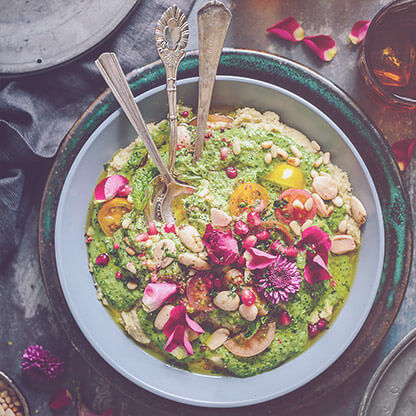
Mu Tong — Akebia stems
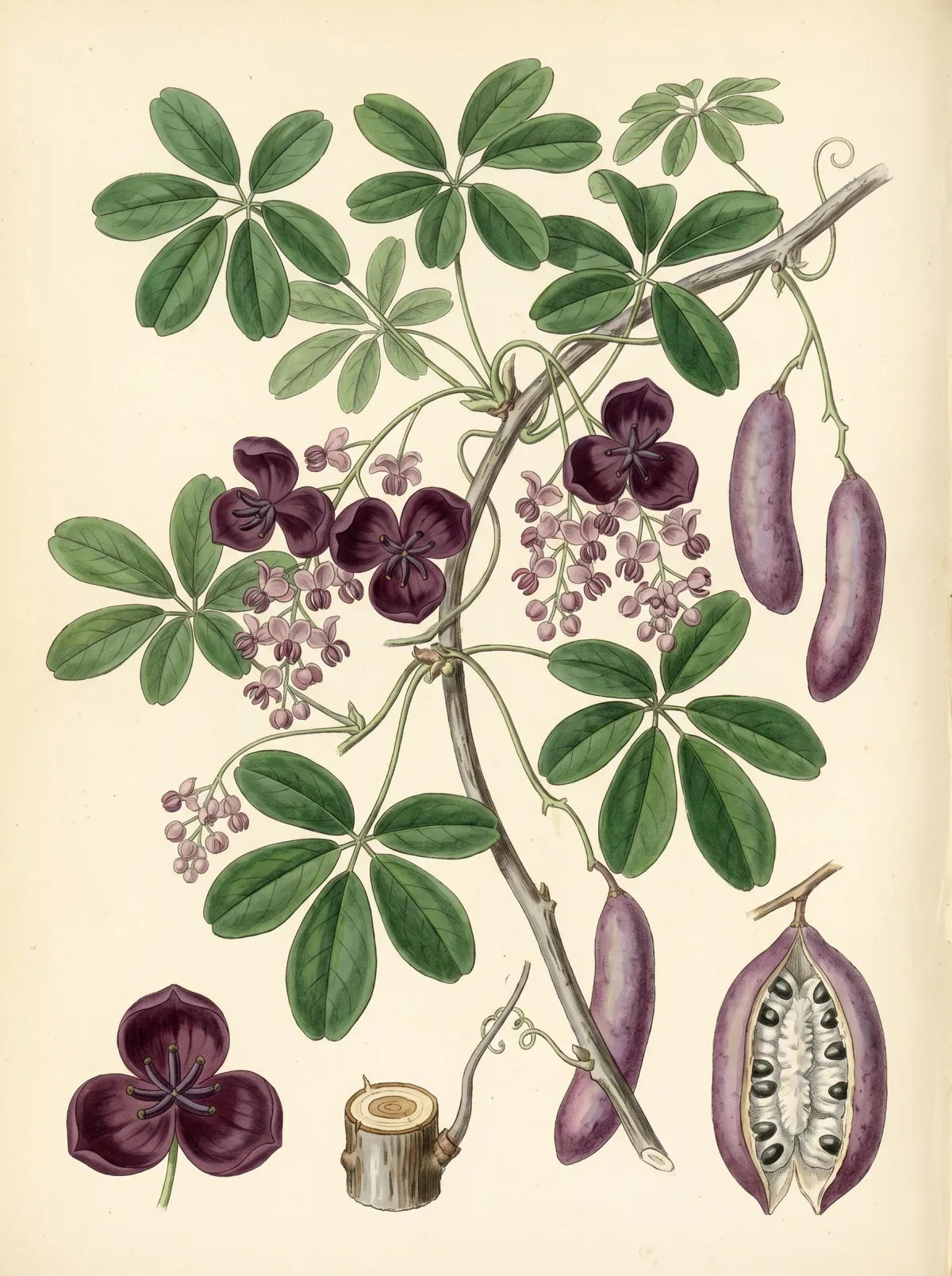
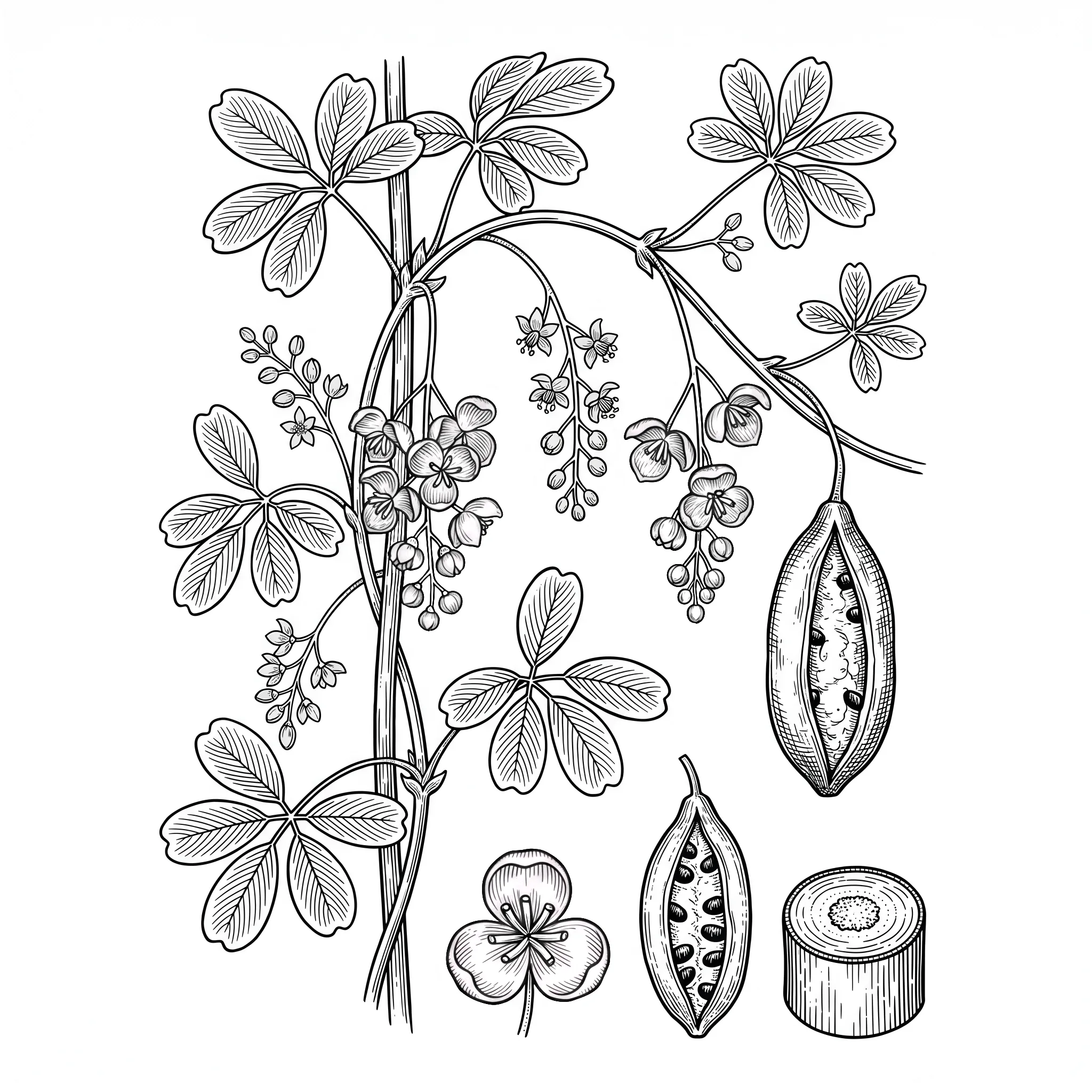
Mu Tong—the Wood Passage—opens the body’s waterways and directs damp-heat downward. In modern TCM practice, only the safe method is used Akebia trifoliata used.
Die aristolochiasäure–haltige Art Aristolochia manshuriensis ist wegen nachgewiesener Nephrotoxizität und Karzinogenität weltweit verboten. Mu Tong kommt zum Einsatz, wenn sich Herz–Feuer über den Dünndarm in der Blase manifestiert — mit brennendem, dunklem Wasserlassen.
Effect from a TCM perspective
Mu Tong leitet Feuchtigkeit–Hitze aus — besonders aus dem Blasen–Funktionskreis. Es klärt Herz–Feuer über den Dünndarm — die klassische Verbindung zwischen Herz und Dünndarm in der TCM erklärt, warum Herz–Feuer sich als brennendes Wasserlassen zeigen kann.
- Leitet Feuchtigkeit–Hitze aus der Blase — bei brennendem, dunklem, tropfenweisem Wasserlassen
- Klärt Herz–Feuer über den Dünndarm — bei Herz–Feuer, das in die Mundhöhle steigt, mit gleichzeitiger Feuchte–Hitze in der Blase
- Macht die Blutgefäße durchgängig — bei Blut–Stase im Uterus, die den Zyklus zum Erliegen bringt
- Fördert die Laktation — bei Milchstau durch Qi–Stagnation in den Leitbahnen
- Klassisches Leitkraut einer Rezeptur gegen Herz–Feuer im Dünndarm — leitet es über den Urin nach unten ab
Application & dosage
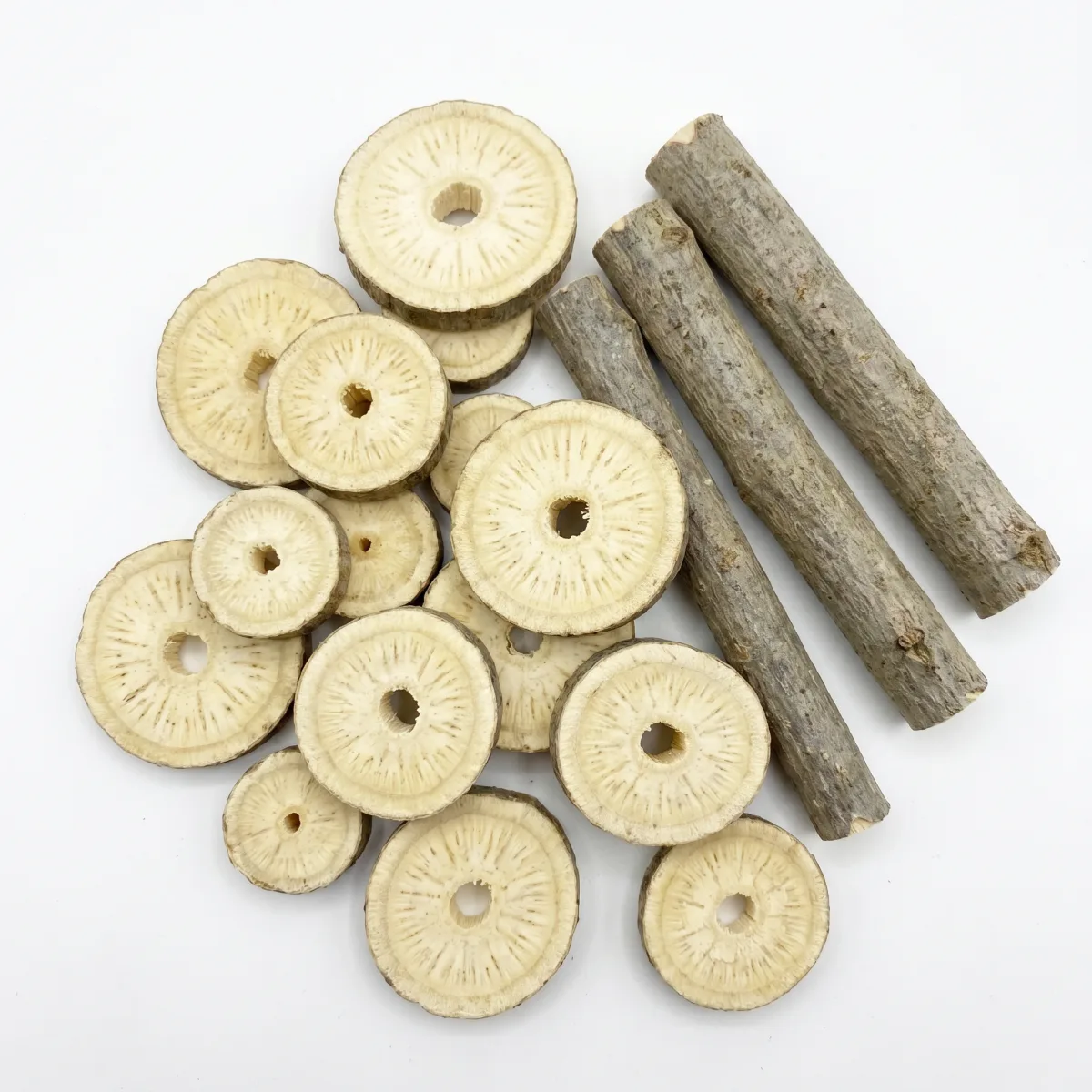
Mu Tong wird in der Regel als Dekokt aus getrockneten Stängeln zubereitet. Die Standarddosis liegt bei 3–6 g pro Tagesdosis — bei akuter Feuchte–Hitze im Unteren Erwärmer kann kurzfristig bis 9 g eingesetzt werden, jedoch stets unter fachkundiger Aufsicht. Ausschließlich die sichere Akebia–Variante (Akebia trifoliata) darf verwendet werden; die toxische Aristolochia–Variante (Guan Mu Tong) ist strikt zu meiden.
Mu Tong eignet sich nicht für die Langzeitanwendung. Die Einnahmedauer sollte auf 1–2 Wochen begrenzt werden, da die stark ausleitende Wirkung bei dauerhaftem Einsatz Körperflüssigkeiten erschöpfen kann. Granulat und Pulver sind praktische Alternativen zum Kochdekokt und werden entsprechend reduziert dosiert.
Dosage forms
- Decoction — 3–6 g in 500 ml of water, simmer for 30 minutes; classic main method of use
- Granules — Dissolve 1–2 g in warm water; convenient for everyday use
- Powder — 1–2 g per dose, taken with warm water or in capsules
- Ready-to-use preparation / tablet — as specified by the manufacturer; use only for a short time
Dosage
- Standard dose of decoction — 3–6 g per day
- Maximum dose (short-term) — up to 9 g per day, only under supervision
- Granules — 1–2 g per day (concentrate, approx. 5:1)
- Powder — 1–2 g per dose, twice daily
- Duration of use — max. 1–2 weeks; not suitable for long-term use
Frequent combination partners
Mu Tong often does not reach its full potential until it is combined with other herbs
History & Tradition
Mu Tong wird seit der Han–Dynastie in der chinesischen Materia Medica geführt. Im Shén Nóng Ben Cao Jing It appears under the name Tōng Cǎo as a herb of the Middle Class that opens the waterways and dispels heat.
Der Name Mu Tong (木通) bedeutet wörtlich „Holz–Durchgang" und bezieht sich auf die hohlen Stängel der Kletterpflanze — als wäre ein Kanal durch das Holz gebohrt. Diese Signatur gab den alten Ärzten den Hinweis, dass das Kraut die Wasserwege des Körpers durchgängig macht.
Die klassische Rezeptur, in der Mu Tong seine kompositorische Eleganz zeigt, wurde von Qian Yi aus der Song–Dynastie überliefert: Gemeinsam mit Sheng Di Huang und Gan Cao leitet es Herz–Feuer über den Dünndarm in die Blase ab. Qian Yi erkannte in Mundhitze und brennendem Harnfluss zwei Ausdrucksformen desselben Herz–Feuers — eine Einsicht, die sich in der Rezeptur bis heute bewährt.
In der modernen Geschichte wurde Mu Tong zum Sinnbild für die Bedeutung korrekter botanischer Identifikation in der TCM. Die Verwechslung mit der Aristolochia–Art (Guan Mu Tong) führte in Belgien in den 1990er–Jahren zu schweren Nierenschäden bei Patientinnen eines Schlankheitsprogramms — bekannt als die „Chinesische–Kräuter–Nephropathie". Dieser Vorfall veränderte die gesamte Quality control der TCM–Pharmazie: Seitdem wird weltweit streng zwischen der sicheren Akebia–Variante und der toxischen Aristolochia–Art unterschieden.
Contraindications & caution
The Aristolochia variety (Guan Mu Tong) is strictly contraindicated—it contains nephrotoxic and carcinogenic aristolochic acid. Use only the safe Akebia variety.
Do not use if Pregnancy — Mu Tong wirkt nach unten ableitend. Nicht bei Nieren–Qi–Schwäche oder häufigem, klarem Wasserlassen — dies zeigt Kälte, nicht Hitze. Vorsicht bei Körperflüssigkeits–Mangel — die stark diuretische Wirkung kann die Austrocknung verschlimmern.
Botany
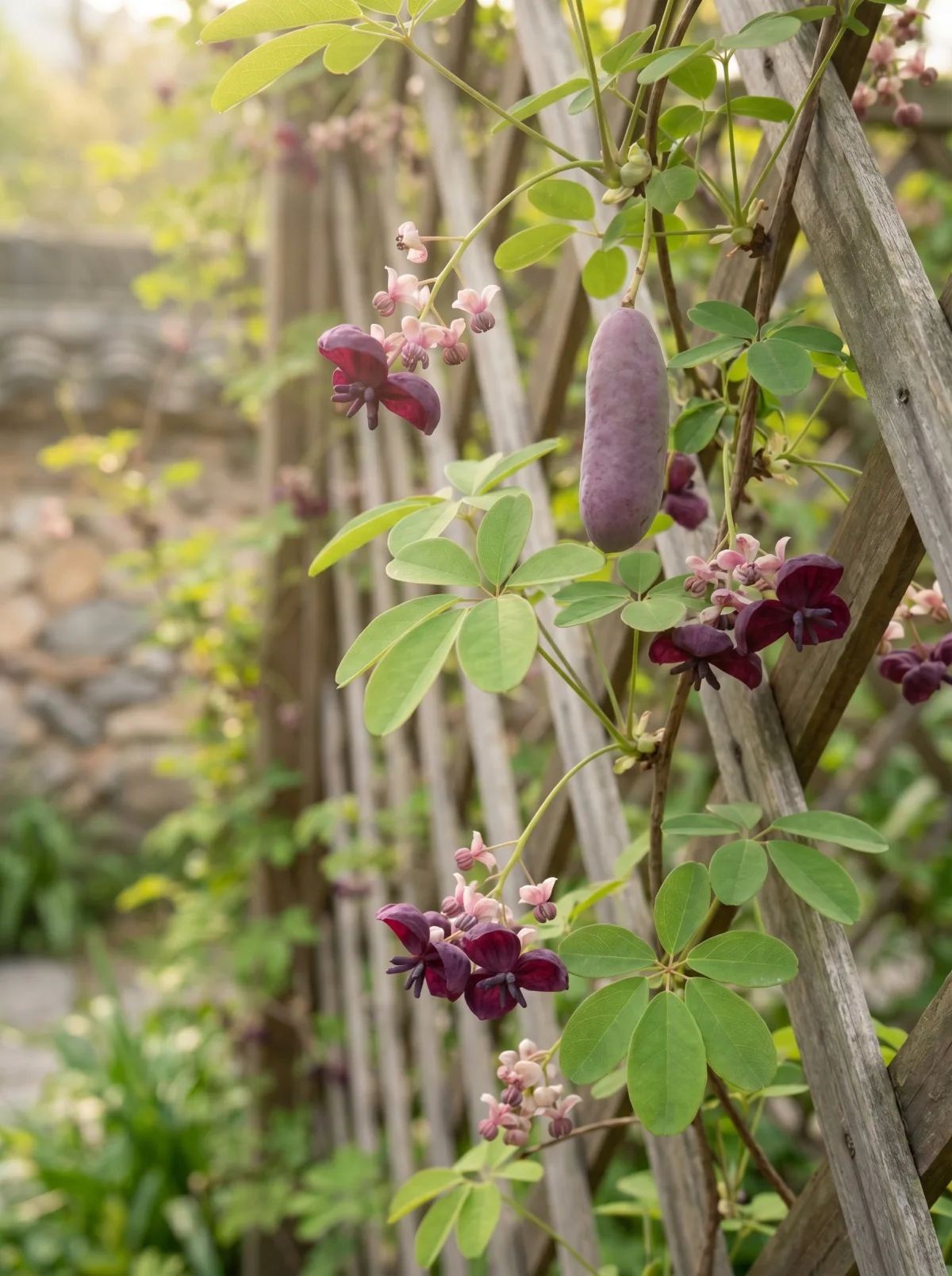
Akebia trifoliata ist eine sommergrüne Kletterpflanze aus der Familie der Fingerfruchtgewächse (Lardizabalaceae). Sie erreicht Wuchslängen von 3–8 m und bildet dreiteilige Blätter mit oval–elliptischen Teilblättchen. Die violett–purpurnen Blüten erscheinen im Frühjahr in hängenden Trauben und duften zart nach Vanille.
Die in der TCM genutzten Stängel sind verholzt und im Querschnitt deutlich hohl — diese charakteristische Röhrenstruktur inspirierte den Namen Holz–Durchgang. Die Rinde ist graubraun mit feinen Längsrissen; im Querschnitt sind die strahlenförmig angeordneten Gefäßbündel mit bloßem Auge erkennbar.
Occurrence
- Central and Southern China — Main growing regions in the provinces of Hubei, Sichuan, Anhui, and Hunan
- Japan und Korea — natürliches Vorkommen und Kultivierung als Zierpflanze
- Mountain Forests and Forest Edges — at elevations of 300–1,500 meters above sea level
- Bevorzugter Standort — halbschattig, an Bäumen und Sträuchern emporkletternd, humusreicher Boden
- Climate — temperate–subtropical; tolerates light frosts; prefers cool, moist winters
Harvest time
- Main Harvest Season — Late summer through fall (August–October)
- Best Time — after the third year of growth, when the stems are fully woody
- Harvesting method — Cut the stems into 30–60 cm long sections; leave the root intact to allow for new growth
- Erkennungsmerkmal reifer Stängel — graubraune Rinde mit deutlicher Längsrissstruktur, Durchmesser 1–3 cm
Processing
The harvested stems of Akebia trifoliata are cleaned immediately after harvesting and processed into sticks. Processing follows the traditional Caules method of Chinese pharmacology—without roasting or wine preparation, since the raw form (Sheng Mu Tong) is most effective.
- Cleaning — Remove soil, bark debris, and weeds from the stem; remove dead outer bark
- Cutting — Cut into even segments 30–60 cm long or into slices 2–3 mm thick
- Drying — in the open air or at a maximum of 50 °C in a drying cabinet, until the moisture content falls below 12 %
- Quality control — botanical identification to distinguish it from the toxic Aristolochia variety (Guan Mu Tong); macroscopic and microscopic
- Storage — Store in a cool, dry place, protected from light, in airtight containers; shelf life: about 2 years
- Quality characteristic: A fresh cross-section shows distinct radial medullary rays and a central canal
- For granules: aqueous hot extract, followed by spray drying to a 5:1 concentrate
- It is not customary to process it with vinegar or wine—unlike many other TCM herbs
Related herbs
Herbs with similar effects and related areas of application