






Hay fever? The problem is not the pollen
What's really behind your allergy - and how to treat the root cause

Every year you wait for spring. And every year you suffer.
🌬️ The TCM perspective: wind and liver
In TCM, allergies are not an „overreaction“—they are a sign of an imbalance.
And this imbalance has two main players:
1. outer wind (Wài Fēng) Pollen, dust, animal dander—TCM refers to these as „wind.“ Wind enters the body from the outside, primarily through the nose, mouth, and skin. It causes symptoms that come and go, wander, and change.
2. inner wind (Nèi Fēng) This is where it gets interesting: Inner wind is created by Liver imbalance. When liver energy rises or becomes stagnant, it generates wind—from within.
The connection: A person with a strong liver and balanced qi can ward off external wind. The pollen comes—and goes. No problem.
A person with a weakened liver or liver qi stagnation is more susceptible. External wind combines with internal wind.
That's why so many people experience in spring its peak time—precisely when the liver (Wood element) is most active and most prone to becoming unbalanced.
💚 The Liver and the Immune System from a TCM Perspective
In TCM, the liver is the „General“—it ensures the free flow of qi throughout the body.
According to TCM, when the liver is blocked:
- The Qi accumulates
- Heat is generated
- The heat rises (eyes, nose, head)
- The body becomes more sensitive
- Small stimuli trigger big reactions
In addition, the Wei Qi a role—the „defensive energy“ of TCM. It is located on the body’s surface.
The Wei-Qi is controlled by the Lung - but nourished by the Spleen.
From a TCM perspective, people with allergies often:
- The liver stagnates or overheats
- The Lung weakened
- The spleen weakened (produces too much „mucus“)
These three combined = the TCM perspective on allergy susceptibility.
🧠 The Western Bridge: Two Perspectives Side by Side
It's interesting to see how similar the images are:
Histamine: Histamine plays a key role in allergies—it is a neurotransmitter involved in swelling and itching. TCM attributes such „rising“ reactions to the liver.
Intestine: A large part of the body's immune system is associated with the intestines. TCM puts it this way: A weak spleen means a weak immune system.
Stress: Stress is also often associated with more severe allergic episodes. According to TCM: Stress causes stagnation in the liver = more internal wind = a stronger reaction to external wind.
Cross-reactions: Many people with pollen allergies also react to certain foods (birch → apple, grasses → wheat). From a TCM perspective, this is a clue: It’s not just about the pollen—it’s about an overstimulated system.
Two worlds. A principle of TCM: The issue is not purely local, but rather a reflection of the entire system in balance.
⚠️ Which TCM pattern suits you best?
From a TCM perspective, there are various patterns. The following overview is for guidance only—it is not a diagnosis. Which one sounds most like you?
Pattern 1: Liver Qi Stagnation with Heat
- Red, itchy, burning eyes
- Irritability, frustration
- Tension in the head
- Reactions become more intense under stress
- Bitter taste in the mouth
Pattern 2: Lung Qi weakness
- Constant runny nose (clear mucus)
- Frequent colds
- Shortness of breath
- Low voice, exhaustion
- Cold hands
Pattern 3: Spleen weakness with moisture
- Stuffy nose (thick mucus)
- Feeling of heaviness in the head
- Tiredness after eating
- Flatulence, soft stools
- Deterioration in damp weather
Pattern 4: Combination (most common)
- Mixture of all three
- Different depending on the day/stress
- Sometimes eyes, sometimes nose, sometimes both
Your profile will give you an idea of which of the following pillars are most interesting to you.
🌿 The 5 Pillars for Pollen Season
1. cool and relax the liver
From a TCM perspective, an overheated or stagnant liver intensifies the reaction.
Install:
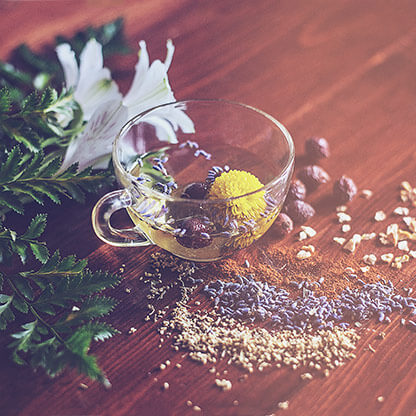
- Peppermint tea (considered cooling in TCM)
- Chrysanthemum Tea (a classic in TCM)
- Green vegetables: spinach, chard, cucumber
- Bitter substances: dandelion, chicory, rocket
- Avoid: Alcohol, coffee in large quantities, spicy food
Emotional:
- Reducing Stress (Stress = Liver Stagnation from a TCM Perspective)
- Giving space to anger and frustration - not suppressing it
- Movement that relaxes: Qi Gong, yoga, walks
📣 Tip: For acute eye itching: Place cold black tea bags on your eyes. The tannins have a cooling and soothing effect.
→ This week: Daily peppermint or chrysanthemum tea. No alcohol.
2. strengthen the lungs
In TCM, the lungs regulate Wei Qi—the body’s external defenses.
Install:
- Pears (considered "food for the lungs" in TCM)
- Almonds (considered beneficial for the lungs in TCM)
- Daikon radish, radishes (considered in TCM to open the lungs)
- Ginger-Honey Tea (warming)
- Breathe deeply: 5 minutes of conscious abdominal breathing daily
Avoid:
- Dairy products (which, from a TCM perspective, produce „phlegm“)
- Cold drinks
- Dry Air from Air Conditioners
📣 Tip: Nasal rinse with salt water. Flushes out pollen and moisturizes the mucous membrane.
→ As of today: Daily nasal rinse (in the morning or after being outdoors).
3. Strengthen the spleen — Dissolve „phlegm“
From a TCM perspective, when the spleen is weak, „dampness“ and „phlegm“ develop.
Install:
- Eat warm and cooked (not raw)
- Rice, potatoes, carrots, pumpkin
- Ginger, cardamom, caraway
- Small meals, chew well
- Don't eat too late
Avoid:
- Sugar
- White flour
- Dairy Products
- Fried foods
- Too much raw food
📣 Tip: Warm rice congee in the morning—a classic remedy for the spleen in TCM. 👉 Recipe: www.meine-tcm.com/winter-congee-gegen-erschoepfung
→ This week: See how giving up dairy products makes you feel.
4. Keep an eye on foods high in histamine
Some foods naturally contain high levels of histamine.
High in histamine:
- Red wine, beer
- Matured cheese
- Smoked and cured meats
- Tomatoes, strawberries, citrus fruits
- Sauerkraut, vinegar
- Chocolate
- Finished products with glutamate
Low in histamine:
- Fresh meat, fresh fish
- Rice, potatoes
- Fresh vegetables (except tomatoes)
- Apples, pears, melon
- Fresh herbs
📣 Tip: Keep a food diary. What did you eat, and how did you feel? After two weeks, you'll start to see patterns.
→ This week: Start a diary.
5. Start Early
The TCM philosophy: Maintain balance early on, not only once you're in the thick of it.
- Start 4–6 weeks before the pollen season begins
- Strengthening the System from a TCM Perspective
- Balance the liver, lungs and spleen
If you're already in the thick of it:
- All of the items listed above can be installed right now
- In addition: acupressure (see below)
- Patience: The body needs time
→ Next year: Start in February, not in April.
📍 Acupressure Points for Pollen Season
LI 04 (Hé Gǔ) — „United Valleys“
- Where: Back of the hand, in the muscle between the thumb and index finger
- Traditional: THE Spot for the Face and Nose
- How: Press vigorously in a circular motion for 60-90 seconds, both hands
- Attention: Not during pregnancy!
LI 20 (Yíng Xiāng) — „Welcome Fragrance“
- Where: Next to the wing of the nose, in the nasolabial fold
- Traditional: Is associated with the nose
- How: Gently massage in a circular motion for 60 seconds, both sides simultaneously
Bl 02 (Cuán Zhú) — „Folded Bamboo“
- Where: At the inner end of the eyebrow, in the hollow
- Traditional: Used for the eyes
- How: Press gently for 60 seconds, both sides simultaneously
Lv 03 (Tài Chōng) - „Big Meeting“
- Where: Back of the foot, between big toe and second toe, 2 fingers wide towards the ankle
- Traditional: Stimulates liver qi and calms the system
- How: Press vigorously in a circular motion for 60-90 seconds, both feet
A seasonal ritual:
LI 20 + Bl 02 + LI 04 + Lv 03 (in that order), about 5 minutes; can be repeated several times a day.
A ritual to prepare:
St 36 + Lv 03 + LI 04 (every morning, 5 minutes).
📍 You can find all the points, along with detailed instructions, in our free acupuncture atlas: 👉 www.meine-tcm.com/akupunkturatlas
💫 The deeper message
Your allergy is not your destiny. It is a signal.
Your body is telling you, „Something is out of balance here.“
Pollen isn't the real issue. The issue is a system out of balance.
If you strengthen the root — Liver, lungs, spleen — then, from a TCM perspective, the wind coming from outside has less surface area to affect the body.
It takes time. It takes patience. It's not a quick fix.
Don't just manage symptoms—address the root cause.
„The wind blows. The bamboo bends. But it doesn't break—because its roots are strong.“
📌 Read more
🌬️ The 3 wise men - The Yellow Emperor, Qi Bo and Dr. Weber in conversation
Why does your body mistake pollen for enemies? Eastern wisdom meets Western science.
👉 www.meine-tcm.com/fruehlingsallergien-wenn-pollen-zur-plage-werden
🌿 Allergy Ritual: Tea, Acupressure, Compress
A 10-minute ritual that combines three simple TCM practices.
👉 www.meine-tcm.com/allergie-soforthilfe-ritual-tee-akupressur-kompresse
🌸 Which TCM pattern suits you best? Our free TCM analysis will help you better understand your TCM pattern.
👉 www.meine-tcm.com/tcm-analyse
Monthly TCM inspiration?
📜 Newsletter - The Yellow Emperor writes to you personally
👉 www.meine-tcm.com/newsletter-anmeldung
Note: This article describes how TCM views the pollen season and the body’s balance. It is intended for general informational purposes only and is not a substitute for a medical diagnosis or treatment. If you experience persistent or severe symptoms, please consult your doctor or a TCM practitioner.
„The wind is blowing. The bamboo is bending.
But it doesn't break,
because its roots are strong.“
Ancient TCM wisdom
More Helpful Tips & Articles

TCM Tip of the Week
Why Your Life Changes in Seven-Year Steps
While tidying up, you come across an old photo. There you are, fourteen years younger, and you recognize yourself at once.
Nov

TCM Tip of the Week
Why Old Injuries Start Hurting Again in Winter
Yesterday morning on the stairs, your left knee spoke up. Twenty years ago you twisted it while skiing,…
Nov


Oct

