






On this page you will learn:
- What this pattern means from the perspective of TCM and Western medicine
- Where your complaints come from and how they are connected
- Which specific treatment methods may help you now
- How you can use TCM herbs, acupressure, Qi Gong and diet to drain dampness from your joints and restore the free flow of Qi and Blood in your meridians
The good news: A Damp Bi Syndrome can be treated very well with the right measures. With targeted diet, acupressure, Qi Gong and proven TCM herbs, you can drain the dampness and make your joints mobile again.
Take your time, getting to know the different treatment approaches — you don't have to put everything into practice at once. Choose what feels right to you and what you can easily fit into your daily life.
Your treatment at a glance:
Which TCM pattern is really behind your complaints?
Degree of the
imbalance

Moderate to Pronounced
Typical
Treatment duration

3–6 months
Self-treatment
Possible

Can partly be treated on your own
Treatment
scope

3–4 methods
Suggested
methods

Extensive selection
Our free TCM Analysis shows you your personal TCM pattern in just 10 minutes.
What is a Damp Bi Syndrome?
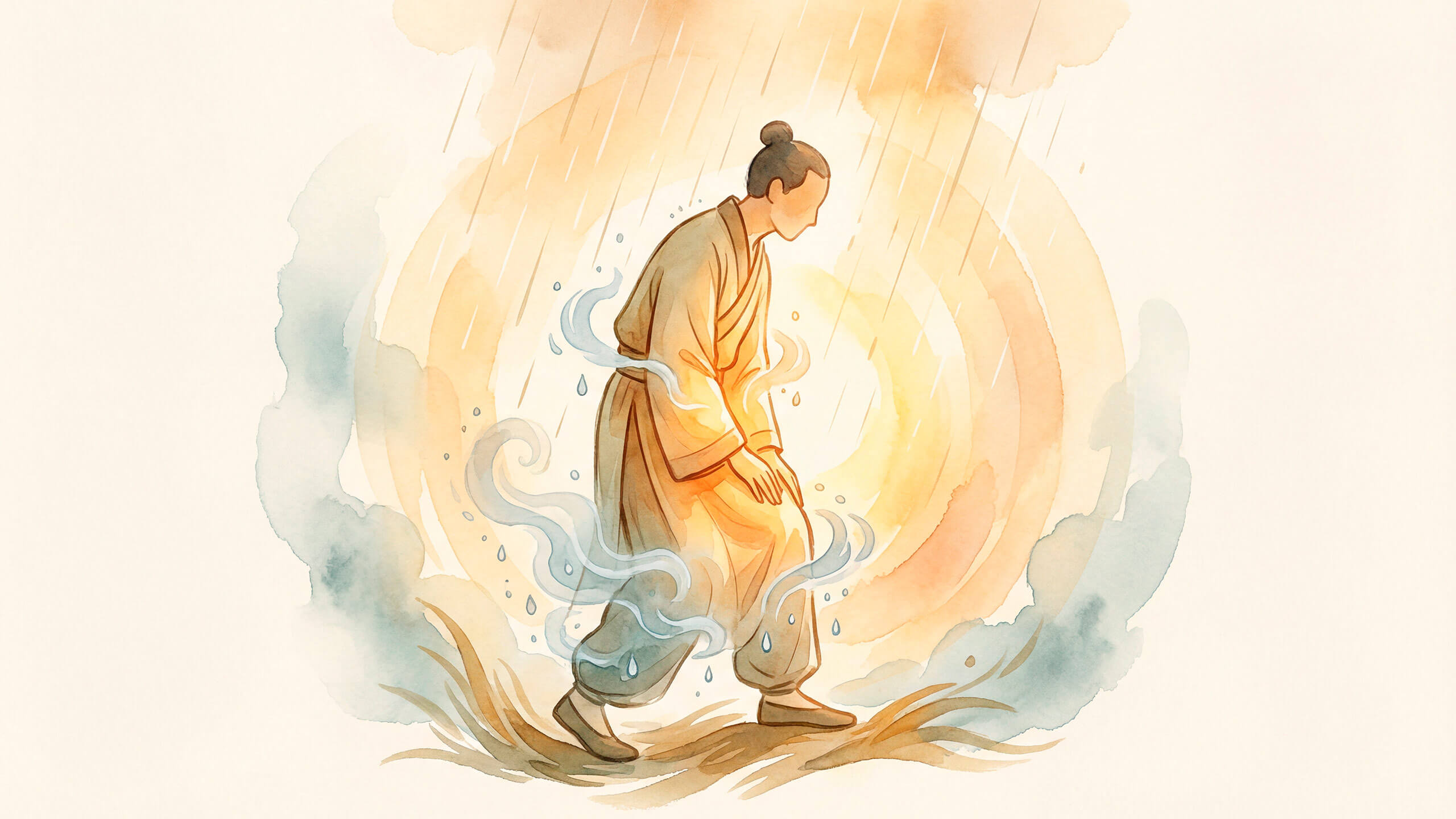
When dampness penetrates the joints
The TCM perspective: When dampness blocks the pathways
In Traditional Chinese Medicine, Bi Syndrome (Bi means "blockage" or "obstruction") is one of the oldest and best-known groups of conditions. It describes states in which pathogenic factors — Wind, Cold, Dampness or Heat — penetrate the meridians and joints and block the free flow of Qi and Blood there.
In Damp Bi Syndrome (Shi Bi), Dampness is the dominant pathogenic factor. In TCM, Dampness has very distinctive qualities: it is heavy, sticky, turbid and tends to sink downward. For this reason, Damp Bi Syndrome especially often affects the lower extremities — knees, ankles, hips — and shows up as heaviness, swelling and dull, aching pains.
The Spleen plays a central role in its development. In TCM, it is responsible for transforming and transporting the body's fluids. When Spleen Qi is weakened — through poor diet, excessive worrying or external dampness — the Spleen may no longer transform fluids properly. "Internal Dampness" forms, which settles into the joints and meridians.
The typical signs of Damp Bi Syndrome:
- Dull, heavy pain in the joints that gets worse in damp weather
- Swelling and stiffness, especially in the morning — if the stiffness lasts longer than half an hour and affects the small joints of both hands, it should be evaluated by a rheumatologist
- A feeling of heaviness throughout the body — as if you were wearing a wet coat
- The pain stays fixed in one spot (in contrast to Wind Bi, where it moves around)
- Numbness and reduced sensation in the affected areas
- Digestive problems, loss of appetite, loose stools
- Tiredness and lack of energy, especially after eating
- Swelling in the legs, especially in the evening — a one-sided, warm, and painful leg swelling, as well as edema together with shortness of breath, on the other hand, should be evaluated by a doctor right away and not checked off as a pattern sign
The good news: Dampness can be effectively drained with the right methods. By strengthening the Spleen, eating in a targeted way, moving your body, and using TCM herbs, you can clear the blockages and restore the lightness in your body.
The Western perspective: inflammation and fluid buildup
From a Western point of view, Damp Bi Syndrome corresponds to a group of complaints linked to joint disease, inflammation, and disturbed fluid balance. These include rheumatic conditions, osteoarthritis with joint effusions, inflammatory joint processes, and edema.
Think of your joints as well-oiled hinges: normally the joint surfaces glide smoothly over one another, lubricated by synovial fluid. With Damp Bi Syndrome, it is as if too much fluid collects in the joints — the hinges become sluggish, swollen, and painful. The natural mobility is lost.
The connection to the lymphatic system is particularly interesting: when lymph flow is disturbed, excess fluid can no longer be effectively carried away — exactly what TCM describes as "Dampness Stagnation." Gut health also plays a role: a weakened digestive system (the "weak Spleen" of TCM) leads to reduced nutrient absorption and can promote inflammatory processes throughout the body.
What does modern medicine show?
- Joint effusions: excessive fluid accumulation in the joint capsules leads to swelling and stiffness
- Inflammatory markers: CRP and other inflammation values may be elevated
- Lymphatic congestion: disturbed lymph flow promotes edema and swelling
- Gut health: Dysbiosis and increased intestinal permeability ("Leaky Gut") promote systemic inflammation
- Weather sensitivity: Studies confirm that damp weather can aggravate joint discomfort
- Obesity: Excess weight puts additional strain on the joints and promotes inflammatory processes
What the research says: Studies exist on individual herbs: Yi Yi Ren and Cang Zhu show anti-inflammatory and diuretic properties in laboratory experiments, and for Yi Yi Ren, Coixenolide is the most extensively studied ingredient. For the formula as a whole, the body of research is not sufficient to make reliable claims, and none of these studies replaces clarifying where the joint discomfort comes from. What is well documented, by contrast, is the unspectacular: movement keeps joints more mobile than rest does.
TCM treatment of Damp Bi Syndrome works on three fronts at once: it strengthens the Center, where Dampness is produced, drains it out, and opens the channels in which it has settled. It is essential, however, that the picture really is one of heaviness and cold, and that the cause of the swelling has been clarified. What to watch for is described further below, in the sections on the herbs and on intake.

The Yellow Emperor's team explains your pattern
Qi Bo | The Yellow Emperor | Dr. Lisa Weber
MASTER OF THE HEALING ARTS | FOUNDER OF TCM | MODERN PHYSICIAN
What happens when the legendary Yellow Emperor of Traditional Chinese Medicine sits down with his advisor Qi Bo and a modern doctor? They discuss your pattern—using 4,000-year-old knowledge AND the latest science.
Damp Bi Syndrome — When Dampness invades the joints and causes heaviness, swelling and dull pain
The Yellow Emperor: "Qi Bo, many of my subjects complain of heavy, swollen joints. Their knees are thick, their legs heavy as lead, and in damp weather they can barely move. What is the cause of this suffering?"
Qi Bo: "Majesty, these people suffer from Shi Bi — Damp Bi Syndrome. 'Bi' means blockage or obstruction. There are various forms of Bi Syndrome: Wind Bi with wandering pain, Cold Bi with piercing pain, and Damp Bi — this is the form with heaviness, swelling and fixed, dull pain. In these people, Dampness is the dominant pathogenic factor. Dampness is heavy, sticky and turbid. It seeps into the meridians and joints and there blocks the flow of Qi and Blood. The result: swelling, stiffness, and a feeling as if one were wearing a wet, heavy coat."
Dr. Weber: "That is an apt description! In Western medicine we often see joint effusions in these patients — that is, excessive accumulations of fluid in the joint capsules. The joints swell, become stiff and painful. Edema in the legs is also typical. We often measure elevated inflammatory markers in the blood and see increased fluid in the joints on ultrasound. The image of 'Dampness that invades the joints' is medically very accurate!"
The Yellow Emperor: "Where does this Dampness come from? Is it from outside or from inside?"
Qi Bo: “Your Majesty, there are two sources. External dampness comes from the environment: a humid climate, fog, rain, damp dwellings, or living near bodies of water. Anyone who lives or works for a long time in a damp environment lets the dampness penetrate the body through the pores. But internal dampness is at least as important: it arises when the Spleen is weakened. The Spleen is the central organ for transforming the body's fluids. When it cannot fulfill its task, through poor diet, excessive worrying, too little movement, or chronic exhaustion, dampness accumulates inside. This internal dampness seeks out the weakest places and settles there: in the joints, the meridians, and the digestive tract.”
Dr. Weber: “The connection between gut health and joint discomfort is a highly current field of research! We know today that a disrupted gut barrier, the ‘weak Spleen’ of TCM, can lead to increased intestinal permeability, the so-called ‘leaky gut’. As a result, inflammatory substances can enter the bloodstream and trigger systemic inflammation, including in the joints. The gut–joint axis is well documented scientifically. And what you describe as ‘external dampness’ matches studies showing that high humidity and certain climate conditions can indeed worsen joint discomfort.”
The Yellow Emperor: “Which diet promotes dampness?”
Qi Bo: “Your Majesty, certain foods generate a great deal of dampness. First and foremost are dairy products: from a TCM perspective they are cooling and damp, and they burden the Spleen. Then sugar and sweets: they weaken the Spleen directly and promote phlegm formation. White flour products and fried or greasy foods are hard to digest and generate dampness. Cold and raw foods, such as salads, cold drinks, and ice cream, cool the Spleen and weaken its transforming power. And excessive alcohol, especially beer, is a strong generator of dampness.”
Dr. Weber: “Very understandable from a nutritional science standpoint! Dairy products can promote inflammation in many people, especially those with lactose intolerance or casein allergy. Sugar triggers the release of inflammatory mediators such as TNF–alpha and interleukin-6. White flour has a high glycemic index and promotes insulin resistance, which in turn favors inflammation. Alcohol, especially beer, burdens the liver and gut and can increase intestinal permeability. All of these factors can worsen joint discomfort!”
The Yellow Emperor: “How can you tell whether dampness is the main issue?”
Qi Bo: “Your Majesty, the signs of dampness are very characteristic. The tongue is swollen and has teeth marks along its edges, because it holds too much fluid. The coating is thick, sticky, and white, like a damp veil. The pulse is slippery, Hua Mai, as if a pearl were gliding under the finger. The joints are swollen but not hot, because with pure dampness there is no redness. The body feels heavy; patients describe it as a ‘lead coat’. The stool is soft or mushy, because the Spleen cannot transform properly. And the symptoms worsen in damp weather or in a humid environment.”
Dr. Weber: “The swollen tongue with teeth marks is indeed something we see frequently in patients with fluid retention! The tongue is a muscular organ and responds sensitively to changes in fluid balance. Soft stool often correlates with a disrupted gut microbiome, a dysbiosis. And the sensitivity to weather is fascinating: studies show that changes in barometric pressure during damp weather can alter intra-articular pressure in the joints, which triggers pain. TCM has observed these connections for thousands of years!”
The Yellow Emperor: "Now let us talk about treatment. How can the Dampness be drained?"
Qi Bo: “Your Majesty, the treatment principle is Qu Shi Tong Bi: drain the dampness and make the blockage passable. This happens in several ways. First and most important: strengthen the Spleen, Jian Pi. Only a strong Spleen can transform dampness. Without strengthening the Spleen, the dampness will keep returning. Second: drain dampness, Li Shi. For this we use herbs such as Yi Yi Ren (Job’s tears seed), Fu Ling (Poria), and Ze Xie (Alisma), which drain dampness through the Bladder. Third: open the meridians, Tong Bi. Acupuncture and acupressure at special points such as Sp 09 (Yin Ling Quan) and St 36 (Zu San Li) open the blocked pathways. Fourth: movement. Gentle Qi Gong and Meridian Yoga get the Qi flow moving and help prevent dampness from settling in again.”
Dr. Weber: “The treatment strategy is excellent from a modern standpoint! Strengthening digestion improves the gut barrier and reduces systemic inflammation. Diuretic herbs such as Yi Yi Ren have indeed shown draining and anti-inflammatory properties in studies. Yi Yi Ren contains coixenolide, which inhibits the NF–kB signaling cascade and thereby reduces inflammation. Movement is essential for joint discomfort: it promotes lymph flow, strengthens the muscles around the joints, and improves joint nutrition through the synovial fluid. The combination of diet, herbs, and movement is evidence-based!”
The Yellow Emperor: „What about the classic herbal formulas?“
Qi Bo: „Majestät, for pure Damp Bi Syndrome we use Yi Yi Ren Tang, the Coix Decoction, as the base formula. Yi Yi Ren drains Dampness and at the same time strengthens the Spleen. Add Cang Zhu (Atractylodes), which is aromatic and dries Dampness. And Fu Ling (Poria), which gently drains Dampness through the urine. If there are also signs of Heat, such as red, hot joints, we add Huang Bai and use Si Miao San. When there is accompanying Cold, meaning the joints feel cold and warmth feels good, we add Gui Zhi and warm the body with Juan Bi Tang.“
Dr. Weber: „Yi Yi Ren, known in science as Coix lacryma-jobi, is one of the most thoroughly researched TCM substances! Studies show significant anti-inflammatory effects through inhibition of cyclooxygenase-2 (COX-2) and pro-inflammatory cytokines. Cang Zhu (Atractylodes lancea) contains atractylodin, which has been shown to inhibit inflammatory processes in vitro. And Fu Ling (Poria cocos) has been shown to have diuretic and immunomodulating effects. Distinguishing between Heat and Cold Dampness is clinically very relevant, and even in Western medicine we distinguish between acute inflammatory ("hot") and degenerative ("cold") joint processes!“
The Yellow Emperor: "Wonderful! Let's put this wisdom into a practical plan."
THE 3 SAGES METHOD FOR DAMP BI SYNDROME
MORNING PROTOCOL (draining Dampness):
- TCM: Warm breakfast, because the Spleen needs warmth in the morning to activate its transforming power
- Science: A warm, fiber-rich breakfast supports digestion and supports the gut barrier
- Practical: Millet congee with ginger and pumpkin, or oatmeal with warm compote
- TCM: Hot ginger water in the morning warms the Center and disperses Dampness
- Science: Ginger contains gingerols, which have been shown to have anti-inflammatory and digestion-supporting effects
- Practical: Pour hot water over 3–4 slices of fresh ginger and let steep for 10 min.
- TCM: Gentle movement in the morning — it helps get stagnant Qi flowing
- Science: Morning movement activates the lymphatic system and eases stiffness in the joints
- Practical: 10 min. of Qi Gong or gentle stretching after getting up
DAILY STRATEGY (strengthening the Spleen):
- TCM: A warm main meal at midday — your digestive power is strongest between 9 and 11 a.m.
- Science: Digestive enzymes are most active at midday, so nutrients are absorbed optimally
- Practical: A warm meal with millet, pumpkin, adzuki beans or vegetable soup
- TCM: Acupressure on Sp 09 (Yin Ling Quan) — the main point for draining Dampness
- Science: Stimulating this point has shown effects on lymph flow and drainage in studies
- Practical: On the inner side of the shin, just below the knee. Press firmly for 3 min. on each side
- TCM: Avoid dairy, sugar and white flour consistently — they create Dampness
- Science: These foods promote inflammation and harm the gut microbiome
- Practical: Instead of milk: oat drink. Instead of sugar: dates. Instead of white bread: millet or rice
EVENING RITUAL (to release blockages):
- TCM: Foot bath with ginger — warms the meridians of the legs and draws dampness out through the feet
- Science: Warm foot baths may improve peripheral circulation and help you relax
- Practical: 20 min. foot bath with fresh ginger (38–42 °C), then keep your feet warm
- TCM: Acupressure on St 36 (Zu San Li) — strengthens the Spleen and Qi, helps draw out dampness
- Science: St 36 is one of the most thoroughly researched acupuncture points, with documented immunomodulating effects
- Practical: One hand-width below the kneecap, to the side of the shinbone edge. Massage in circles for 3 min. per side
- TCM: Eat a light dinner before 7 p.m. — the Spleen needs rest at night, not heavy digestive work
- Science: Late, heavy meals impair digestion and promote fluid retention
- Practical: Light vegetable soup or steamed vegetables with rice
The Yellow Emperor: "Qi Bo, how long does it take until the Dampness is cleared out?"
Qi Bo: "Your Majesty, Dampness is the most stubborn pathogenic factor in TCM. It clings and lingers, so treatment requires patience. After 2–3 weeks of consistent practice, most people notice less heaviness, better digestion, and reduced morning stiffness. After 6–8 weeks, the improvements become more pronounced: joint swelling subsides, mobility increases, and dull aches lessen. After 3–6 months, Dampness may be eliminated for good, and the joints feel light and free. How long this takes depends on how long the Dampness has been present and whether your diet is changed consistently. Without a dietary change, Dampness keeps coming back."
Dr. Weber: "The timeframe is realistic! For chronic joint effusions and inflammation, we see first measurable improvements in inflammatory markers after 4–6 weeks of consistent dietary change and exercise. Full recovery can take several months, especially if the complaints have existed for a long time. What matters most: patience and consistency! And emphasizing dietary change is absolutely right. Without eliminating the sources of Dampness, no therapy can work lastingly. It is like pumping out a pool while the faucet is still running."
The Yellow Emperor: "What absolutely must be avoided?"
Qi Bo: "Your Majesty, the most important points are these. First, strictly avoid foods that produce Dampness: dairy products, sugar, white flour, fried foods, and alcohol. Second, avoid cold and raw foods, as they further weaken the Spleen. Third, avoid damp environments: don't sit on wet ground, change damp clothing right away, and ventilate well. Fourth, don't sit too much, since lack of movement lets Dampness stagnate. Fifth, excessive brooding and worry, which weaken the Spleen directly. And sixth: don't drink too much! It sounds paradoxical, but with Dampness-Stagnation, too much fluid burdens the weak Spleen further."
Dr. Weber: "All medically sound! Sugar and white flour are demonstrably known to promote inflammation via the NF–kB signaling cascade. Dairy products contain arachidonic acid, a precursor of inflammation-promoting prostaglandins. Damp environments favor molds, whose mycotoxins promote inflammation. Lack of movement worsens lymphatic flow, since the lymphatic system has no pump of its own and depends on muscle movement. And the advice not to drink too much is indeed relevant for edema and fluid retention. Here, elimination must be encouraged, not intake!"
The Yellow Emperor: "So the message is clear: Dampness is a stubborn but beatable enemy. With a strong Spleen, the right diet, movement, and targeted herbs, we can drive Dampness out of the body and restore lightness to the joints."
Qi Bo: [smiles] "Indeed, Your Majesty. The Spleen is like a diligent farmer who drains the land. When we give him the right tools and open the sluices, the excess water drains away. The field dries, the paths clear, and life can flourish again. The same is true for our joints and meridians."
About our "3 Sages" story
Who are the Yellow Emperor and Qi Bo?
The Yellow Emperor (Huangdi) is said to have lived around 2600 BCE and is regarded as the mythical founder of Chinese culture and medicine. Qi Bo was his most important advisor and personal physician. Their conversations about health, illness, and the nature of human beings were recorded in the most important foundational work of TCM.
The book: Huangdi Neijing
The "Huangdi Neijing," also known as "The Yellow Emperor — The Foundational Work of Traditional Chinese Medicine," was probably written between 200 BCE and 200 CE. It is the oldest surviving work of Chinese medicine and consists of dialogues between the Yellow Emperor and his advisors — mainly Qi Bo.
For TCM, this work is what the Bible is for Christianity: the absolute foundation. All the key concepts — Yin and Yang, the 5 Elements, Qi, meridians, and acupuncture points — are described systematically here for the first time.
Our modern approach: The 3 Sages
In our series "The 3 Sages," we bring the Yellow Emperor and Qi Bo together with the fictional modern physician and microbiologist Dr. Weber.
Important note: All three characters and their conversations are purely fictional and invented by us.
We use this narrative style, similar to the dialogue form in the Huangdi Neijing, to explain the often complex connections within TCM in a way that is easy to follow and entertaining. When the 4,000-year-old emperor is confronted with modern science, illuminating "aha moments" arise that show: ancient wisdom and new research often speak the same language — just in different words.
This is how TCM comes alive, becomes easy to understand, and can be put into practice in your everyday life.
The dialogues are creative interpretations — not historical documents. For medical questions, please consult a qualified TCM practitioner or physician.
Your treatment options
Damp Bi Syndrome is very treatable! TCM offers you a wide range of effective methods to drain Dampness from your joints and restore the flow of Qi. You don't have to do everything at once. Choose the methods that suit you and your everyday life.
Here you will find specific treatment approaches that have proven themselves in TCM over thousands of years and that you can mostly do yourself.
TCM Herbs
Herbal medicine (or, in modern terms, phytotherapy) is the MOST IMPORTANT tool of TCM. It is part of every classical TCM treatment. Today there is a suitable herbal blend for every TCM Pattern.

How to get your matching herbal blend
- Search online. Enter Damp Bi Syndrome "TCM herbal blend" — with the quotation marks — into the search engine of your choice. If you like, add the form: Pressed tablets — in our experience the easiest to take — or Granules. That way you'll see several providers and can compare at your leisure.
- Our therapist directory. In TCM Therapist Directory you'll find TCM therapists near you who tailor a TCM herbal blend to your personal pattern.
- Your TCM pharmacy. Some pharmacies carry TCM herbal blends or will order them for you. Tell them your pattern — or show them this page.
In any case, pay attention to the quality of the TCM herbal blend, not the price — it's worth taking a look at the ingredient list.
Not sure which herbal blend fits your TCM pattern? Write to us. We'll tell you which classical formula traditionally belongs to this pattern and what to look for when choosing.
Request a herbal blend tip
TCM uses many tools. Which of them suit you is the question we hear most often. And it can't be answered in passing.
That's why we offer personal TCM guidance. It begins with a free, no-obligation ONLINE initial consultation with Wolfgang.
After that, you'll receive your personal guidance plan with all of its components and the costs as a proposal. If it feels right for you, we get started: in a second online session (about 30 minutes), Wolfgang goes over your path with you.
Acupressure
Acupressure is acupuncture without needles — you can apply it yourself at any time. By applying gentle, targeted pressure to certain points, you activate the flow of energy in the meridians and help guide dampness out.
These three points form an effective combination for draining dampness and strengthening the Spleen. Regular stimulation is especially important with Damp Bi — patient, consistent practice helps drain the dampness and keep the blocked meridians flowing again.
ACUPUNCTURE POINT: Sp 09
Spleen-Pancreas 09
Spring at the Yin Mound — Yin Ling Quan
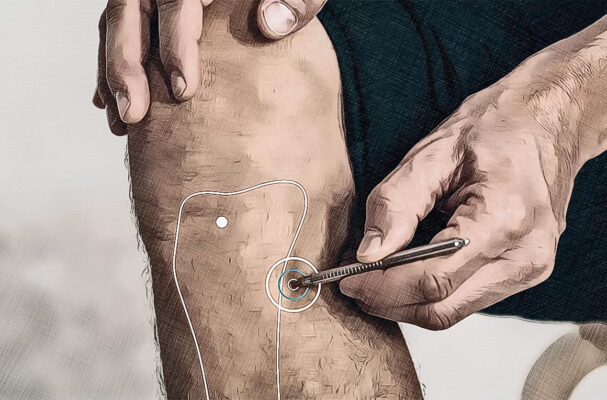
- Main point for draining dampness from the body
- Strengthens the Spleen and its transforming function
- Regulates the body's fluid balance
- Opens the water pathways and resolves edema
- Especially effective for heaviness and swelling in the legs
Location: On the inner side of the lower leg, in the hollow below the medial condyle of the tibia.
Use:
2x täglich für 2–3 Min. pro Seite mit kräftigem Druck kreisend massieren. Besonders wirksam morgens und nach den Mahlzeiten.
ACUPUNCTURE POINT: St 36
Stomach 36
Three Miles of the Foot — Zu San Li
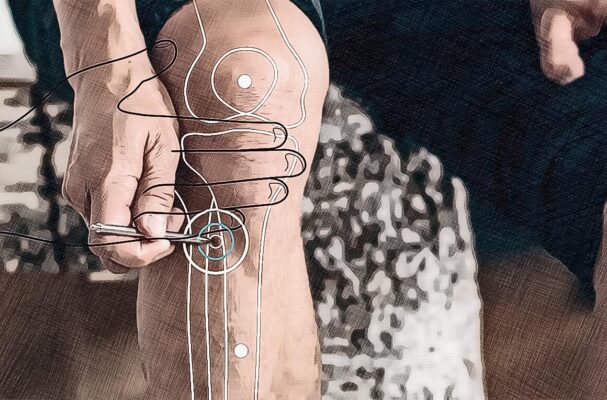
- Stärkster Punkt zur Kräftigung von Qi, Milz und Magen
- Promotes the transformation of moisture
- Stärkt das Qi und gibt Energie
- Reguliert die Verdauung
- Stärkt das Immunsystem und die Abwehrkraft
Location: One hand's width below the kneecap, one thumb's width outward from the edge of the shinbone.
Use:
2x täglich für 2–3 Min. pro Seite kräftig drücken oder kreisend massieren. Kann auch mit Moxibustion gewärmt werden — besonders wirksam bei Kälte–Feuchtigkeit.
ACUPUNCTURE POINT: Sp 06
Spleen–Pancreas 06
Meeting point of the three Yin — San Yin Jiao
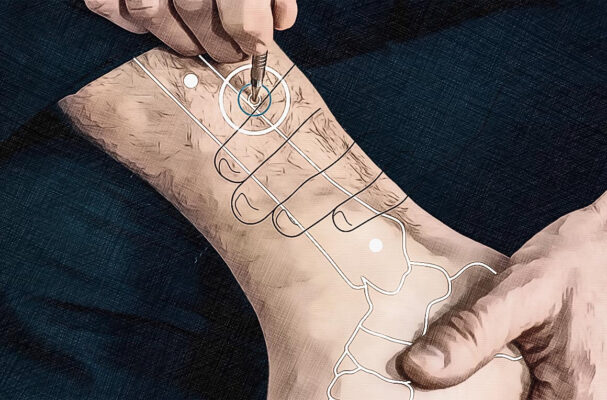
- Meeting point of the three Yin meridians (Spleen, Liver, Kidney)
- Strengthens the spleen and removes moisture
- Regulates the body's fluid balance
- Fördert die Verdauung und Transformation
- Unterstützt die Ausleitung über die unteren Wasserwege
Location: Four finger widths above the highest point of the inner ankle bone, directly behind the shinbone.
Use:
Massage in circles with medium pressure, 2x daily for 2–3 minutes per side. Ideally in the morning and evening. Do NOT use during pregnancy!
Our app recommendation
Atemraum: your app for mindful breathing


Breathing is the foundation for physical and mental well-being — and in everyday life it is usually COMPLETELY underestimated. Yet hardly anything is as immediate: how we breathe shapes how we feel.
That's why we built Atemraum: an app with guided breathing exercises that you can take with you anywhere. Wolfgang put the exercises together — plus a 35-day course, quick help for the moment, and breath tests that let you see your progress.
A few minutes a day are enough. And if you use our personal guidance you already have Atemraum included.


You can try the app free for 7 days.
Qi Gong
Qi Gong is moving meditation — sanfte, fließende Übungen, die deinen Energiefluss harmonisieren und Feuchtigkeit aus deinem Körper ausleiten. Bei einem Feuchtigkeit–Bi Syndrom helfen diese Übungen, deine Milz zu stärken, das Qi in Bewegung zu bringen und damit die Feuchtigkeit in deinen Gelenken aufzulösen.
Regelmäßiges Praktizieren von Qi Gong (schon 10–15 Min. täglich) zeigt nachweislich positive Effekte auf die Gelenkbeweglichkeit, den Feuchtigkeitsabbau und das allgemeine Wohlbefinden.
QI GONG: Exercise 1
Warming the Center
Stärkt die Milz, fördert die Feuchtigkeitstransformation

Especially helpful for:
- Schweregefühl in Gliedern und Gelenken
- Weak digestion
- Tiredness after eating
- Feuchtigkeit in der Mitte
Effect:
Diese Erde–Element–Übung wärmt und stärkt gezielt die Mitte — die Milz als Zentrum der Feuchtigkeitstransformation. Durch die sanften, kreisenden Bewegungen wird die Verdauungskraft aktiviert und die Milz kann Feuchtigkeit besser umwandeln und ausleiten.
QI GONG: Exercise 2
Connecting Heaven and Earth
Öffnet die Meridiane, fördert den Qi–Fluss

Especially helpful for:
- Steifigkeit in den Gelenken
- Blocked Flow of Qi
- Feeling of heaviness
- Low Energy
Effect:
Diese Übung öffnet die Meridiane und bringt das stagnierende Qi in Fluss. Die Dehnbewegung zwischen Himmel und Erde löst Blockaden in den Gelenken und fördert den Abtransport von Feuchtigkeit.
QI GONG: Exercise 3
Regulating Qi
Regulates the flow of Qi, harmonizes the center
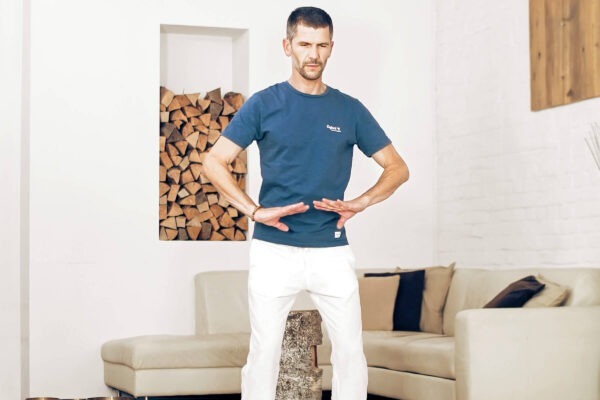
Especially helpful for:
- Qi Stagnation
- Aufgeblähter Bauch
- Malaise
- Low Energy
Effect:
Diese Übung reguliert den Qi–Fluss im gesamten Körper und harmonisiert besonders den mittleren Erwärmer. Bei Feuchtigkeit–Bi hilft sie, das Qi wieder in Bewegung zu bringen und die Stagnation in den Meridianen zu lösen.
These Qi Gong exercises sind speziell für die Ausleitung von Feuchtigkeit und die Stärkung der Milz ausgewählt. Sie bringen das Qi in Bewegung, öffnen die Meridiane und lösen Blockaden in den Gelenken.
Alle Übungen wirken besonders gut, wenn du sie zwischen 9 und 11 Uhr praktizierst — das ist die Milz–Zeit in der Organuhr und ideal für die Feuchtigkeitstransformation. Nach jeder Übungseinheit trinke ein Glas warmes Wasser — keine kalten Getränke.
QI GONG:
When and how often?
In the morning or late morning (ideal):
- All 3 exercises as a sequence: approx. 15–20 min.
- Or just 1–2 exercises: approx. 5–10 min.
- Am besten zwischen 9 und 11 Uhr (Milz–Zeit) — ideal für die Feuchtigkeitstransformation
Nach jeder Übungseinheit:
- Ein Glas warmes Wasser trinken
- Keine kalten Getränke — Kälte erzeugt neue Feuchtigkeit
Consistency matters more than duration:
- It is better to exercise for 10 minutes every day than for 60 minutes once a week.
- After 2–3 weeks, you will notice your first changes
- Nach 2–3 Monaten regelmäßiger Praxis: deutlich weniger Feuchtigkeit und mehr Beweglichkeit
Pro tip: Bei Feuchtigkeit–Bi ist es wichtig, während des Qi Gong sanft zu schwitzen — das hilft, Feuchtigkeit über die Haut auszuleiten. Aber nicht übermäßig schwitzen! Leichtes Schwitzen ist ideal, starkes Schwitzen verbraucht Qi und schwächt die Milz.
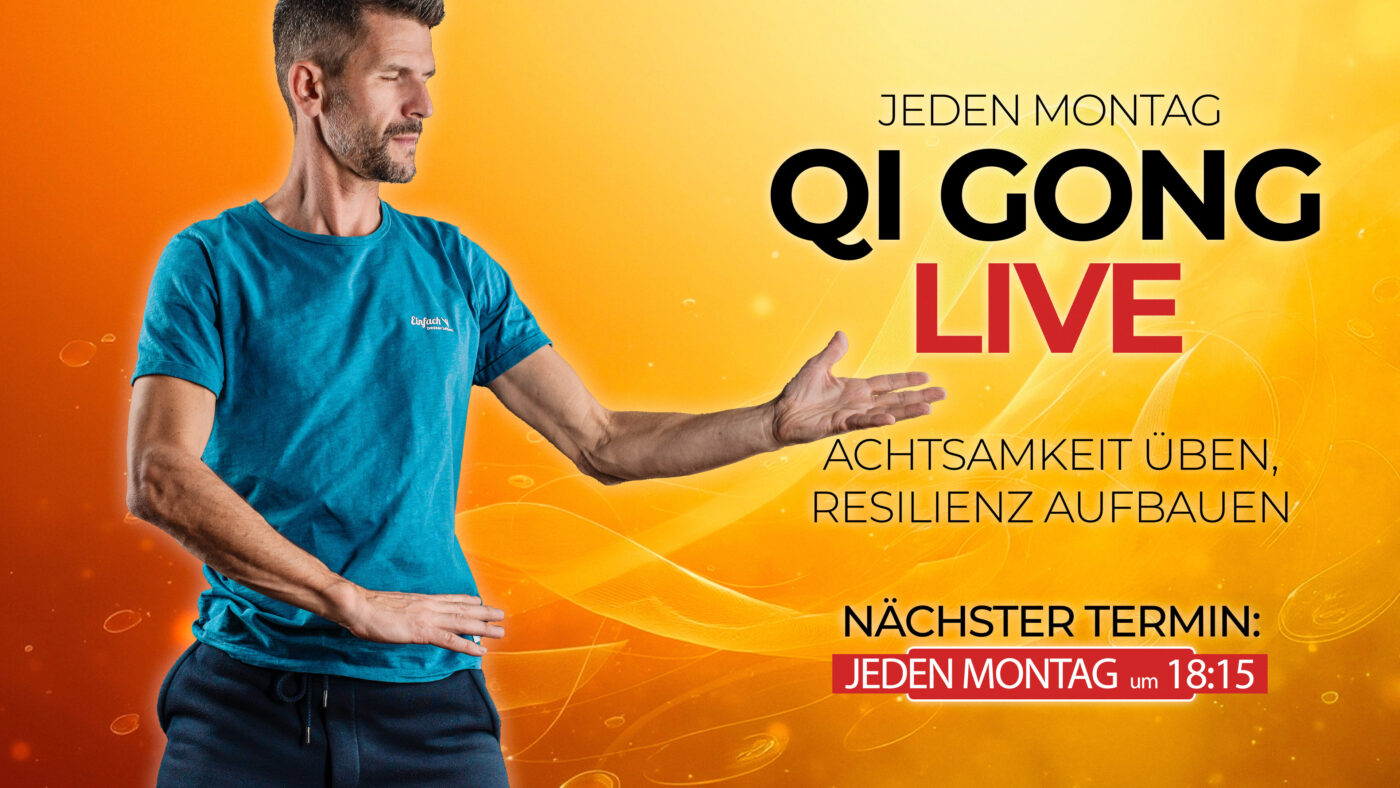
EVERY MONDAY LIVE: QI GONG WITH WOLFGANG
Every Monday at 6:00 p.m. we practice together live on YouTube. Among other things, Wolfgang guides you through a complete Qi Gong sequence — free of charge and suitable for all levels.
Why join live? ✓ Practicing together is motivating ✓ Wolfgang explains the exercises in detail ✓ You can ask questions in the live chat ✓ A fixed time gives your routine structure
More about Qi Gong LiveMeridian Yoga — The Yoga of TCM
Meridian Yoga combines yoga with Traditional Chinese Medicine. Das Ergebnis ist ein ganzheitliches Bewegungskonzept, das gezielt auf die Meridiane wirkt und den Qi–Fluss im gesamten Körper fördert.
Die folgenden Übungen aktivieren gezielt den Magen–Meridian — denn Magen und Milz bilden ein Yin–Yang–Paar und arbeiten gemeinsam daran, Feuchtigkeit zu transformieren und auszuleiten. Wenn der Magen–Meridian frei fließt, unterstützt dies die Milz bei der Transformation und Ausleitung von Feuchtigkeit.
MERIDIAN YOGA: Exercise 1
The Tree with Acupressure for the Stomach Meridian
Stärkt die Beine, aktiviert den Magen–Meridian
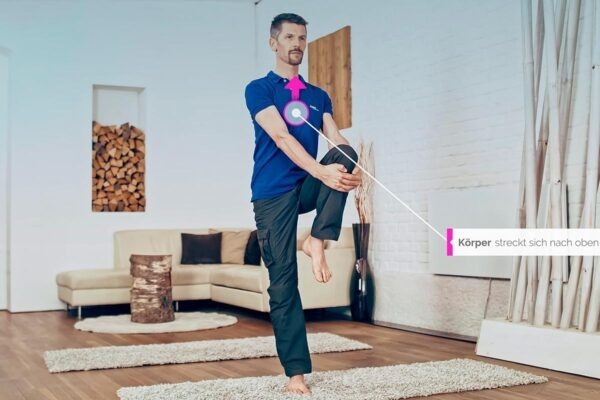
Especially helpful for:
- Weak digestion
- Fatigue
- Schwere Beine
- Low Energy
Effect:
Diese Übung aktiviert den Magen–Meridian, der an der Vorderseite des Beins verläuft. Sie stärkt die Beinmuskulatur, fördert den Lymphfluss und hilft der Milz bei der Transformation von Feuchtigkeit. Die gleichzeitige Akupressur auf Ma 36 verstärkt die Wirkung.
MERIDIAN YOGA: Exercise 2
The Sheet for the Stomach Meridian
Dehnt den Magen–Meridian, öffnet den Brustkorb
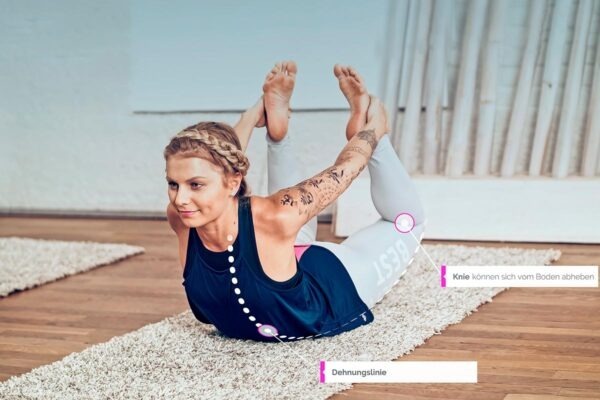
Especially helpful for:
- Stiffness in the upper body
- Digestive problems
- Feeling of heaviness
- Blocked Flow of Qi
Effect:
Der Bogen dehnt den gesamten Magen–Meridian und öffnet den Brustkorb. Bei Feuchtigkeit–Bi hilft diese Übung, den Qi–Fluss im Magen–Meridian zu aktivieren und Stagnation in den Gelenken zu lösen.
Beide Übungen aktivieren den Magen–Meridian, der an der Vorderseite des Beins verläuft und eng mit der Milz zusammenarbeitet. Magen und Milz sind als Yin–Yang–Paar gemeinsam für die Transformation und den Transport von Feuchtigkeit verantwortlich — durch die Aktivierung des Magen–Meridians unterstützt du die Ausleitung von Feuchtigkeit aus deinen Gelenken.
Especially effective: Halte jede Position für 3–5 Atemzüge und stelle dir dabei vor, wie warme, goldene Energie die Feuchtigkeit in deinen Gelenken auflöst und ausleitet.
MERIDIAN YOGA:
When and how often?
Best time:
- Morgens zwischen 7–9 Uhr (Magen–Zeit)
- Oder zwischen 9–11 Uhr (Milz–Zeit)
Duration:
- Hold each position for 3–5 breaths
- Complete sequence: 10–15 minutes
- 3–5x per week for best results
Important:
- Übe in einer warmen, trockenen Umgebung
- Breathe deeply and slowly during the positions
- Stretching should feel comfortable, never painful
Pro tip: Trinke vor der Praxis ein Glas warmes Ingwerwasser. Ingwer wärmt die Mitte, aktiviert die Milz und verstärkt die feuchtigkeitsausleitende Wirkung der Übungen.
Nutrition according to TCM
"Let food be your medicine" — dieser Grundsatz gilt in der TCM seit Jahrtausenden. Bei einem Feuchtigkeit–Bi Syndrom ist die richtige Ernährung der wichtigste Schlüssel zur Heilung.
Feuchtigkeit gehört zum Element Erde (Milz/Magen) and needs warme, trocknende und aromatische Nahrung, um ausgeleitet zu werden. Feuchtigkeitserzeugende Lebensmittel müssen dabei STRIKT gemieden werden.
What you eat, HOW you eat, and WHEN du isst — all das entscheidet darüber, ob dein Körper Feuchtigkeit ansammelt oder ausleitet.
Die goldenen Regeln gegen Feuchtigkeit
What does you good:
Trocknende und wärmende Nahrung
- Hirse — das beste Getreide gegen Feuchtigkeit
- Mais — trocknet und stärkt die Milz
- Quinoa and amaranth
- Kürbis — warm und Milz stärkend
Warme, trocknende Getreide sind die Basis deiner Ernährung!
Aromatic spices
- Ingwer — wärmt und trocknet Feuchtigkeit
- Kardamom — löst Feuchtigkeit in der Mitte
- Kreuzkümmel und Kurkuma
- Fenchel — bewegt Qi und trocknet
Aromatische Gewürze transformieren Feuchtigkeit — reichlich verwenden!
Entwässernde Lebensmittel
- Adzuki–Bohnen — stark entwässernd
- Maisbart–Tee — leitet Feuchtigkeit aus
- Sellerie und Spargel
- Kürbis und Kürbiskerne
Diese Lebensmittel helfen deinem Körper, Feuchtigkeit auszuleiten
Bittere Lebensmittel
- Chicorée — bitter und trocknend
- Arugula and dandelion
- Artischocke — stärkt die Leber
- Grüner Tee — leicht und trocknend
Bitterer Geschmack trocknet Feuchtigkeit — bei einem schweren, kalten Bild aber nur in kleinen Mengen: Kühle Bitterstoffe schwächen die Mitte. Die wärmenden, aromatischen Gewürze darüber sind hier die wichtigere Gruppe.
What you should avoid:
Milchprodukte (größter Feuchtigkeitserzeuger!)
- Milch — erzeugt massive Feuchtigkeit
- Cheese (especially soft cheese)
- Yogurt and quark
- Cream and sour cream
Milchprodukte sind der Feuchtigkeitserzeuger Nr. 1 — strikt meiden!
Sugar and Sweets
- Weißer Zucker — nährt Feuchtigkeit direkt
- Kuchen, Gebäck, Kekse
- Schokolade und Süßigkeiten
- Soft drinks and juices
Süßes erzeugt Feuchtigkeit und schwächt die Milz!
Weißmehlprodukte
- White Bread and Rolls
- Pasta made from white flour
- Gebäck und Kuchen
- Pizza und Fertigteige
Weißmehl verklebt die Mitte und erzeugt Schleim!
Kalte und rohe Nahrung
- Salads as a main meal
- Kalte Getränke und Eiswürfel
- Eiscreme und Tiefkühlkost
- Raw foods in large amounts
Kälte und Rohkost schwächt die Milz und fördert Feuchtigkeit!
HOW YOU SHOULD EAT:
Cooked and warm
- Prefer warm meals — always!
- Suppen und Eintöpfe — ideal gegen Feuchtigkeit
- Steamed or cooked vegetables
- Auch Frühstück warm (Hirse–Brei!)
Regularly and in peace
- 3 regular meals a day
- Größte Mahlzeit mittags (Milz–Zeit!)
- Light and early in the evening (before 7 pm)
- Eat slowly and chew well
The Spleen loves regularity and warmth!
Drinking the right way
- Warmes Wasser in kleinen Mengen
- Maisbart–Tee — täglich 2–3 Tassen
- Ingwertee — wärmt und trocknet
- Don't drink too much at once
Zu viel Flüssigkeit überflutet die Milz — trinke warm und in kleinen Schlucken
IDEAL MENU FOR ONE DAY:
Breakfast (7–9 a.m.):
- Hirse–Congee mit Kürbis und Ingwer
- Along with it: Hot Ginger Tea
Lunch (12–1 p.m.):
- Gemüsesuppe mit Adzuki–Bohnen und Kurkuma
- Along with it: Hirse oder Quinoa
- Or: Gedämpftes Gemüse mit aromatischen Gewürzen
Dinner (6–7 p.m.):
- Gedünstetes Gemüse mit Hirse
- Or: Leichte Suppe mit Sellerie und Kürbis
- Along with it: Fresh ginger
Snack if needed:
- Maisbart–Tee oder warmes Ingwerwasser
- Or: Handvoll Kürbiskerne
- Or: Ein Stück gedämpfter Kürbis
The most important rule when changing your diet is:
Start with ONE step!
Don't change everything at once.
Our suggestion for getting started:
- Consistently avoid dairy products - 2 weeks
- Warmes Frühstück (Hirse–Congee) einführen — 2 Wochen
- Zucker und Weißmehl reduzieren — 2 Wochen
Schritt für Schritt wirst du merken, wie die Schwere nachlässt, deine Gelenke beweglicher werden und du dich insgesamt leichter fühlst.
Your Spleen will thank you!
REZEPT: HIRSE–KÜRBIS–CONGEE MIT INGWER
Ingredients:
Makes 2–3 servings
- 100 g millet
- 200 g Kürbis (z. B. Hokkaido), gewürfelt
- 3 cm frischer Ingwer, fein geschnitten
- 1 pinch of turmeric
- 800 ml water
- Salt to taste
- Optional: 1 TL Kokosöl
Preparation:
- Hirse gründlich waschen und abtropfen lassen
- Kürbis schälen und in kleine Würfel schneiden
- Ingwer in feine Scheiben schneiden
- Hirse, Kürbis, Ingwer und Wasser in einen Topf geben
- Aufkochen lassen, dann bei niedriger Hitze 30–40 Min. köcheln
- Gelegentlich umrühren, bis ein cremiger Brei entsteht
- Kurkuma und Salz hinzufügen, abschmecken
Effect:
Strengthens the spleen and removes moisture
Wärmt die Mitte und fördert die Transformation
Ideal als warmes Frühstück bei Feuchtigkeit–Bi
Täglich möglich — perfekt für den Start in den Tag!
REZEPT: ADZUKI–BOHNEN–SUPPE MIT SELLERIE
Ingredients:
Serves 4
- 200 g Adzuki–Bohnen (über Nacht eingeweicht)
- 2 Stangen Sellerie, in Stücke geschnitten
- 1 Karotte, gewürfelt
- 1 Zwiebel, fein gehackt
- 1 L vegetable broth
- 1 TL Kurkuma
- Salt to taste
- Optional: 2 slices of fresh ginger
Preparation:
- Eingeweichte Adzuki–Bohnen abgießen und abspülen
- Zwiebel in etwas Öl anschwitzen
- Karotte und Sellerie dazugeben, kurz mitschwitzen
- Adzuki–Bohnen und Gemüsebrühe hinzufügen
- Optional: Ingwer dazugeben
- Aufkochen, dann bei niedriger Hitze 45–60 Min. köcheln
- Mit Kurkuma und Salz abschmecken
Effect:
Stark entwässernd und Milz stärkend
Löst Ödeme und leitet Feuchtigkeit über die Blase aus
Ideal bei geschwollenen Gelenken und Schweregefühl
2–3x pro Woche — kraftvoll gegen Feuchtigkeit!
Breathing
Breathing is the bridge between body and mind. In TCM it is said: "The Lung governs the Qi" — according to this idea, conscious breathing lets you address your Qi flow directly and settle into deeper calm.
Breathe calmly and slowly: Deep belly breathing noticeably calms many people — the breath becomes deeper, the shoulders drop, and the mind becomes clearer. The good news: Even 5–10 minutes a day can make a difference for your well-being.
Recommended breathing techniques
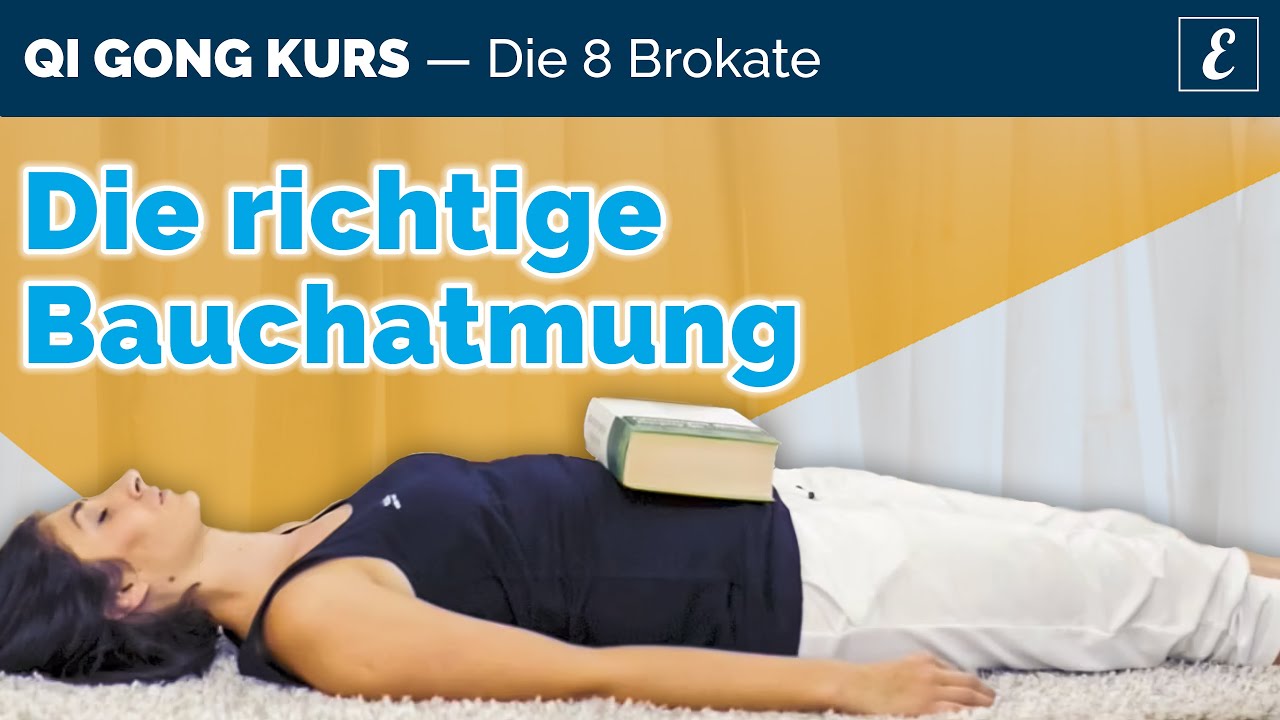
ABDOMINAL BREATHING — The foundation for every breathing technique
Natural breathing
Abdominal breathing is the most natural and calming form of breathing. According to TCM teachings, with every breath you bring Qi into your center (Dantian).
Wolfgang shows you step by step, how to learn abdominal breathing correctly — lying down at first, and later sitting and standing too.
Duration: 9 minutes
4–7–8 BREATHING — Settle into calm
The calming breath for the evening
In 4–7–8 breathing, you inhale for 4 seconds, hold for 7 seconds, and exhale for 8 seconds. Many people find that this steady rhythm helps them wind down in the evening — ideal when your mind just won't switch off at night.
Ideal for the evening or whenever you want to settle down quickly.
Duration: 9 minutes
To the follow-along videoBOX BREATHING — For inner coherence
The pro breathing technique for focus and calm
Box Breathing (4 sec. in, 4 sec. hold, 4 sec. out, 4 sec. hold) combines activation and relaxation in perfect balance. This method is used by elite soldiers, athletes, and executives to stay calm and focused even in extremely stressful situations.
A steady 4–4–4–4 rhythm of activation and calm — many people experience it as clearing and centering.
Duration: 9 minutes
To the follow-along videoCOHERENT BREATHING — Brings body & mind into harmony
The calming breath for balance
In coherent breathing you breathe in for 5.5 seconds and out for 5.5 seconds. This rhythm brings your Heart and breathing into an even beat — a state known as "coherence." Many people use it as a regular breathing break in their day.
A nice side effect: Heart and breath settle into a calm, shared rhythm.
Duration: 14 minutes
To the follow-along video
COHERENT BREATHING Around the clock
Our 24/7 livestream for coherent breathing runs non-stop. You can tune in at any time and join right away.
Perfect for:
✓ Spontaneous breathing breaks during the day
✓ If you would like calm breathing guidance
✓ As background while you work
✓ For the evening and for winding down
✓ For regular daily practice
Relaxation
When your body is relaxed, things flow more easily. Ongoing tension keeps you in constant stress mode. With targeted relaxation techniques, you signal to your body that it can settle down and gather new strength.
Progressive Muscle Relaxation is one of the best-known relaxation methods and has been practiced for over 100 years. It helps you notice tension, actively let go, and reach a state of deep relaxation — whenever you like.
Recommended relaxation technique
PROGRESSIVE MUSCLE RELAXATION (PMR)
The classic relaxation method
Progressive Muscle Relaxation according to Jacobson is one of the best-known relaxation techniques worldwide. By deliberately tensing and releasing individual muscle groups, you learn to consciously notice tension and let it go again.
This is how it feels:
Step by step, the body becomes heavier and calmer, and the breath more even. Many people use it as a regular part of their evening routine to help them fall asleep well.
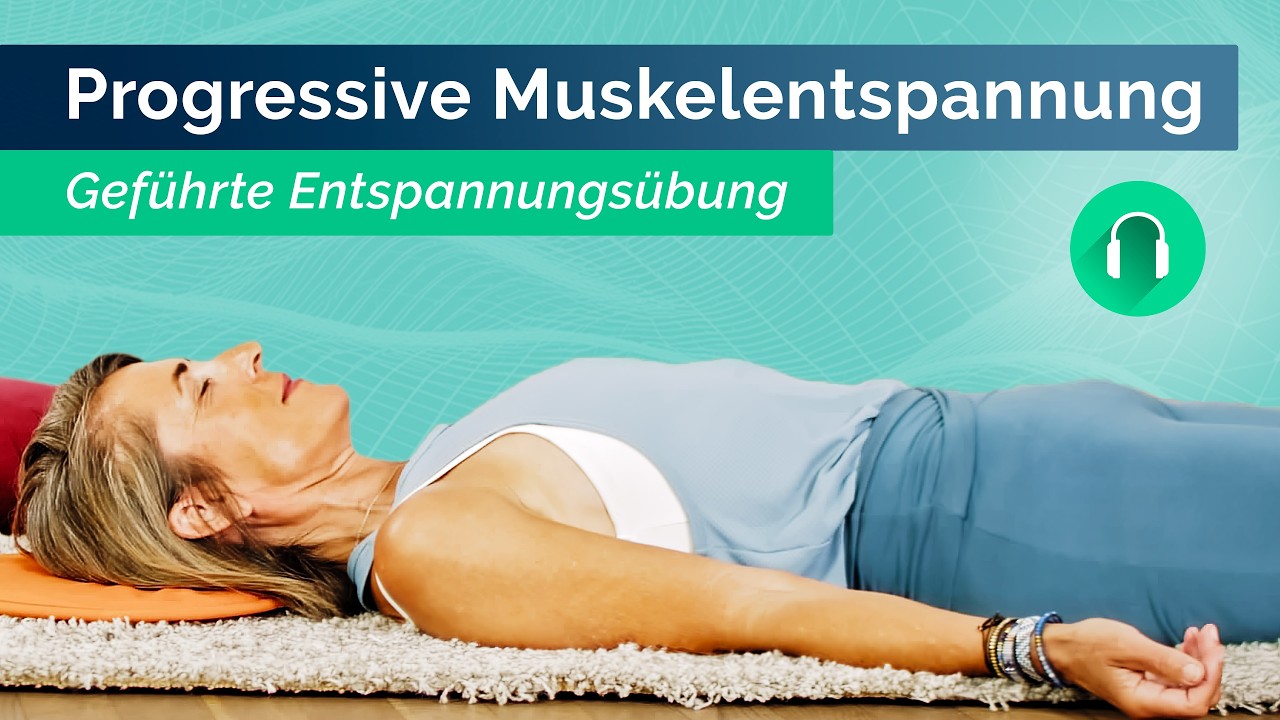
Maria guides you step by step through the complete exercise — perfect for beginners and advanced practitioners.
Duration: 23 minutes of complete instruction
To the guided PMRMeditation
Meditation calms the mind — and a calm mind is good for the whole person. In TCM, it is said that every emotion touches a particular organ. Through regular meditation, you learn to step out of circling thoughts, find emotional balance, and strengthen your inner center.
Just 10 minutes a day can do a lot for your inner calm. Many people find that it makes their everyday life feel more relaxed and clearer.
Recommended meditations
GUIDED MEDITATIONS FOR EVERY DAY
Your personal meditation library
We have put together a complete playlist with over 60 guided meditations, breathing exercises, and relaxation techniques for you — from short 5-minute meditations for in between to deep 30-minute sessions for intensive practice.
In the playlist you will find:
- Morning meditations for a mindful start to the day
- Sleep meditations for restful sleep
- Breathing meditations for inner calm
- Meditations for calm moments during stress and rumination
- TCM standing meditations for all 5 Elements
- Body scan and body journeys
- Calming meditations for body and mind
- Special breathing techniques (4-7-8, coherent breathing, bee breath)

Perfect for beginners and advanced practitioners. Choose the meditation that fits your time, time of day, and needs.
To the meditation playlistWenn die Milz ihre Kraft verliert, sammelt sich Feuchtigkeit und blockiert die Wege des Qi. Erst wenn die Mitte gestärkt wird, kann der Körper das Trübe ausscheiden und das Klare bewahren.
— Freely adapted from the HUANG DI NEI JING
(The Yellow Emperor's Classic of Internal Medicine)
More tips for your daily life
Alongside the classic TCM treatment methods gibt es viele kleine Alltagsgewohnheiten, die dir helfen, Feuchtigkeit auszuleiten und die Milz zu stärken. Die Milz ist in der TCM das zentrale Organ für die Transformation von Feuchtigkeit — mit den richtigen Gewohnheiten kannst du sie wirksam unterstützen.
Feuchtigkeit meiden — die Umgebung
Wohnraum trocken halten
Äußere Feuchtigkeit kann innere Feuchtigkeit verschlimmern:
- Regelmäßig lüften, besonders nach dem Kochen und Duschen
- Luftfeuchtigkeit unter 60 % halten — ein Hygrometer hilft bei der Kontrolle
- Nasse Kleidung sofort wechseln, nicht am Körper trocknen lassen
- Nicht auf nassem oder kaltem Boden sitzen
- Schimmelbildung konsequent vermeiden — Schimmel ist eine starke Feuchtigkeitsquelle
Wetter und Klima
Feuchtigkeit dringt von außen ein:
- Bei feuchtem Wetter warm anziehen und die Gelenke schützen
- Nach Regen die Gelenke warmhalten — besonders Knie, Hüften und Schultern
- Wenn möglich: trockenes, warmes Klima bevorzugen
- Wind–Feuchtigkeit nicht durch offene Poren eindringen lassen — nach dem Sport sofort abtrocknen und warme Kleidung anziehen
- Nasse Schuhe und Socken zeitnah wechseln
Die Milz stärken — die Quelle der Transformation
Warm meals
The Spleen loves warmth:
- Prefer cooked foods — they are easier to digest
- Auch das Frühstück warm essen (Porridge, Congee, Hirsesuppe)
- Rohkost nur als kleine Beilage, nicht als Hauptmahlzeit
- Avoid cold drinks — even in summer
- Suppen und Eintöpfe sind ideal, um die Milz zu stärken
Eat regularly
The Spleen likes rhythm:
- 3 meals at regular times
- Eat your largest meal at midday (when digestive strength is at its peak)
- Eat light and early in the evening (before 7 pm)
- Cut back on snacks between meals — the Spleen needs breaks
- Don't eat too late — your Spleen needs rest at night
Avoid overthinking
Worry weakens the Spleen:
- Overthinking drains the Spleen energy
- Don't work or watch the news while you eat
- Break Out of Worry Spirals — Through Movement or Distraction
- Meditation and mindfulness help calm the mind
- Solve problems instead of endlessly brooding
Bewegung — Feuchtigkeit in Fluss bringen
The right intensity
Sanfte, regelmäßige Bewegung leitet Feuchtigkeit aus:
- Sanfte, regelmäßige Bewegung ist ideal — sie bringt das Qi in Fluss
- Spaziergänge an der frischen Luft, besonders bei trockenem Wetter
- Qi Gong and Tai Chi — movement without exhausting yourself
- Schwimmen im warmen Wasser (nicht im kalten Becken)
- Sanftes Dehnen hält die Gelenke beweglich
What you should avoid
Falsches Verhalten fördert Feuchtigkeit:
- Zu langes Sitzen — Stagnation fördert Feuchtigkeitsansammlung
- Langes Stehen auf kaltem oder nassem Boden
- Intensiver Sport bei feuchtem Wetter im Freien
- Nach dem Training in nasser Kleidung bleiben
- Sport bei starker Erschöpfung — das schwächt die Milz zusätzlich
Fußbäder mit Ingwer
Ein einfaches Ritual, das Feuchtigkeit über die Füße ausleitet:
- 20 Min. abends vor dem Schlafengehen
- Wassertemperatur: 38–42 °C
- 2–3 Scheiben frischen Ingwer ins Wasser geben
- Hilft, Feuchtigkeit über die Füße auszuleiten
- Wärmt die Meridiane und fördert die Durchblutung der Gelenke
Important to know
Feuchtigkeit ist in der TCM einer der hartnäckigsten pathogenen Faktoren — sie lässt sich nicht über Nacht ausleiten. Geduld ist der Schlüssel. Achte auf die Signale deines Körpers: Wenn sich die Schwere in den Gliedern verringert und die Gelenke beweglicher werden, bist du auf dem richtigen Weg. Mit konsequenter Pflege — warme Ernährung, Bewegung und trockene Umgebung — wirst du spüren, wie die Feuchtigkeit Schritt für Schritt weicht.
When to see a doctor? Bei starken Gelenkschwellungen, Rötung, Fieber oder plötzlicher Verschlechterung — und ebenso, wenn die Schmerzen trotz konsequenter Behandlung über Wochen nicht nachlassen. Drei Bilder gehören dabei noch am selben Tag angesehen: eine einseitige, warme, schmerzhafte Beinschwellung, Beinödeme zusammen mit Luftnot und ein einzelnes heißes, hochrotes Gelenk mit Fieber. TCM und westliche Medizin ergänzen sich gut — die Reihenfolge steht aber fest.
For the best possible course of treatment
TCM is not a quick fix for symptoms, but a holistic path to healing. You will get the best results when you consistently build the treatment into your daily life and give your body time to regenerate.
Integrating it into your daily life
Start with ONE step
Don't try to change everything at once! That is overwhelming and
usually leads to giving up. Instead:
- Woche 1–2: Feuchtigkeitserzeugende Lebensmittel konsequent meiden (Milchprodukte, Zucker, Weißmehl) — und mit deiner TCM–Kräutermischung beginnen
- Week 3–4: Acupressure Sp 09 and St 36 daily
- Weeks 5–6: Qi Gong "Warming the Center" daily for 10 min.
- From week 7 on: Check whether you still need your herbal blend at all — with mild to moderate severity, it has usually already been stopped by then. It ends with the signs, not with the weekly schedule
- From week 9: Add further methods as needed
Realistic expectations
After 2–3 weeks: First improvements noticeable
- Weniger Schweregefühl in den Gliedern
- Reduzierte Gelenksteifigkeit am Morgen
- Better Digestion
After 6–8 weeks: Clear improvements
- Deutlich weniger Gelenkschwellungen
- Mehr Beweglichkeit
- Weniger dumpfe Schmerzen
After 3–6 months: Lasting healing
- Feuchtigkeit spürbar ausgeleitet
- Gelenke fühlen sich leicht und beweglich an
- Lasting improvement in well-being
TCM vs. Western Medicine
TCM and Western medicine do not exclude each other — they complement each other!
When Western medicine is important:
- In acute emergencies
- In cases of structural damage
- In cases of infection
- For precise diagnoses (lab work, imaging)
Where TCM has its strengths:
- For functional disorders
- For chronic complaints
- For prevention
- For holistic healing
Ideal: Combine both systems! Use Western medicine for
acute treatment and precise diagnostics, and TCM for lasting healing
and for strengthening the body's self-healing powers.
Important: Never stop taking prescribed medications on your own!
Talk to your doctor when you begin TCM treatment.
Do you have questions?

Wolfgang from meine-tcm.com
TCM is a broad field. Much of it sounds unfamiliar at first, and the real question often comes up only once you start trying some of it out in everyday life.
That's exactly what I'm here for. Write to me — no matter whether your question is big or small, whether it relates to this page or to something else entirely from TCM. I read every message myself and will get back to you. Calmly, clearly, and without a sales pitch.
P.S. There are no silly questions. So write to me.
Ask your questionEvery step counts
Your body strives for balance — you just need to create the right conditions for it.
Remember:
👣 Every small step counts
You don't have to be perfect. Even one warm meal a day is better than none. Even 5 minutes of Qi Gong is better than no movement at all.
⏳ Patience pays off
Your body took years to get into this state. Give it time to find its balance again. Change takes time, but it comes.
🎯 Focus on what you CAN do
Don't concentrate on everything you're doing "wrong." Focus on every positive step you take.
💚 Be good to yourself
There's no such thing as perfection. You're allowed to have a bad day now and then. Tomorrow is a new day, and you can pick up where you left off.
🤝 You are not alone
Thousands of people are walking this path with you. For over 2,000 years, TCM has been guiding people like you on their journey toward greater well-being.
Track your progress

To track your progress, we recommend repeating the TCM analysis after about 3 months.
Why is this useful?
- You see how your pattern has changed
- You can adjust your support as needed
- It motivates you to keep going
- You recognize which measures suit you best
⚠️ Important: Your answers from today are stored in encrypted form in a code that you received by e-mail. ONLY with this code can you follow your progress later on. Keep the e-mail in a safe place!
🔒 YOUR DATA IS SAFE
We store:
✓ Only your email for the reminder
✓ The date for sending
We do NOT store:
✗ Your analysis results
✗ Your personal data
✗ The link between e-mail and pattern
All analysis data is completely anonymous and is not linked to your e-mail address.

Newsletter
Stay up to date with our newsletter. Along with helpful tips and tricks for your training and your everyday life, you won't miss any of our new releases.